
When you grow your own fruits and vegetables at home, you have a choice of options.
And if you have an adventurous streak, there are a wide array of unusual varieties available to you, provided you have the right growing conditions.
Whether it’s annuals for my garden patch or trees for my orchard, there’s a question I always ask myself before I consider adding a new fruit or vegetable: how easy is this to find at the supermarket?
We link to vendors to help you find relevant products. If you buy from one of our links, we may earn a commission.
If the produce is easily obtainable in my local community, it may not be worth its real estate in my edible landscape.
That’s why I’ll probably never plant a ‘Granny Smith’ apple tree, even though I love this tart cultivar, since they are readily available at my local supermarkets.
On the other hand, for hard-to-find fruits or rare cultivars, I give the plant bonus points when being considered for inclusion.
And that is the same question I asked when cultivating this list of 17 of some of the most unusual fruits and vegetables you can grow in your backyard.
Here’s everything I’ll cover:
17 Unusual Fruits and Vegetables to Grow at Home
But before your sense of adventure makes you yell out, “One of each, please!” make sure to double check the growing conditions required for each of these, to save yourself from disappointment.
I have included this information for each of these fantastic plants.
1. Armenian Cucumbers
Have you ever thought to yourself, “Gee, I wish there was a type of cucumber that was really long, burpless, a good keeper, and could stand up to blistering heat”?
Armenian cucumbers aren’t true cucumbers like other varieties cultivated from the Cucumis sativus species.
They are actually melons, cultivars of C. melo, just like honeydew and cantaloupe – but they taste and look like cucumbers.
Armenian cucumbers are pale green and ribbed, with thin skin and few seeds.
Also known as serpent cucumbers or yard-long cucumbers, these wonders can grow up to three feet long.
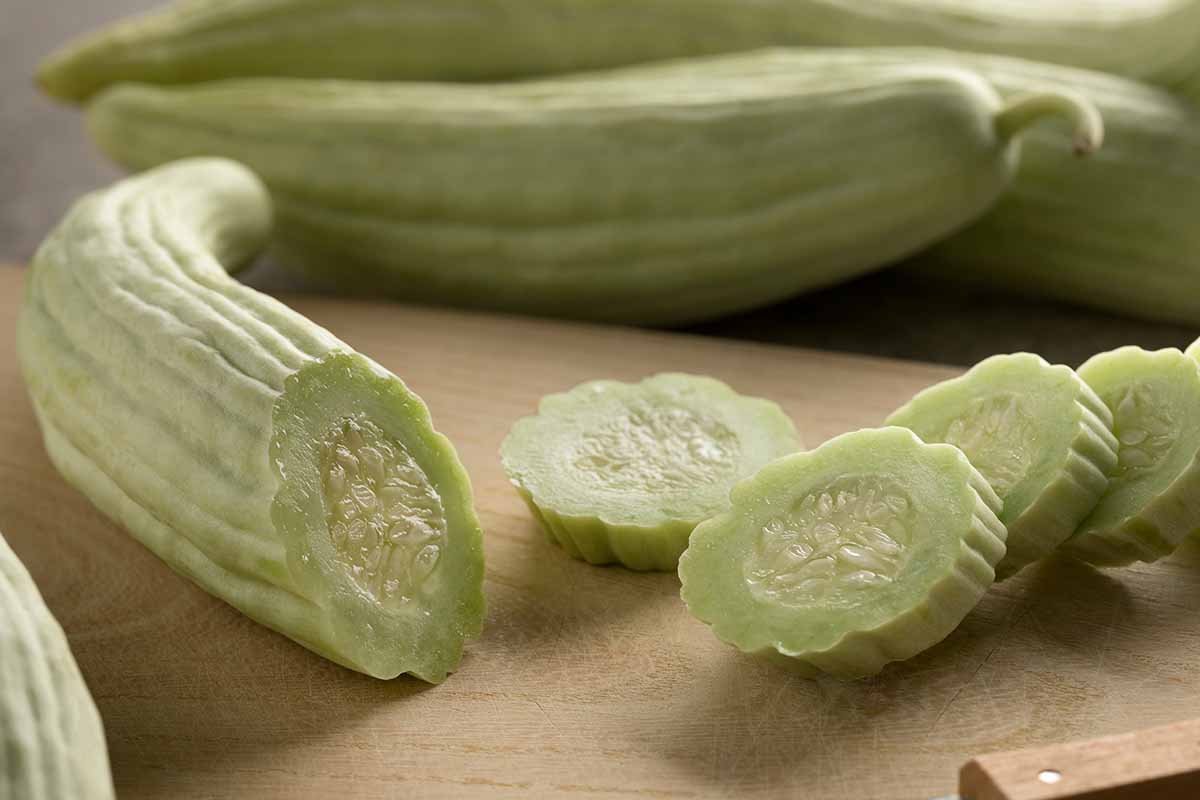
These are considered slicing cucumbers, but I have experimented with fermenting and they work fabulously for that purpose as well.
If turning your bumper crop into pickles sounds like a brilliant plan and you need a recipe for lacto-fermented dill pickles, you’ll find one at our sister site, Foodal.
Armenian cucumbers are annuals – plant them in full sun and grow them as you would any other type of cucumber.
The vines can reach six to eight feet in length – you can let them sprawl if you have the room or train them to grow vertically on a trellis.
The fruits of untrellised plants will develop some amusing twists and turns as they grow, while trellised plants will produce straight cucumbers.
These plants are extremely drought and heat tolerant, and have proven themselves in my high desert garden year after year.
It will take 50 to 70 days for your Armenian cucumber plants to produce ripe fruit.

You’ll find Armenian cucumber seeds available for purchase in two-gram packs at Botanical Interests.
Check out our guide to growing cucumbers to learn more.
2. Banana Melons
Let’s continue to explore longer-than-usual produce for a moment, shall we?
This selection takes the form of a melon that is unabashedly sweet and comes in a surprising banana-like shape.
‘Banana’ is a muskmelon cultivar that can reach 18 inches long and weigh up to nine pounds.
This open-pollinated melon has a rind that is yellowish green at maturity and encloses soft orange flesh that tastes like cantaloupe.
Some fruits will have lobes running lengthwise and others may show some light netting.
This cultivar is also sometimes called ‘American Banana,’ ‘Banana Citron,’ ‘Cuban Banana,’ and ‘Mexican Banana.’
Plant ‘Banana’ melons as an annual in full sun in your melon patch, and look for ripe fruits in 90 days.
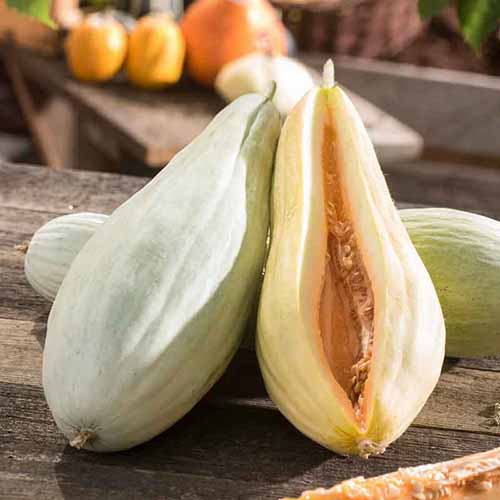
You’ll find ‘Banana Melon’ seeds available for purchase in an array of pack sizes at Eden Brothers.
How about slipping from this ‘Banana’ into a whole article about different melon cultivars? We’ve got you covered, with 33 melon varieties to discover.
Learn more about growing melons here.
3. Big Max Pumpkins
Have you ever thought of growing a giant pumpkin in your backyard? Maybe it’s the right moment to entertain the fanciful idea of adding a behemoth to your pumpkin patch.
‘Big Max’ has big potential. It might even have you pondering ideas of entering your homegrown pumpkin in a competition at a local fair.
Just don’t expect Guinness World Records to come banging on your door – while ‘Big Max’ pumpkins can weigh up to 200 pounds, the current record holder for heaviest pumpkin in the world weighed in at over 2,600 pounds.
So, let’s consider ‘Big Max’ as a gateway giant pumpkin, one for you to practice with on your way to mammoth vegetable glory.

Of course, if taking ‘Big Max’ to the state fair isn’t high on your list of priorities, you can always keep it at home and use it as an oversized jack-o’-lantern.
‘Big Max’ is an open-pollinated, heirloom variety of Cucurbita maxima that has light orange skin and thick walls of very moist, tasty, yellowish orange flesh – so it could also be transformed into soup or pumpkin pie filling.
The vines of these annuals can reach 10 to 15 feet long, so make sure to give them plenty of room – and as with growing more modest sized pumpkins, make sure to grow them in full sun.
And if you are aiming for pumpkin notoriety, grow just one pumpkin per vine to ensure that all the plant’s resources go into that single pumpkin.
You can learn more about the proper techniques for pruning pumpkin plants in our article.
Short season gardeners beware, you’ll need 120 frost-free days to bring ‘Big Max’ to maturity.
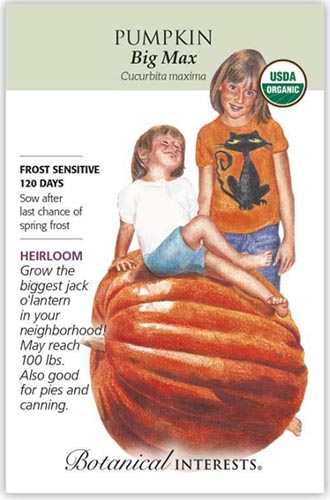
You can find organic ‘Big Max’ pumpkin seeds available for purchase in packs of four grams, enough to sow five mounds, at Botanical Interests.
And by the way, the trick to growing giant pumpkins isn’t only in selecting the right variety, there are many other steps involved to ensure vegetable glory.
Want to know more? Read our guide to growing giant pumpkins.
4. Chioggia Beets
If your garden plan includes growing beets but you’re looking for something a little different, you may wish to consider ‘Chioggia,’ an heirloom beet variety from Italy that boasts beautiful red and white rings inside its red skin.
This cultivar takes its name from Chioggia, a town located within the metropolitan boundaries of the renowned city of Venice, a location rich with history and known for its colorful glasswork and masks.
With ‘Chioggia,’ we can add colorful veggies to the region’s fame – as well as the beet, this Italian town also gives its name to a variety of radicchio and a pumpkin cultivar.

When you slice one of these red-skinned beets in half horizontally, you’ll find concentric rings alternating in bright reddish pink and white, giving them a candy-striped or bull’s-eye appearance.
‘Chioggia’ beets are round and slightly flattened on top, and are usually picked when the roots are about two inches across.
The roots have a delicate flavor and thin skin, and the pale green leaves grow to about 10 inches tall.
These beets will be ready to harvest in 55 days on average. Plant in full sun.
The red pigments can bleed when boiled, so if you want the roots to retain their gorgeous stripes, steam them lightly.
You might also consider julienning or cutting them into slices, and enjoying them raw on salads to preserve their impressive striping.
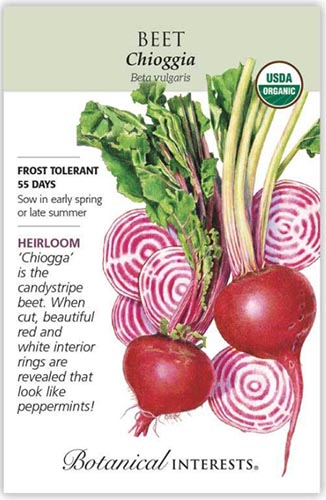
You’ll find organic ‘Chioggia’ beet seeds available for purchase in packs of two grams at Botanical Interests.
Learn more about how to grow beets here.
5. Cosmic Purple Carrots
If you want to add a bit of excitement to your carrot patch, you may wish to include ‘Cosmic Purple.’
This cultivar has gorgeous amethyst-colored skin with an orange interior and an orange to yellow core.
The roots grow six to seven inches long with tapered ends and are sweet and somewhat spicy.
Like other purple veggies, purple carrots are high in anthocyanins, and may offer an advantage to your health over the standard orange varieties.
‘Cosmic Purple’ should be sown in your garden as a cool season vegetable. You’ll be ready to harvest your carrot crop in 70 days.
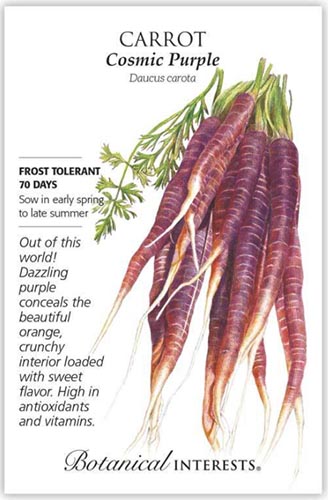
Ready to grow some unexpected color in your carrot patch?
You can find ‘Cosmic Purple’ carrot seeds available in packs of 700 milligrams at Botanical Interests.
Want to explore more exciting carrot cultivars? Check out our guide to the best carrot varieties.
Learn more about growing carrots here.
6. Cucamelons
If growing giant pumpkins like ‘Big Max’ isn’t your thing, maybe planting a teeny tiny cucumber from seed will hold more allure.
Cucamelons are one- to two-inch-long cucurbits that look like miniscule watermelons, but have a fresh, cucumber-like taste.
These tiny fruits are also called “mouse melons” and “Mexican sour gherkins.”

However, while cucamelons are related to watermelons, melons, and cucumbers, they are members of a different genus, Melothria.
The cucamelon, or Melothria scabra, is native to Mexico and Central America where it’s called “sandita,” which means “little watermelon” in Spanish.
And they look very much like tiny watermelons, with their pale green skin and darker green markings.
Inside the tiny fruit, you’ll find white flesh. But there’s no need to peel tiny mouse melons – the entire fruit is edible.
For best results, cucamelons should be planted in full sun in well-draining soil. The vines can grow to be between five and 10 feet long.
Cucamelon vines are pest-, drought-, and disease-resistant, producing tiny ripe fruit in 60 to 75 days.
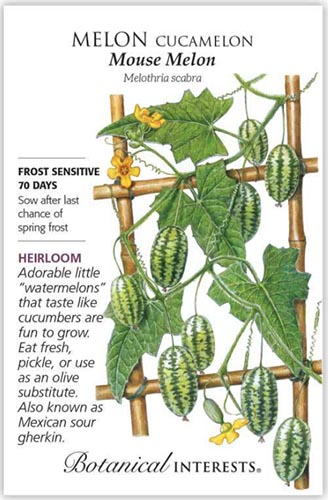
You’ll find cucamelon seeds available in packs of 24 at Botanical Interests.
You can learn more about how to grow cucamelons here.
7. Goji Berries
If you’re one of those health-conscious souls who likes to include a scoop of goji berries in your breakfast cereal or morning smoothie, you may not have realized you can grow your own.
Goji berries, also known as wolfberries (Lycium barbarum and Lycium chinense), aren’t hard to grow, as long as you live in USDA Hardiness Zones 2 to 7.
Both species are members of the nightshade family which also includes tomatoes, eggplant, peppers, and potatoes.

Gojis are somewhat drought-tolerant deciduous shrubs that should be grown in full sun or light shade.
These shrubs can serve as a hedge or border and work well on slopes.
The plants can easily reach 12 feet tall if they are not pruned. And to make berry harvesting easier, they can also be trellised.
Fruit will appear on two-year-old plants.
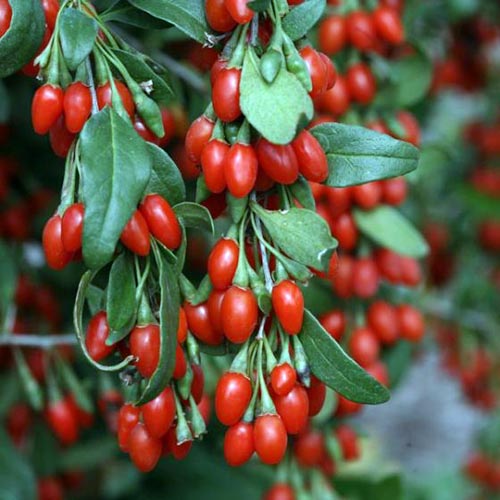
When harvest time arrives, be aware that the small red berries tend to taste better after you dry them.
You’ll find goji berry plants that are 18 months old or younger available at Nature Hills Nursery.
8. Ground Cherries
If you like the idea of growing fruit in your backyard but don’t want to wait for a shrub or tree to get settled in, try ground cherries, the boon of impatient gardeners.
Ground cherries are annual plants, related to tomatoes and tomatillos, that bring their fruit to maturity in a single growing season.

Like tomatillos, each fruit grows within a delicate, lantern-shaped husk.
These small nightshade plants produce delicious fruits that are about a half an inch across, and golden colored.
Ground cherries have a fruity, tropical flavor that is tart and sweet, somewhat reminiscent of pineapple.
‘Goldie’ is an exceptional cultivar that grows 28 to 36 inches tall, can spread to 24 inches wide, and will produce ripe fruit that’s ready to enjoy 75 days after sowing.

You’ll find ‘Goldie’ ground cherry seeds in a variety of packet sizes at High Mowing Organic Seeds.
And if you’ve never grown this tropical fruit before, make sure you bookmark our complete guide to growing ground cherries.
9. Hardy Kiwis
While I plant lots of edible annuals in my garden every year, I’m always looking for perennials to include.
So I was ecstatic when I learned about Actinidia arguta, commonly known as hardy kiwi.
Unlike the kiwifruit that you buy at the supermarket which can only be grown in USDA Hardiness Zones 8 and 9, hardy kiwi can be grown successfully in Zones 3 to 8, depending on the cultivar.
Though both types of kiwis are native to Asia, hardy kiwis differ from kiwifruit in a couple of ways.
They are much smaller than kiwifruit, about the size of a grape. Some markets sell them as “kiwi berries.”

And unlike the hairy skin of the brown fruit you are likely familiar with, hardy kiwis have smooth skin that can be green, purple, or reddish brown.
As far as taste goes, they have the same tart, sweet taste, though some find the hardy type to be even sweeter than kiwifruit.
Hardy kiwi is a fast-growing, deciduous vine that grows up to 20 or 30 feet long and will require trellising.
Make sure you grow both a male and a female plant, otherwise your vines will be purely decorative.
Plant hardy kiwis in full sun and look for ripe fruit in autumn.
One variety of hardy kiwi fruit, ‘Extra Hardy Michigan State’ produces lime green fruits that are a bit larger than average, weighing in at one ounce each.
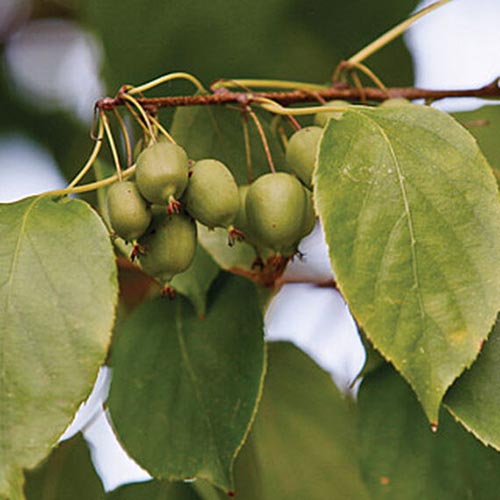
‘Extra Hardy Michigan State’ Hardy Kiwi Vines
You’ll find a two-pack of ‘Extra Hardy Michigan State’ hardy kiwi vines available at Burpee.
You can choose to receive one male and one female vine, or if you already have a male plant, you can select two female plants.
Learn more about growing hardy kiwi here.
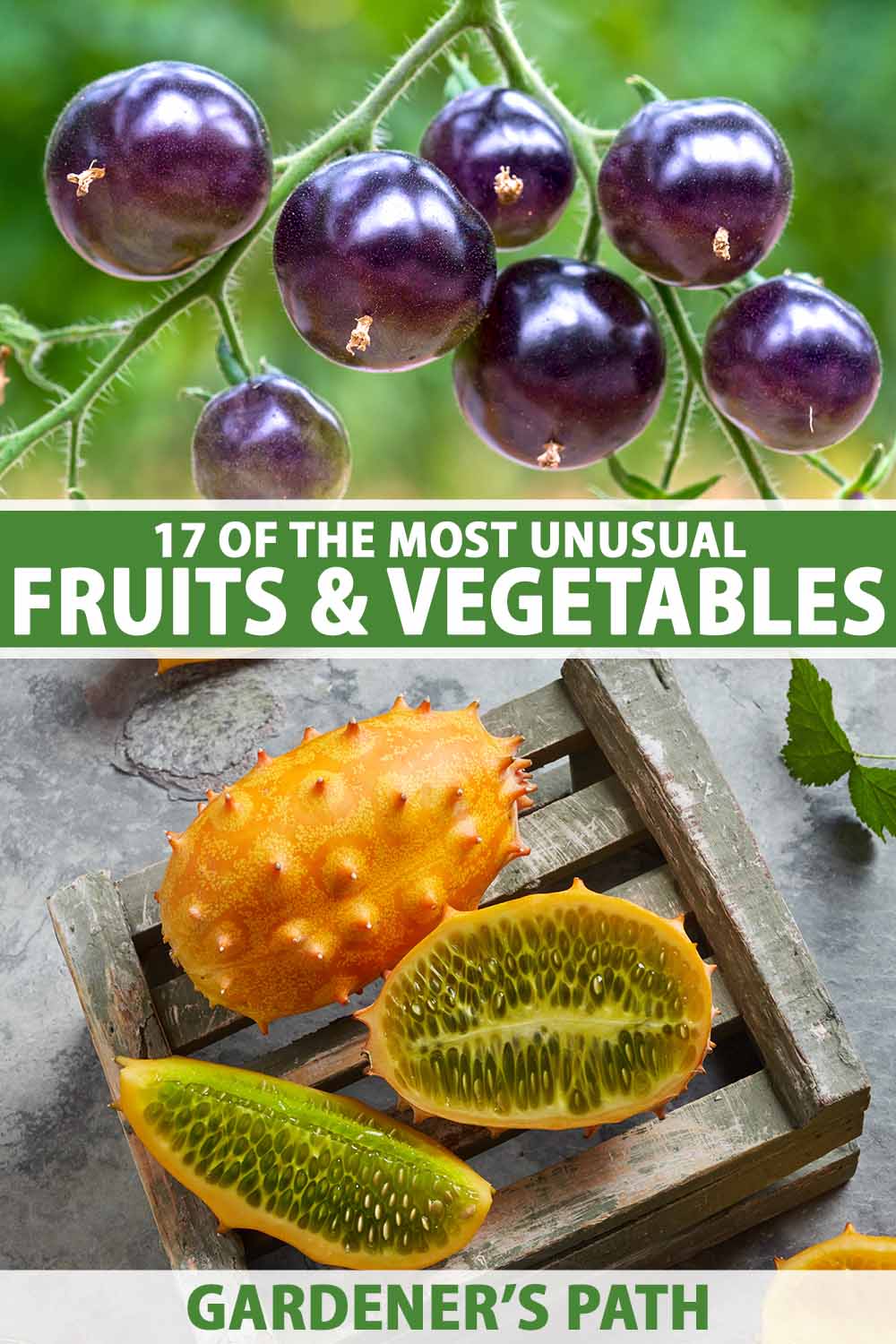
10. Indigo Rose Cherry Tomatoes
Sometimes plant breeders breed new cultivars not just for improved taste or transportability, but with health in mind. Such is the case with the purple-hued ‘Indigo Rose.’
This cherry tomato was developed at Oregon State University by Professor Jim Myers with the aim of increasing anthocyanins, those phytochemicals that may act as antioxidants in our bodies.

These cocktail-sized tomatoes have purple skin and a flavor that is both sweet and acidic.
‘Indigo Rose’ has good disease resistance, and as a semi-determinate tomato variety, would benefit from being staked to support its five-foot vines.
These purple tomatoes will be ready to pick approximately 90 days after transplanting.
When ripe, the bottoms of ‘Indigo Rose’ tomatoes turn from green to red, and the shiny purple skin turns a matte brownish purple.
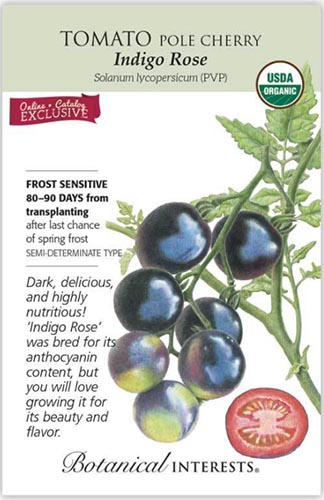
‘Indigo Rose’ Cherry Tomato Seeds
You’ll find ‘Indigo Rose’ cherry tomato seeds available for purchase in packs of 10 at Botanical Interests.
Learn how to grow cherry tomatoes here.
11. Kiwano Jelly Melons
Kiwanos look like something a mad scientist might have dreamt up – the fruits resemble short, fat cucumbers that have sprouted spiky horns.
Despite this off-putting appearance, kiwanos are delightfully refreshing.
Native to the tropical regions of Africa, they also go by the names “jelly melon,” “horned melon,” and “African horned cucumber.”
Like mouse melons, Armenian cucumbers, and banana melons, kiwanos are members of the Cucurbitaceae family.

Classified as Cucumis metuliferus, kiwanos are vining plants that produce oval-shaped fruits that are two and a half to six inches long, and covered with thick thorns.
When ripe, they turn yellow or orange. Inside, the fruits contain thin, flat seeds surrounded by a bright green gel that has a citrusy and very refreshing taste.
While these are similar to cucumbers, kiwanos are all gel and no flesh. When you eat one of these odd-looking fruits, you’ll find that their texture is similar to that of passionfruit.
As for the seeds, you can strain them out or just enjoy their crunch.
Plant kiwano seeds in well-drained soil in full sun, or start them indoors and transplant them when the risk of frost has passed, and the soil temperature is at least 59°F.
Kiwano vines can grow to be ten feet long and do very well on trellises.
They are very resistant to insect pests, and can even be used as a barrier against larger garden pests like deer or rabbits, since the vines are also prickly.
These long-season fruits take approximately 120 days to reach maturity. When it’s time to harvest, do so carefully – watch out for those thorns.
You’ll find kiwano jelly melon seeds available for purchase in packs of 30 from BuggyBeds Store via Amazon.
12. Painted Hill Corn
‘Painted Hill’ is a variety of dual-purpose corn that you probably won’t find at any market.
It is sweet and flavorful, and the kernels are a dazzling mix of purple, red, and blue hues, along with a smattering of yellow.
This open-pollinated cultivar was developed by plant breeder Dr. Alan Kapuler of Peace Seeds from a cross between the sweet corn variety, ‘Luther Hill,’ and a flour corn cultivar, ‘Painted Mountain.’
These flavorful ears grow to seven inches long and should be picked when kernels are still pale for fresh eating.
When allowed to dry for cornmeal or corn flour, the full deep colors of the kernels will develop.
‘Painted Hill’ corn is well adapted to short growing seasons and the seeds don’t have any trouble germinating when the soil is still cool.
It requires up to 80 days to reach maturity – make sure to review our article on harvesting corn to prepare yourself.
The cornstalks grow to be five feet tall and produce two ears per stalk.
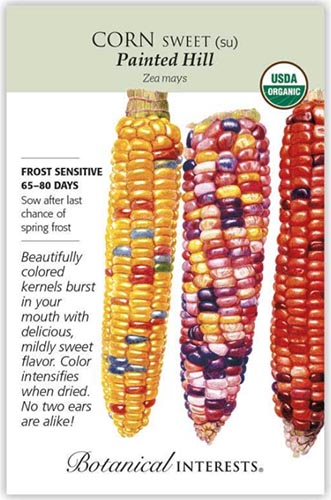
You’ll find organic ‘Painted Hill’ corn seeds available in eight-gram packs at Botanical Interests.
And if the idea of fresh cobs of corn has you salivating, why not learn about the best varieties of sweet corn?
13. Persimmons
Persimmons are uncommon in supermarkets in most parts of the country. And when you do find them? You’ll pay a premium for a single fresh fruit.
That’s why – if you are a persimmon fan, like I am – it’s a smart move to start growing your own.
There can be a hurdle to persimmon appreciation, though.
Some varieties are astringent unless eaten when they have matured to a pudding-like consistency, and the texture can take some getting used to.
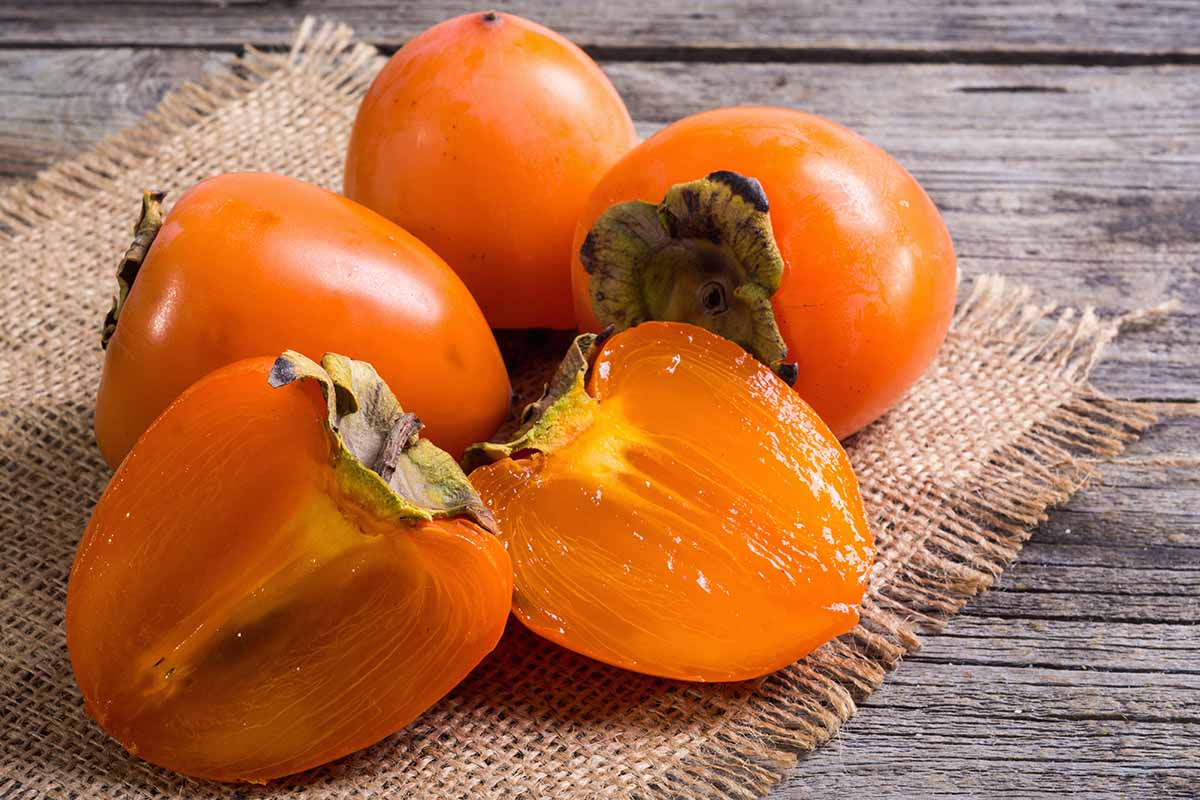
However, gelatinous texture or not, these orange-colored fruits have an enticing feature that tends to win over even the most skeptical – a sweet and rich flavor that is purely decadent.
If you live in USDA Hardiness Zones 7 to 10, you can include Asian persimmons among your growing options.
Learn about 15 different varieties of Asian persimmons – and pick your favorite – right here, including some that are never astringent and can be enjoyed when their flesh is still firm.
But if you live in a location with colder winters or you enjoy adding native plants to your landscape, you might want to consider the American persimmon (Diospyros virginiana) instead.
You can grow these trees in Zones 4 to 9, where they will mature to a height of 30 to 50 feet tall and 20 to 35 feet wide.
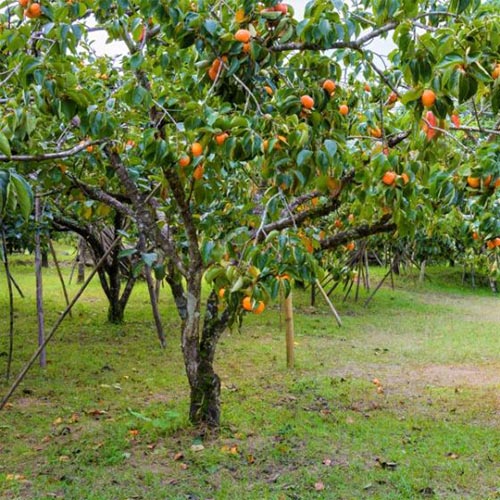
You’ll find American persimmon trees available for purchase as two three-foot bare root plants at Nature Hills Nursery.
To learn more, make sure to read our complete guide to growing American persimmons.
14. Pineberries
No one ever said garden produce couldn’t be adorable, and pineberries are proof that homegrown food can be as sweet looking as it is sweet tasting.
A cross between two different species of strawberries, these fruits look too cute to be authentic, but believe it or not, pineberries are the real deal.
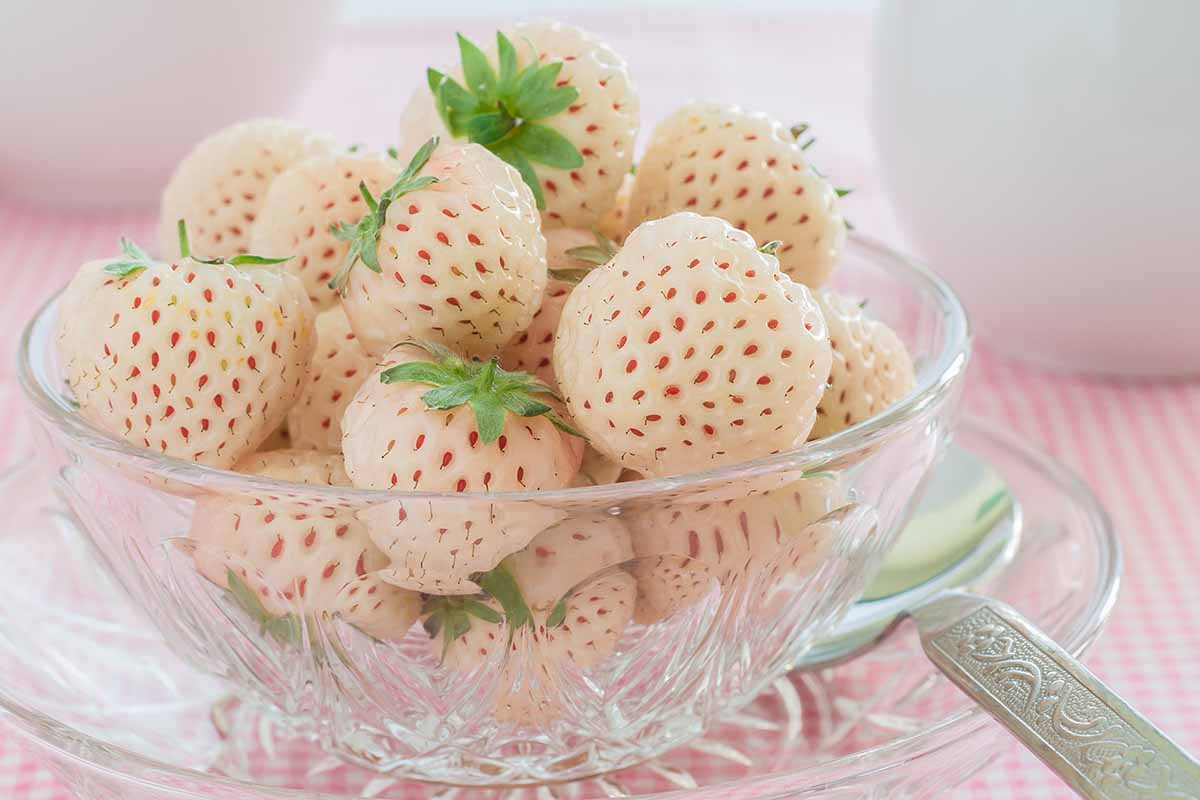
When you bite into one of these small, white to pale pink berries with red seeds, they taste like strawberries with a hint of a pineapple.
‘White Carolina’ is a cultivar of pineberry that is well-suited to growing in Zones 4-9. Plant it in full sun in well-draining, slightly acidic soil.
These everbearing plants will grow to be six to eight inches tall and will have an 18 to 24-inch spread – so make sure to leave adequate spacing between plants.
Pineberries are only partially self-fertile, so you’ll need to make sure you plant one red everbearing strawberry plant for every five pineberry plants to ensure the best fruit production.
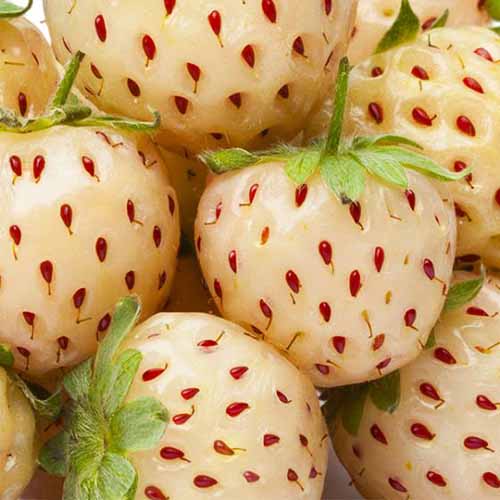
You’ll find ‘White Carolina’ bare root pineberry plants available at Nature Hills Nursery.
If you need help picking a red variety to go with ‘White Carolina,’ make sure to peruse our article on 35 of the best strawberry cultivars.
If you’re going to grow strawberries this year, why not try this unusual cross?
15. Rat’s Tail Radishes
Are you a fan of wasabi? Do you like your food to hurt a little? Welcome to your new garden snack – the rat’s tail radish.
Also known as “rattail radish” or “rat tailed radish,” this is a variety grown not for its root but for its seed pod.
Taxonomically, it is classified as Raphanus sativus var. mougri, R. sativus ‘Caudatus’ or R. sativus var. caudatus, depending on who you ask.
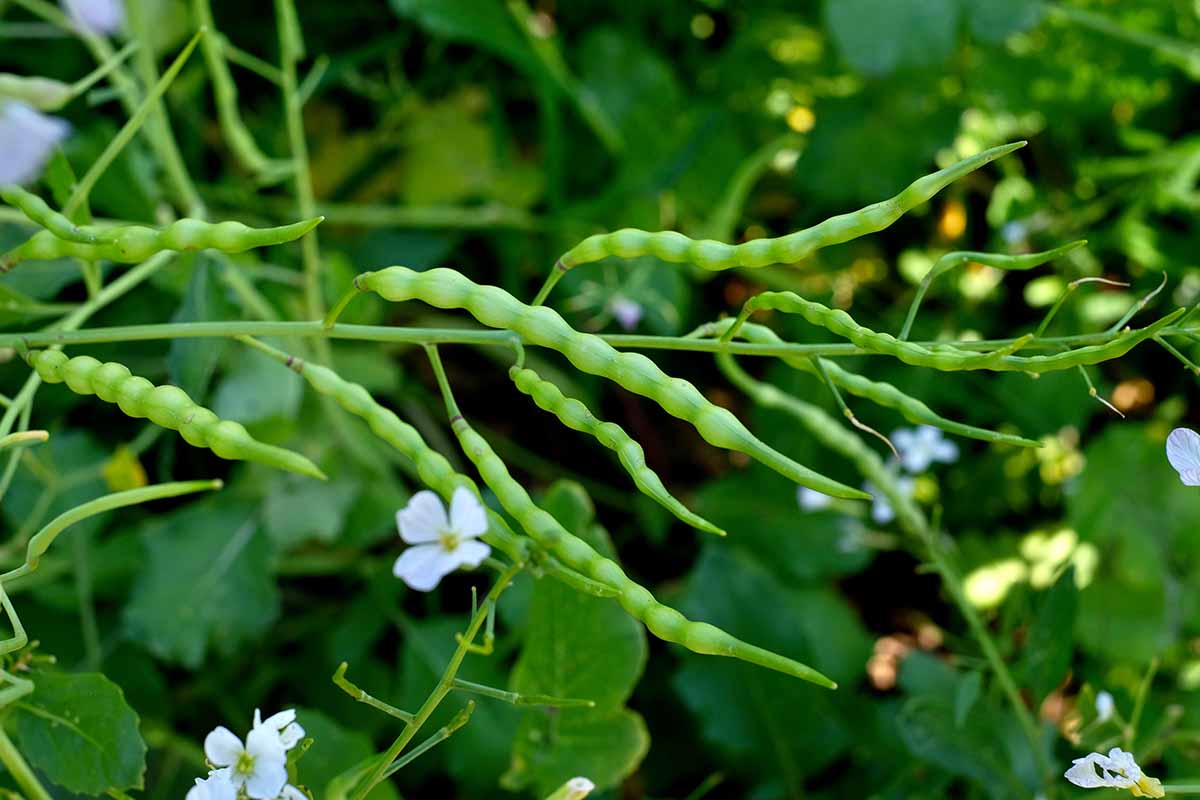
The green pods of rattail radishes are spicy and peppery tasting, much like radish roots.
You can slice these up and use them to top a salad or rice bowl, or include them in a wok full of sauteed veggies.
Sow these radishes in full sun as soon as you can work your garden soil, in early spring.
This annual plant can grow up to five feet tall with a one- to two-foot spread and will benefit from a cage to remain upright.
These rat’s tails will be ready to pick in 40 to 50 days. While the pods can grow to 12 inches long, they are best when picked between three and five inches in length.
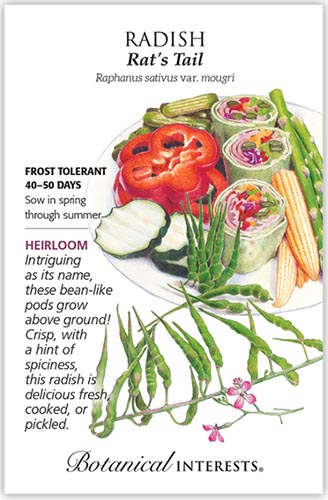
You’ll find ‘Rat’s Tail’ radish seeds available for purchase in packs of 250 milligrams at Botanical Interests.
Learn more about growing radishes here.
16. White Eggplant
Some fruits and vegetables have colors that are strongly associated with them. In our minds, oranges should be orange, broccoli should be green – and eggplant should be purple, right?
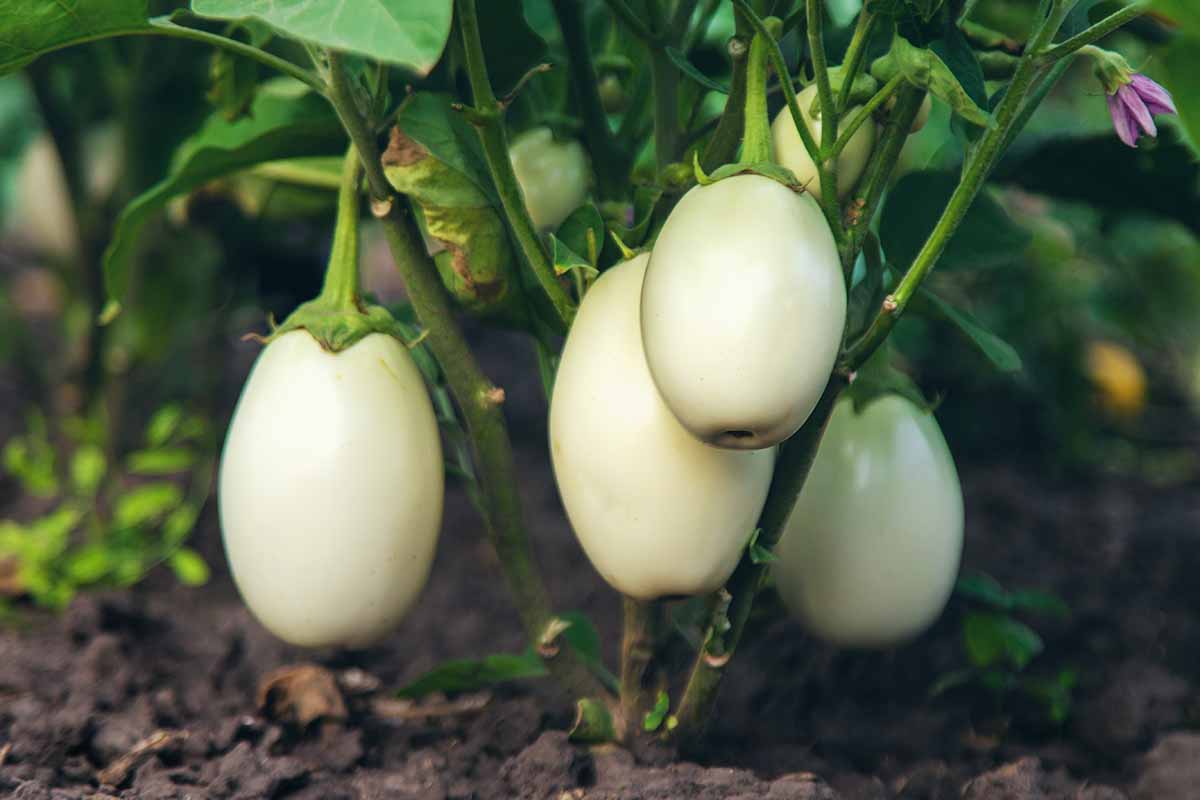
It may take some time to wrap your head around this, but eggplants actually come in colors other than purple, and that includes shades of white.
Beyond the appeal to novelty, white eggplants have some winning characteristics – many of the white varieties are milder, have fewer seeds, and are less bitter than their purple counterparts.
One of my favorite varieties is ‘Casper,’ an open-pollinated French heirloom. This cultivar has a tasty, mushroom-like flavor and a hearty, meaty texture.
The annual plants grow to be two to three feet tall and do well in cooler summer weather.
‘Casper’ eggplants are best when picked at six inches in length, and will be ready to harvest approximately 70 days after transplanting.
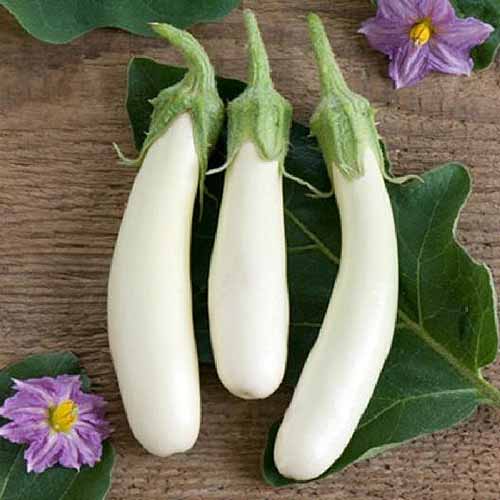
You’ll find ‘Casper’ white eggplant seeds available for purchase in a selection of packet sizes at Eden Brothers.
Learn more about how to grow eggplant here.
17. Yard Long Beans
I’m going to try hard not to get too overzealous – but I love, love, love yard long beans. This is no subtle flirtation. I am head over heels amorous. Did I mention I love these beans?
I think they have an absolutely gorgeous flavor. If pressed, I might just fight another shopper for a bag of them at the farmers market.
The thing is, they aren’t standard fare, even at farmers markets.
So when you are as crazy about these veggies as I am, it comes in very handy to know how to grow your own yard long beans.
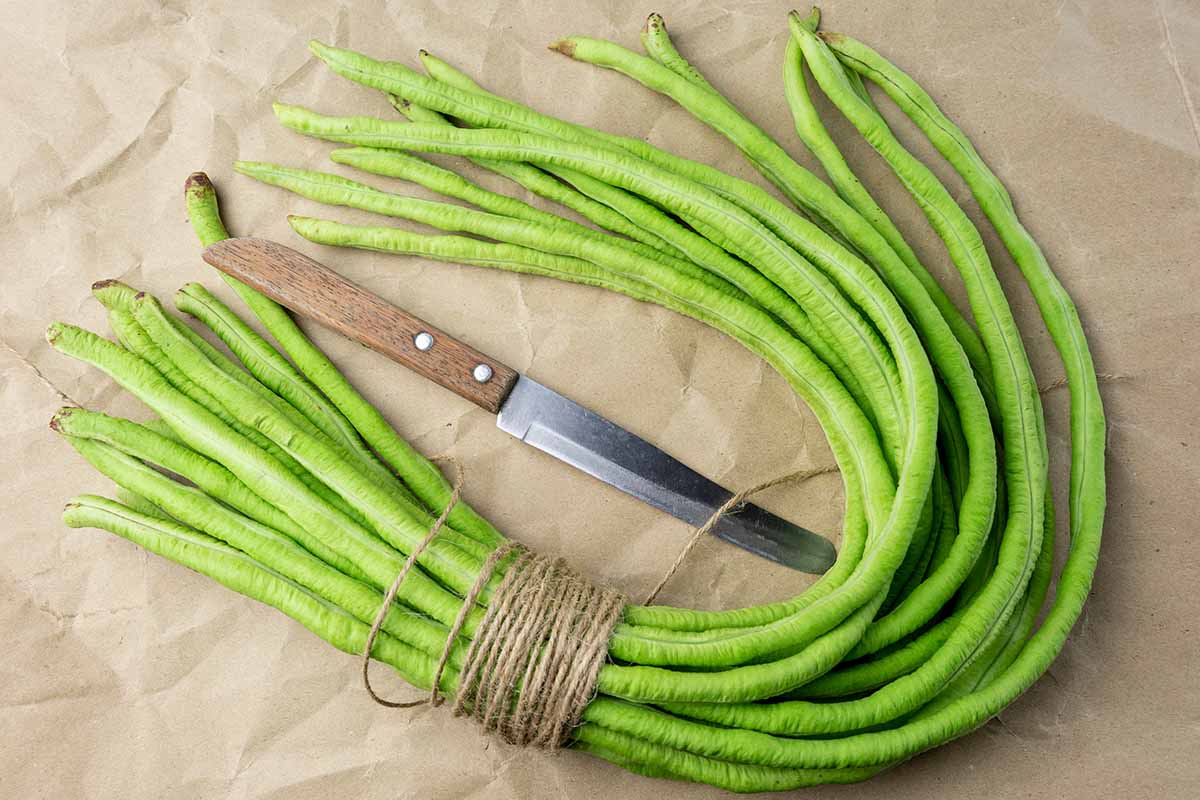
Also called “Chinese long beans” or “asparagus beans,” this plant (Vigna sesquipedalis or Vigna unguiculata subsp. sesquipedalis) is more closely related to black-eyed peas than it is to green beans.
Yard long beans have a slightly different taste than standard bush beans or pole beans. To me, they taste like dill has already been added to them.
They also have a somewhat nutty flavor, and I would also describe them as having a lighter taste than green beans.
‘Orient Wonder’ is one of my favorite varieties of yard long beans. The pods can reach thirty inches in length but are best when they’re harvested at twelve to eighteen inches.
These plants produce vines that can grow six to eight feet long, so they should be grown on a support such as a trellis, or you could try growing them on a bean teepee.
‘Orient Wonder’ will be ready to harvest in 80 days.
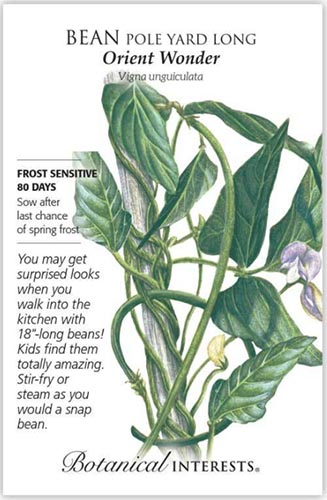
‘Orient Wonder’ Yard Long Bean Seeds
You’ll find ‘Orient Wonder’ yard long beans available in packs of 20 seeds at Botanical Interests.
Learn more about planting and growing yard long beans.
Pick a Unique Harvest
Whether you’re looking for exciting homegrown food for your veggie plot, your orchard, or just to incorporate into your landscaping, you have your pick of unique edible plants.
Which of these options has your mouth watering? Do you have any other favorite unusual fruits or vegetables you like to grow?
Let me know below in the comments section – I’m always interested in discovering new edible plants to include in my landscape.
And if you’re looking for other out of the ordinary fruits and vegetables to grow at home, you might want to dig into these articles next:



very good very nice
One of the reasons that I garden is so that I have access to “unusual” produce. This is a great list and I’ll be using it next season.
Hi Dawn,
Thanks so much for letting us know you found this list helpful! Happy (unusual) gardening!
verry cool