
There’s no better way to make a garden pop than by introducing a bold splash of blue.
Whether your color scheme is pinks and reds, yellows and oranges, or an eclectic mix, the addition of blue – at random or as a focal point – wakes up a garden.
The plants listed in this guide are all native to the US and do exceptionally well in their appropriate regions.
This means less watering and maintenance for you, and better habitat for animals like birds, bees, and butterflies and other pollinators.

We link to vendors to help you find relevant products. If you buy from one of our links, we may earn a commission.
The native plants we’re about to discuss are not on the USDA’s Federal Noxious Weeds List, ensuring that they are environmentally advantageous additions to home gardens.
Those listed as perennials may behave as annuals in states with colder climates, re-sowing themselves by dropping seed, as opposed to overwintering in a dormant phase.
A US native flower is defined as one that originates in one or more of our states. Where we find it growing in the wild, we call it a wildflower.
And now, for some flowers that are sure to delight!
15 Best Native Wildflowers
1. Blue Flag Iris
The northern blue flag iris (Iris versicolor) is native to the eastern US.
This herbaceous perennial loves to have wet feet, and thrives in marshes and pond borders. It’s a wildflower that grows in clumps with two-foot stems topped by showy blossoms.

This species is hardy in Zones 3 to 8 and requires shallow planting, with a bit of thick rhizome root showing.
It needs space between plants for air circulation to inhibit rotting, a common iris problem.
This species grows two to three feet tall and enjoys full sun to part shade locations with moist, organically-rich soil.
Note: This plant is toxic. Handling the rhizomes may cause skin irritation, so wear gloves.

You can purchase packets of 25 seeds from Earthbeat Seeds. Or you can find plants in #1 containers available at Nature Hills.
2. Bluehead Gilia
Known also as globe gilia and Queen Anne’s thimble, Gilia capitata is a bushy, multi-branching annual native to the western US.

Its light blue pom-pom flowers and dense foliage make a refreshing statement in rock gardens.
This annual wildflower is a member of the phlox family with the ability to reseed itself, coming up year after year like a perennial.
It’s drought tolerant, making it a good candidate for xeriscaping.
Bluehead gilia is not particular about soil, thriving in average to dry, well-draining substrate. It self-sows readily, returning year after year in Zones 3 to 10.
Blooming in late spring to early summer, the flowers are lightly scented.

You can find seeds in a variety of packet sizez available at Eden Brothers.
3. Bottle Gentian
Native to the northeastern US, the bottle gentian (Gentiana andrewsii) is an herbaceous perennial with a unique bud-like blossom that doesn’t open as most flowers do.
That’s why it has another name: the closed gentian.

This wildflower is relatively easy to grow in Zones 3 to 6. Keep in mind that while the plant likes moist soil, it doesn’t like to be waterlogged. Grow in full sun to part shade in soil that drains well.
This species can grow up to two feet in height and does best with neighboring plants or stakes to lend support.
Protect tender seedlings from foraging animals, and then stand back and watch this beauty bloom until the first frost.
4. Common Hepatica
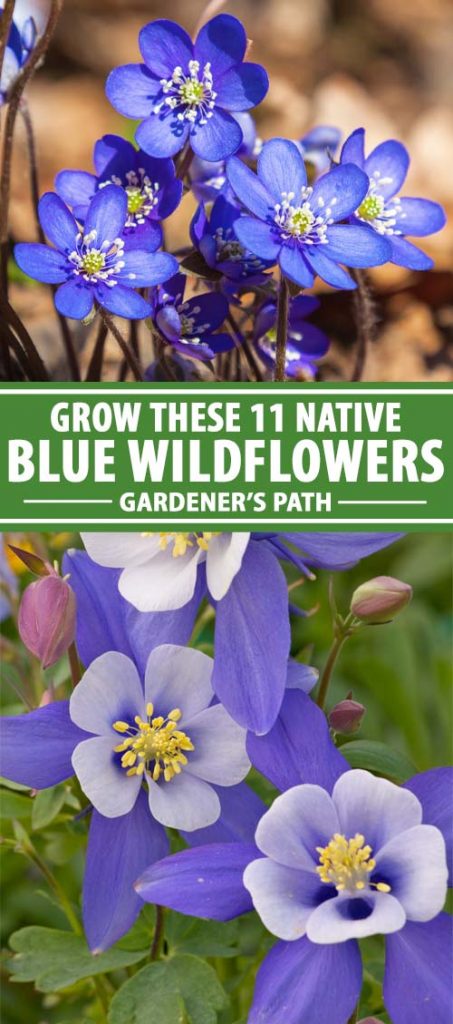
The common hepatica (Hepatica americana) is known by various names, including blue anemone, liverleaf, and mayflower. This species is native to the southeastern US.

It’s a charming wildflower that grows close to the ground in woodsy settings, where there is partial shade and rich, well-drained soil.
As an herbaceous plant, the stems, leaves, and flowers die at the end of the growing season while roots lie dormant beneath the soil throughout the winter.
This species grows up to six inches tall and blooms in early spring. Depending on the variety the flowers may be blue, pink, or white and are sometimes fragrant.
Hardy in Zones 3 to 8, common hepatica enjoys a part shade location and organically-rich, well draining soil.
5. Colorado Blue Columbine
Colorado blue columbine (Aquilegia caerulea) is native to the Colorado Rocky Mountain region that thrives in moist, well-drained soil.

This hardy herbaceous perennial does best in full sun but will tolerate partial shade. It is the Colorado state flower, and a protected species.
Colorado blue columbine may succumb to the heat of areas with hot summers after just a few years, usually because the soil isn’t moist enough.
However, it self-propagates by scattering seeds that grow into new plants, much like an annual.
Plants grow two to three feet tall and bloom in late spring. The blooms consist of central white petals flanked with blue sepals, providing a delightful, star-like display. Hardy in Zones 3 to 8.

You can find seeds in packets of 60 available at Burpee.
6. False Indigo
False indigo (Baptisia australis) is a large, clumping perennial, native to the eastern US, that looks great at the back of a border.

It has small violet-blue blossoms in clusters called racemes, which are elongated like that of the larkspur or delphinium.
It is a majestic wildflower growing two to four feet tall with deep roots that shares space companionably with neighboring plants.
Grow in full sun to part shade in average, well-draining soil. Hardy in Zones 3 to 10.
Give it time to establish, and you’ll have a stunning landscape scheme. Divide roots during dormant periods to thin plants.
Note: All parts of this plant are toxic.
You can find false indigo plants available in #1 containers at Nature Hills Nursery.
Our guide to growing false indigo has more information.
7. Great Blue Lobelia
Great blue lobelia (Lobelia siphilitica) is an herbaceous perennial native to eastern and central US.

It blooms from mid to late summer in Zones 4 to 9 with spikes of vivid blue, tubular blooms.
Plants reach two to four feet tall and thrive in organically-rich, fertile soil that is consistently moist.
A full sun location is ideal but this species will tolerate part shade, especially in hot climates.
8. Lewis Flax
Lewis or blue flax (Linum lewisii) is a short-lived perennial native to much of western North America, from Alaska and western Canada down through the western United States into northern Mexico.

Its delicate, sky-blue flowers open in the morning and often drop by afternoon, with new blooms appearing daily from late spring into midsummer.
Plants typically grow one to three feet tall and spread about a foot wide, forming airy clumps.
Hardy in Zones 3 to 9, this species thrives in full sun and well-drained soil, tolerating drought once established and often flourishing in prairies, foothills, and open slopes.
9. Mealycup Sage
Mealycup sage aka blue salvia (Salvia farinacea) is a drought-tolerant herbaceous perennial native to south-central US, including Texas and Oklahoma.

Hardy in Zones 3 to 10, in colder climates, it grows exceptionally well as an annual.
Blue salvia grows tall in full sun, often stretching its flower-laden stalks to four feet. When deadheaded, it blooms intermittently throughout its long growing season.

You can find ‘Big Blue’ plants and seeds available at Burpee.
Learn more about growing salvia here.
10. Miniature Lupine
Miniature or two-colored lupine (Lupinus bicolor) is an annual wildflower native to western North America, ranging from British Columbia south through California and into Baja California.

It produces charming spikes of blue and white pea-like flowers in spring, with blooms typically lasting several weeks depending on moisture and temperature.
Plants usually reach four to 16 inches in height, remaining compact and spreading modestly in open, sunny areas.
This species thrives in full sun and well-drained soils, often appearing in grasslands, open woods, and disturbed sites. It will self-seed readily in Zones 7 to 10.
Learn more about growing lupines here.
11. Narrowleaf Blue-Eyed Grass
Narrowleaf blue-eyed grass (Sisyrinchium angustifolium) is not a true grass, but a member of the iris family, native to the eastern US.

Known also as Bermuda blue-eyed grass as well as lucerne, it makes a sweeping meadow of blue, with clumps of slender green leaves, each sporting one flower per stem.
It’s an herbaceous perennial that’s perfect as a border plant, and hardy in Zones 4 to 9.
Give this species room to roam, dividing clumps to thin as needed over the years.
It likes moist, organically-rich soil with good drainage, and full sun, but also tolerates some shade.
You can find plants available at Nature Hills Nursery in #1 containers.
12. Prairie Bluebells
Prairie Bluebells (Mertensia lanceolata) is a perennial native to the Rocky Mountains and parts of the Great Plains in the western United States.

Its nodding clusters of pinkish-purple buds open into bell-shaped blue flowers in early to mid-spring, with the display typically lasting several weeks.
Plants grow about six to 18 inches tall, forming small clumps that naturalize in ideal conditions.
Hardy in Zones 4 to 8, it prefers well-drained, moderately moist soil in full sun to partial shade, often thriving in open woodlands and meadows.
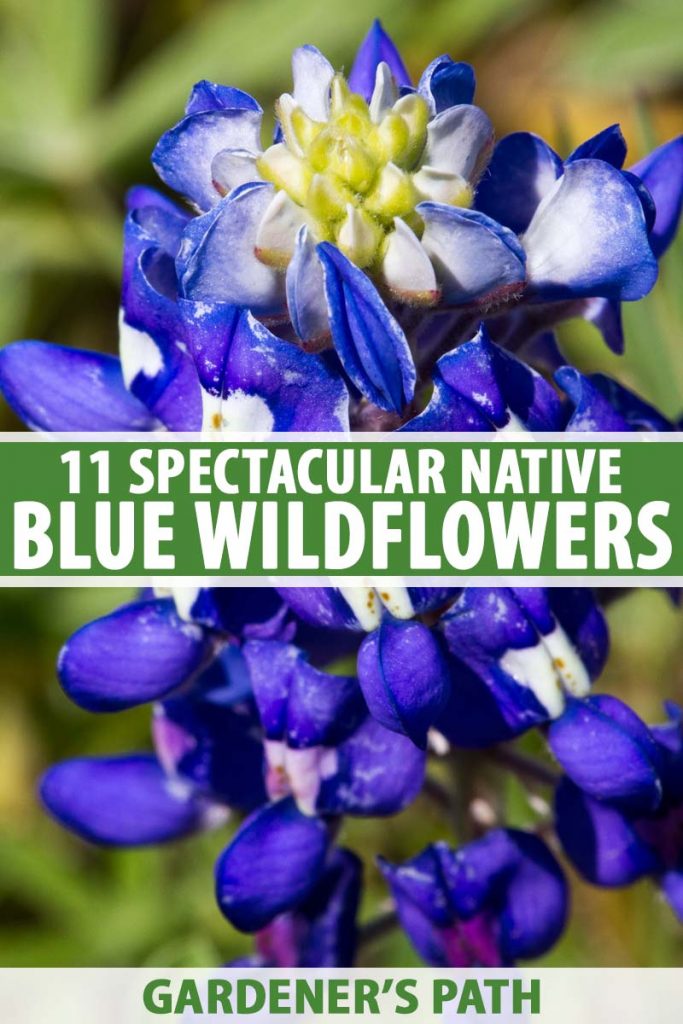
13. Texas Bluebonnet
The official state flower of Texas, the Texas bluebonnet (Lupinus texensis) is a native that glories in dry soil and abundant sunshine.

To see a field of them waving in the breeze is nothing short of breathtaking.
Reaching one to three feet in height, this herbaceous annual is a member of the lupine family. It’s topped by clusters of scented cobalt flowers with white tips.
Texas bluebonnet forms an intricate rhizome root system that may benefit from soil treated with a rhizobium, to inhibit damaging bacteria.
It is drought-tolerant and thrives in well-draining soil in full sun.
Note: This species is toxic to people and pets.

You can find Texas bluebonnet seeds available in a variety of packet sizes at Eden Brothers.
14. Virginia Dayflower
Virginia dayflower (Commelina virginica) is a three-petaled wildflower with clusters of flowers at the end of each stem that open in the morning and close at noon, lasting one day only.

It is a hardy herbaceous perennial commonly found in the eastern US. It has a long growing season from late spring to late summer.
Sometimes reaching three feet in height, Virginia dayflower self-sows as it drops spent blossoms.
Trimming leggy or withering foliage helps to maintain shape and promote blooming.
Given room, the rhizome root system of this plant may spread extensively. This species is hardy in Zones 5 to 10 and thrives in moist soil on riverbanks and wetlands.
15. Wasatch Gentian
This native of Utah’s Wasatch Mountains is a hardy herbaceous perennial that thrives in sandy soil with little water.

Known also as Wasatch beardtongue, Penstemon cyananthus is a biennial, blooming in its second year.
In two years, you’ll have 18-inch spikes with dense clusters of bright blue tubular blossoms that are sure to be the envy of your neighborhood.
This species is hardy in Zones 4 to 8 and enjoys a full sun location.
True Blue in Many a Hue
With 11 options for an eye-popping splash of blue, it’s time to choose your favorites and start shopping!
As you begin to shop, you’ll soon see that there are many plant varieties with similar names. Be sure to look for the Latin names of plants you like, to be sure to get the ones discussed here.
You may find them online, in catalogs, or at nurseries that specialize in native plants.
Once you have your favorites in hand, read all of the instructions on seed packets and plant tags before you grab your gear bag and get going.
You have several growing options, including starting seeds indoors, potting rhizome plants to force indoors, and planting directly in the garden.
You’re going to love the impact of native blue flowers on your outdoor living space.
We can’t wait to hear which ones will take center stage in your gardens! Tell us in the comments section below.
And for more information about growing native wildflowers in your landscape, add these guides to your reading list next: