If you want to create a more sustainable yard or garden, using native plants in the landscape is a no-brainer: these locally adapted species are beautiful, low maintenance, and water-wise.
And some native wildflowers are wide-ranging and highly adaptable, making them even easier for more gardeners to grow!

We link to vendors to help you find relevant products. If you buy from one of our links, we may earn a commission.
I’ve narrowed down a list of 15 species of native wildflowers that are widespread across the continental United States and Canada.
And with a wide range, that means these plants tend to adapt well to different conditions.
Ready to learn about these lovely locals? Here’s a sneak peek:
15 of the Best Native Wildflowers for the US and Canada
Note that all growing zones mentioned below were derived from the USDA Hardiness Zone map of planting regions.
1. Black-Eyed Susan
Black-eyed Susans (Rudbeckia hirta) make a cheery appearance in the garden with their large, daisy-like yellow flowers with brown centers.
In the wild this plant grows in prairies, and is native to the eastern two-thirds of North America.
A member of the Asteraceae family, black-eyed Susan is a short-lived perennial, hardy in Zones 3 through 7, but it is also sometimes treated as an annual, blooming from summer to first frost.

Black-eyed Susan requires full sun and moderate water. With good drought tolerance, it is adaptable to soils that are dry to moist, as long as the soil is well-drained.
This species grows to be two to three feet tall and one to two feet wide, and it is not particularly attractive to deer.
For those looking for juglone-tolerant plants to include near black walnut trees, you can add this one to your list!
Black-eyed Susan looks great in a flower bed or border, and is particularly showy when used in mass plantings.
New England aster, butterflyweed, and purple coneflower all make excellent companions for this species, both in terms of cultural requirements and aesthetic appeal.
One of the advantages of gardening with natives is the opportunity to observe unique interactions between local plants and local pollinators.
Black-eyed Susan serves as a larval host for bordered patch butterflies (Chlosyne lacinia) and gorgone checkerspot butterflies (Chlosyne gorgone).
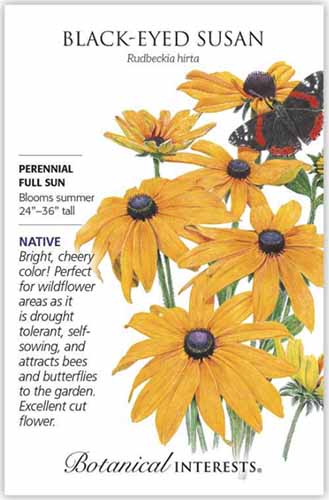
You can purchase black-eyed Susan seeds in 500 milligram packets from Botanical Interests.
For more tips, read our complete guide to growing black-eyed Susans.
2. Blue Vervain
Blue vervain (Verbena hastata) has a wide native distribution and is found growing wild in almost all US states and Canadian provinces.
Hardy in Zones 3 to 8, it sports green, lance-shaped leaves with deeply serrated margins. Long spikes of purplish-blue flowers bloom from midsummer to early fall.
This species is also called American blue vervain, swamp verbena, blue verbena, and simpler’s joy.

Blue vervain has a spread of 12 to 30 inches, and usually grows to be two to four feet tall, sometimes reaching up to six feet.
In the wild, this plant thrives in moist locations and can grow in full sun, part shade, or full shade.
It should be grown in soil that is moist or wet, and makes a great selection for a rain garden.
Blue vervain can self-seed when grown in the right conditions, so pick off spent flowers if you want to prevent spread.
Alternatively, you might locate it where its spread would be appreciated, such as in a naturalized-type garden.
Joe-pye weed, common self-heal, and cardinal flower make ideal companions.
You’ll find blue vervain seeds in a choice of package sizes from Everwilde Farms via Amazon.
3. Butterflyweed
A type of milkweed, butterflyweed (Asclepias tuberosa) has deep orange flower clusters held aloft above dark green foliage.
In Canada, this plant is native to Ontario and Newfoundland, while in the US its native range stretches from New England to Florida, and west to Colorado and Texas.
This species is hardy in Zones 3 to 9 and blooms from May through September.

Butterflyweed thrives in full sun or part shade. Its water needs are low once established, and it is quite drought tolerant.
Reaching heights of one to three feet, butterflyweed is adaptable to many different soil types as long as it has good drainage.
Fitting companions for butterflyweed include purple coneflower, gray goldenrod, common yarrow, wild bergamot, nodding onion, and black-eyed Susan.
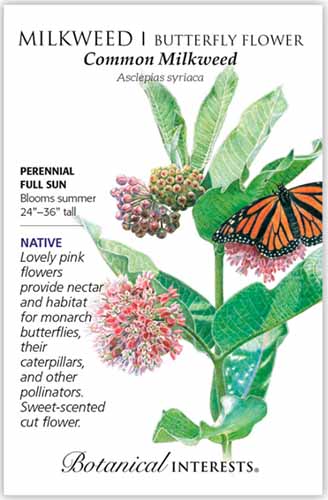
You can find packets of butterflyweed seeds available at Botanical Interests.
If this Asclepias species isn’t native to your particular region, have a look at our guide to 15 of the best types of milkweed to identify those that are best suited to your area.
For further guidance, read our complete guide to growing milkweed.
4. Cardinal Flower
A type of lobelia, cardinal flower (Lobelia cardinalis) produces spikes of bright red flowers held above lance-shaped, dark green leaves with finely serrated margins.

This plant has a very wide native distribution, ranging from southern Canada all the way south to northern Colombia in South America.
This member of the bellflower family is hardy in Zones 3 to 9, and reaches two to three feet tall, or sometimes up to four feet at maturity.
Cardinal flower thrives in full sun or part shade, with afternoon shade appreciated in hotter climates.
This species enjoys moist to wet soils and since it tolerates brief flooding, can be used in rain gardens. The long, red, tubular flowers attract hummingbirds.
Blue vervain, fall sneezeweed, or common self-heal will make good companions.
You’ll find seeds in a variety of packet sizes from Everwilde Farms via Amazon.
Read more about growing cardinal flowers here.
5. Common Self-Heal
Common self-heal (Prunella vulgaris) is easily recognizable as a member of the mint family, with its spikes of blueish purple flowers, square stems, and leaves arranged on the stems in opposite pairs.
Also known as lance self-heal and heal all, this species has an extremely wide native distribution, growing wild across North America, and also throughout Europe and most of Asia.

From midsummer to fall, this species blooms with blue, purple, pink, or white flowers.
Common self-heal grows up to 12 inches tall and eight inches wide, and is hardy in Zones 4 to 8.
In the US its native range stretches from Maine south to Florida, with its western range spanning to Minnesota, Nebraska, and Colorado, and across the southwest to California.
The showy red blooms appear in late summer, making it one of the best perennials to grow for fall color.
Adapted to both full sun and part shade, it does best with afternoon shade in hotter climates. It will thrive in different soil types but prefers moist conditions.
An edible plant, as its common names suggest, common self-heal is often used medicinally.
But humans aren’t the only ones who appreciate it – this species is also a larval host for the clouded sulphur butterfly (Colias philodice).
Common self-heal makes an excellent ground cover. Its low stature is ideal for front of the border placements with some taller companions growing behind.
Cardinal flower, blue vervain, and fall sneezeweed make good moisture-loving companions for this species.
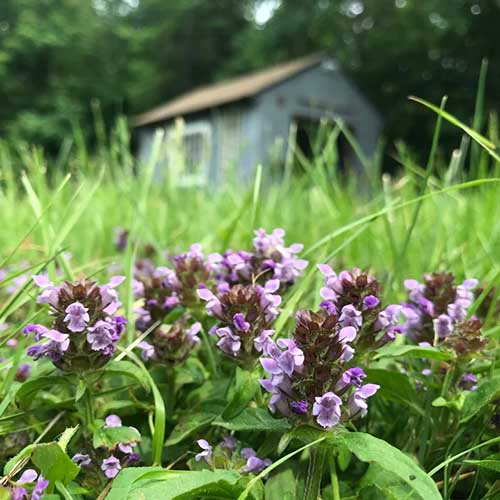
You can purchase packs of 50 seeds of common self-heal from Earthbeat Seeds.
6. Fall Sneezeweed
Don’t expect this plant to make you sneeze – its odd common name comes from the plant’s historical use as snuff.
Fall sneezeweed (Helenium autumnale) is native to most of the US and Canada, except for New England, where it has naturalized.
Flowers have wedge-shaped, yellow petals with greenish yellow centers, held atop dark green foliage.
An excellent choice for late summer blooms, fall sneezeweed is in flower from late summer through fall.

A member of the aster family, this species requires full sun and moist soil, preferably clay.
Fall sneezeweed reaches three to five feet tall, has a spread of two to three feet, and is deer resistant.
It’s a great wildflower to include in your cut flower garden. Cardinal flower or common self-heal will make good companions.
You can find fall sneezeweed seeds in a selection of package sizes from Everwilde Farms via Amazon.
7. Fireweed
After wildfires wreak havoc, fireweed (Chamerion angustifolium) is one of the first species to recolonize the burnt landscape, spreading swaths of bright magenta flowers across the land.
Fireweed has an extremely wide distribution throughout the Northern Hemisphere, including most of North America, Europe, and Asia.
In the US, it grows in Alaska, throughout the western states, in the Midwest, and from Tennessee and North Carolina north to Maine. It’s also native to every province in Canada.
This perennial is hardy in Zones 2 to 7 and is also known as narrow leaf fireweed or blooming sally.

The long, narrow leaves resemble those of willows, inspiring a couple of other common names: willow herb and great willow herb.
A member of the Onagraceae family like its relative evening primrose, the upright racemes of magenta flowers bloom from summer to fall.
Though fireweed usually grows to heights of two to six feet, occasionally it reaches an outstanding nine feet tall. It typically has a spread one to three feet.
This species grows well in full sun, but in climates with hot summers, it is happier in part shade.
Fireweed is adaptable to medium-dry to medium-wet soil. It grows best in acidic soils that are rich in organic matter and well-drained, with a pH between 5.0 and 6.6.
C. angustifolium spreads via rhizomes and self-seeding, so this plant works best in a naturalized-type planting.
It is also suitable for rock gardens, borders, and cottage gardens, and is very striking when grown in large swaths, for more color impact.
Fireweed is a larval host to the white-lined sphinx moth (Hyles lineata), and also attracts long-tongued bees and hummingbirds.
You’ll find fireweed seeds available from Everwilde Farms via Amazon.
8. Gray Goldenrod
With its large sprays of golden flowers, gray goldenrod (Solidago nemoralis) creates a mass of bright color from summer to fall.
Native to the eastern two-thirds of North America this species is hardy in Zones 3 to 9.

A member of the sunflower family, gray goldenrod has grayish-green foliage, and its spikes of yellow flowers nod slightly when in full bloom.
Also called prairie goldenrod, old field goldenrod, or field goldenrod, it grows six to 24 inches tall with a six- to 24-inch spread. It’s one of the smaller varieties of goldenrod.
Gray goldenrod can grow in full sun or part shade, tolerates dry or medium-dry conditions, and thrives in poor soil. It’s ideal for planting in sandy, rocky locations.
This species spreads by rhizomes and self-seeding, so it is best used in naturalized plantings, like cottage gardens.
Butterflyweed, black-eyed Susan, common yarrow, Jerusalem artichoke, nodding onion, and wild bergamot make excellent companions for gray goldenrod.
Find gray goldenrod in packs of 2,000 seeds from Everwilde Farms via Amazon.
Learn about growing goldenrod here.
9. Jerusalem Artichoke
Related to sunflowers, the Jerusalem artichoke (Helianthus tuberosus) produces edible tubers, which have a taste reminiscent of globe artichoke.
This species is native to eastern and central North America, the Intermountain West, Idaho, and Washington. It is hardy in Zones 3 to 9.

Also called sunchoke, the flowers have yellow petals and greenish-yellow centers, with green foliage that is rough to the touch.
It grows six to 10 feet tall with a spread of three to five feet, and blooms in late summer.
Jerusalem artichokes are adaptable to either full sun or part shade, and either dry or moderately moist soils. The plants are not fussy about soil type, provided it is well draining.
This species spreads through rhizomes and self-seeding, so it is best used in a natural-type planting where its spread will be appreciated.
Purple coneflower, wild bergamot, nodding onion, and New England aster will make good companions.
Organic Jerusalem Artichoke Tubers
Ready to plant these perennials? You can purchase Jerusalem artichokes tubers from Yumheart Gardens via Amazon.
You can read more about growing and caring for Jerusalem artichokes here.
10. Joe-Pye Weed
With flat clusters of fragrant pink or purple flowers, joe-pye weed (Eutrochium spp.) is a pollinator favorite.
This plant is native to most of the northern two-thirds of North America, and is hardy in Zones 4 to 8.
The species that I am recommending here is a perennial that was formerly classified as Eupatorium purpureum.

There are several more closely related species that also go by this common name, and all have similar growing requirements.
Its leaves are oval-shaped with serrated margins on stems that have purplish spots, giving this species another of its common names, spotted joe-pye weed.
The pink or purple flower clusters bloom from late summer to autumn, and look most dramatic when used in mass plantings.
Joe-pye weed grows four to seven feet tall with a spread of three to four feet.
It can grow in full sun or light shade, and prefers rich soils rich with plenty of organic matter. Adaptable to moderate or wet conditions, it is ideal for a rain garden.
Combine joe-pye weed with New England asters, fall sneezeweed, common self-heal, or blue vervain.
Joe-pye weed seeds are available in an array of packet sizes from Everwilde Farms via Amazon.
You can read more about joe-pye weed here.
11. New England Aster
Looking for a native substitute or companion for fall blooming chrysanthemums? Why not give New England (Symphyotrichum novae-angliae) aster a try?
Despite its common name, this species has a range well beyond New England.

It’s native to most of the eastern half of Canada, and a large swath of the US, ranging from New England south to Georgia, and west to Oklahoma, New Mexico, Utah, Wyoming, and Montana, as well as the Pacific Northwest.
This species has stout stems and dense foliage. Blooming from late summer until frost, the flowers have orange centers. The petals are usually lavender, but can also be blue or white.
This plant grows to be three to six feet tall and two to three feet wide.
It requires full sun and prefers rich, moderately moist to moist soils with good drainage.
In the landscape, New England aster makes an excellent addition to the cut flower garden. Good companions include black-eyed Susans, Jerusalem artichokes, and fall sneezeweed.
Another pollinator favorite, New England aster is a larval host to pearl crescent butterflies (Phyciodes tharos).
New England aster seeds are available in packs of 1,000 from Everwilde Farms via Amazon.
To learn more, be sure to read our complete guide to growing New England asters.
12. Nodding Onion
When choosing wildflowers for a native landscape, consider adding some visual interest by including a member of the Allium genus, such as nodding onion (Allium cernuum).
In the US, its native range spreads from New York to Georgia, and west to Arizona, Utah, Washington, and Oregon. In Canada, its natural range includes British Columbia, Alberta, Ontario, and Saskatchewan.
Also called nodding wild onion and lady’s leek, A. cernuum is perennial in Zones 4 to 8, the leaves of this species are grass-like.
The flower clusters of nodding onion aren’t held upright, as they are with chives.
Instead, inflorescences are loose clusters of dangling pink or purple flowers, and they bloom in the summer. Occasionally, the flowers are white.

Nodding onion grows to heights of 12 to 18 inches with a spread of three to six inches.
This species can be grown in full sun or light shade. Afternoon shade is particularly welcomed in hot climates.
Nodding onion adapts readily to dry to moderately moist conditions, grows best in sandy loam, and prefers an alkaline soil pH.
This native can be put to good use in rock gardens, cottage gardens, or natural areas. Because of its smaller stature, it would be well-placed at the front of a planting.
For even more visual impact, grow nodding onion in groups rather than planting single specimens.
Nodding onion will find good companions among butterflyweed, wild bergamot, black-eyed Susan, purple coneflower, common yarrow, gray goldenrod, and Jerusalem artichoke.
You can find packs of 200 nodding onion seeds available from Everwilde Farms via Amazon.
Learn more about lady’s leek or nodding onion here.
13. Purple Coneflower
Purple coneflower (Echinacea purpurea), a favorite of native plant enthusiasts, parades its large, showy flowers from summer until first frost.
This species is native to the eastern United States, from the East Coast west to Texas, Colorado, Nebraska, and the Great Lakes region.

Perennial in Zones 3 to 8, plants reach heights of two to five feet tall, with a spread of 18 to 24 inches.
Purple coneflower has lance- or oval-shaped green leaves. Its large flowers have purplish pink petals and large, cone-shaped, orange centers.
Drought tolerant, purple coneflower has low to medium moisture requirements, and needs to be planted in soil that drains well. It can tolerate rocky, clay, and shallow soils, preferring a full sun location.
Birds appreciate the dried seed heads, but deer tend to leave it alone.
Purple coneflower is also well known for its medicinal qualities, and is one of the species used to craft echinacea supplements.
In the landscape, it can be used as a specimen plant, and it also works wonderfully in borders and beds.
Good companions for purple coneflower include black-eyed Susan, butterflyweed, common yarrow, gray goldenrod, New England aster, nodding onion, wild bergamot, and Jerusalem artichoke.

Purple coneflower seeds are available from Botanical Interests in 400-milligram packets.
Be sure to read our guide to growing coneflowers next!
14. Wild Bergamot
Wild bergamot (Monarda fistulosa) is undoubtedly a delight for the eyes, but its fragrant flowers and foliage make it a joy for the nose as well.
There are many species of bergamot or bee balm, as it’s also called, but this one has an extremely wide native range, including most of southern Canada.
In the US, its range extends from the East Coast to the Rockies, or depending on who you ask, most of the western states as well.
Wild bergamot is a hardy perennial in Zones 4 to 8, and it is a member of the mint family. Also known as Oswego tea or horsemint, though this latter name is also used for other members of the mint family.
It has square stems, and grayish-green leaves that are arranged in opposite pairs. The flowers bloom from summer to fall, growing in globular clusters that look like pink to lilac pom-poms.

This species grows to be three to four feet tall and 18 to 24 inches wide.
It thrives in full sun to part shade, likes dry to medium-moist soil, and is somewhat drought tolerant. It’s adaptable to many soil types but requires good drainage.
This species attracts bees and butterflies, and is a larval host for the raspberry pyrausta butterfly (Pyrausta signatalis).
Hummingbirds are also frequent visitors, feeding from its tube-shaped individual flowers.
In the landscape, you might use this native in an herb garden or perennial border.
Wild bergamot will find good companions among black-eyed Susan, butterflyweed, common yarrow, gray goldenrod, Jerusalem artichoke, nodding onion, and purple coneflower.
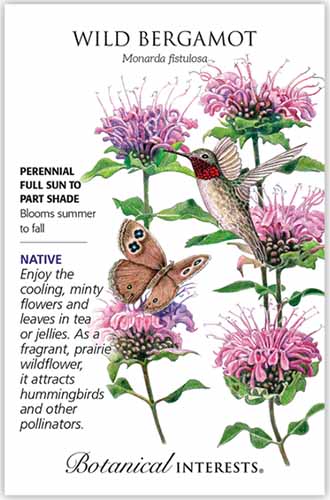
Wild bergamot seeds are available in 100-milligram packets from Botanical Interests.
Check out our bee balm growing guide for more information.
15. Yarrow
A member of the aster family, common yarrow is widespread not only across North America, but throughout the northern hemisphere.
With delicate fern-like leaves and umbels of flowers that are usually white, Achillea millefolium blooms from spring in southern locations to fall in more northern areas.

Common yarrow reaches two to three feet in height with a spread of two to three feet.
Drought tolerant, it grows best in full sun and can thrive in dry to moderately moist conditions.
This plant does best in sandy loam soils and requires good drainage.
The striking umbel-shaped flower heads of this plant provide structural interest in a mixed bed planting. Common yarrow also looks striking in mass plantings.
Good garden companions include purple coneflower, gray goldenrod, butterflyweed, wild bergamot, and black-eyed Susan.
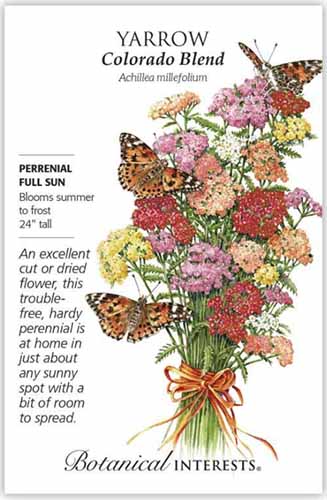
You can find packets of Colorado blend seeds, a selection with pink, red, yellow, and white flowers, at Botanical Interests.
Find more tips on growing yarrow here.
Turn on the Wildflower Power
Now that you have a short list of gorgeous options to choose from, planting native wildflowers at home should be even easier.

And if you want some tips on how to bring these plants together, make sure to read our article about growing native wildflowers in the landscape.
Do you have any other favorite native wildflowers? Let us know in the comments section below, and feel free to show off your own native plantings with a photo or two!
Want to learn about a few more wildflowers that are native to North America? Check out these guides next: