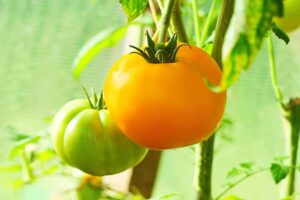
Are you wondering which herbs, flowers, or vegetables make the best garden buddies for your tomatoes?
Growing different companion plants with your tomatoes can help supply nutrients, protect from pests, or attract pollinators.
Companion planting is the growing beneficial pairings of plants together in a polyculture style garden.

We link to vendors to help you find relevant products. If you buy from one of our links, we may earn a commission.
Our guide to the scientifically-backed benefits of companion planting has more information.
In this article you’ll learn about 21 of the best tomato companion plants to help you grow the juiciest, most abundant crop yet!
And in case you need a refresher, our guide to growing tomatoes has full cultivation instructions.
Here’s a quick overview of your options:
21 of the Best Companion Plants for Tomatoes
1. Basil
A fragrant garden herb, basil (Ocimum basilicum) is known for its delicious flavor pairings with tomatoes.
But basil also makes a good tomato companion plant in the garden, too, thanks to its ability to ward off whiteflies, thrips, and hornworms.
And one study of tomatoes and basil growing together in a greenhouse concluded that this pairing increased the yield of both!
Not sure which type of basil to choose?
‘Genovese’ basil has large leaves, making it perfect for pesto and caprese salads.

You can purchase organic ‘Genovese’ basil seeds in a choice of packet sizes from High Mowing Organic Seeds.
Check out our guide to growing basil.
2. Beans
Beans (Phaseolus spp. and Vigna spp.) are excellent tomato companion plants.
With the help of beneficial microbes, these annuals help fix nitrogen in the soil – that means they don’t just take nutrients from the soil, they also give back!
And you don’t have to stick to pole beans when looking for tomato companion plants – cool-season fava beans and warm-season cowpeas also make good garden buddies!
A type of black-eyed pea, ‘California Blackeye #5’ is a bush variety that will hold up to high heat, and both humidity and dry conditions.

‘California Blackeye #5’ Cowpea Seeds
You’ll find packs of 200 ‘California Blackeye #5’ available at Burpee.
Learn more about growing beans here.
3. Beets
Grow cool season root crops like beets (Beta vulgaris) to take advantage of the belowground real estate in your vegetable garden – while warm season tomatoes start to grow by their side!
As beets mature, you can harvest them, making more room for your ‘Cherokee Purple’ or ‘Mortgage Lifter’ tomato crop to become established!
‘Shiraz’ is an heirloom beet variety with excellent disease resistance.

Pick up packets of ‘Shiraz’ beet seeds in a wide range of sizes from High Mowing Organic Seeds.
Find our guide to growing beets here.
4. Borage
Borage (Borago officinalis) is a fuzzy-leafed annual with star-shaped blue flowers, that makes an excellent tomato companion plant in the vegetable garden.
A favorite with pollinators and beneficial insects, by growing these flowers alongside your edible crops, borage will help to keep insect pests in check.

Organic borage seeds are available in a variety of packet sizes from True Leaf Market.
Learn more about borage in our growing guide.
5. Calendula
Calendula may be ideal for making tea and skin-soothing oil, but that’s not all – you can also use it as a garden companion for tomatoes!
Also known as pot marigold, calendula (Calendula officinalis) attracts a wide array of insects, including the mirid bug, which is a predatory insect that targets whiteflies.
Our article about calendula and pests has more information about its uses as a companion plant.
With a high resin content, ‘Resina’ is a mostly yellow-blooming calendula, though expect a few orange flowers as well.

Find ‘Resina’ calendula seeds in a large variety of packet sizes from High Mowing Organic Seeds.
Our guide to growing calendula has more information about this herb.
6. Carrots
Like beets, carrots (Daucus carota) make good companion plants by sharing garden space – they conveniently produce roots belowground while tomatoes work their way skyward on trellises.
But that’s not the only benefit – inevitably a random carrot plant will bolt, producing flowers instead of developing succulent roots.
When it happens, treat it as a lucky accident – carrot flowers are like a banquet for pollinators, including beneficial wasps!
If you’re growing in containers or square foot garden raised beds, pick a carrot variety that doesn’t produce super long roots, such as ‘Danvers.’

Grab packets of ‘Danvers’ carrot seeds in a variety of sizes from Burpee.
And read our guide to growing carrots to learn more.
7. Cilantro
Love it or hate it, cilantro (Coriandrum sativum) isn’t just a cool season herb that is perfect for garnishing beans and rice.
Right about the time your tomato transplants are getting comfortable in the garden, cilantro will bolt, producing flower heads that attract multitudes of beneficial insects.
‘Leisure’ is a cilantro variety that is slow to bolt, giving you more delicious foliage before plants turn into pollinator magnets!

‘Leisure’ Cilantro seeds are available in a variety of packet sizes from High Mowing Organic Seeds.
Our guide to growing cilantro has more information.
8. Cosmos
Cosmos (Cosmos spp.) is an annual flower that is as beautiful as it is useful.
The flowers attract bees to the garden and bees will help produce a bumper crop by pollinating your tomato plants!
When choosing from the many different types of cosmos flowers, try to pick those that have simple rather than double flowers, to make them as helpful and attractive to pollinators as possible.
One of my favorite types of cosmos for attracting pollinators is Sensation Blend, which comes in a mix of white, pink, lavender, and magenta blooms.

Nab packets of organic Sensation Blend seeds in a variety of sizes from High Mowing Organic Seeds.
Learn more about growing cosmos here.
9. Garlic
Tomatoes and garlic are another perfect pairing in a pan – and also in the garden!
With its pungent aroma, garlic (Allium sativum) helps ward off several pests, including flea beetles.
‘Silver Rose’ is a softneck garlic variety with a mild flavor and a beautiful silvery pink skin.

Pick up half pound packs of ‘Silver Rose’ garlic bulbs from Burpee.
Learn how to grow garlic here.
10. Garlic Chives
In general, herbs make excellent plant partners, offering the benefit of pest defense thanks to the fragrant compounds in their foliage.
So it’s not surprising that research indicates better yields for tomato crops when they are interplanted with alliums such as chives (Allium schoenoprasum).
In particular, there is an abundance of data on using garlic chives (A. tuberosum) to ward off pests – no doubt because of the pungent volatile organic compounds the plants produce!

You can purchase organic garlic chive seeds in a variety of pack sizes from True Leaf Market.
Learn more about garlic chives here.
11. Hairy Vetch
Hairy vetch (Vicia villosa) is a cover crop that provides multiple benefits as a companion plant for tomatoes.
This legume fixes nitrogen in the soil, it can be used as a green mulch when grown underneath other plants, and it also helps protect crops from diseases!
With so many benefits, hairy vetch is simply one of the best cover crops to grow in your vegetable garden.

You can purchase organic hairy vetch seeds in a selection of pack sizes from True Leaf Market.
12. Marigolds
You may have heard that marigolds (Tagetes spp.) make excellent companion plants in the garden – and truly they are!
Marigolds repel root knot-nematodes, pests that will attack pretty much all other garden plants, including tomatoes.
Our guide to the benefits of growing marigolds with tomatoes goes into more detail.
Looking for a type of marigold that will help with pest control in the garden?
Why not try the lovely French marigold (T. patula) cultivar ‘Red Metamorph?’ It has dark red petals and gold centers.

‘Red Metamorph’ Marigold Seeds
You’ll find ‘Red Metamorph’ marigolds in packs of 36 seeds available at Botanical Interests.
Read our guide to growing marigolds here.
13. Okra
If you enjoy cooking with okra, you’ll be thrilled to know that this crop makes a great plant pal for your tomatoes.
Interplanting okra (Abelmoschus esculentus) and tomatoes purportedly increases the overall yield of the garden plot.
There are many fabulous types of okra and my favorite is ‘Burgundy,’ with its deep purple pods.

You can find ‘Burgundy’ okra seeds available in a variety of packet sizes from High Mowing Organic Seeds.
14. Onions
Onion plants (Allium cepa) have a pungent odor that can confuse and deter pests, which is one reason why they are ideal for growing with tomatoes.
These alliums can also protect your crops from diseases such as Verticillium wilt by lending immune-boosting sulfur compounds.
‘Evergreen Long White’ is a cold hardy heirloom bunching onion variety.

‘Evergreen Long White’ Bunching Onions
You can find ‘Evergreen Long White’ bunching onion seeds in a choice of packet sizes from Burpee.
Check out our guide to growing onions here.
15. Oregano
Are you a fan of Mediterranean herbs? Well, so are tomatoes, especially when it comes to oregano (Origanum vulgare)!
Oregano contains volatile oils that repel pests such as whiteflies.
Since this herb can be grown as a perennial, you may want to cultivate it in a container and place the pot near your tomato plants.
There are many different types of oregano, but Greek oregano is certainly my favorite!

Find Greek oregano seeds in a variety of packet sizes from High Mowing Organic Seeds.
Read our guide to growing oregano next.
16. Parsley
If you love the idea of using herbs as companion plants, here’s another one for your list: parsley (Petroselinum crispum).
Parsley attracts beneficial insects like ladybugs, spiders, and hoverflies, all of which predate on pests that trouble plants in the nightshade family like tomatoes.
To provide the beneficial insects with forage, you’ll need to allow this biennial plant to bloom.
Italian flat leaf parsley is easier to clean than the curly kind, making it a breeze to transform into pesto or tabouleh.

Italian Flat Leaf Parsley Seeds
Organic Italian flat leaf parsley seed is available in an array of packet sizes from High Mowing Organic Seeds.
Learn more about growing parsley here.
17. Peas
Like beans, peas (Pisum sativum) are nitrogen fixers, and as a result of this, one study showed that growing peas with tomatoes increased tomato yield by 20 percent!
And since peas are cool season crops, right about the time you’re harvesting the delicious pods, it’ll be time to transplant your tomato starts.
Not everyone loves the distinctive taste of garden peas, so if you’re looking for something a bit milder, consider snow peas, which are just as easy to grow.
‘Oregon Sugar Pod II’ snow peas grow on short vines and are disease resistant.

‘Oregon Sugar Pod II’ Snow Pea Seeds
Purchase ‘Oregon Sugar Pod II’ snow pea seeds from Botanical Interests.
Learn more about growing peas here.
18. Rue
Rue (Ruta graveolens), a member of the citrus family, is a short-lived perennial herb you can add to your raised beds, rows, or container herb garden.
When interplanted with rue as part of an integrated pest management strategy, tomato harvest increased compared to the same crop grown in a monoculture.

You can find rue seeds in a choice of packet sizes from True Leaf Market.
19. Sweet Alyssum
Sweet alyssum (Lobularia maritima) is an annual that grows as a ground cover that can act as a living mulch under tall veggie plants like tomatoes or peppers.
Sweet alyssum also attracts beneficial insects such as wasps that can help protect your plants from herbivorous insects.
This companion plant blooms in shades of white, or purple – or pink, like the pretty cultivar, ‘Rosie O’Day.’

‘Rosie O’Day’ Sweet Alyssum Seeds
You can find ‘Rosie O’Day’ sweet alyssum seeds available from Botanical Interests.
Read our guide to growing sweet alyssum for more information.
20. Thyme
Like sweet alyssum, thyme (Thymus spp.) can act as a living mulch and it also produces pest-repelling volatile organic compounds.
In one study, it was concluded that thyme helped with root development, flowering, and fruiting of tomato plants.

Pick up packs of organic common thyme seeds in an assortment of sizes from High Mowing Organic Seeds.
Check out our guide to growing thyme to learn more.
21. Zinnias
Along with cosmos, annual zinnia flowers (Zinnia spp.) always take a top spot in my vegetable garden – but I don’t just grow them for their good looks!
Zinnias increase the presence of predatory insects and spiders in the garden – which means they’ll help control populations of garden pests that affect tomatoes!
For best results helping out beneficial insects, choose a type of zinnia that has single rather than double blooms as these are better suppliers of nectar and pollen.
County Fair Blend is a mixture of single-flowered blooms in pink, orange, red, purple, and gold.

County Fair Blend Zinnia Seeds
You can find County Fair Blend zinnia seeds available in a variety of packet sizes from High Mowing Organic Seeds.
Our guide to growing zinnias has more information.
Plants to Avoid
In addition to these 21 beneficial companion plants, you’ll also want to know which types of garden plants to avoid growing next to your tomatoes.
1. Corn
Corn is known to be a heavy feeder, which means it will compete with your tomatoes for soil nutrients, and in addition, they are prone to the same pests, such as the corn earworm.
To lower the risk of spreading these pests throughout your veggie patch, don’t plant corn and tomatoes side by side.
2. Eggplant
Eggplant may taste delicious when paired with tomatoes, but you may want to avoid planting them side by side.
Since they are both from the nightshade family, the plants are attacked by the same pests and diseases.
One strategy for controlling pests organically is to make it harder for them to access your crops.
When you grow members of the same plant family together, pests can simply hop from one to the other!
3. Potatoes
Also from the same plant family the humble potato is closely related to the tomato.
Hornworms will chow down on potatoes with as much relish as they will devour your other nightshade plants.
The two crops are also targets of some of the same diseases, like blight.
Take Your Pick of Plant Pals
You now have plenty of options for companion plants to grow with your tomatoes. But there’s no reason to be picky!
Choose more than one of these to increase the benefits: making good use of the soil nutrients in your garden, attracting pest predators, preventing pest and disease spread, and providing forage for helpful pollinators.
Do you have any other favorite plant partners for tomatoes – or any pairings you’re wondering about? Share your thoughts and questions in the comments section below!
Want to dig even deeper into the art of growing perfect tomatoes? We have more reading for you right here: