
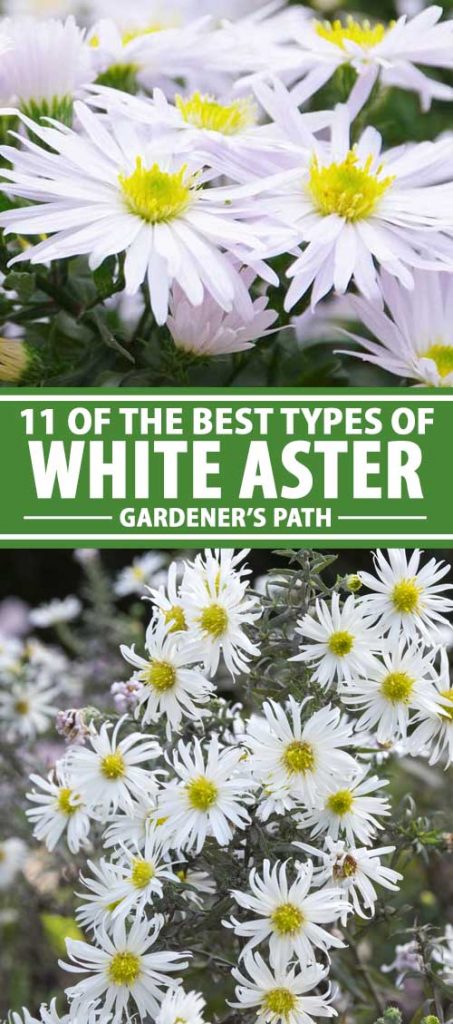


The aster is a flowering plant in the large Asteraceae family that includes the chrysanthemum, dahlia, and daisy.
Its flower heads consist of radiating rays around a dense central disk of tiny florets.
You may be familiar with the blue, pink, and purple shades commonly found in late summer to fall gardens.
But, did you know that these flowers are also available in white?

We link to vendors to help you find relevant products. If you buy from one of our links, we may earn a commission.
Read on for 11 white aster varieties that are sure to add interest to beds, borders, large containers, meadows, rockeries, and woodlands.
Here’s the lineup:
11 of the Best White Aster Varieties
1. Alba Stokes’
‘Alba’ is a white cultivar of the Stokes’ aster, Stokesia laevis, a US native perennial that thrives in Zones 5 to 9.
It prefers full sun, and tolerates a variety of soil types. Good drainage is essential, and in colder regions, winter mulching is recommended.

Erect plants have stems with two-and-a-half-inch individual flowers that feature profoundly divided rays. They resemble those of the bachelor’s button, Centaurea cyanus.
Mature heights range from one to one and a half feet tall, making this variety an ideal choice for small-space gardening.
Blooming begins in spring, and continues through summer – with diligent deadheading to prevent plants from going to seed.
In warm regions the leaves are evergreen. This is a drought- and rabbit-resistant plant.
Find tips on growing Stokes’ asters here.
2. Arrow-Leaved
The arrow-leaved species, Symphyotrichum sagittifolium, is a native perennial that thrives in Zones 3 to 9.
It prefers a full sun to part shade location, and dry to average soil that drains well.

Tall stems of one to four feet bear dense, cone-shaped clusters of tiny, multi-rayed blossoms that measure half an inch across.
The rays are generally white, but may be light blue. The centers are light yellow and redden with age.
This type is easily distinguished from others by its heart-shaped basal leaves. Grow it in woodland settings where it has room to spread freely. Bloom time is from late summer into fall.
Note: There is also a species called arrowleaf aster, Symphyotrichum urophyllum. It has the same stature and bloom time. The two are often referred to interchangeably.
3. Color Carpet White
The china aster, Callistephus chinensis, is a non-native annual suitable for Zones 2 to 11.
It prefers a full sun to part shade location and moist, fertile, well-draining soil.

There are numerous cultivars of this species available.
Dwarf ‘Color Carpet White’ is noted for its petite, eight- to 10-inch height. The flower heads are three inches across and resemble those of a chrysanthemum.
This type is an excellent choice for beds, borders, containers, rock gardens, and window boxes – where you want a temporary attraction that doesn’t return the following year.
Bloom time is from late summer to fall.
4. Flat-Topped
The flat-topped white aster, Doellingeria umbellata, aka ‘Parasol Whitetop,’ or tall white, is a US native perennial suited to Zones 3 to 8.
This species thrives in a full sun to part shade location and moist, well-draining soil.

This plant has a bushy, mounding habit and matures to a height ranging from two to five feet tall.
Sparse-rayed flowers are half an inch wide with yellow centers, and are arranged in flattened, loose clusters.
This type is ideal for areas with moist, sandy soil, where there’s room to roam. Bloom time is midsummer to fall.
5. Frost
The frost variety, Symphyotrichum pilosum, aka hairy aster, is a US native perennial suitable for gardens in Zones 4 to 8.
It requires full sun to part shade and soil that is moist and well-draining. Some over-saturation is tolerated.

This plant has a bushy growth habit and a mature height of four to five feet. Its stems and leaves are hairy.
Slender-rayed blossoms measure three quarters of an inch wide and sport prominent yellow center disks.
This wildflower naturalizes readily, to the point that it is sometimes considered a weed.
However, massed in a meadow, it creates a bright, cheerful vista. Bloom time is from late summer into fall.
6. Lady in Black Calico
The calico aster, Symphyotrichum lateriflorum, aka side-flowering or white-woodland aster, is a perennial US native that does well in Zones 3 to 8.
It prefers a full sun to part shade location and dry to moist, well-draining soil. This one tolerates some over-saturation.
‘Lady in Black’ is an especially attractive mounding cultivar that tops out at three to four feet tall.
Clusters of half-inch blossoms consist of sparse rays with striking red or purple centers, and grow along only one side of each stem. The foliage matures to deep purple.
This drought-tolerant choice blooms from early summer to mid-fall. It readily naturalizes in moist, woodland settings.
You can find seeds now on Amazon.
7. Snow Flurry Heath
‘Snow Flurry’ is a cultivar of the white heath species, Symphyotrichum ericoides, a US native perennial ground-covering plant suitable for Zones 3 to 9.
Heights range from four to six inches at maturity. This variety thrives in a full sun location with well-draining soil, and has low water needs, making it suitable for xeriscaping.

Tiny half-inch flowers have slender rays with yellow centers that envelop the dense, creeping foliage.
Look no further for a rock garden star with a bloom time from late summer well into fall. This type resists mildew, and tolerates drought and poor-quality soil.
A cultivar to look for is ‘Bridal Veil,’ which grows up to two feet tall at maturity, and exhibits greater density and an attractive arching growth habit.
You can find seeds available on Amazon.
8. Snowbank
The false aster cultivar ‘Snowbank,’ Boltonia asteroides var. latisquama ‘Snowbank,’ aka false chamomile, is a US native perennial for growers in Zones 4 to 9.
It thrives in a full sun location, with medium to moist, well-draining soil. It tolerates dense clay, salt, and some over-saturation.
Unlike the true species that tops out at a leggy five to six feet, ‘Snowbank’ grows to a more compact stature of three to four feet tall at maturity.
Mounding, airy panicles are laden with three-quarter-inch daisy-like flowers consisting of yellow centers and white rays that are sometimes tinged with pink.
Mass plant in drifts, or use as dense hedging. Bloom time is late summer to fall.
You can find packets of 500 seeds from Pase Seeds via Amazon.
9. White Panicled
The white panicled type, Symphyotrichum lanceolatum, is a US native perennial suitable for Zones 3 to 9, and thrives in full to part sun and moist, well-draining soil.

Clusters of mini-blossoms consist of daisy-like rays with prominent yellow disks that redden with age.
Each measures half to three-quarters of an inch across. Heights vary widely from one to five feet tall at maturity.
This species is remarkable for how it clings to its brown and withered leaves as they curl with age.
After other species drop their foliage, panicled types continue to add texture and interest to the garden.
This is a vigorous grower whose erect stems have a tendency to flop sideways and may require staking.
It blooms from late summer well into fall. Plant in a location where it can spread unchecked for a mass of color that creates privacy and a habitat for local wildlife.
10. White Swan New York
‘White Swan’ is a New York aster cultivar, Symphyotrichum novi-belgii, aka Michaelmas daisy.
The species is a US native perennial that prefers full sun, and average to moist, well-draining soil of any type. It does best in Zones 4 to 8.

Daisy-like rays with bold yellow centers measure one and a half inches across.
Flowers grow in dense profusion over clumps of foliage that top out at one to three feet tall. Bloom time is from late summer into fall.
Take care to provide adequate air circulation between plants to avoid powdery mildew. Similar cultivars include ‘Boningale White’ and ‘White Ladies.’
11. White Wood
The white wood aster, Eurybia divaricata, is a US native perennial suitable for gardeners in Zones 3 to 8.
It grows best in a part to full shade location with soil of average quality, dry to moist conditions, and good drainage.

This type has a low profile, growing to a mature height of only one to two and a half feet. Flowers have star-like rays with yellow centers that redden with age.
They are about one inch in diameter, and cluster together for a flattened blanket of blossoms.
This plant spreads with a mounding habit, and works well beneath airy tall trees and shrubs that afford ample air circulation. It’s tolerant of drought and dry soil.
Bloom time is from late summer to fall.
An Entr’acte of White
With 11 types to choose from, you’re ready to put asters on your gardening to-do list.
Perennial species are vigorous growers that spread via extensive root systems and self-sowing, so investing in seeds is an economical way to line a woodland walkway or fill a meadow.

And native varieties are especially energetic, so plan to give them lots of room to roam.
Prepare to be amazed by the wonderful assortment of beneficial insects and backyard birds these plants attract.
Masses of snowy-white flowers act as a “palette” -cleansing interlude between summer’s waning hues and the vibrant autumn colors to come.
Are you growing white asters? Let us know in the comments section below!
If you found this article informative, you may enjoy reading some of our other aster guides next:


What is the best wat to tell the difference between an Aster and a False Aster?
Hello Thomas –
The aster generally has hairy stems and leaves, as well as tufted seeds that disperse readily. The false aster has smooth stems and leaves, and a somewhat scaly seed that does not lift on the breeze.