

Not just another pretty face in a lush and lazy garden, yarrow (Achillea) earns its keep in the worst soils with the least amount of water.
If you’ve got barren areas crying out for color, it’s yarrow to the rescue!
This hardy flowering perennial thrives in USDA Hardiness Zones 3 to 9. Some gardeners even have success as far north as Zone 2, and as far south as Zone 10.

We link to vendors to help you find relevant products. If you buy from one of our links, we may earn a commission.
Our guide to growing yarrow has all you need to cultivate Achillea species at home.
In this article, I’m going to introduce you to my 13 favorite yarrow varieties you are sure to love.
Here’s the lineup:
13 of the Best Yarrow Varieties to Grow at Home
Achillea is virtually pest and disease free. It prefers a dry environment with full sun, and average to poor soil that drains well.
If you cultivate it in fertile soil, be prepared for it to develop “leggy” stems that may require staking, and pruning in spring to restore a more compact appearance.
Sow seeds or flowering mature plants directly into gardens or containers in early spring, after all danger of frost has passed. Expect blooms in the second year.

Alternatively, start seeds indoors or in a greenhouse in late winter to get ahead of the game and produce flowers in the first year.
Once established, yarrow is drought tolerant, and seems to share its high level of pest and disease resistance with neighboring plants. Rabbits and deer usually don’t bother with Achillea.
Our backyard yarrow cultivars and hybrids come to us courtesy of five main species: A. clypeolata, A. filipendulina, A. millefolium, A. ptarmica, and A. taygetea.
Though it’s not included among my top picks here, I would be remiss if I failed to mention a little more detail about A. ptarmica.
Several cultivars are available, including ‘The Pearl’ and ‘Angel’s Breath.’
Widespread in Europe, it has naturalized in scattered areas across the US. Flowers exhibit varying shades of white, and it is sometimes called “sneezeweed.”
But it is not to be confused with common sneezeweed (Helenium autumnale), which is poisonous to humans and animals.

Whether native, introduced and naturalized, heirloom cultivars, or hybrids, yarrow is a vigorous grower that spreads by an intricate system of rhizomes and may require dividing every few years.
Other than that, it’s a low-maintenance, water-wise powerhouse.
And now, here are 13 exciting varieties to love!
1. Apple Blossom
A. millefolium ‘Apple Blossom’ or ‘Apfelblute’ is one of numerous Galaxy hybrids from Germany, and is a cross between A. millefolium and A. taygetea.

It has purplish-pink flowers atop upright, green-leafed stems that reach 18 to 24 inches tall at maturity. Flower heads are two to three inches across.
2. Cerise Queen
This A. millefolium cultivar is known for its deep pink flowers, with dark green foliage and a mature height of twelve to 36 inches.
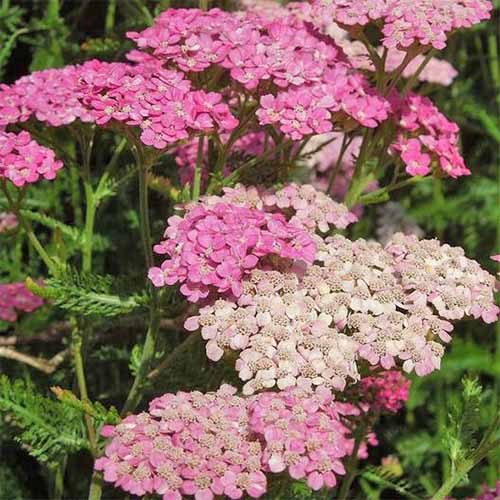
With a long vase life, you can brighten up the garden beds as well as rooms of your house with these pretty, colorful blooms.
‘Cerise Queen’ seeds are available from Eden Brothers in a variety of packet sizes.
3. Common
A. millefolium, aka common yarrow, milfoil, or soldier’s woundwort, is a white variety that may be somewhat invasive if allowed to roam.
In addition, native white-flowering varieties were already growing here, including mountain yarrow, A. millefolium lanulosa, and western yarrow, A. millefolium occidentalis.
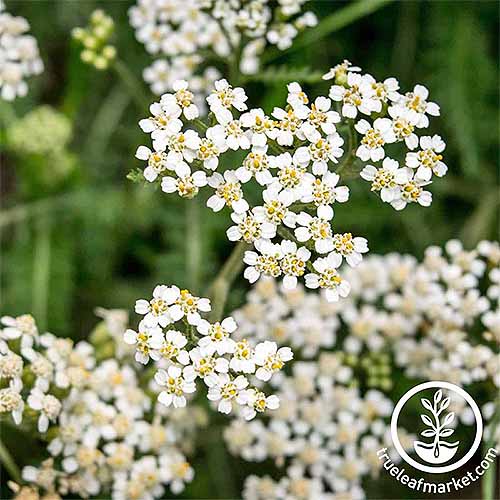
Today, the introduced and native varieties are almost indistinguishable in the wild.
White-flowering seeds are available from True Leaf Market in one- and four-ounce packages.
4. Gold
A. filipendulina ‘Gold’ is a fern-leaf cultivar that produces bright yellow saucer-like flower heads up to four inches across, atop upright stems of three to four feet tall.
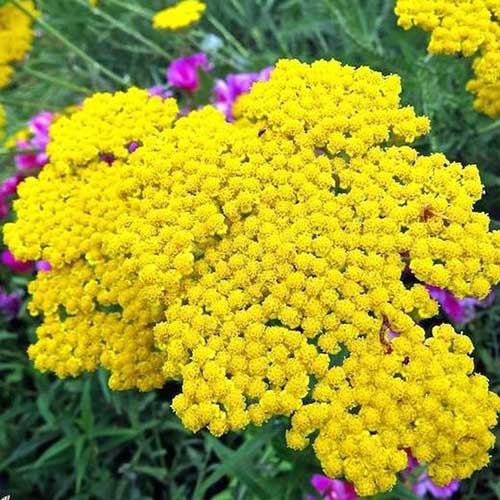
Its silvery green leaves grow like ferns from the base of this clumping variety.
You can find ‘Gold’ seeds in packets of various sizes available at Eden Brothers.
5. Gold Plate
A. filipendulina ‘Gold Plate’ is a fern-leaf cultivar. It boasts upright stems of four to five feet tall, and flower heads six inches across in mustard-yellow hues.
Its silvery green leaves arise from the base of this clumping variety.
Other gold-flowered hybrids and cultivars include ‘Parker’s Variety’ and ‘Coronation Gold.’
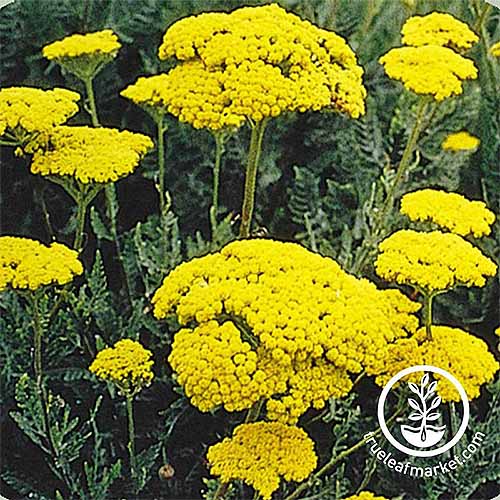
Some reach six feet in height, and all make a bold, structural statement in an outdoor living space.
Pair them beautifully with gold-centered shasta daisies.
‘Gold Plate’ seeds are available from True Leaf Market in quarter -, one-, and four-ounce packages.
Have you heard of xeriscaping?
It’s a style of gardening that focuses on planting species that thrive with little intervention and the fewest possible natural resources.
Yarrow is an environmentally responsible, water-wise garden choice.
6. King Edward
A. tomentosa ‘King Edward’ is a matting dwarf variety that’s perfect for rock gardens.
Its six-inch height also makes it a pretty ground cover for barren open spaces, and gives you the option of easily mowing it down at season’s end.
This variety has small, pale yellow flower heads, and woolly leaves of silvery green.
Another low-growing variety that you might enjoy is A. ageratifolia, which has white flowers, silvery-green foliage, and a maximum height of about nine inches.
7. Moonshine
A. millefolium ‘Moonshine’ sports beautiful bright yellow flowers with silvery-green foliage, and grows to a mature height of 18 to to 24 inches tall.

‘Little Moonshine’ is a recent variation of the original ‘Moonshine’ variety, a hybrid of A. clypeolata x A. taygetea.
It’s a compact, mounding plant that reaches nine to 12 inches in height, making it perfect for container gardening.
8. New Vintage Rose
A. millefolium ‘New Vintage Rose’ is a compact, mounding plant with medium-sized non-fading vibrant deep pink to red flower heads.

Leaves are green, and stems reach 12 to 15 inches in height at maturity.
The intense color of this type is best as a stand-alone specimen in gardens and containers. A striking violet ‘New Vintage’ cultivar is also available at some nurseries.
9. Paprika
A. millefolium ‘Paprika’ is a Galaxy series hybrid that has green leaves and dusty brick red flowers that measure a medium-sized two to three inches across.
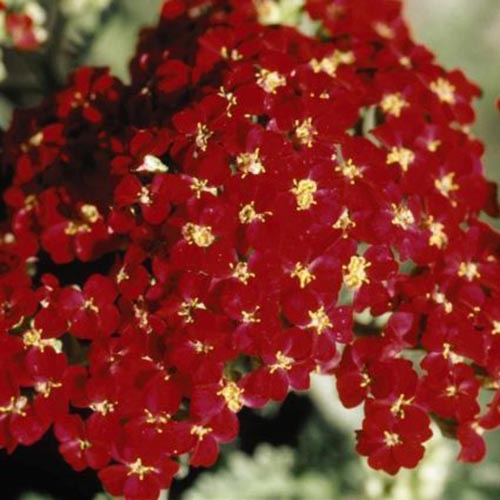
Blossoms fade to shades of pink, and perch atop upright stems that top out at at a mature height of 18 inches to two feet tall.
‘Paprika’ plants are available in #1 containers from Nature Hills Nursery.
10. Red
Red yarrow (A. millefolium rubra) is a vibrant, brightly colored variety with rusty red blooms that are excellent for attracting pollinators.
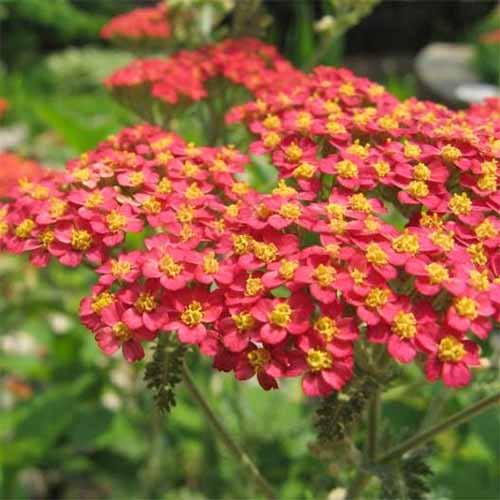
Reaching a mature height of twelve to 30 inches, it’s perfect for bouquets or to save as a dried flower.
A variety of package sizes – from 400 milligrams up through a whopping one-pound sack – are available from Eden Brothers.
11. Strawberry Seduction
From the Seduction series comes A. millefolium ‘Strawberry Seduction,’ with medium-sized flowers that resemble red, ripe strawberries, and fade to straw yellow in late summer.

Characteristic of this series, its green-leafed stems grow in compact mounds that reach 18 inches to two feet in height at maturity.
This cultivar tolerates heat and humidity exceptionally well. Plant en masse, or in a container on its own for a focal specimen.
Note: All Achillea cultivars are members of the Asteraceae family that includes daisies, sunflowers – and ragweed.
Some people may be allergic to it via pollen inhalation or skin contact. In addition, the ASPCA warns that yarrow is toxic to cats, dogs, and horses.
12. Summer Berries
A. millefolium Summer Berries is a mix of Galaxy hybrids that offers multi-colored medium-sized blossoms in an array of light hues, including pastel shades of mauve, orange-red, pink, purple, rose, and salmon.
These top green-leafed stems with a mature height of 18 inches to two feet tall.

A. millefolium Summer Berries Mix
This is a compact, mounding variety that does well as a filler in mixed patio containers. Known for its excellent tolerance of warmth and humidity, its colors may fade during heatwaves.
Seeds for the Summer Berries Mix are available from High Mowing Organic Seeds.
13. Sunny Seduction
A. millefolium ‘Sunny Seduction’ has green leaves and medium-sized muted yellow blossoms atop stems ranging from 18 to 30 inches tall at maturity.
It’s an excellent filler in containers, particularly those with blue specimen plants such as sage or gilia.
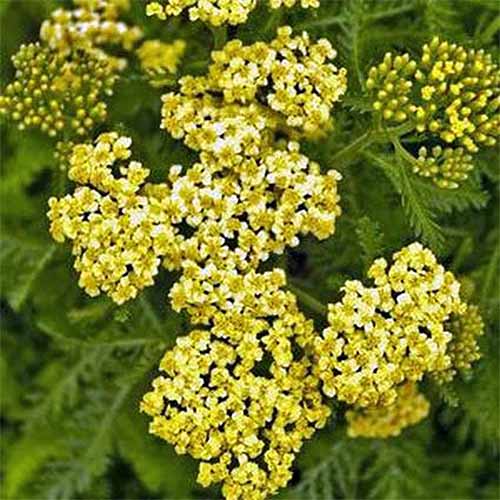
The Seduction series of plants offers sturdy, compact foliage and a long bloom season.
‘Sunny Seduction’ plants are available from Nature Hills Nursery in five-inch containers.
My Hero
Yarrow earns its keep where other plants fail to thrive. And it sure saved the day for me.
I had all but given up on a dry, gritty patch by the driveway that grew nothing but scraggly weeds. I had tried amending the soil and watering constantly, but the hot blacktop seemed to create a microclimate just short of desert.
Once I planted rugged Achillea varieties, I was able to create a focal point that said, “Welcome! A gardener really does live here!”

So, whether you’re already a fan, or have just discovered it today, you’re bound to enjoy good value and a pleasant view when you introduce one or more of our 13 varieties to your outdoor living space.
In addition to beautifying the outdoors, yarrow is an exceptional cutting flower.
You’ll know it’s time to harvest when the blossoms open and reveal the pollen within. They’ll last at least a week in fresh arrangements, provided you snip the stems and change vase water daily.
For everlasting displays, cut in the same fashion and hang stems upside-down to dry. Enjoy true color and that classic yarrow aroma for months to come.
Are you ready to turn barren spaces into beautiful focal points with sturdy foliage and vivid color, year after year? Share your stories about this flower favorite with us in the comments below.
And for more information about growing medicinal herbs like yarrow, check out these guides next:



Nan, I was all set to look for the ” Saucy Seduction” variety when I stumbled on your article but now I wonder about my choice since it didn’t make your list. Curious about whether you have any opinion about this one.
Hello Melanie –
“Saucy Seduction” is an excellent pink choice, particularly because it is slow to fade. I chose to represent the exceptional Seduction Series with ‘Strawberry Seduction’ because its unique coloration is so striking and really does resemble a strawberry.
I have a hot pink yarrow in a circle garden. It’s been there for a few years but unfortunately I didn’t pay attention to the name of the cultivar. It looks vivid and beautiful when it starts off in the spring but then quickly fades under the hot, full sun. Are there deep pink varieties that fade less quickly? Mine look pretty anemic for the bulk of the summer. Thanks, Joan
Hi Joan –
‘Saucy Seduction’ is a hot pink cultivar that is slower to fade than others.
I have a flower bed planted with what I think is moonshine yarrow. One was pulled out by another person so I replaced it with one from our local Home Depot. Although it has yellow blossoms, the leaves are totally different, not being feathery but firmer and broader. I like it. Do you know what variety it is? Chris L
Can you share a photo, Chris? We’d love to help you with identifying this plant!
Can yarrow survive in a large outdoor pot over the winter in zone 3?
It’s important to remember that roots in pots are not as well-insulated as those in the ground, and the usual rule of thumb is to subtract one Zone to calculate estimated exposure. Though yarrow will often do well through cold Zone 3 winters, in Zone 2 conditions it may be able to get by with extra protection, or you might want to move the pot if you can to an unheated but protected area like a garage for the winter.
Hello,
Which achillea has the biggest individual little flowers, but still in the original form?
i love to paint them.
Hi Cynthia –
With flower heads that measure six inches across, A. filipendulina ‘Gold Plate’ may offer the best opportunity to distinguish one little flower from another.