

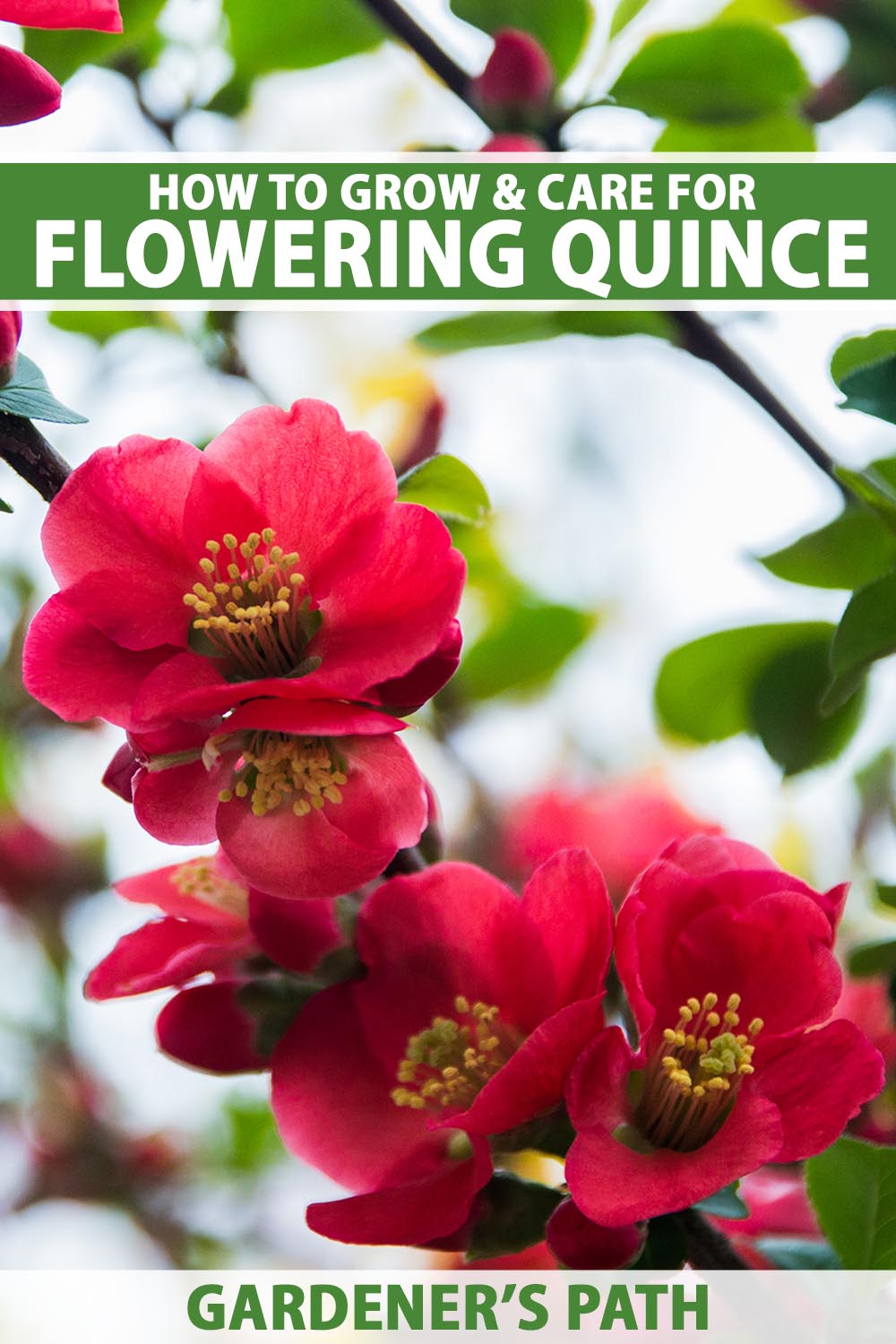
Chaenomeles spp.
Flowering quince is one of the garden’s most welcome arrivals, producing vivid blooms on bare branches in late winter to the start of spring, while much of the landscape is still dormant.
Suitable for cultivation in USDA Hardiness Zones 4 to 9, these attractive plants are one of spring’s earliest harbingers.
We link to vendors to help you find relevant products. If you buy from one of our links, we may earn a commission.
These woody, perennial shrubs aren’t the same as quince fruit trees. Both belong to the rose family, Rosaceae, but fruiting quince trees are the sole members of the Cydonia genus.
Flowering quince refers to species in the Chaenomeles genus.
Are you ready to grow one or more of these beauties in your own yard? Let’s get started!
Here’s what I’ll cover:
What You’ll Learn
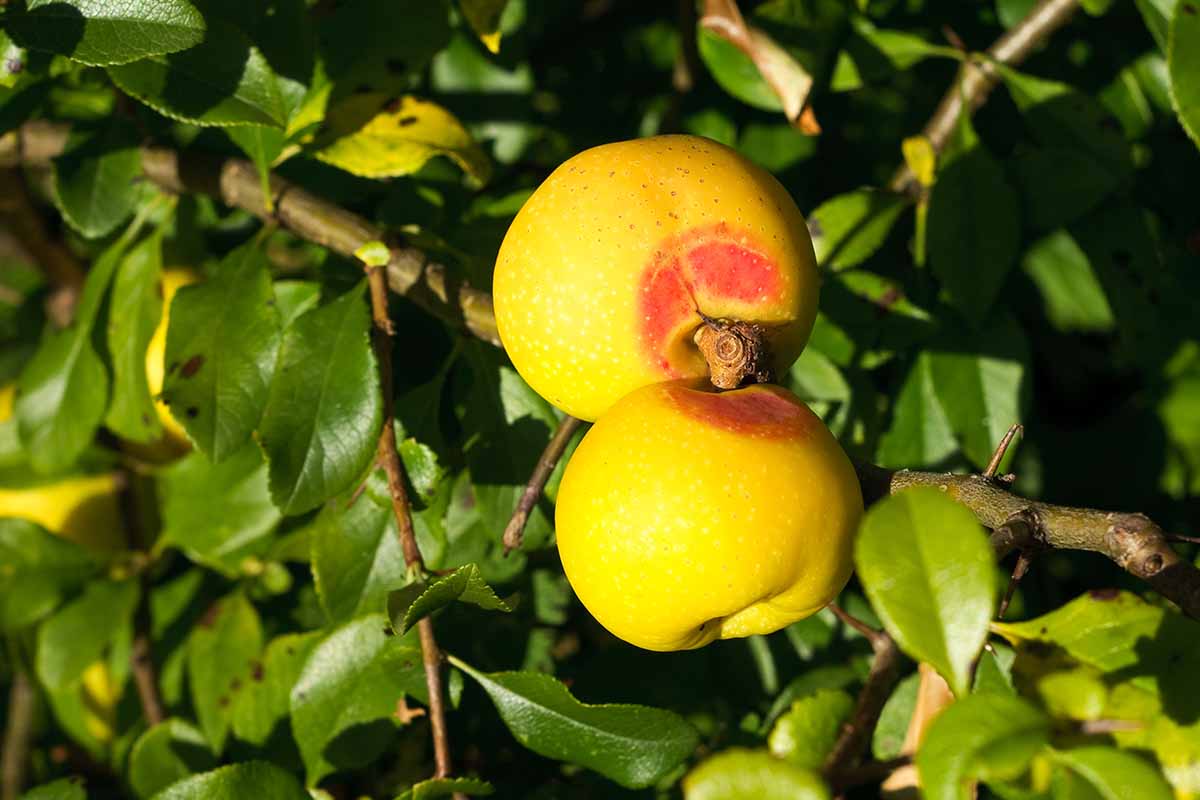
While it’s not the same plant as fruiting quince, some Chaenomeles varieties actually do produce edible fruits in the fall, which the birds in your backyard will appreciate.
The aromatic fruits resemble apples and are typically small and hard, with a bitter taste.
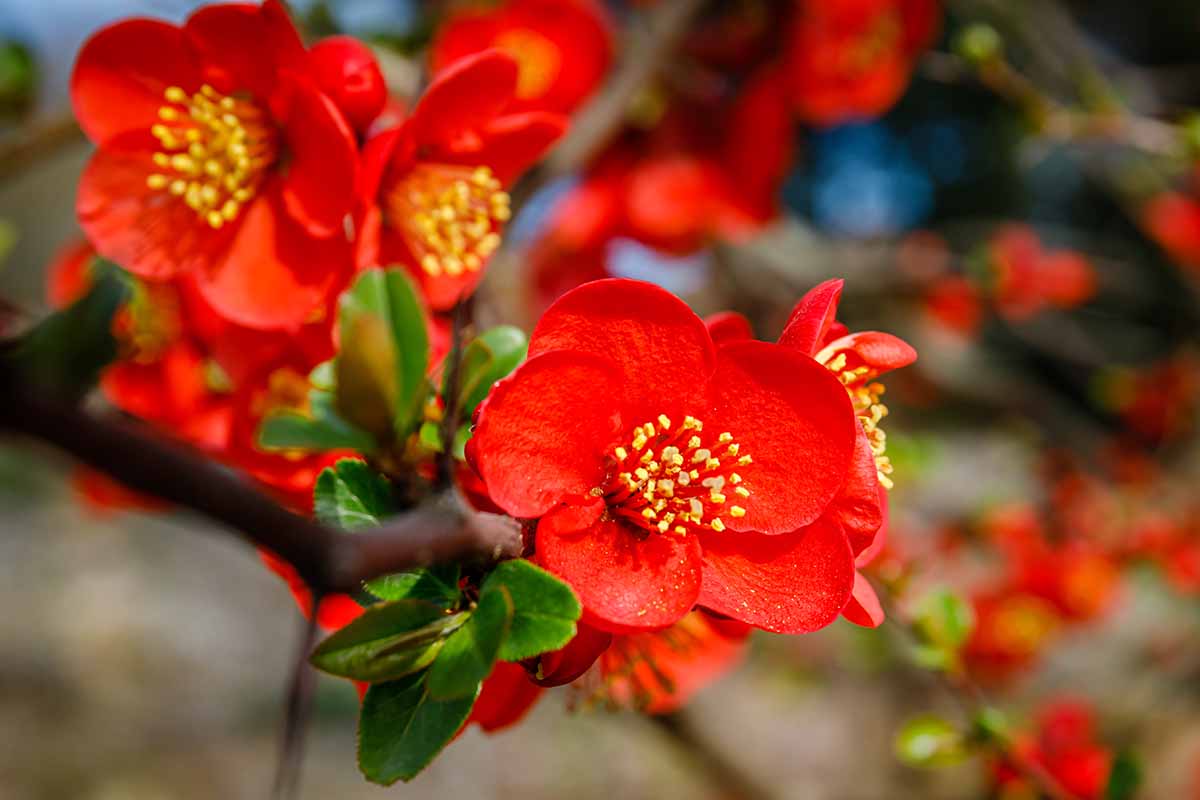
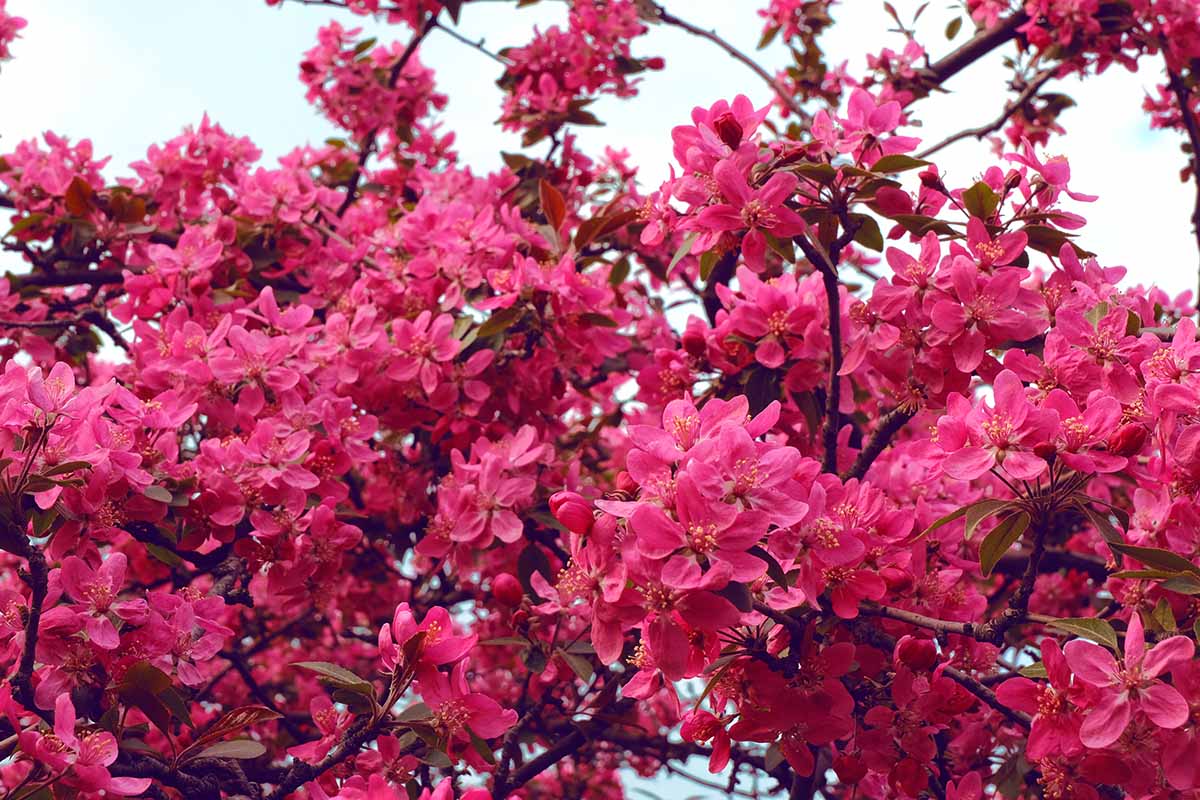
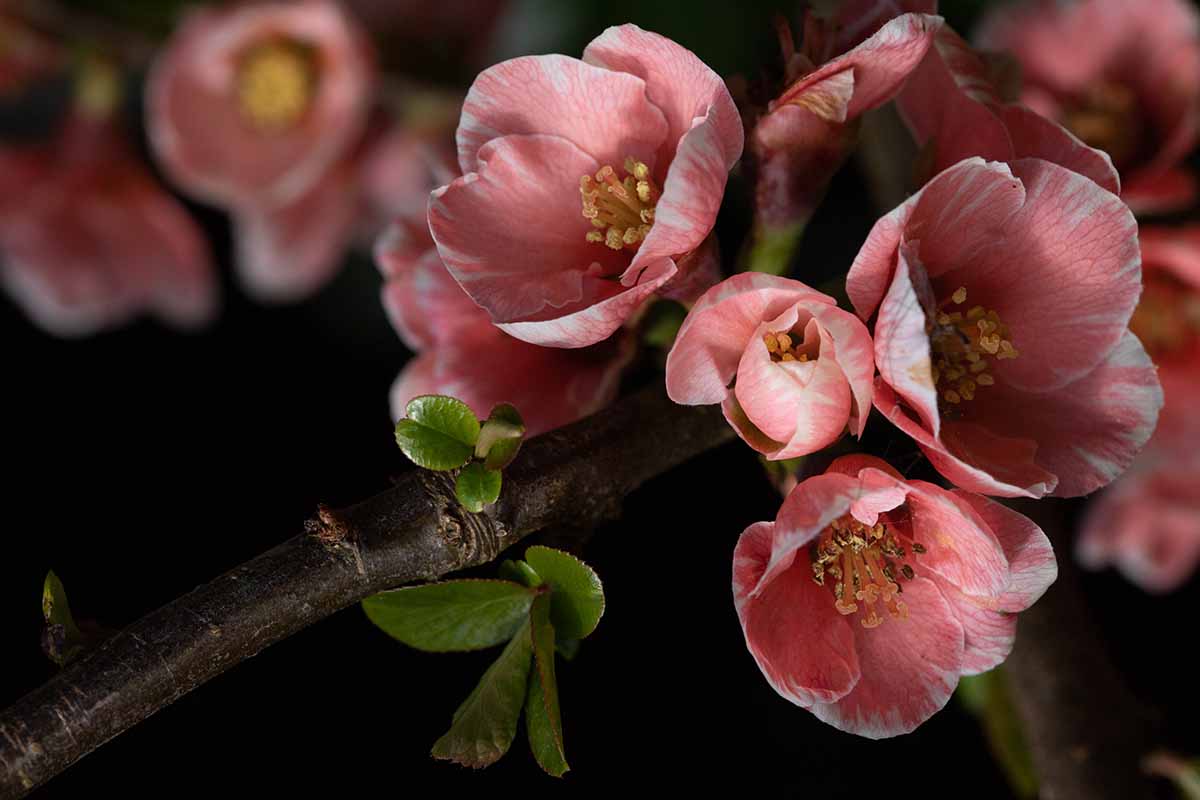
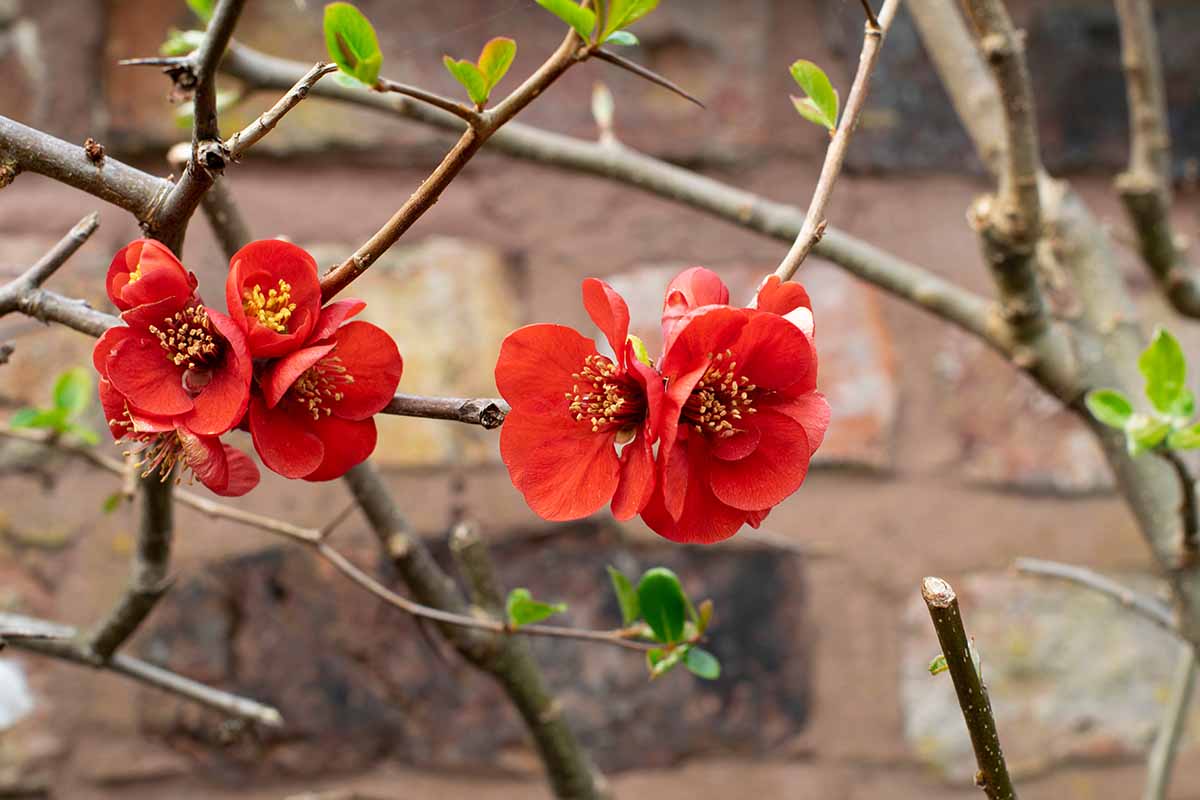
But the standout feature of these shrubs is the profusion of glorious flowers in various shades of pink, orange, and red, along with pure white.
Quick Look
Common name(s): Flowering quince
Plant type: Deciduous woody shrub
Hardiness (USDA Zone): 4-9
Native to: Eastern Asia
Bloom time: Late winter to early spring
Exposure: Full sun to part shade
Soil type: Loose, organically-rich, well-draining
Soil pH: 5.0-6.5, slightly acidic
Mature size: 2-10 ft wide x 2-10 ft high (depending on variety)
Best uses: Beds, borders, containers, hedges
Taxonomy
Order: Rosales
Family: Rosaceae
Genus: Chaenomeles
Species: Cathayensis, japonica, speciosa
The three flowering quince species are:
C. cathayensis, aka Chinese flowering quince, grows and spreads up to 10 feet and bears fruit that’s nearly six inches in diameter.
Native to China, Bhutan, and Burma, this species has light-pink and white flowers and is hardy in Zones 4 to 8.
C. cathayensis is less commonly available to home gardeners than C. speciosa and C. japonica.
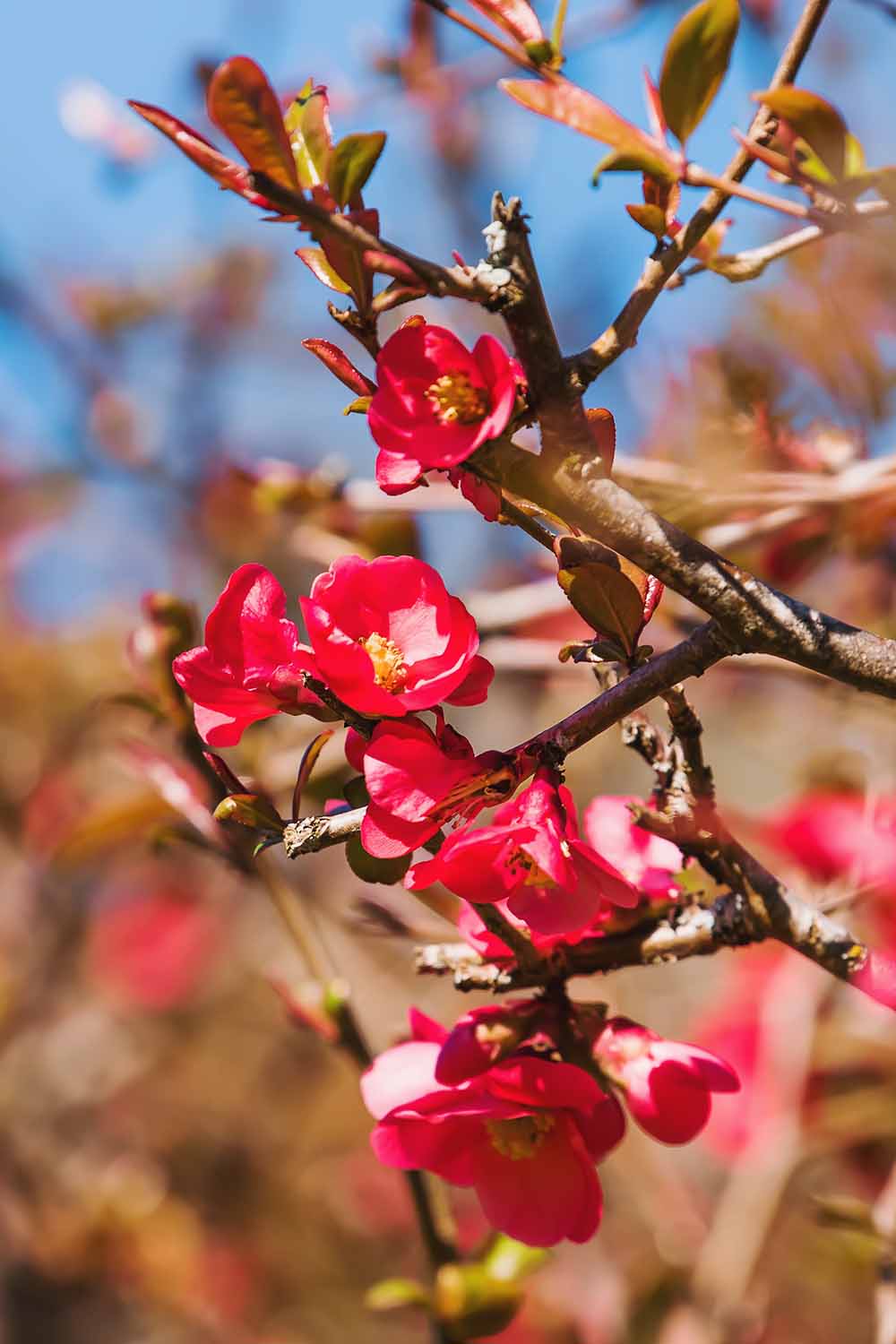
C. speciosa grows and spreads four to 10 feet high and wide, bears red, pink, orange, or white blossoms in early spring on branches that grow in an arching, vertical fashion.
C. japonica, or Japanese flowering quince, grows to just two to four feet in height and width and produces shades of red, salmon- and orange-hued blooms on outward-arching branches.
C. speciosa and C. japonica are both native to east Asia, including China, Japan, and North and South Korea, and have naturalized in much of the eastern half of the United States, as well as in Oregon.
After the first flowering in spring, some varieties rebloom in the fall, giving you an extra dose of color just before winter sets in.
The leaves are one and a half to three and a half inches long and one inch across, with blooms that grow to about one and a half inches in diameter, depending on the variety.
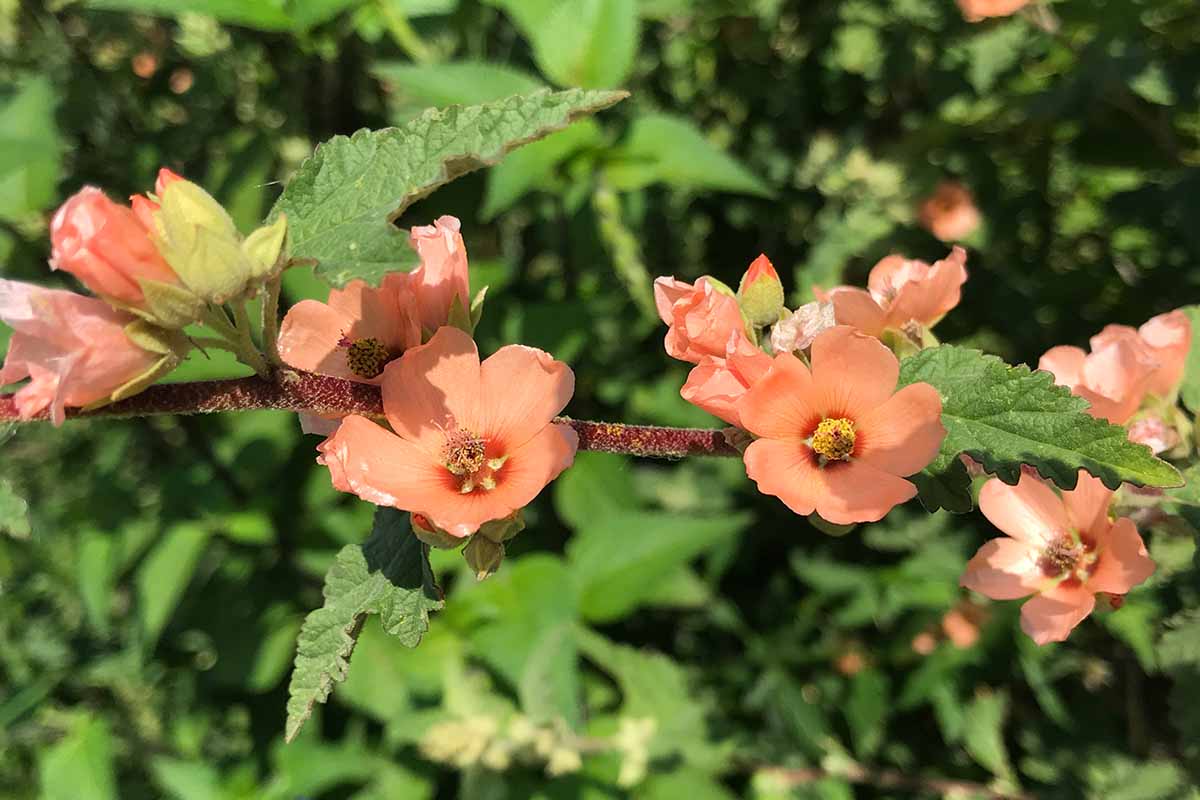
Flowering quince grows in a sprawling fashion, somewhat like boysenberries and other cane bushes.
Some varieties are so prone to tangle that if you don’t prune the branches every year the shrub can turn into an unsightly mess.
The branches are thorny, so you probably don’t want to line your walkways with this shrub.
But planting it under your windows or as a security hedge creates a spiky deterrent for potential intruders.
The many cultivars of Chaenomeles species are available in various sizes, colors, and petal configurations.
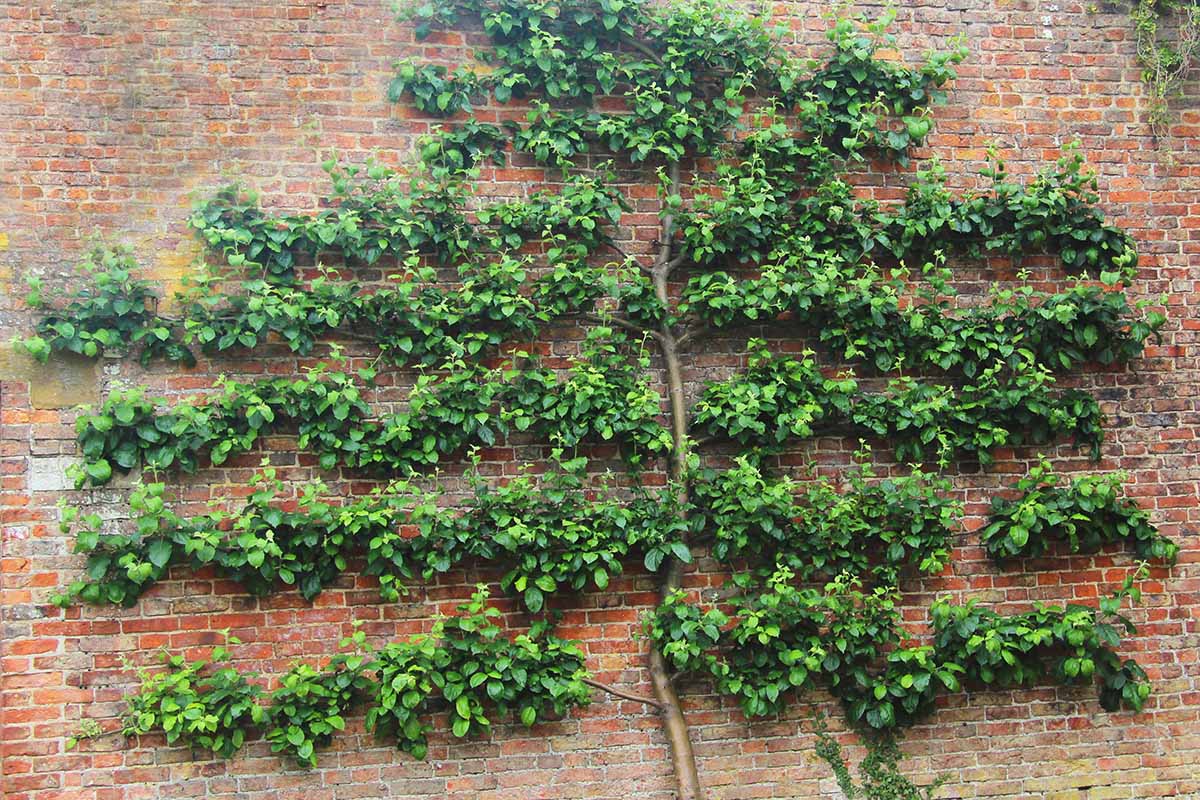
C. speciosa varieties make wonderful espaliers and some, like ‘Chojubai,’ are adorably attractive when trained as bonsai trees.
Some feature single-flowered blooms while others dazzle with gorgeous double-flowered blossoms.
If you grow a cultivar that bears fruit, you can either leave the fruits for the birds or try your hand at making quince jam.
How to Grow
Suitable for cultivation in Zones 4 to 9, flowering quince shrubs are easy to care for if you choose the right planting site.
Light
Select an area in your yard that receives full sun or part shade.
If you live in a windy location, choose a spot that’s a few feet away from a wall or fence to give the shrub a windbreak.
Strong winds can snap the branches, particularly those of young shrubs. And don’t forget to be mindful of the thorns when you choose your location.
Soil
Flowering quince requires well-draining soil that’s organically rich, with a slightly acidic pH of between 5.0 to 6.5.
You can conduct a soil test before planting if you wish, and amend accordingly.
Mature flowering quince can tolerate dense soil, but if your garden has a lot of clay, you’ll need to amend it with some well-rotted compost and topsoil to loosen it and improve drainage.
For a show of spring flowers, new shrubs are best planted in the winter, when they’re dormant.
To transplant, dig a hole twice as wide as the root ball and as deep as the nursery pot. Place the plant inside the hole and backfill with soil. Water thoroughly.
Water
For the first year, while your young plant is becoming established, you’ll need to water your shrub when the top half-inch of soil dries out.
After the first year, you’ll only need to water when the top inch of soil is dry.
Flowering quince is pretty drought tolerant when established, but you can spread a thin layer of mulch over the planting site to help retain moisture during dry spells.
Well-draining soil is important, because this shrub does not like wet feet.
Fertilizer
You only need to feed your flowering quince once a year, in late winter or very early spring just before flowers appear.
Use a balanced, 10-10-10 (NPK) fertilizer and apply according to package instructions.
Container Cultivation
Smaller varieties of flowering quince can be grown in containers.
You’ll need to choose a container that’s large enough to accommodate the mature dimensions of your plant – so be sure to read the nursery tag when purchasing!
Ensure that your chosen container has adequate drainage holes in the bottom, and fill with potting mix, amended with perlite or vermiculite to improve drainage.
As a rule of thumb, when transplanting into a container, select one that’s approximately eight to 10 inches wider than the current pot it’s growing in, to allow for root development.
You’ll need to be a bit more vigilant about watering, as soil in containers dries out quicker than it does in the garden – but beware of oversaturating your plant, as it can lead to root rot.
Cultivars to Select
While there are several cultivated varieties to choose from, here are three of our favorites for you to enjoy in your yard.
Chojubai
If you don’t have room for a thick hedge but want the appeal of ruby-red blooms, ‘Chojubai’ is the dwarf cultivar for you.
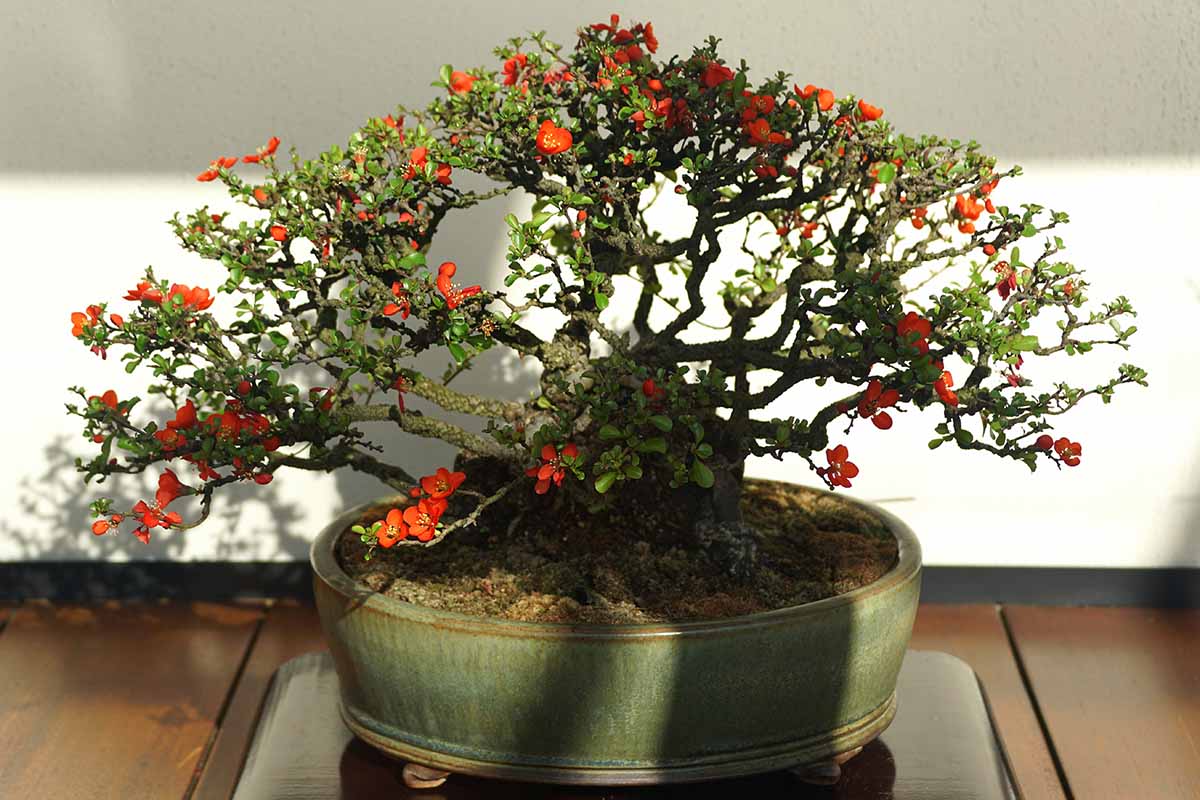
The non-fruit-producing flowers are just one inch across, and the leaves are just half an inch long, making for a perfectly to-scale miniature tree that grows to a mature height of about two feet tall.
This is a cultivar that’s hard to find, but it grows readily from cuttings and thrives in Zones 5-9.
You can grow it in a container and let this C. japonica cultivar brighten your patio or porch garden! This variety is also popular for growing as a bonsai tree, if that’s your thing.
Double Take Pink
For lush double-flowered, peachy-colored blooms, check out Double Take® Peach, (C. speciosa ‘NCCS4’).
This C. speciosa cultivar is hardy in Zones 5 to 9 and grows up to five feet tall and wide – and no higher.
If you hate pruning, you’re in luck: Double Take® Peach doesn’t need a yearly haircut nor does this cultivar produce fruit.
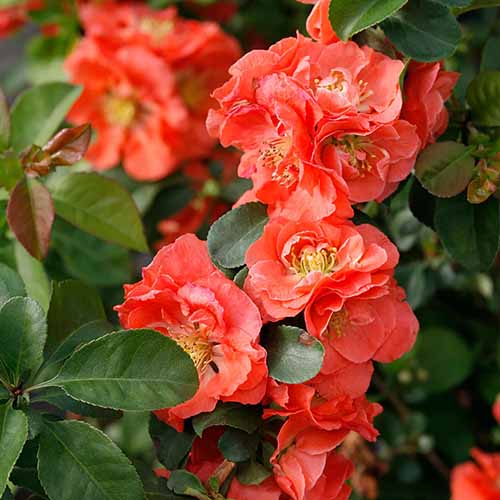
The flowers are purely for show, and after the initial spring bloom there’s often a rebloom in the fall.
You can find Double Take® Peach available from Fast Growing Trees.
Texas Scarlet
For an exuberant display of salmon-pink, single-flowered blossoms, look no further than ‘Texas Scarlet,’ a C. japonica cultivar that attracts birds and butterflies to your early-spring yard.
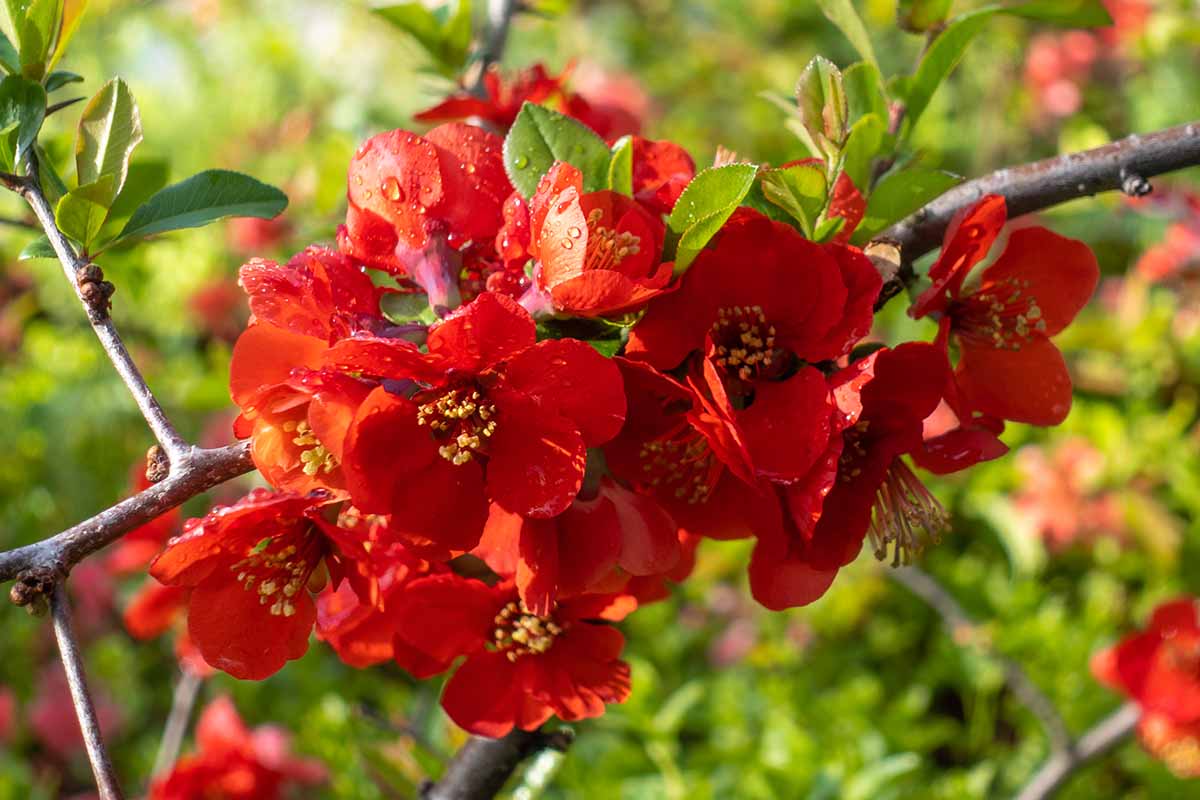
It produces small, astringent fruits that the birds simply adore.
This cultivar is hardy to Zones 5 to 9 and grows and spreads three to four feet tall and wide. Plant several shrubs three to five feet apart to create a prickly yet pretty hedge.
Maintenance
Once established, flowering quince shrubs are easy to maintain.
Larger varieties can grow up to 10 feet tall, and these will require yearly pruning to keep in check and prevent them from becoming a thorny, tangled mess.
In the case of some cultivated types and Japanese flowering quince, C. japonica, all you need to do is remove dead, broken, or diseased branches each fall.
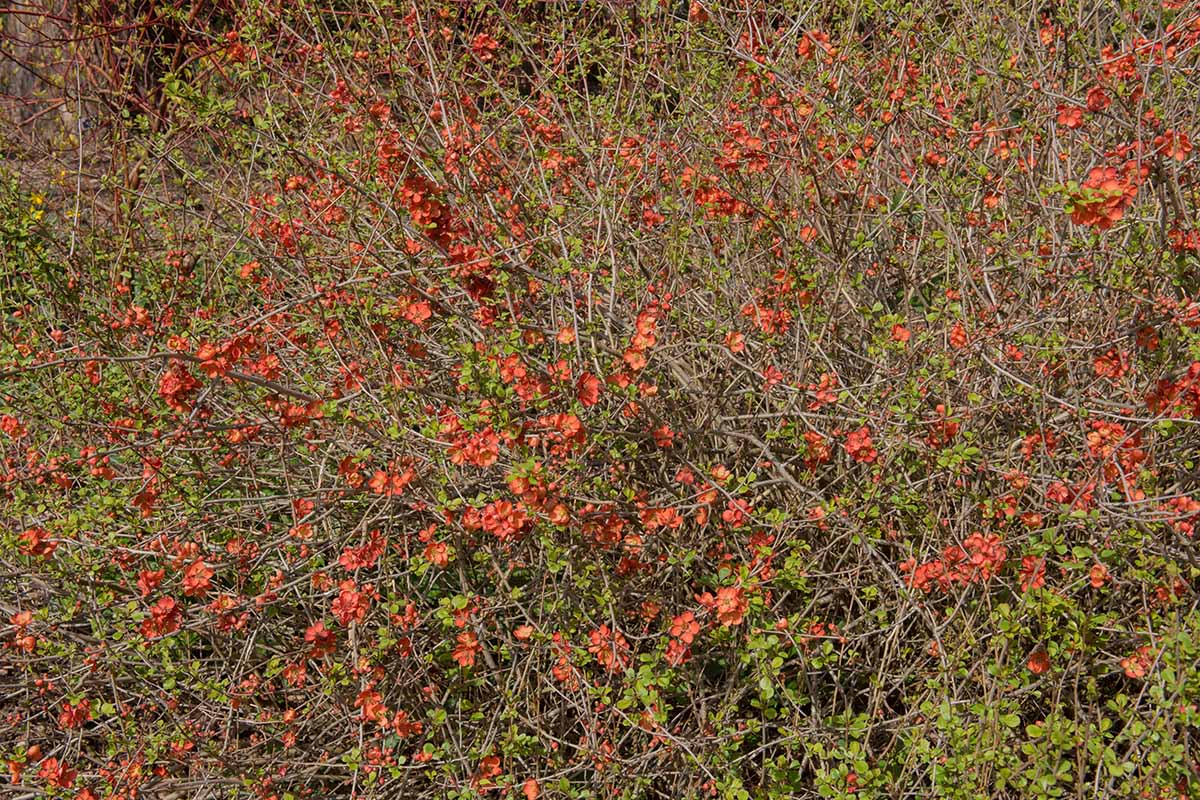
The shrub flowers on old wood, so the best time to prune is in late spring after the flowers have faded and dropped to the ground.
You’ll need to put on a pair of sturdy gloves, and wear long sleeves to protect your hands and arms from the thorns.
Find the oldest branches – they’ll be darker than the new wood – and cut one third of them all the way down to the ground.
Remove a few branches from the interior portion of the plant, too, in order to maintain adequate air flow between the branches.
This also helps the sun reach the inner part of the shrub, and prevents it from becoming too dense.
Propagation
While you can grow flowering quince from seed, the seedlings take a long time to mature into full-sized shrubs, and germination can be a bit hit or miss.
In the case of hybrid varieties, seeds will not produce true to the parent plant.
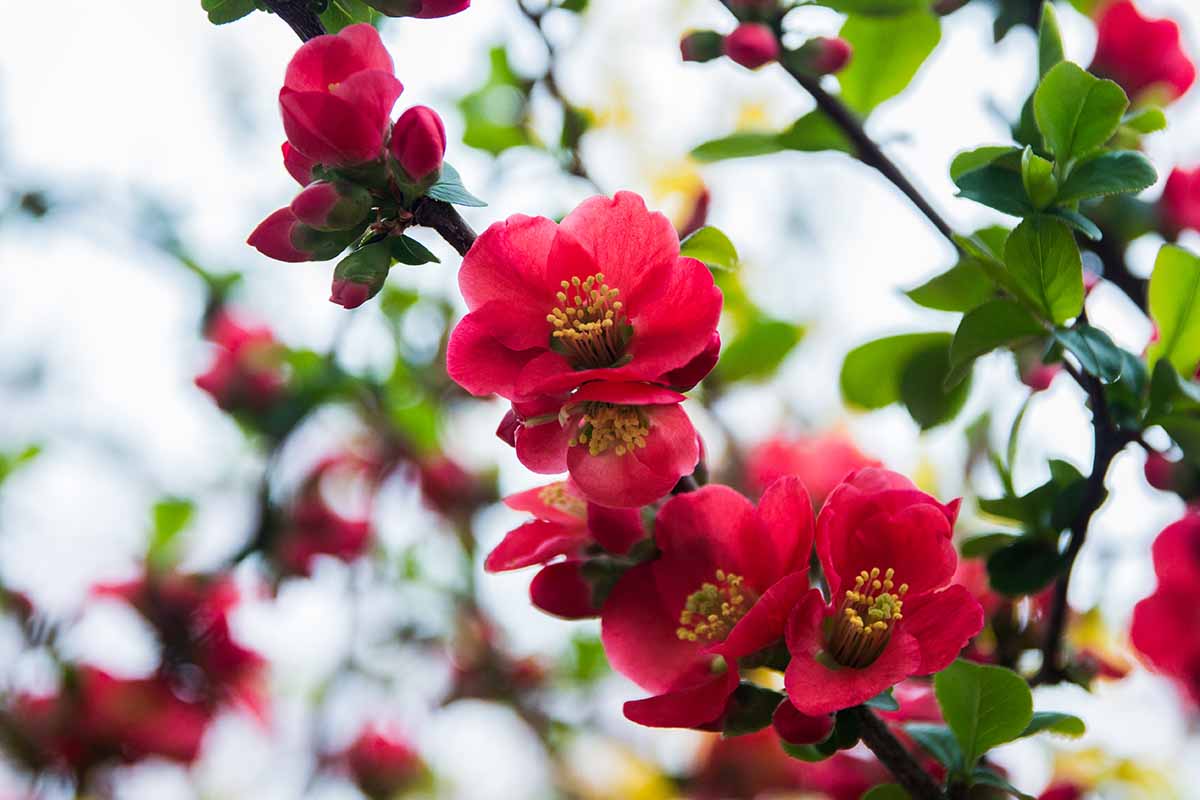
Most of the time, gardeners propagate flowering quince by tip layering or from stem or basal cuttings.
The easiest way to get started is to purchase an existing shrub from a nursery.
From Seed
If you do collect seed from an existing plant, they’ll need to be cold-stratified before sowing.
To do this, place them in a baggie in some peat moss or soilless potting mix and keep in the refrigerator for three months.
Start them indoors in pots or flats in a seed starting mix that is well draining. Keep the soil evenly moist but not waterlogged until germination, which can take up to six weeks.
Tip Layering
If you have an existing shrub, tip layering is an easy way to propagate new plants. This method is often used to propagate cane plants, such as boysenberries.
In spring, when the plant is actively growing, select a long, flexible branch that will bend down to the ground without breaking.
Dig a three-inch-deep trench, and remove the leaves from the six- to eight-inch section of stem that you will bury.
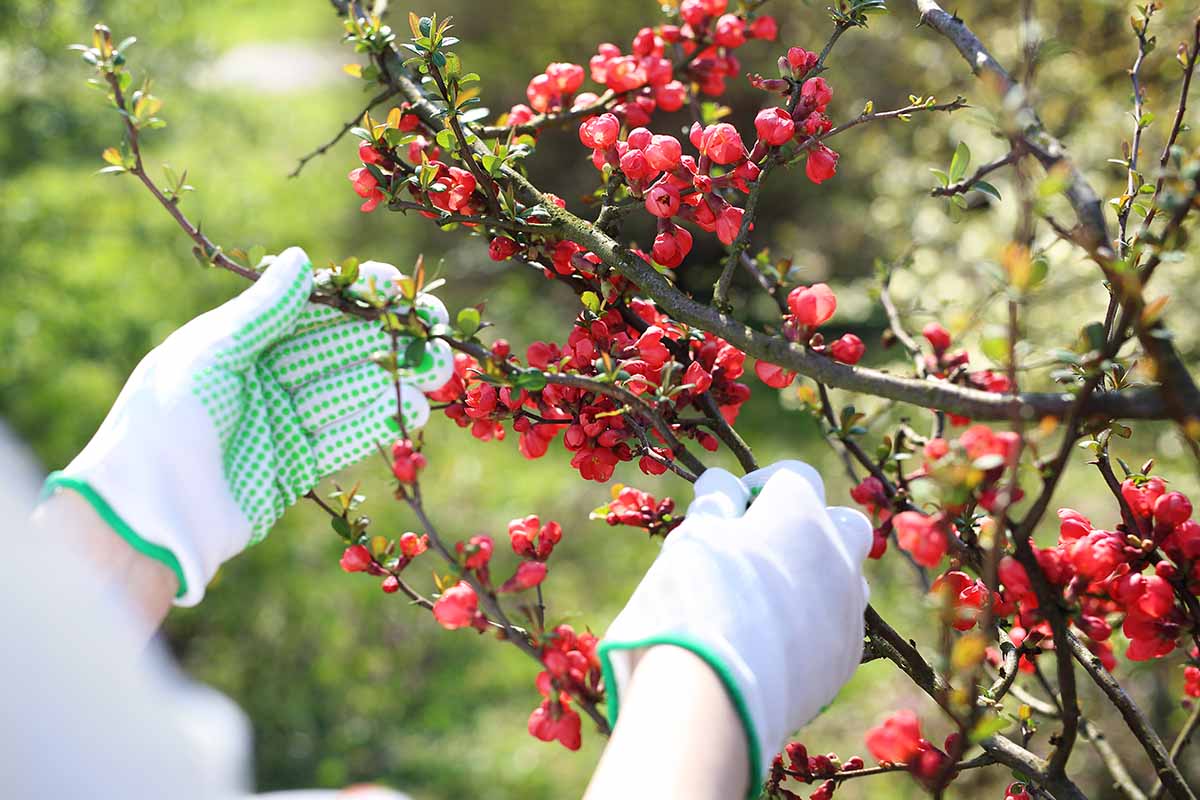
Bury the section of stem, leaving the branch connected to the mother plant.
You may need to weight it down with a brick or use landscaping pins to keep the branch in place. Water well, and keep the soil evenly moist until it takes root.
After about six to eight weeks, you can gently move the soil and check whether the stem has rooted.
If you see evidence of roots, you can cut the branch away from the existing specimen, and dig up the newly-rooted plant for transplanting elsewhere.
From Basal Cuttings and Suckers
Propagating flowering quince from basal cuttings is a lot easier than doing so from stem cuttings.
It can be done at any time during the year. Plants also produce suckers, which can be dug up and transplanted.
To take a basal cutting, locate a young, new stem at the base of the plant and carefully dig it out, leaving as much of the root system intact as possible.
Plant the basal cutting or sucker in a container that’s at least six inches deep, in a well-draining potting mix and keep it moist until you see new growth.
At that point you can transplant it into the garden.
Pests and Disease
While flowering quince isn’t especially prone to disease and pests, there are a few issues to watch out for.
Thanks to the thorns, these shrubs are deer-resistant, although rabbits may nibble on younger plants.
Diseases are uncommon, but there are a couple that can be a real threat to the plant’s health if not taken care of.
Pests
Flowering quince doesn’t usually have many insect problems, but aphids (of course) love to feast on new growth.
If you see any of the small, pear-shaped insects on the plant, spray them off with a blast of water from the hose and apply neem oil or insecticidal soap, according to package instructions.
Learn more about how to manage aphids in the garden here.
You also need to watch out for scale insects.
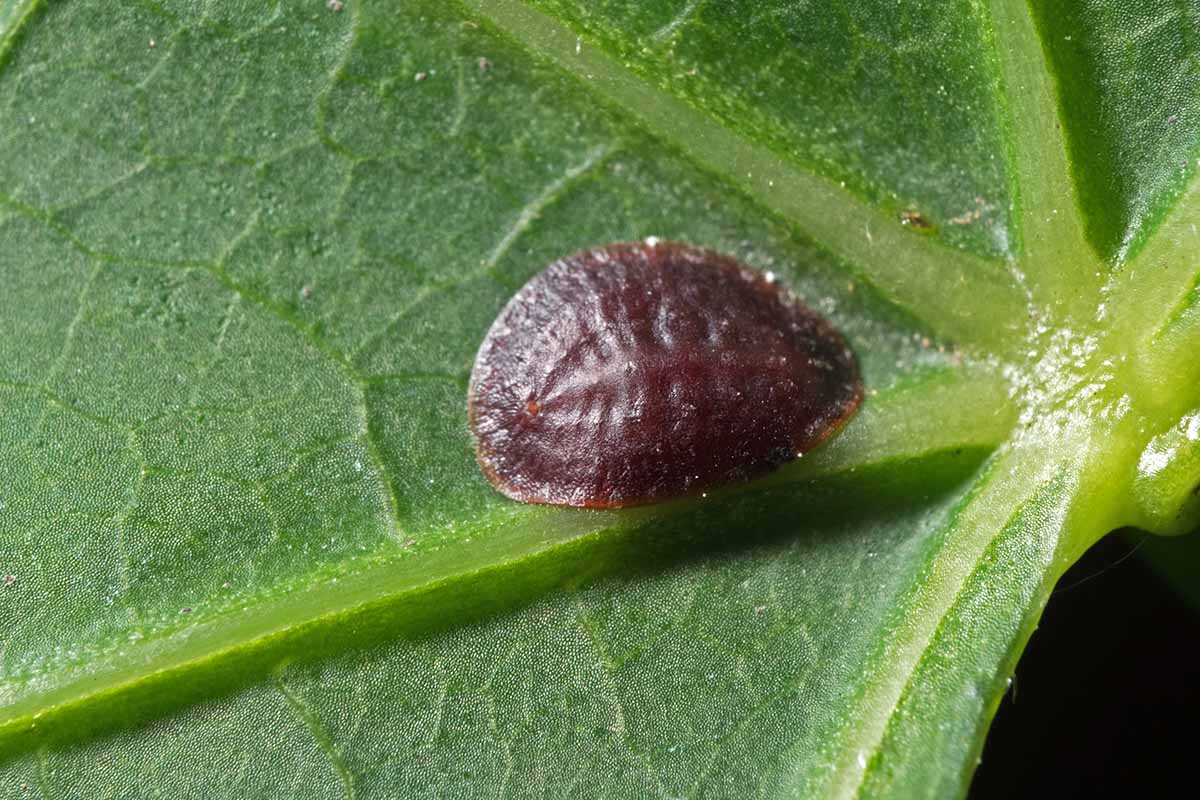
These can be hard to spot because they look a bit like fungus collecting on the branches, or like a line of brownish or grayish scabs or galls.
These insects can suck the sap out of the shrub, weakening the plant.
If you notice an infestation, you can spray horticultural oil, like Bonide All Seasons Horticultural and Dormant Spray Oil, available via Arbico Organics.
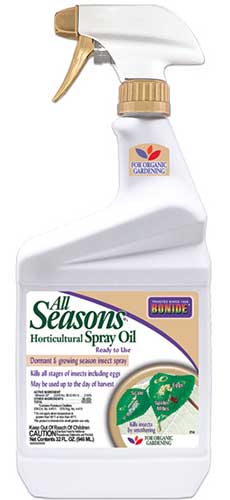
Bonide All Seasons Horticultural and Dormant Spray Oil
Spider mites can sometimes cause trouble, too.
If you see small dark-brown spots on the undersides of the leaves, spray them away with water and apply neem oil to the affected area.
Diseases
Apple scab is caused by the fungus Venturia inaequalis and symptoms include dark green lesions on the foliage that turn a dark rust color over time.
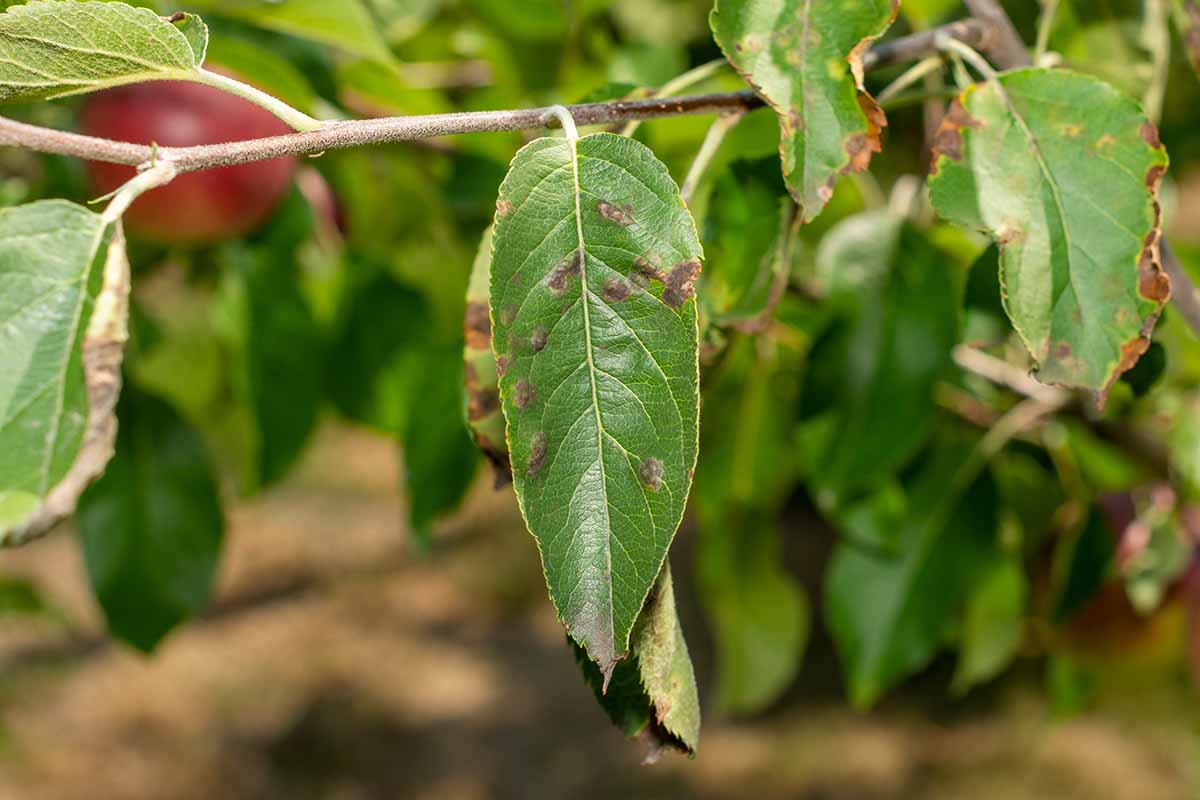
The fungus overwinters in plant debris, and typically strikes in warm, wet weather. As the name suggests, it also affects apple trees.
Learn more about apple scab here.
Another pernicious ailment is cedar-quince rust, caused by the fungus Gymnosporangium clavipes.
The primary hosts for this fungus are juniper bushes or cedar trees and it spreads by wind. Cedar-quince rust causes swollen galls on flowering quince branches.
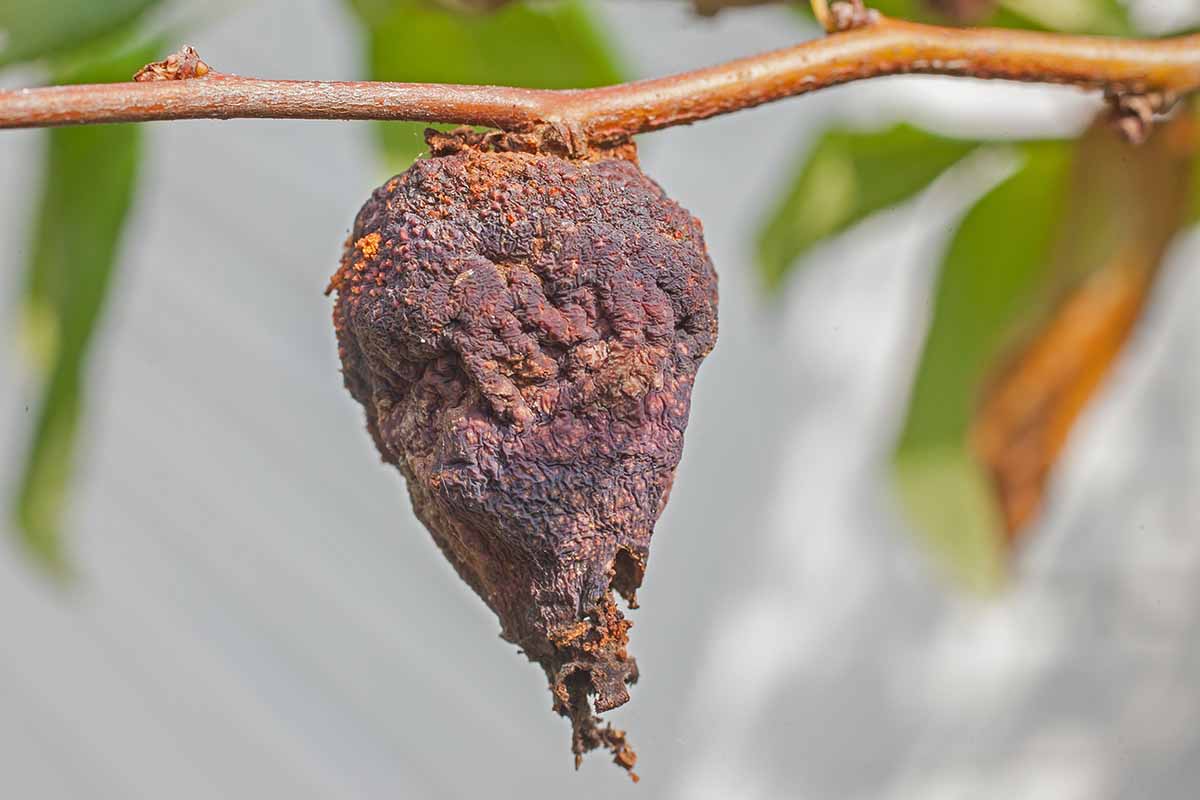
The galls can stay on the branches indefinitely and the fungus will infect the rest of the plant over time, which may result in a loss of blooms and fruit.
If you see the galls, cut off the infected branches and dispose of them in the garbage can, then spray the plant with copper fungicide.
A Feast for the Eyes
Like its rose relatives, flowering quince is easy on the eyes yet thorny enough to defend itself (and your yard) if needed.
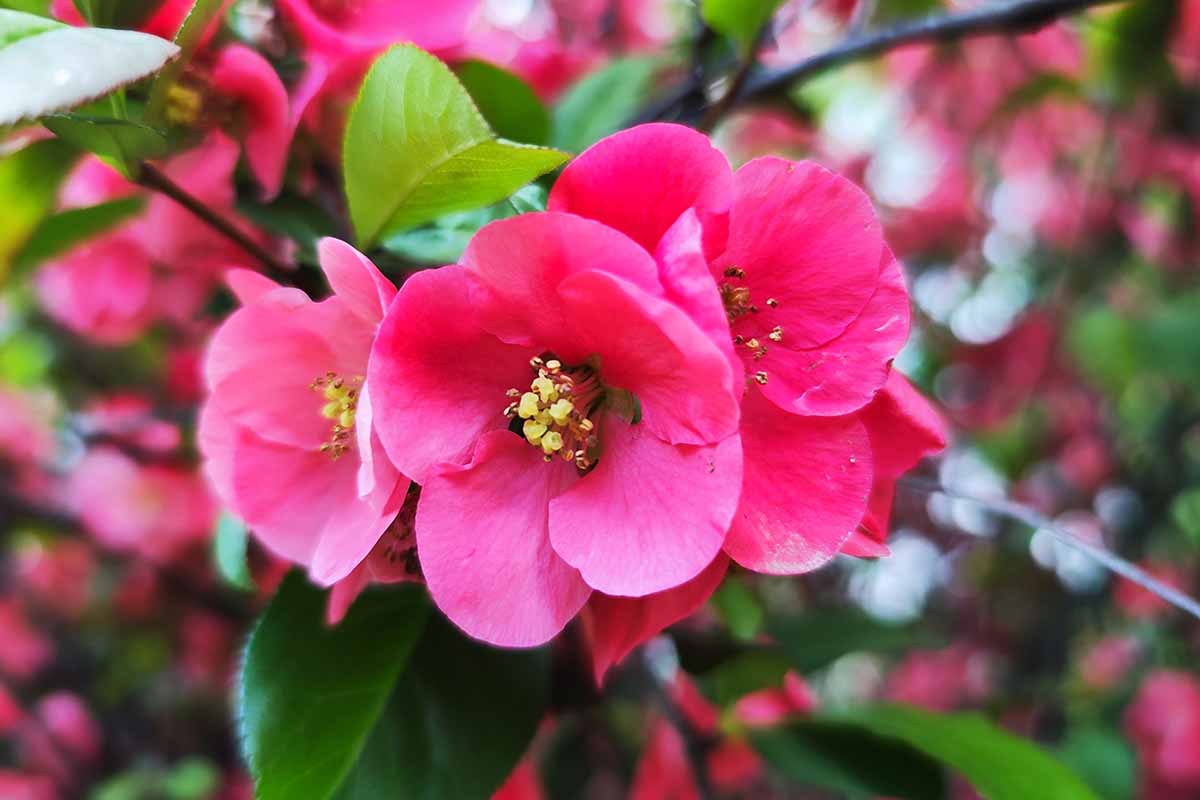
It’s a low-maintenance shrub that provides an early pop of much-needed color in the springtime, attracting bees and other pollinators to the landscape.
And some varieties will even produce edible fruit, which the birds will appreciate, even if you don’t!
Are you growing flowering quince? We’d love to hear your stories and questions in the comments section below.
And to learn more about growing ornamental shrubs in your garden, check out these guides next:

I have a lovely salmon colored quince in my yard since childhood. It was my mom’s favorite. Each sibling has a bush that was taken from the shoots. It has now been passed to my stepdaughter. It is a lovely bush that makes flower arrangements with an oriental flare. I appreciate the info as it needs pruning.
Hi Dotti — that is so special! I love when plants live long, healthy lives and cuttings and the plants themselves get passed down as heirlooms.
I’m glad you found this guide helpful! Let us know if you have any questions. ????
We have enjoyed a red-blooming “japonica” for years. It’s in severe need of help right now. Your article is very useful.
I’m sorry to hear your plant is struggling Barbara, I hope the information has helped you figure out how to help it! Feel free to reach out with any specific questions you may have.
Is this a quince? If so, what variety is it? Thank you.
No, this is not a type of quince. It’s difficult to tell from your photo what exactly this is- maybe hawthorn? Can you provide a picture of the full plant? Are there any leaves? I assume the green needles also pictured are part of a different plant, correct? Happy to help with identification if you can provide a little more information!
Hi there,
I have taken suckers from a friend’s quince and planted them in my own garden. They have been growing for 3-4 years now and are approx 4 ft tall but no blooms. Will these suckers bloom eventually? Their stems are still green and have side branches now too. Do i need to be more patient? or do suckers not bloom!
Thanks,
deanna
Quince flowers in the spring and it may take several years for propagules to produce blooms. I’d give it one more season, and be sure to check the surrounding growing conditions. Are they receiving enough sun, and have you tested the soil? There’s a chance that soil that is too alkaline (with a pH above 7.0) or too rich in nitrogen may impede flowering.