


Syngonium podophyllum
Arrowhead plants are unkillable.
Okay, you could probably manage it if you really tried. Even better, their sturdy nature is hidden beneath a surprisingly beautiful and delicate appearance.
I think that’s part of what makes them such exceptional options as houseplants – they have beauty and brawn.
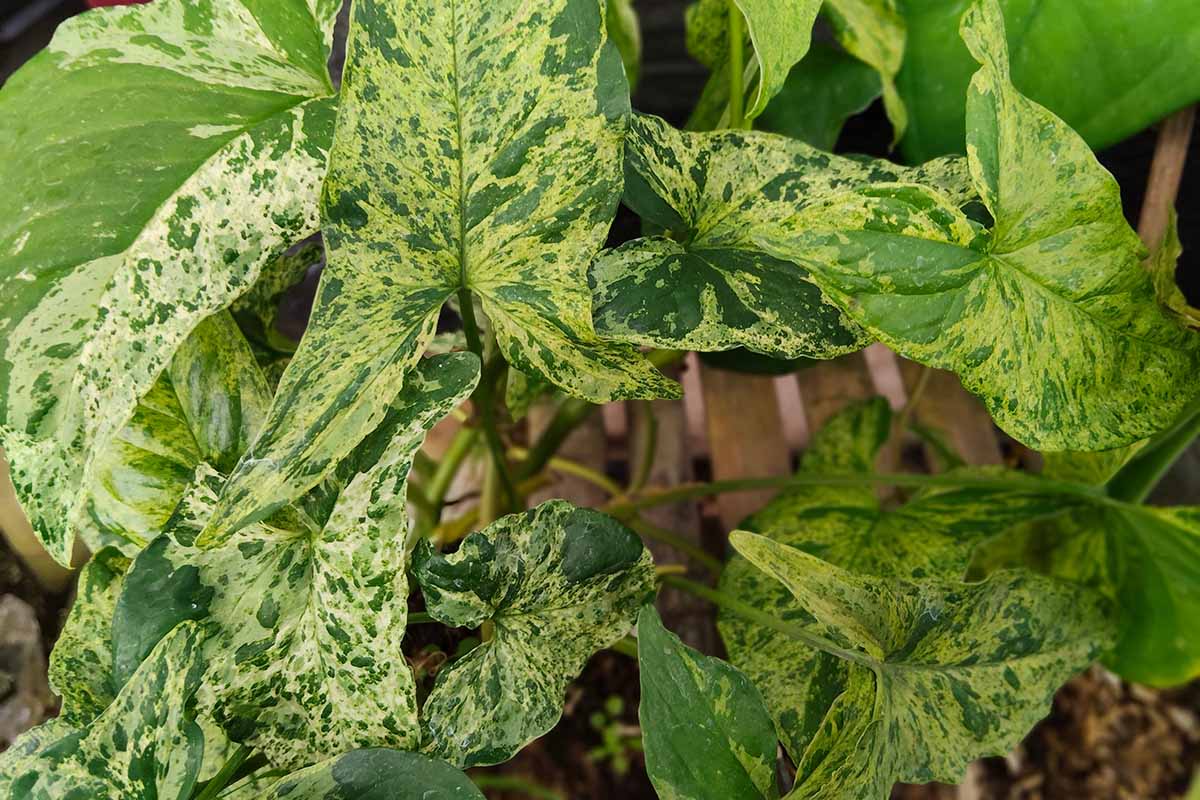
The foliage has a distinct arrowhead-like shape, as you probably guessed by the name, but it’s the fascinating array of colors and patterns that makes them extremely appealing.
Most cultivars have soft, muted colors in shades of pink, cream, and green. A few are bolder, with deep red or emerald green coloring.

We link to vendors to help you find relevant products. If you buy from one of our links, we may earn a commission.
Though I joke about it being impossible to kill them, you do need to provide a certain set of conditions to make them truly happy. That’s what this guide will show you.
Here’s what’s coming up ahead:
What You’ll Learn
Arrowhead vine, American evergreen, five fingers, goosefoot vine, arrowhead philodendron – whatever you call Syngonium podophyllum, this tropical native is a sturdy houseplant that provides visual interest with its multicolored and uniquely shaped leaves.
Don’t confuse this tropical houseplant with species in the Chenopodium genus, which are also commonly called goosefoot plants.
While they can be delicious greens to forage, they’re completely different species that won’t make very attractive houseplants.
Arrowheads are not philodendrons either, despite one of their common names. Closely related to monsteras and pothos, they have different care requirements than their cousins.
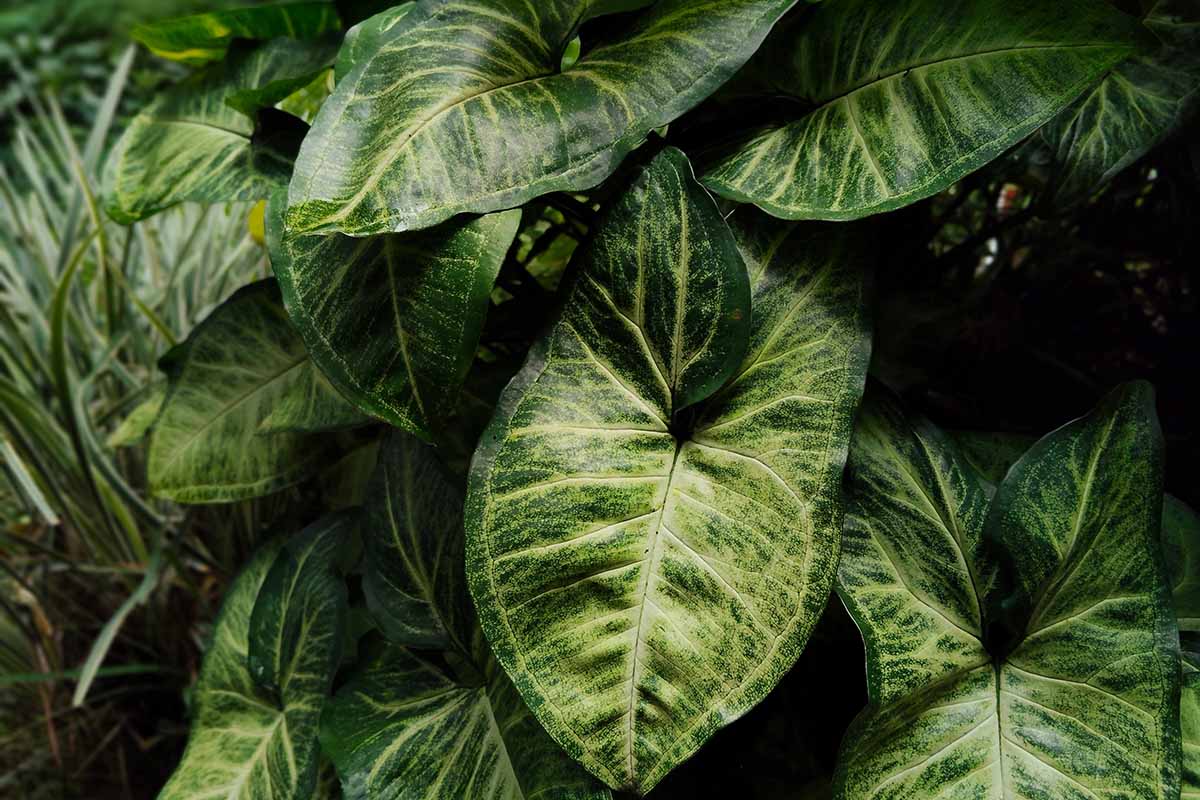
Goosefoot vine is native to tropical areas from Mexico to Bolivia. You can also find it naturalized across the globe in places like Hawaii, Florida, Costa Rica, and the West Indies.
In USDA Hardiness Zones 10 to 12, you can grow these outdoors as a ground cover or small bush in a shady area.
It shouldn’t come as a surprise that, being so difficult to kill when cultivated indoors, this species has the potential to be invasive outdoors.
In Florida and American Samoa, it has formed dense mats on the floors of forests, displacing native flora.
Arrowhead plants are epiphytic, starting their lives in the trees in the wild, and sending out runners along branches as they expand.
They can even send stems down into the soil to act as trunks if they need additional support.

In the right conditions, they blossom with large, fleshy spathes covered in tiny flowers, and then produce red berries.
Depending on the cultivar, a happy specimen can grow up to six feet tall indoors.
How to Grow
Arrowhead plants are versatile, making lovely potted plants as well as being gorgeous in hanging containers.

Because they’re epiphytic, you can also train one to grow up a moss-covered pole, or plant one in a moss-filled basket. They also make nice additions to a dish garden.
Don’t place your arrowhead plants in full sun. You can gradually introduce them to a few hours of morning sunlight, but they do best if you keep them in bright but indirect light.

In the wild, these plants are protected from the sun by the canopy of the trees that they’re growing on. That’s the sort of environment that you want to recreate.
Additionally, they grow in humid areas where they receive a lot of rain. Your job is to try to recreate these tropical conditions.
Add water to the potting medium when the top half-inch has dried out.

It’s easy to determine when more water is needed. Just stick your finger in the soil. When it feels dry about halfway to your first knuckle, it’s time for more water.
Reduce watering so that the top inch or two of soil is allowed to dry out first in the fall and winter.
Arrowhead plants like consistent feeding throughout the growing season. Fertilize the soil once a month with liquid houseplant food diluted by half.
Organic Indoor Plant Food by the Grow Co., available at Amazon, is an excellent option. Just reduce what’s recommended for use by the manufacturer by half, by diluting it with water.
Don’t fertilize in the fall or winter.
Having said all that, arrowhead plants are incredibly adaptable, especially if you change their conditions gradually – they will adapt to less water, less sunlight, or lower humidity.
But if you want the biggest, fullest plant possible, try to give them what they crave.
Cultivars to Select
The range of arrowhead plant cultivars is astounding. They have varying leaf sizes and shapes, and an incredible variety of colors, both solid and variegated.

The leaves can range from pale pink to deep green, and they may feature accents of white, cream, yellow, rust, or red.
‘Merry Maria’ is a lovely option. It has glossy leaves that start out salmon pink before fading to medium green.
‘White Butterfly’ features broad leaves that are pale green with dark green edges.
Other common cultivars include ‘Pink Fairy,’ with splashes of dark pink in the centers, and ‘Golden Allusion,’ which has yellow and green leaves with a pink midvein.
Want More Options?
Take a look at our round up of 23 of the best arrowhead varieties.
Maintenance
There’s no need to prune unless you notice any dead or yellow leaves.
That said, feel free to give your plant some shape. If you have one vine that’s growing a bit leggy or too long, trim it just beyond the node.
This will encourage the vine to branch out rather than growing longer.

You can trim back to a node at any point when you want to create fuller, thicker growth.
Arrowhead plants are perfectly happy when they are fairly rootbound, but you will need to upgrade the pot a few times as yours matures.
If the roots start to crawl out of the drainage hole, it’s time to go up one pot size.
Aerial roots aren’t a sign of needing to repot. Just snip them off if you don’t like the look of them.
To repot, remove the plant from its container and brush away as much of the soil as possible.
Transplant in fresh potting soil. Once the plant has reached its mature size, replace the potting medium with fresh soil every couple of years.
Propagation
Arrowhead plants respond well to propagation via stem cuttings.
If you have access to a parent plant, that’s the best way to go.
It is possible to propagate arrowhead plants from seed, but this is definitely not the preferred method. Germination is spotty and it’s hard to source seeds.
On top of that, hybrids won’t grow true to the parent, and you might not end up with what you expected in terms of color.
You can also purchase plants from the nursery.
From Cuttings
If you have a plant and a cup of water, you can make little arrowhead vine babies without much effort.
This process is best done in the spring or summer because the plant starts to go dormant in the fall.
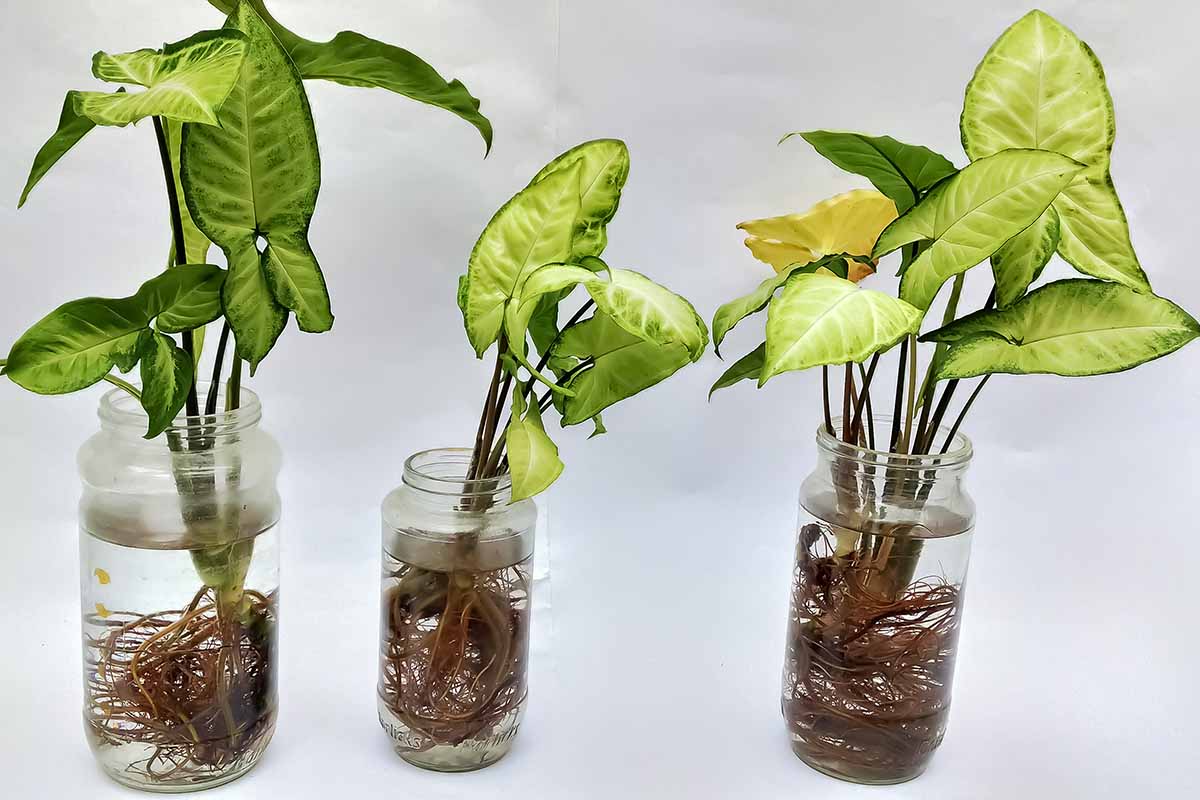
Take a cutting just below a node, the point on the vine where a leaf bud or roots may emerge.
You can place the cutting in a container of potting medium or in water. Either method works well.
For the water method, place the cutting so the cut end is submerged under lukewarm water to a point just above the node.
Place the receptacle in a spot with bright but indirect light. Replace the water every other day or so.
You’ll start to see roots forming in a week or two. If not, the cutting didn’t take and you’ll need to start over.
Once the roots are about an inch or two long, transplant them into potting soil in a container.
To start your cutting in soil, fill a small container with a seed-starting medium.
Place the cutting so the node is covered by the potting medium. Water so the medium feels like a well-wrung-out sponge, and maintain this level of moisture while the roots are forming.
By the time two or three weeks have gone by, roots should have developed under the soil. Give the cutting a gentle tug to see if it resists. If so, rooting is successful.
Wait until you see at least two or three new leaves forming. Then you can transplant as described below.
Transplanting
Purchasing an arrowhead plant from a nursery is the most common method of obtaining one of these beauties.
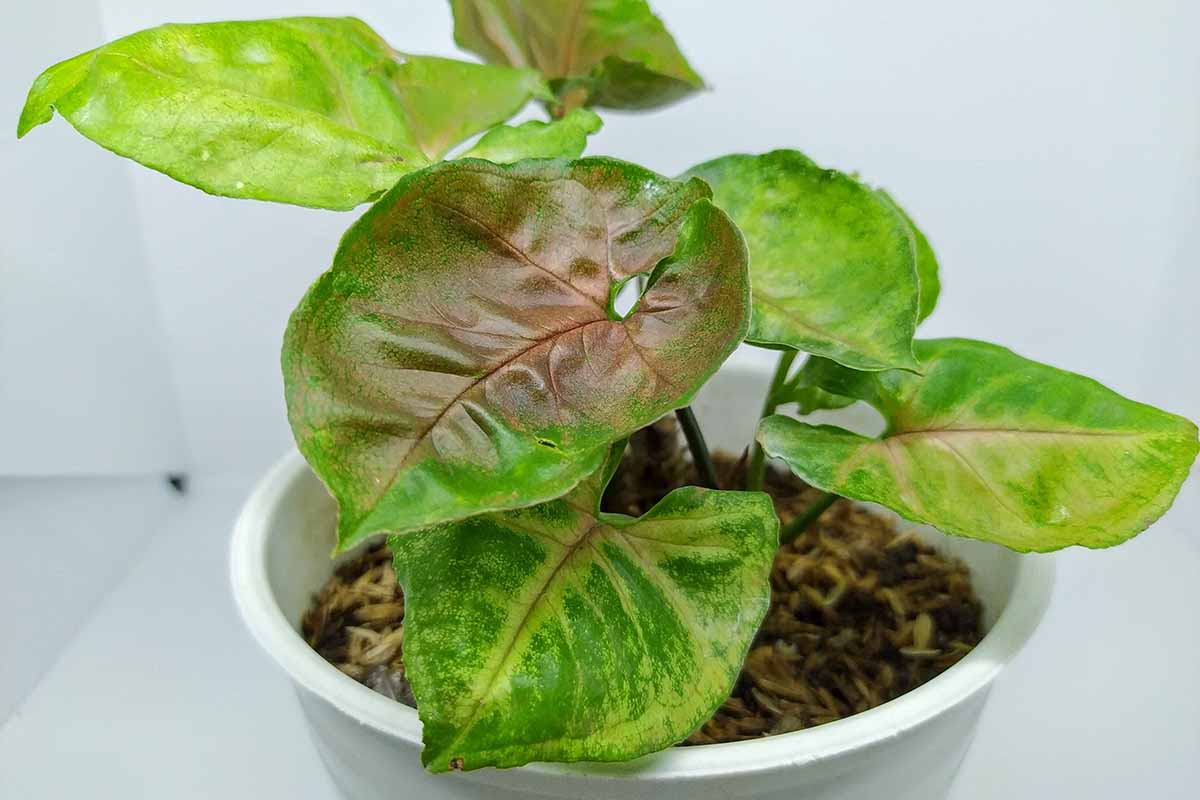
To transplant your purchase into its new home, choose a container that is one size larger than the nursery pot.
Select a potting medium that contains orchid bark or perlite.
A product such as Tank’s-Pro Cactus and Succulent Mix, with a few handfuls of orchid bark mixed into the bag works well.

Tank’s-Pro Cactus and Succulent Mix
You can find this potting mix available from Arbico Organics.
Put a layer of potting mix in the base, and gently remove the plant from its existing container.
Gently tease apart the roots and place the plant in the new container.
The crown should be sitting at the same height that it was in its original container. Fill in around the roots with more potting soil.
Water until the excess starts to run out of the drainage hole. After about 30 minutes, dump the drained water and add additional soil if necessary.
Pests and Disease
Arrowheads are sturdy, as I’ve mentioned.
That doesn’t mean they’re immune to pests and diseases, but you’ll rarely come up against any problems.
Insects
Arrowhead plants are occasionally attacked by the usual houseplant pests: aphids, mealybugs, scale, and spider mites.
Chances are, if you’ve been growing houseplants for a while, you’ve come across one or more of these before.
Aphids
Aphids are small, sap-sucking insects that feed on your houseplants. Symptoms include yellowing leaves and stunted growth if enough aphids are present.
They also leave behind a sticky substance called honeydew that can attract ants and sooty mold – which can interfere with photosynthesis.
If you spot aphids or the symptoms, there are many ways to control them. Our guide has all the details.
Mealybugs
Mealybugs (family Pseudococcidae) are covered in a white, cottony wax and they cluster together on the stems and leaves.
Symptoms are similar to that of aphids, so you will need to look for the pests themselves. They’re pretty distinctive.
If you do find them, isolate your plant immediately and prune off any infested leaves. Take some cotton swabs dipped isopropyl alcohol and wipe each insect.
Our guide to controlling mealybugs has more tips.
Scale
Brown soft scale (Coccus hesperidum) are sap-sucking insects that cluster on stems or leaf veins.
The symptoms of an infestation look similar to that of aphids and mealybugs, with the addition of dropping leaves.
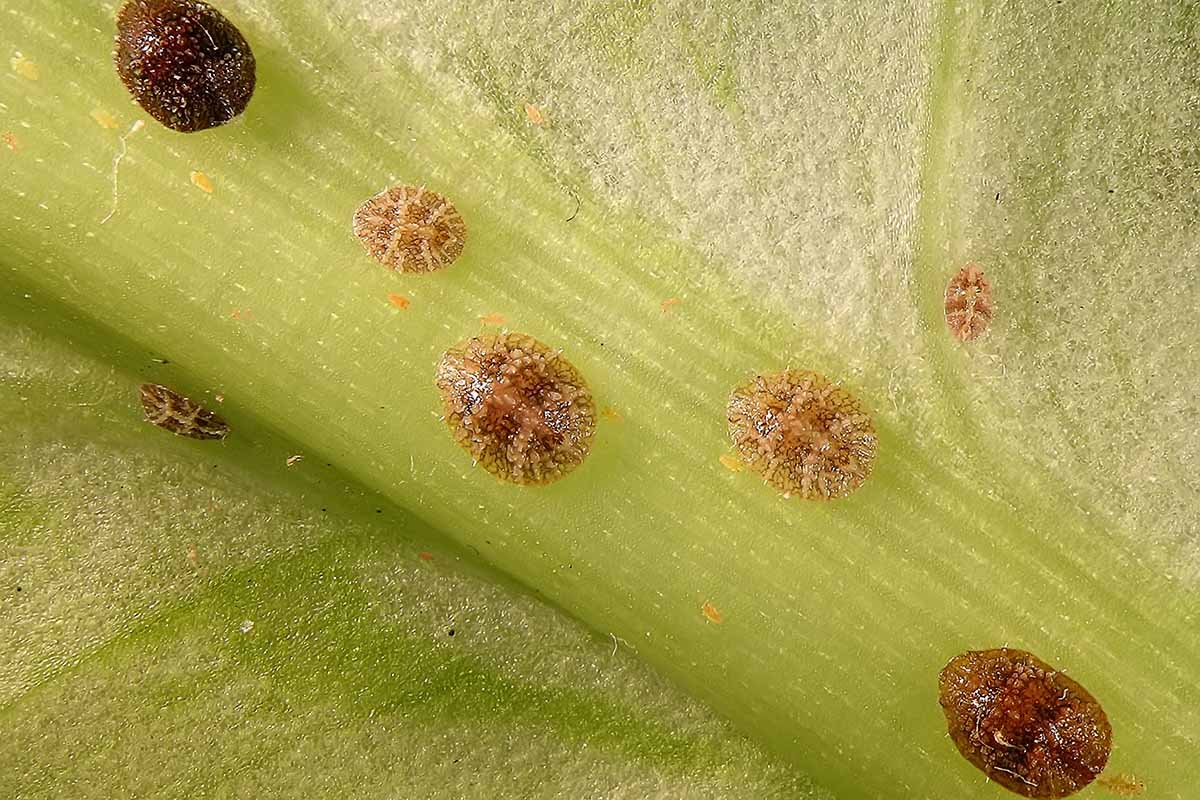
Scale resemble little brown lumps. They don’t move much and you can scrape them away with a blunt knife.
Check out our comprehensive guide to learn more information about these common pests.
Spider Mites
Red spider mites (Tetranychus urticae) are extremely small, and it’s pretty rare to notice them.
Look for fine webbing all over the leaves and stems as an indication of their presence.
You may also see yellow stippling and leaves that are turning brown or yellow.
Spider mites thrive in dry, dusty conditions, so keep the soil moist and the air humid around your plants to deter them.
If you notice evidence of these pests take your plant into the shower and spray it with water to knock off the pests. Do this weekly until they are gone.
Learn about how to deal with spider mites here.
Disease
You can avoid most disease issues by using good hygiene and by isolating new plants for a month before bringing them inside.
The most common problems caused by disease pathogens are as follows:
Bacterial Leaf Spot
Bacterial leaf spot can be caused by several different strains of bacteria (Erwinia spp., Pseudomonas spp. and Xanthomonas spp.).
The symptoms all look the same.
If this disease is present, you’ll see water-soaked green spots that may or may not have yellow halos around them. These can spread and merge.
There is no cure for bacterial leaf spot, so you’ll have to toss the plant.
Root Rot
Root rot isn’t always a disease so much as it is a physiological issue caused by drowning the roots in too much water.
It can also be caused by one of many different pathogens, including various species of Pythium and Phytophthora water molds and Fusarium fungi, as well as Rhizoctonia solani, another fungal species.
Remove the plant from the container and wash away all the soil. Carefully trim any rotting, mushy, or black roots with a clean pair of scissors.
Then spray the roots with copper fungicide and sterilize the container with a 10 percent bleach solution (one part bleach to nine parts water).
Repot the plant in fresh potting medium.
Be extra careful to avoid overwatering. A soil moisture meter can help.
After a couple of weeks, drench the soil with copper fungicide, following the manufacturer’s directions.
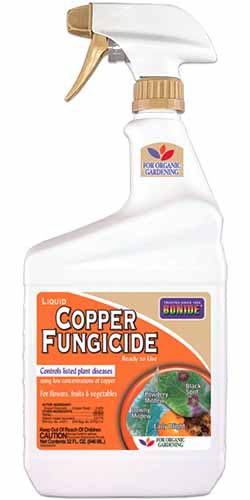
You can find Bonide copper fungicide available at Arbico Organics.
Learn more about managing root rot problems here.
Arrowhead Plants Have Brawn and Beauty
Some tough houseplants aren’t exceptionally beautiful, and some beautiful houseplants aren’t very tough.
But arrowhead plants have it all. With their elegantly-shaped leaves and attractive colors, you’d never know they were hiding the soul of a lion.
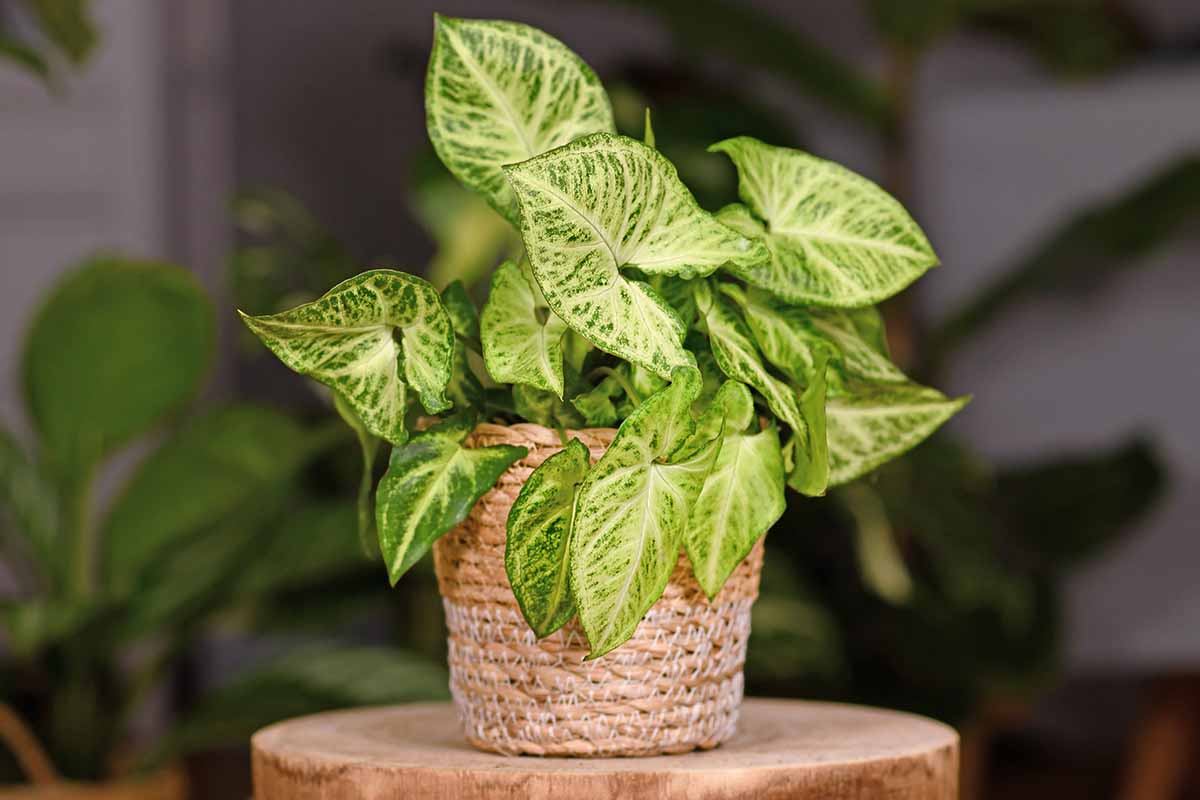
Are you growing arrowhead vines? Let us know in the comments section below, and feel free to share your photos!
And to learn more about growing houseplants, add these guides to your reading list next:


I have grown arrowhead plants for years. This is the first time I’ve ever seen this! Is my potting soil contaminated?
Hi Dawn, here is the picture you uploaded.
Hi Dawn, don’t worry! This is a common occurrence. Mushroom spores are naturally present in many potting soils but most of them never have the right conditions to develop. For whatever reason, the spores in your soil had what they needed to thrive. Often, though not always, it’s a sign that you’re overwatering. Try reducing the amount of water you’re giving and just pluck them out when they pop up. They won’t harm your plant at all.
I have my arrowhead draping down the sides of my China hutch, but I’d like to repot it with a moss pile and train to climb. Is that possible?
Hi Debbie, absolutely! Syngoniums are perfectly happy climbing up a pole. I think some of them actually do better that way. Let us know how it goes.
My White Butterfly is determined to die, despite my best efforts. It must be some sort of infection, but the symptoms are not clear, apart from wilting and dying of leaves. Certainly not “unkillable” in my experience.
Oh no, I’m sorry to hear that, James. No plant is truly “unkillable” and that’s unfortunate that you’re one of the unlucky ones. Have you tried repotting in a clean pot with fresh soil and treating with a broad fungicide like copper?