
Shopping for a new succulent to add to your collection? Or will this be the first installment with many more to come?
Aloe probably made the list of options you’re considering. Which makes sense, since these are some of the most beloved houseplants in the world.
I’d wager that the first member of the genus that springs to mind is the old faithful, Aloe barbadensis, also known as aloe vera.
Indeed, this succulent is the most common and widely distributed amongst home gardeners the world over.

We link to vendors to help you find relevant products. If you buy from one of our links, we may earn a commission.
It’s often chosen for outdoor growing in warm climates as a border or bedding plant or as part of a succulent garden, or it may be cultivated indoors, potted in containers.
There are well over 400 known species in the genus, with more still being discovered!
Among the better-known varieties, there’s quite a selection available depending on your growing zone and space requirements.
Some plants commonly referred to as aloe have also been reclassified by botanists in recent years, and they now technically belong to different plant genera.
We’re going to take a look at 13 stunning varieties to prepare you for success as a home gardener or houseplant enthusiast.
Let’s get started!
13 Favorite Aloe Varieties
You could spend weeks reading about all of the species, cultivars, and hybrids out there today!
Our guide to the different types of aloe gives a breakdown of the various growth habits and classifications of these plants.
This roundup offers just a small sampling of the best varieties to choose for indoor or outdoor growing.
If you’re a fan of out-of-the-ordinary plants, the specimen you choose could be more interesting than the most common of the genus.
Of course, there’s nothing wrong with choosing the old standby, aloe vera – and if you do decide to do that, we have a complete guide to help you grow your own aloe vera.

If you’re planning to purchase one, head on over to Fast Growing Trees where you can find plants in one-gallon containers.
Otherwise, let’s spend a little time getting better acquainted with some more distinctive choices.
1. Cape
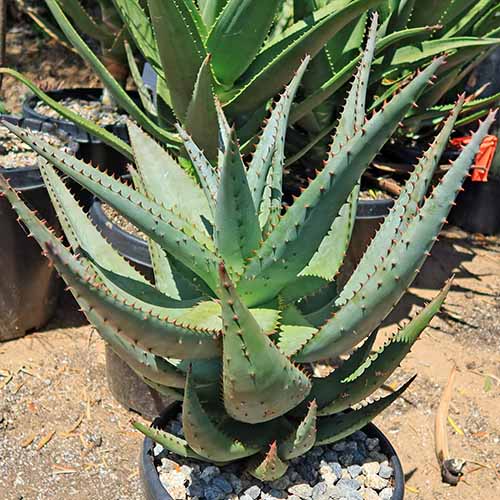
A. ferox, also known as Cape or bitter aloe, is one of the showier options.
The blue-green leaves are arranged in a rosette pattern, and are often tinged with red or rose, with red or deep blue-green marginal teeth.

It’s also a bit toothier than other types, with small spines appearing on inner and outer leaf surfaces in younger plants.
As they mature, they tend to lose some of their surface spines as they outgrow the danger of grazing near ground level.
Often confused with tree aloe species, A. ferox forms a single trunk and sports red-orange inflorescences that can reach up to two feet above the crown of foliage.
The leaves are decurrent, emerging directly from the upper portion of the trunk, with no stems or branches.
The total height at maturity for this species can measure well over 10 feet, so this is a specimen best suited for outdoor growing.
Plants can be started in containers, but will likely need regular repotting until they eventually become too large for this to be convenient.
This South African native needs a warm, arid environment and full sun for best results.
USDA Hardiness Zones 9 to 11 are ideal, but in the heat of summer, this species will benefit from protection to provide some shade.
You can find A. ferox plants in one- and 15-gallon containers available at Planet Desert.
2. Christmas Carol
‘Christmas Carol’ is a hybrid cultivar with dark orange or red spots and edging on its spiky, succulent leaves. When viewed from above, the plant has a star-shaped appearance.

The coloration is more pronounced when the plant is exposed to full sun.
When grown outdoors in Zones 9b to 11b, reddish-pink flowers may appear, though these are uncommon in plants kept indoors.
This cultivar was bred by hybridizer Kelly Griffin, using ‘Doran Black,’ described below, as one of the parent plants.
With a mature height and width of just eight to 12 inches, ‘Christmas Carol’ is ideal for growing in small spaces outdoors, or in containers either indoors or out.
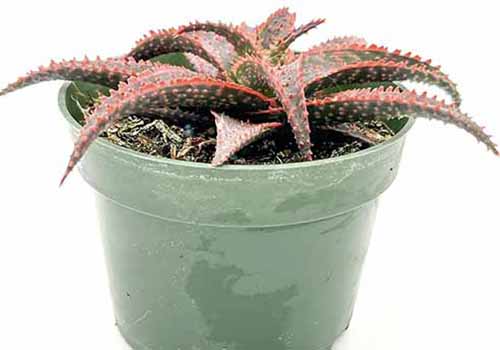
You can find ‘Christmas Carol’ available from Walmart in four-inch pots.
And check out our guide to learn how to grow and care for ‘Christmas Carol.’
3. Coral
A. striata, aka the coral aloe, features broad, gray-green succulent leaves with hints of red on the smooth, spineless edges.

Subtle dark green vertical stripes running along the length of the foliage provide textural interest to the fleshy leaves.
This species is more cold-tolerant than many aloe types, and can be grown outdoors in Zones 9 to 11. You may need to provide winter protection in the more northern parts of Zone 9.
At maturity, the rosettes can reach 18 to 24 inches tall and wide, and may produce offsets at the base, which can be dug up and transplanted.
When grown outdoors, mature rosettes can produce two- to three-foot-tall flower stalks adorned with orangey-red blooms, providing a pop of color to the water-wise garden.
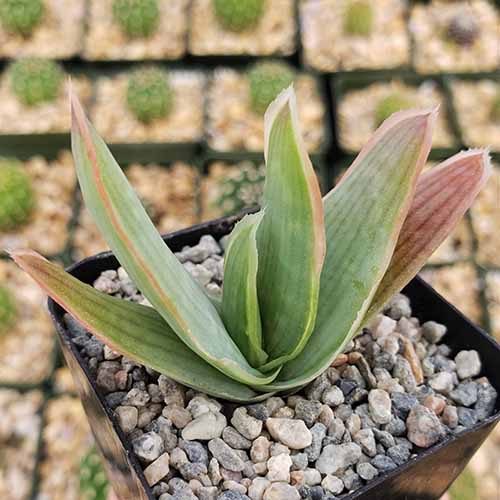
Ready to add A. striata to your landscape? You can find specimens in two- and four-inch containers available from Planet Desert.
4. Doran Black
One of the most popular hybrid aloe cultivars, ‘Doran Black’ exhibits short, flat, fleshy leaves of green to gray, although a pinkish tone is sometimes visible on the ends of the leaves.
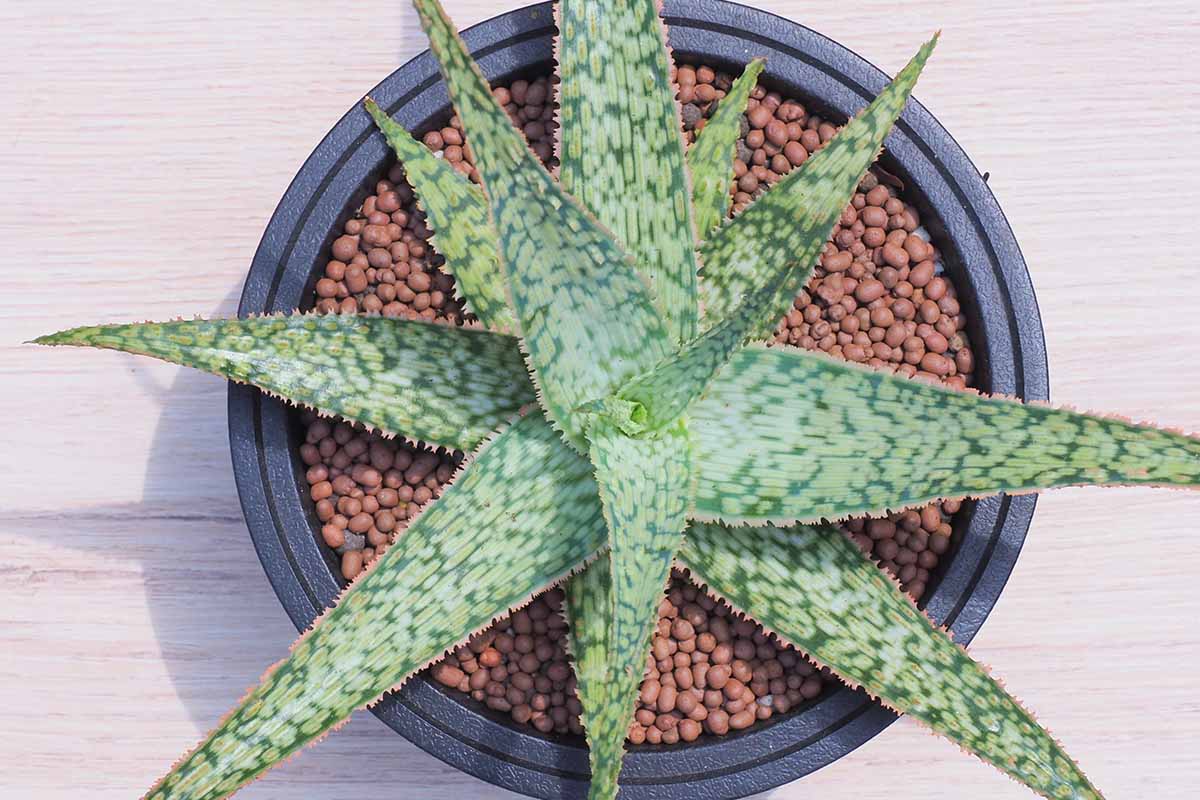
The white pattern of speckles or slashes is arranged in stripe-like bands in some instances, but often appears mottled. White marginal teeth line each leaf.
The undersides of the foliage usually have a bumpy texture that adds an even more distinctive appearance to this standout specimen.
Flowers may be bright or pale pink, rose, or coral. Note that flowering is more common in specimens grown outdoors.
With an expected stature of no more than about eight inches, and a minimal spread of five to eight inches, this hybrid is perfect for container planting. It also prefers less light than some aloes and produces a rosy tone in times of drought.
If your windowsill is a place where thirsty plants often go to die, you might give this one a go!
Want to install ‘Doran Black’ in an outdoor xeriscape, rock garden, or bed? You can do so safely in USDA Hardiness Zones 10 to 11. Otherwise, indoors it is!
You can purchase ‘Doran Black’ in a three-and-a-half-inch pot from Planet Desert via Amazon.
5. Fan
Kumara plicatilis, or the fan aloe, has been reclassified due to its very different structure from most other aloes.
The Kumara genus only includes two known species: K. plicatilis and K. haemanthifolia.
I mentioned earlier that this is my absolute favorite species on our list.

This species forms a smooth, gray, semi-woody trunk over time, lifting the jade-like fans of leaves up into an array that you just can’t help but notice.
The trunks tend to branch and fork over time, creating a shape akin to a naturally-occurring bonsai.
The fans can reach about 12 inches in length, and coupled with the height of the trunk, this specimen can reach six to eight feet in height at maturity.
And if that isn’t enough to turn heads, floral racemes of coral to orange really pop against the muted, blue-green color of the fans.
Young specimens may appear more similar to other aloes, with leaves that grow from a short stem, reaching upward in clusters.
It can take several years for a trunk to develop since this species grows slowly, but this can provide a grace period for container growing if you choose to start one of these in a pot.
Bear in mind, however, that container-grown plants will need to be transplanted after a few years to a suitable place in the landscape.
This location should be chosen carefully because this species can live for decades.
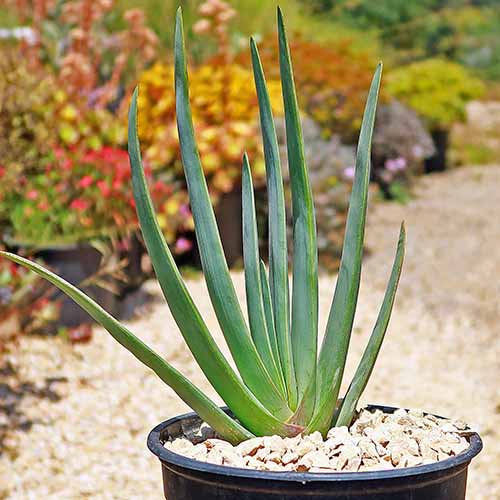
Add fan aloe to your yard or garden in Zones 9 to 11, but be sure to keep an eye out for cold snaps that dip below about 20°F, because this species is not cold tolerant.
You can find K. plicatilis plants in one-inch, one-gallon, and three-gallon containers available at Planet Desert.
Learn how to grow fan aloe here.
6. Short-Leaved
If you’re looking for a specimen that reaches 10 to 12 inches in height, and that can fill in space as a ground cover, short-leaved aloe (A. brevifolia) might do the trick.

This species has green to burgundy coloration and thick, stout, toothy leaves.
Its blooms are red-orange and contrast nicely against its subtle foliage, making it attractive enough to use as a focal point.
In bright sunlight, the foliage can sometimes turn a brilliant flame red.
This species sometimes forms mounds that make for a lovely presentation in a wide, shallow basin.
Pair it with other succulents, such as string of pearls or hens and chicks, for a whimsical appearance.
Dense mounds can quickly become overcrowded. Luckily, separating pups or offshoots is pretty simple – you can find instructions in our guide to separating aloe pups for propagation.
Sometimes referred to as the crocodile plant, this compact type fares best in USDA Hardiness Zones 10 and 11 as an outdoor planting.
You can find plants in two- or four-inch plastic or clay pots from the DH7 Enterprise Store via Amazon.
7. Spiral
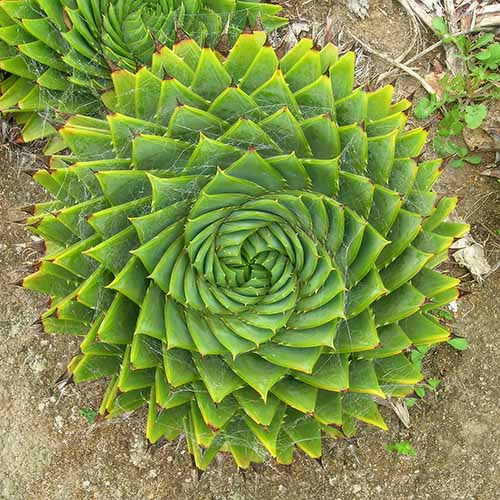
For an intricate, seemingly mystical addition to your home or garden, spiral aloe (A. polyphylla) is a top option!
This glorious specimen features a highly symmetrical arrangement of short, triangular leaves that wind in a perfect spiral rosette form.

The deep green to blue-green tone of the foliage, sometimes tipped with rose, red, or a touch of yellow, is focal-point-worthy on its own.
Couple that with the salmon to orange inflorescences it produces and you’re sure to be mesmerized.
This South African native grows to a modest 12 inches in height at maturity, with a lovely mounding habit that spreads to 12 to 24 inches.
An accelerated growth rate is normal with this species, which often reaches its mature size at about five years of age.
But its fast growth is unfortunately no match for overcollection in the wild due to its popularity, and this species appears on the endangered species list in its native range.
Be sure to purchase from a reputable nursery and leave the remaining wild specimens to nature.
Unlike heat-loving aloes, A. polyphylla prefers the cooler temperatures in Hardiness Zones 7 to 9.
Growing it in warmer regions means providing more shade and mulched soil to prevent overheating. Or, bring it indoors as a houseplant, potted in a wide, low container for stability.
Find A. polyphylla in four-inch pots available at Planet Desert.
Find more tips on caring for spiral aloe here.
8. Spotted
A. buhrii is a stemless variety also known as Elias Buhr’s aloe, so named in 1971 by botanist John Lavranos to honor the farmer who first collected a specimen from the Northern Cape Province of South Africa.

It’s a compact grower, reaching no more than about one foot tall and two or three feet wide at maturity, but what it lacks in size it makes up for in form and color.
The thick, green leaves often display burgundy, purple, or reddish tones, providing a nice pop of color along a walkway or when coupled with less vibrantly colored succulents.
In addition to the sometimes brightly toned foliage, this specimen sends up inflorescences of bright coral or orange in clusters similar in arrangement to those of sedum.
Plant this variety, which is most colorful in bright sunlight, outdoors in Zones 9 to 11, or grow it indoors in containers year-round.
This species is hardy to about 30°F for short periods of time, but if your region experiences long-term freezes in the winter, plants will either need to be protected or moved indoors.
9. Tiger
Tiger aloe, or Gonialoe variegata (formerly A. variegata), has been reclassified and is no longer a member of the Aloe genus.
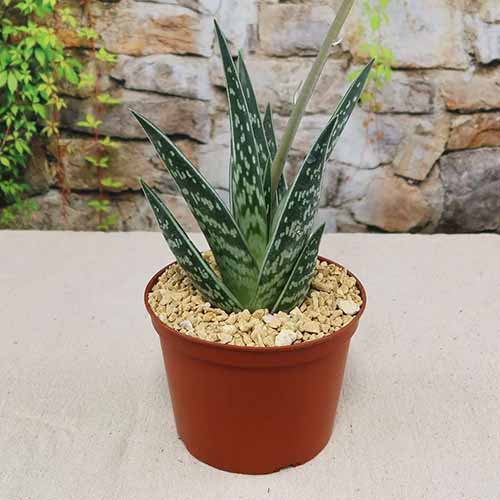
Containing only three species – G. dinteri, G. sladeniana, and G. variegata – plants in the Gonialoe genus are characterized by striped or speckled foliage, with flat or V-shaped leaves, typically nested one inside the other.

They produce racemes with green to pink stems and pink, coral, or orange flowers, each with a bell-shaped structure.
In the case of G. variegata, or partridge aloe as it’s also sometimes called, strong, distinctive stripes of deep green and white alternate to create a pattern that bears a resemblance to tiger stripes or partridge feathers.
White margins of fine teeth line each leaf. This is a truly eye-catching houseplant.
Aside from its color and pattern, the modest size of the specimen also lends itself perfectly to indoor growing.
Top height at maturity ranges from 12 to 24 inches, but because of the slow growth rate of this species, it can take five to 10 years to reach this size.
Unlike some of the varieties on our list, this one doesn’t mind slightly lower levels of light. Outdoors, it can tolerate temperatures in Hardiness Zones 9 to 11.
Under about 40°F, it’s best to cover and protect outdoor plantings from cold damage, or move potted specimens indoors to safety.
Tiger aloe is available in four- and six-inch pots at Planet Desert.
If you’re considering this species but need more details on planting and caring for it, check out our guide to growing tiger aloe before you pick one up.
10. Tiger Tooth
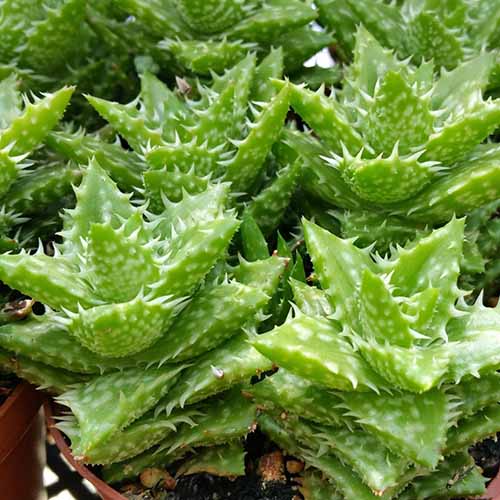
Compact, cute, and sometimes brightly colored, A. juvenna, or tiger tooth aloe, is a favorite among houseplant parents.
This species sports short, white-speckled green leaves that sometimes change to a golden tone.

A rather prickly looking variety, you’ll find teeth along all margins and sometimes on the inner and outer surfaces of the short, triangular leaves – but this species is menacing in appearance alone. The spines are flexible and rarely prick the skin.
Pokes aside, mature specimens rarely reach more than about eight inches in height at maturity.
Ideal growing conditions encourage offshoots to develop, which can form a dense cluster of columnar plants over time.
This Kenyan native is best planted indoors in pots where it has room to spread, if outdoor conditions fall outside the range of Zones 9 to 11.
As an outdoor planting, you’ll want to keep an eye out to make sure it’s not spreading further than intended with runners and pups.
Find A. juvenna plants in four-inch, six-inch, and two-gallon pots available from Planet Desert.
Learn more about growing tiger tooth aloe here.
11. Torch
The shrub-like A. arborescens makes quite an impact in the landscape!
Tufts of green, toothed leaves grow atop a branched, low-growing trunk, with red-orange floral racemes rising like Roman candles in the spring and summer.

Zones 9 to 11 are most appropriate for this species, which tolerates seasonal lows in the 25 to 30°F range.
In cooler zones, mulching and covering prior to the onset of chilly temperatures can help to prevent cold damage.
Small, young plants can be grown in containers until they become too large. Mature plants, however, can tower overhead at six to 10 feet in height with a similar spread.
They don’t grow fast, but this is something to bear in mind if you don’t have space or appropriate growing conditions for them outdoors.
12. Tree
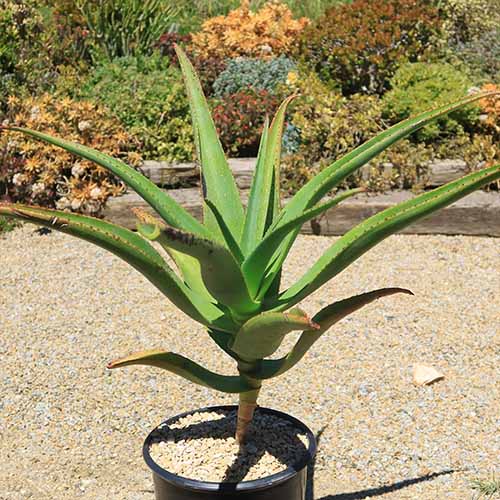
Aloe bainesii has been reclassified as Aloidendron barberae and moved to the Aloidendron genus, also known as the tree form aloes.
Other members of the genus are commonly referred to as quiver trees. At maturity, these African natives display clusters of succulent leaves atop single or branched trunks.

As with other tree form specimens, this species is a native of Southern and Central Africa. In this region, plants experience high heat, strong sunlight, and frequent drought.
If you’re planning to bring one home, Hardiness Zones 9 to 11 are suitable for outdoor cultivation, but seasonal low temperatures in these areas can still pose an issue for immature trees.
Juveniles are not frost tolerant and protection will be necessary.
Tree aloe grows slowly, reaching 30 to 60 feet at full height. As you can imagine with a plant of this size, indoor growing would be challenging beyond the first few years of life.
If you have an outdoor location that is suitable, plants can be started in pots to be brought indoors for the winter, and transplanted into the ground before they grow to be too large to manipulate.
Head to Planet Desert to pick up Aloidendron barberae in your choice of five- or 20-gallon pots.
13. Twilight Zone
Whereas most members of the Aloe genus exhibit toothed leaf margins and may sometimes produce spines along the surface of their leaves, hybrid A. haworthioidies x Gasteria carinata ‘Twilight Zone’ exhibits a distinctive texture as well.

Instead of spines, the leaves of this Gasteraloe hybrid have what appears to be a coating of rough, white, granular bumps.
Deep, emerald green coloration under the grainy white pattern adds an interesting contrast.
The thick, nearly tubular leaves grow straight and upright, reaching for the sun at a mature height of around 12 inches.
The moniker ‘Twilight Zone’ was assigned by Kelly Griffin, who develops hybrid varieties for Altman Plants.
It was selected to pay homage to the opening credits of Rod Sterling’s popular sci-fi show “The Twilight Zone,” which depicts stars in space.
If you’re in the market for a houseplant that is easy to care for, small in stature, and fun to pair with other succulents and cacti with low water needs, this may be your best bet.
Ideal outdoor growing conditions for ‘Twilight Zone’ fall within Zones 9 to 11, although exposure to temperatures under about 50°F should not be prolonged.
If possible, grow this hybrid as a container plant and move it indoors when a chill touches the air.
Aloe Affection or Addiction?
I officially let you off the hook if you’ve reached the end of this roundup with a list of must-have plants to acquire ASAP. No one could blame you.
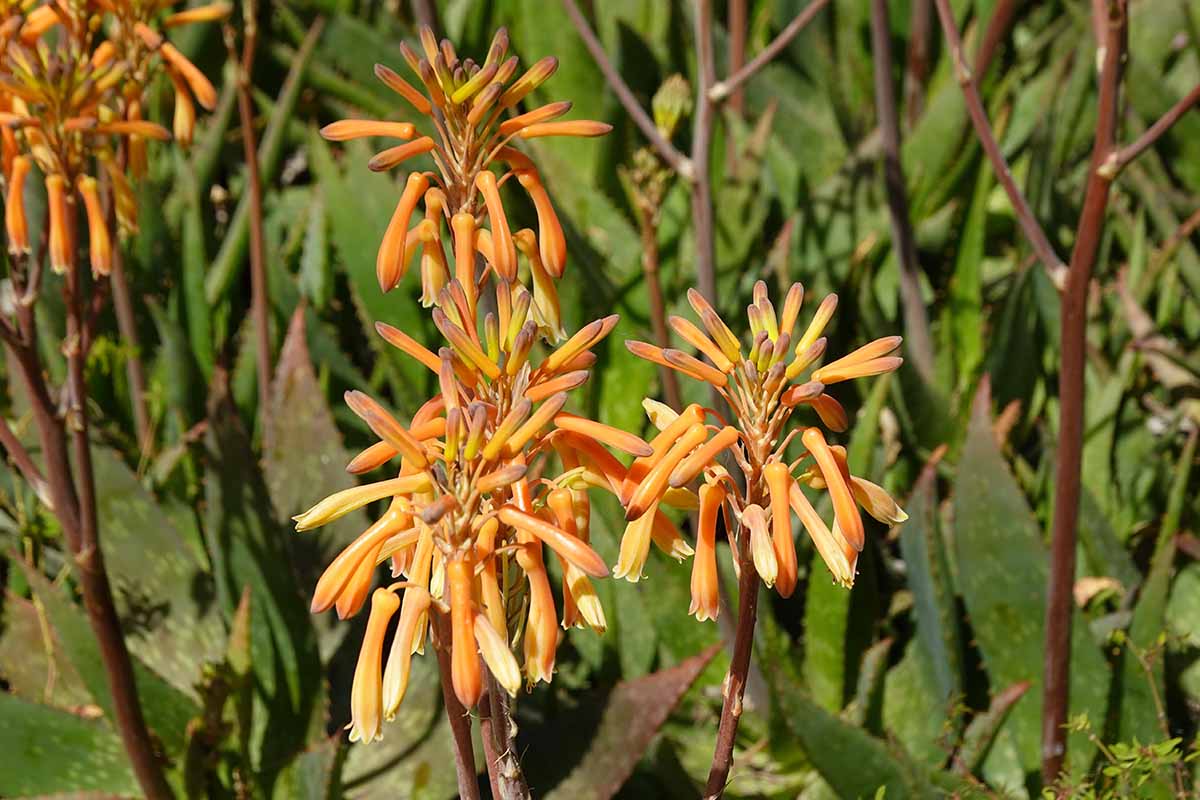
There’s no reason to feel guilty when there are so many gorgeous species, hybrids, and cultivars available.
Do you live in a climate where outdoor growing is a possibility? Or are you going to bring one of these lovely types home to grow as a houseplant? Let us know in the comments section below!
If you’ve enjoyed this roundup, check out these titles next. You’ll be an aloe specialist in no time at all!


Excellent ????
Hello my name is Lorraine and I am wondering in anyone can tell me if this is an Aloe Vera or is is an other sort of Aloe its huge
Hi Lorraine, thanks for reaching out – this is an agave aka century plant. We have a guide to growing agave where you can learn more about it.