

Geranium spp.
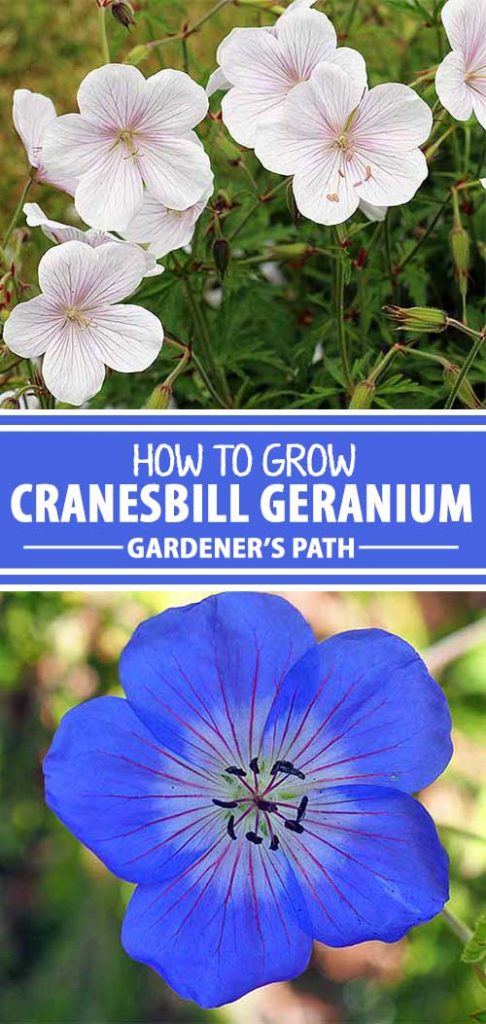
Cranesbill geraniums, also known as hardy or true geraniums, are prized for their pretty, saucer-shaped flowers, long flowering time, vigorous sprawling habit, and easy care.
The single or double blooms flower in shades of blue, mauve, pink, purple, or white from early summer through to first frost.
And the softly scrambling plants are excellent as seasonal ground covers, tumbling over retaining walls, spilling from containers, or as a filler in borders and mixed beds.

We link to vendors to help you find relevant products. If you buy from one of our links, we may earn a commission.
With their long flowering time, the nectar- and pollen-laden flowers attract several species of bees and other pollinators but are mostly resistant to grazing herbivores like deer and rabbits.
A long-lived perennial, growth is slow in the first couple of years. But once a mound is formed, cranesbill geraniums put on a steady performance all season long.
So if you are looking for some easy care perennials with a long flowering season, let’s dive into how to grow and care for cranesbill geraniums.
Here’s what I’ll cover:
What You’ll Learn
Cranesbills are herbaceous perennials in the Geranium genus, part of the Geraniaceae family, and shouldn’t be confused with either scented geraniums or garden geraniums which belong to the genus Pelargonium.
Native to temperate regions around the world, Geranium species can be found nodding in alpine and lowland meadows, prairies, rocky slopes, and mixed woodlands.
Quick Look
Common name(s): Cranesbill, hardy, or true geranium
Plant type: Herbaceous perennial
Hardiness (USDA Zone): 4-9
Native to: Temperate regions of Asia, Europe, and North America
Bloom time / season: Early summer to fall
Exposure: Full sun to light shade
Soil type: Humus rich, loamy, well-draining
Soil pH: 6.0 to 7.5, slightly acidic to slightly alkaline
Time to maturity: 3-5 years (from seed)
Mature size: 12-36 inches wide x 6-24 inches high
Best uses: Borders, mixed beds, ground covers, containers
Taxonomy
Order: Geraniales
Family: Geraniaceae
Genus: Geranium
Species: Clarkei, himalayense, maculatum, psilostemon, sanguineum
The genus name comes from the Greek “geranos” for crane, and the common name of cranesbill is Old English, referring to the long, beak-like fruit capsules that form after flowering.

A loosely mounding plant, the dark green leaves have a light, citrusy fragrance and grow alternately in a roughly circular shape, with five-petaled flowers borne on delicate, branched stems.
The roundish leaves are lobed or heavily cleft, and many varieties offer late season interest with colorful foliage in burnished bronzes, browns, reds, and yellows.
They grow in a range of six to 24 inches tall with a spread of 12 to 24 inches.
Easily cultivated and low maintenance, these reliable garden stalwarts put on a handsome, if somewhat low-key, display of charming pastel beauty from early summer to autumn.
How to Grow
Cranesbills are easy-care plants and once established, require only a little attention from the gardener.

Here’s what they like for optimal performance:
Climate
Geranium plants are from temperate regions and grow most vigorously in warm, but not overly hot, daytime temperatures with cooler nights.
As herbaceous plants, all the foliage dies back after the first hard frosts arrive, with new growth emerging in mid-spring the following year.
They’re hardy in USDA Zones 4 to 9, with variations in cold temperature tolerance depending on the cultivar.
Light
The ideal lighting for the most floriferous plants is to provide conditions similar to their meadow margins and woodland homes.

Full sun in the morning and light shade in the afternoon – to prevent sun scorch from intense sunlight – is their happy place.
Settings such as open areas under tall trees, gardens with an easterly orientation, or shouldering taller shrubs in mixed beds are good choices.
Soil
Cranesbills can grow in a variety of soils including chalk, loam, and sandy mediums.
But for the most robust growth and an abundance of flowers all season, loamy, humus-rich, and well-draining soil is best.
To enrich your soil, mix in a generous one or two parts of compost, well-rotted manure, or worm castings with two or three parts of good quality garden soil.
To improve the soil’s drainage, mix in one part of grit using materials such as landscape sand, pea gravel, perlite, or stone chips to sharpen the texture and improve water flow.
Temperature and Humidity
For robust growth, cranesbills prefer daytime temperatures between 70 and 85°F and cooler nights of 55 to 65°F.

They require moderate humidity levels in the range of 40 to 60 percent.
Avoid arid conditions with low humidity which can cause drooping, wilting, and low flower production.
And avoid excessive humidity as well to dodge fungal issues such as powdery mildew and root rot.
Water
Hardy geraniums like to keep their roots cool in soil that’s lightly moist but not soaking wet.
Aim to provide cranesbill geraniums with one or two inches of water per week, depending on rainfall, how much sun they receive, and ambient temperatures.
But remember that container-grown specimens typically need more frequent watering when temperatures soar.
Fertilizing
When grown in rich soil, hardy geraniums require little additional feeding but do benefit from having their nutrients “topped up” each year.

In springtime after new growth emerges, apply a topdressing of compost, manure, or worm castings, spreading a one- or two-inch layer of organic matter over the root zone – which also helps to retain soil moisture.
If your soil is poor quality, along with the spring topdressing, a slow release, granular fertilizer can be applied in spring using a balanced formula such as 5-5-5 (NPK) or a flower-boosting ratio like 4-6-4.

Enhanced All Purpose Plant Food
Burpee carries their own-brand Enhanced All Purpose Plant Food that can be applied according to package instructions.
Alternatively, a liquid or water soluble feed may be used. Apply in late spring when new growth is at least six inches tall and reapply after six weeks if needed.
However, it’s important to avoid overfertilizing – like most plants that enjoy lightly shady conditions and moist soil, overfertilizing is one of the main causes of sprawling, lanky growth.
If you give your cranesbill geraniums a midsummer shearing to reshape lanky limbs, a second application of slow release fertilizer can be applied after pruning. More on shearing in a bit!
Now let’s check out a few noteworthy varieties.
Cultivars to Select
With dozens of cultivars available, there’s plenty of choice. Here are a few popular options to consider starting with.
Boom Chocolatta
Loaded with masses of mauve flowers, ‘Boom Chocolatta’ also sports gorgeous foliage in chocolaty bronze.

The mounding, upright growth is ideal for mass planting or as a filler in beds and borders. Plants are hardy in Zones 4 to 8.
Bare root plants are available at Burpee and in one-gallon containers at Nature Hills Nursery.
Havana Blues
The unique coloring of ‘Havana Blues’ features large, pretty blue mauve flowers with magenta veining and new foliage of bright chartreuse.

A tidy, low growing cultivar with a vigorous spread, ‘Havana Blues’ makes a good choice for ground covers, underplanting shrubs, and in cottage gardens. Hardy in Zones 5 to 8.
Bare root plants are available at Burpee.
Tiny Monster
A miniature cultivar, the compact ‘Tiny Monster’ is highly floriferous with clouds of fuchsia pink flowers and foliage with gorgeous fall shades of bronze, red, and purple.

A beautiful choice for beds, borders, containers, edging, and ground covers. Hardy in Zones 4 to 8.
Plants are available in one-gallon containers at Nature Hills Nursery.
Maintenance
Cranesbill geraniums have few needs, but a little regular maintenance helps to keep plants tidy, healthy, and producing plenty of blooms.

To maintain their light, airy form with a lovely spreading habit, deadhead regularly to encourage more flowers.
Shearing
In some situations, such as too much shade or overfertilizing, they can become lanky and spent-looking, with long, leafless stems and only a few flowers at the tips.
To quickly restore a full form and encourage more flowers, shear plants back in midsummer by up to one-half of their overall size.
Winter Care
In fall after the foliage has yellowed and died back, cut back any stems still attached to the crown, cutting them close to the soil.

Rake up and dispose of any remaining plant debris.
A protective winter mulch can be beneficial to insulate the roots and protect them from heaving in freeze/thaw cycles.
During dormancy, place a two- to four-inch layer of mulch over the crown and root zone, using materials with a lofty structure such as shredded leaves, chopped bark, or straw.
Pull back and remove winter mulches after the soil thaws in late winter or early spring.
Propagation
Propagating cranesbill geraniums is easy, you can either sow seed, take stem cuttings, or root division.
And because cranesbills self-seed lightly, volunteer seedlings are often available for transplanting.
From Seed
Sowing seeds is reliable, but it can take a few years for seed-started plants to flower.
To collect seeds, wait until the seed pods dry out and darken, changing color from green to brown, gray, or tan. This happens about a month after flowering.

But don’t way too long after the color changes – they need to be harvested before the mericarps separate and eject the seeds.
Many varieties need cold stratification for germination. Place dry seeds in an envelope and set them in the refrigerator for up to 60 days.
Or you may simply purchase pre-treated seeds of your favorite cultivars.
- To sow seeds, prepare two-inch cells with a seed starter soil. Water lightly to moisten.
- Add a single seed to each cell and barely cover with soil, no more than one-quarter inch.
- Cover the cells with a cloche or cover with clear plastic to contain moisture and aid germination.
- Place the cells in a warm location, at least 70°F, in bright, indirect light.
- Keep the soil lightly moist. Germination should occur in seven to 21 days.
- After germination, remove the covers.
- When seedlings have two sets of true leaves, transplant into containers or prepared beds.
Taking stem cuttings is another quick option for starting new plants.
From Stem Cuttings
Choose semi-ripe stems from the current year’s growth and collect from midsummer to mid-autumn.

Use clean, sharp shears to snip stems three or four inches long, cutting just above a set of leaves.
Dip the cut end in a rooting hormone powder then place cuttings in four-inch pots filled with good quality potting soil that has a light, sandy texture.

Bonide Bontone II Rooting Hormone
If you need rooting hormone, you can find Bonide Bontone II available from Arbico Organics.
Water gently to settle stems then tuck them into a protected location outdoors that receives morning sun and afternoon shade. Alternatively you can keep them indoors or in a greenhouse.
Allow the cuttings to grow for a year before planting out, ensuring the soil stays lightly moist and scratching in a teaspoon of slow-release fertilizer pellets into the medium in spring.
Learn more about propagating geraniums from stem cuttings here.
Root Division
Most hardy geraniums live longer if they are divided every three to five years. When you see that the center growth is dying out, it’s time to divide.
Divide cranesbill geraniums anytime from early spring to early summer, as this gives them plenty of time to establish roots before cold weather arrives. Here’s how:
- Use a sharp spade to dig up the clump of plants.
- Gently shake off soil from the roots.
- Use a clean, sharp hori hori, garden knife, spade, or trowel to separate the root ball into quarters or equally sized pieces, ensuring each division has a healthy root section and some foliage.
- Prepare the planting site with humus rich, well-draining soil and mix in one or two tablespoons of bone meal for strong roots and ample bud set.
- Replant each quarter or section at its original depth – the crown should be at soil level.
- Water gently to settle plants in place.
Until they are established, water regularly to keep the soil lightly moist.
Managing Pests and Disease
True geraniums are quite tough and resilient with few problems, but there are a couple of issues to watch for.
Pests
Common pests you might come across are mostly sapsuckers such as aphids, spider mites, and thrips.
A strong spray of water from the garden hose can dispatch many pesky insects or plants can be sprayed with a natural pesticide such as neem oil.

You can find Bonide Neem Oil available from Arbico Organics.
Disease
Fungal issues such as powdery mildew and bacterial problems like leaf spot can hinder growth.
Both can be treated by removing the infected areas of the plant with clean, sharp shears then spraying with a natural fungicide such as neem oil.
Be sure to clean your shears afterwards with bleach to prevent spreading disease – a solution of one part bleach to nine parts water works well.
Hardworking Perennials
The cranesbill geranium is everything good about hardworking perennials!
Their care and feeding requirements are simple, they adapt to multiple garden locations, and they reliably add colorful blooms all summer long.

Just give your plants regular water, some afternoon shade, and a good shearing if they get a bit too leggy.
Then relax, kick back, and enjoy the show!
How about you folks, are you growing hardy geraniums? What are your favorite cultivars? Let us know in the comments section below!
And for more information about growing geraniums in the garden, check out these guides next:


My cranesbill leaves turn brown after spring flowering. Should I move to a shady location? How can I get them to flower all summer?
They prefer afternoon shade Evelyn, so moving them might help if they’re getting blasted with hot sun. Try cutting them back lightly (no more than 1/4 of total growth) after spring flowering, and give them regular doses of a 20-20-20 all purpose fertilizer throughout the growing season – that should help produce a few more blooms. Thanks for asking!
Hi Lorna, Thank you for your sharing your knowledge on the hardy geranium. I purchased 6 of the Rozanne variety last year to line my walk. . They did great through the summer and fall. This spring I waited to see them come up again. Sadly only 1 returned after winter. I did nothing to them after their growing season ended. Should I have cut them back right before winter? They were expensive and I hesitate to purchase 5 more to replace the ones I lost especially if something I did wrong caused them to die. I am planning to… Read more »
Your Rozanne sounds like it should be a better performer Doreen. A couple of things I can think of… they need good drainage, and sitting in water over the winter could cause root collapse.
The other thought is to ensure the plant’s crown is planted deep enough to withstand freezing temperatures. – a thick winter mulch, 4-6 inches deep will help with this. And no need to cut them back at the end of the season, they’ll die back on their own. Hope this helps, and good luck with your cuttings!
I just received some cranesbill geranium from a friend. When planting, should I cut the top growth to encourage strong roots?
Spot on Barb! I’d trim back about one-third and add a nice topdressing of compost. A mid-summer trim will encourage more blooms too!
Thanks for your question!
Hi, Mine seem to spread beautifully but I only get one or two flowers. It looks healthy and keeps spreading but no flowers. Any idea why?
Lots of plants will respond to too much nitrogen in the soil by leafing out but failing to flower. Are you fertilizing your plants?
I was at a garden center where a beautiful geranium was growing up through a crack in the sidewalk. I was offered the opportunity to take seeds, which I did. My question is, should I plant the seeds now or wait and plant them in the spring and be able to take a year before they bloom? The owner of the garden center said she thought it was a perennial geranium. It had that kind of a bloom, and kind of an ivy geranium leaf.
What a lucky find, Ellen! Geranium seedlings tend to grow slowly. Save them in an envelope in a cool, dry place for now, and plant them indoors in February in a warm and sunny location, or under grow lights on a heating mat. Some types will germinate in just a few days while others may take a month or so- be patient! Plan to transplant them outdoors or transfer them to pots in a sunny location, hardening them off gradually after the threat of frost has passed.
Good luck! Let us know how it goes!
Cranesbill Geranium, Do seeds need a cold season to germinate? When starting seeds indoors, do seeds need to be scratched to promote germination? I have tried to cultivate indoors from seed in early spring without success.
The seeds don’t require any special treatment to germinate Norine, but I suspect you may have collected seed from a sterile hybrid. Plants of this nature need to be propagated vegetatively, with root divisions or stem cuttings – both of which are easy and reliable with geraniums.
Thanks for your question!
Hello Lorna. Hope you are well. I recently bought ‘PATRICIA’ cranesbill in memory of my dear mom who passed away in May this year. They were plug plants and we left them in bigger pots before planting them out under a rose. The one plant has flowered well but the flowers are wilting now the other 2 failed to flower. The leaves are very leggy. Any advise please. Blessings to you x
‘Patricia’ makes a lovely tribute to your mom Teresa, such a pretty color! Cranesbill can take a year or two to really hit their stride, so new plants with low flower count might just be ‘late bloomers’ – production should improve next year. As the growing season wears on they can become leggy and benefit from a good pruning around mid-summer. Cut back by as much as half to encourage new growth and blooms. Also, ensure the soil is consistently moist and avoid over-fertilizing, which can cause them to sprawl. A single application of a slow-release, 10-20-10 fertilizer in spring… Read more »
Thank you and blessings to you x
Hello Lorna, We purchased a new home last summer and there is an over abundance of NH Cranesbill on the property. Pretty much the backyard is a field of it. It is thriving and has been well established here for years. I want to relocate some of it and give some away to neighbors and friends. Would a sod cutter work to transplant large patches or do you recommend repotting and distributing in this way? There is so much of it that it seems I could take it in small squares or sheets to transplant. I am excited to see… Read more »
I like your idea of cutting out squares or sheets to transplant, Brenda. It would certainly be a lot less labor-intensive than lifting and repotting individual plants. This would work well for the masses of plants you describe, and you should be able to lift enough of the roots with a sod cutter or shovel to move them successfully. Try lifting and relocating half a dozen or so sections this spring – if you’re happy with the results, you can move more at the end of summer. If not, it’s back to repotting. Thanks for you question, and let us… Read more »
I bought some geranium Roseanne for my back yard to plant along my garage, but the front of my house has a red theme and was wondering if they have a red geranium I could purchase that will return yearly as well? Any suggestions? Thanks, Tom
Unfortunately, there are no true red ones that I know of, Tom.
There are plenty of magentas and several in shades of bright pink… what about white or a very pale pink?
G. cantabrigiense ‘Biokovo’ is a very light blush color and G. ‘Spessart’ has white petals – could look very nice against the red!
Thanks for your question, and let us know what you decide on!
Are there any Cranesbill’s that bloom 2 or 3 times a year? Thanks Sharon
Hi Sharon, there are no “repeat blooming” cultivars that I’m aware of.
However, with regular deadheading and cutting back leggy growth, many of the popular cultivars provide months of flowers from spring until frost.
‘Ann Folkard’, ‘Ballerina’, ‘Mavis Simpson’, ‘Patricia’, and ‘Rozanne’ are a few award-winning cultivars noted for their outstanding displays and long flowering seasons.
Thanks for asking!
Hi Lorna, I have a cranesbill for several years now. When I first planted it it had beautiful purple flowers however this year the flowers came in white. Is this a ph problem?
Unlike hydrangeas, geraniums do not change color based on the pH level of the soil. Did the flowers that had white blooms this year grow from seed? Hybrid cultivars do not produce seeds with the same qualities of the original parent plant, so this may be what happened here.