

Astrophytum spp.
Whenever I hear news about space exploration and astronomical discoveries, I perk up and take interest – while at the same time knowing that there’s so much here on planet earth to learn about as well.
Enter the aptly named astrophytums – which literally translates to star plants.
With their decorative surfaces, these cacti can provide nearly as many opportunities for star gazing as the night sky.

We link to vendors to help you find relevant products. If you buy from one of our links, we may earn a commission.
Astrophytum species are globular or column-shaped cacti and most of them are spineless.
They tend to have large areoles, either along the ribs or centered between the ribs, which create attractive patterns on the surface of the plant.
Some Astrophytum species also have tufts of wooly hair emerging from these areoles, while others lack these tufts.
They are native to Texas and Mexico, growing in regions where conditions are hot, sunny, and windy.
In the wild, these plants grow among rocks and scrubby vegetation, as well as among other cacti such as prickly pears.
If you are looking for a gorgeous houseplant or a spineless addition to your xeriscape in Zones 9b to 11b, this guide will show you just how easy it is to grow astrophytums.
Here’s what I’ll cover:
What You’ll Learn
There are six different species in the Astrophytum genus, but the ones most commonly found in cultivation are A. myriostigma, aka bishop’s cap, A. ornatum, aka monk’s hood, and A. asterias, the star cactus.
Most species feature three to 13 ribs divided by vertical grooves. The number of ribs varies depending on the species and the individual plant.

These slow-growing plants can reach mature sizes of two to 12 inches wide, and two inches to over six feet tall.
Four out of the six species of Astrophytum are spineless, making them attractive to succulent collectors such as myself who avoid most desert cacti for fear of getting stabbed.
Also, astrophytums do not have glochid spines, so you won’t have to be concerned about those soft looking hairs playing a nasty trick on your skin.
Quick Look
Common name(s): Astrophytum, bishop’s cap, monk’s hood, star cactus
Plant type: Evergreen succulent
Hardiness (USDA Zone): 9b-11b (outdoors)
Native to: Mexico, Texas
Bloom time / season: Spring, summer
Exposure: Direct sunlight, full sun outdoors
Soil type: Very gritty succulent and cactus growing medium
Soil pH: 6.0-7.0, slightly acidic to neutral
Time to maturity: 5 years
Mature size: 2-72 inches high x 2-12 inches wide (depending on species)
Best uses: Houseplant, cactus planters, xeriscaping
Taxonomy
Family: Cactaceae
Subfamily: Cactoideae
Genus: Astrophytum
Species: Asterias, capricorne, caput-medusae, coahuilense, myriostigma, ornatum
Some, such as monk’s hood cactus (A. ornatum), also feature white flecks – sometimes referred to as flocking – on their skin, which are hairy white scales, while others have bare skin. These flecks are unique to cacti in this genus!
These scales can vary in size from tiny to large, and can create intricate patterns, a feature seen on some of the Astrophytum cultivars.
The flowers are fairly large relative to the size of the plants themselves, are funnel shaped, and pink, yellow, or yellow and red in color.
If flowers are pollinated, blooms will give way to berry-like fruits. These fruits naturally split open, revealing seeds which can easily be propagated to produce new plants.

Astrophytums are undemanding houseplants provided they are given ample light exposure on a sunny windowsill or under a grow light, or a combination of both.
Outdoors, gardeners in USDA Hardiness Zones 9b to 11b can grow astrophytums as specimen plants, or as companion plants for agaves or other xerophytes, in areas where there’s protection from rain.
How to Grow Astrophytum
Astrophytums can be incorporated into cactus and succulent collections in interiors where direct sunlight or grow lights are available.
While succulent planters are cute, if you include astrophytums in a dish planter with other species, choose those with similar water and soil needs – many succulents require more frequent watering and a richer growing medium than these plants do.
Let’s have a look at the growing conditions you need to cultivate astrophytum cacti:
Light
Monk’s hood cactus and the other members of this genus require at least six, preferably eight hours of direct sunlight each day or the equivalent from a grow light.
There’s a good way to find out if your light conditions are bright enough – use a light meter to take objective measurements.
With the light meter, choose a spot where the astrophytum will receive at least 800 foot candles of light.
Outdoors, provide a sunny location with light shade during the hottest part of the day. In the wild, they grow nestled among rocks or other plants that offer them some protection from the elements.
Water
Astrophytums are drought-tolerant, and their growing medium should be allowed to dry thoroughly between waterings.
It’s far better to err on the side of underwatering rather than overwatering.

If you notice cracks on your astrophytum, you may be overwatering. When the plant is thirsty, you might notice it looking a bit deflated.
To avoid the damaging effects of chlorine from tap water and buildup of mineral deposits from well water, use rain water or filtered water.
Want to learn more about the best water for succulent plants? Read our guide!
You will notice that you don’t have to water these plants very often.
Watering will be even less frequent during winter, and you should stop watering entirely while the plant is exposed to temperatures below 60°F.
Our guide has more information about how to water cacti.
Soil and Pots
Astrophytums need well draining soil with a pH of 6.0 to 7.0.
The growing medium should ideally consist of just 10 percent organic matter, such as coconut coir, compost, horticultural charcoal, biochar, or pine fines, and 90 percent mineral content, like coarse sand, fine rocks, pumice, or lava rocks.
These plants require excellent drainage so make sure to choose a container that has drainage holes in the bottom.

When choosing a pot, also keep in mind that unlike many cacti, astrophytums have long tap roots.
So pick a pot that is narrow, about the same width as the cactus, but deep enough to allow room for the roots.
You can learn more about how to make your own cactus potting mix in our guide.
Humidity
Unlike many lithops and other succulents from South Africa such as tiger jaws that are adapted to low rainfall but high air moisture, astrophytums evolved to thrive in low levels of humidity.
Humidity of approximately 40 percent is what you should aim for indoors.
Temperature
Monks hood cacti and other members of this genus prefer daytime temperature ranges of 70 to 90°F.
Nighttime temperatures that are 10 degrees lower will help mimic the plants’ native environments.
On the colder end of the temperature spectrum, astrophytums are hardy down to the low 20s as long as the humidity is low and the growing medium is kept dry.
Fertilizing
Cacti and succulents tend to grow in areas with poor soils so they don’t need to be pumped full of nutrients like garden veggies.
A mild fertilizer formulated for cacti should be applied only once a month during the growing season.

I like to use Dr. Earth’s Succulence Cactus and Succulent Plant Food, available from Arbico Organics.
Deadheading
If your astrophytums produce flowers that aren’t pollinated, the blooms will fade rather than turning into seed-bearing fruits.
When the flowers have dried, use a clean, sterilized pair of garden snips or scissors to trim them off.

After pollination, the fruit will swell until it cracks open. Let it split open on its own before you harvest the seeds for propagation.
Repotting
The best time to repot astrophytums is in spring or summer, when the plant is actively growing. Plan to repot every two years to refresh the growing medium, even if a larger pot is not needed.

If the plant has become rootbound, choose a pot that’s just one size larger. Avoid using overly large pots as the excess soil can end up retaining too much moisture.
When you are repotting, ensure that the plant is sitting at the same depth as it was in its original container.
After repotting, wait a week before watering rather than doing so straight away.
Learn more about how to repot cacti in our guide.
Species and Cultivars to Select
After learning how easy it is to care for these plants, it’s time to take a look at the different species in more detail as well as some fabulous cultivars.
Asterias
Known as sand dollar, sea urchin, star, Texas star cactus, or star peyote, A. asterias reaches one to two inches tall and two to six inches wide at maturity.
And though the round, squat shape of this plant resembles peyote, A. asterias contains no hallucinogenic compounds!

This astrophytum is spineless, brownish green in color, covered with small white flecks, and has wooly areoles that form lines going down the center of each rib, of which there are four to 13.
The flowers are yellow with red centers.
Since these plants are endangered, it’s illegal to collect them from the wild. There are plenty of seed-grown options in cultivation.
It can be tricky to know if plant nurseries have sustainable practices without interviewing them. If in doubt, choose a cultivated variety of A. asterias instead.
‘Super Kabuto’ is perhaps the most popular A. asterias cultivar. These plants are covered in attractive, large white flecks.

The flocking on different specimens will vary in its exact pattern – some are so covered in flecks that they are almost completely white, others have large woolly spots or V-like patterns.
Capricorne
Named for its curved spines, A. capricorne is commonly called goat’s horn cactus.
This globe-shaped astrophytum has a single stem that becomes more columnar as it matures, eventually reaching up to six inches wide and four feet tall.

Goat’s horn cactus is green and covered to varying degrees with white flecks. Its spines grow in clusters of five to 10, and it has eight ribs, with areoles that grow vertically along the ribs.
Flowers on goat’s horns cacti are yellow with red centers.
Caput-medusae
With a species epithet that means Medusa’s head, A. caput-medusae was formerly classified in a different genus, as Digitostigma caput-medusae.
When you look at this plant, you don’t see a globular or columnar stem, but instead a bunch of unruly-looking protuberances that inspire its species name.

Those protuberances, or tubercles, as they are more commonly called, are covered with white flocking and emerge from a tiny, ground level stem that is covered in bristles.
Plants can reach up to seven and a half inches tall and wide, and bear yellow blooms at the ends of their protuberances.
This astrophytum is critically endangered as a result of overcollection and grazing pressures.
Coahuilense
A species that is sometimes known by the common names bishop’s cap, bishop’s miter, or monk’s hood cactus, A. coahuilense is easily confused with the more widely available A. myriostigma.

With five ribs and growing in a globe or columnar shape, this bishop’s cap reaches up to eight inches tall and up to four inches wide at maturity.
The skin is densely covered with white flecks, giving this spineless species a gray appearance.
The flowers are yellow with red centers.
Myriostigma
Commonly known as bishop’s hat, bishop’s cap, or bishop’s miter, A. myriostigma is one of the most widely cultivated of the astrophytums.
At maturity, plants reach four to 10 inches wide and up to two feet tall, though occasionally they can reach five feet tall at maturity.

Spineless plants are green with white flecks or may be smooth, without flocking.
This species produces three to 10 ribs, with areoles along the ribs, and bears flowers that are yellow with yellow centers.
There are many A. myriostigma cultivars available, including the fascinating ‘Kikko.’

‘Kikko’ has horizontal furrows in its ribs, giving the plants a unique texture.
There are different forms of the ‘Kikko’ cultivar, some of which are quite geometrical looking, while others look more like they were roughly sculpted out of clay by children!
Read more about growing A. myriostigma succulents.
Ornatum
With the most spines of all astrophytums, A. ornatum is most commonly known as monk’s hood cactus but is also sometimes called ornamented bishop’s cap.
Monk’s hood cactus is dark green to grayish green, and globe-shaped, becoming cylindrical as it matures. This species can reach 12 inches wide and six feet tall or more as it ages.

The skin is covered with white flecks, but in variable amounts – they can be very sparsely or quite densely covered, with the flecks creating beautiful patterns.
Monk’s hood cacti usually produce eight ribs, but this number can be between five and 10, giving the plant a star shape when viewed from above.
A. ornatum bears yellow flowers with yellow centers when it blooms.
The conservation status of monk’s hood cactus is vulnerable as a result of habitat destruction and overcollection, so shop responsibly or grow it from seed instead.
Propagation
If you want to propagate species in the Astrophytum genus, you have a couple of options: sowing seeds and grafting.
While some cacti produce offsets, astrophytums don’t usually reproduce in this manner.
Want to take a deep dive into cactus propagation? Read our article to learn more.
If you’re growing these succulents from seed, you’ll need to have a fair bit of patience as it takes a long time for them to reach maturity.
Grafting is a good option as it involves taking an astrophytum scion and attaching it to a rootstock from a faster-growing species.
Managing Pests and Disease
Healthy astrophytums aren’t going to be bothered by many pests. Outdoors, they won’t be bothered by herbivores like deer or rabbits.
The pests you’re most likely to encounter are spider mites and mealybugs, so check new plants carefully before purchasing, or as soon as you unpack them if purchasing online.
On cultivars with a lot of white flocking it can be hard to make out mealybugs, so you may need to use the macro lens on your camera or pull out a jeweler’s loop or a magnifying glass.
The disease you’re most likely to encounter in astrophytums is rot. If the plant is going mushy, that’s a sign it’s suffering from rot
You can learn more about how to deal with rotting succulents in our guide.
Spiny or Spineless Star Gazing
You now know enough to do more than just gaze lovingly at your astrophytum – you can confidently care for it as well!
Water infrequently, provide plenty of sunlight, and excellent drainage.
Which type of astrophytum got you hooked? (No pun intended, hopefully!) Let us know in the comments section below.
And if you need any help troubleshooting, feel free to drop your questions and photos there as well.
Want to keep educating yourself on the fine art of cacti and succulent growing? We have more reading for you right here:

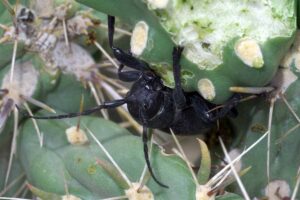
The Asterias astrophytum on your first picture ) shows red mites on the cactus. My Asterias suddenly also has those red mites. Are those spider mites?
Hi S.R., I can understand why you think those might be red mites, but I’m not totally convinced that they are. I don’t see enough detail in the image to be sure, personally, but I will also admit that my eyesight isn’t perfect! There are other types of red mites that are found on houseplants besides spider mites, and some of them are actually beneficial. So before you treat your cactus like it has an infestation, I would confirm that the bugs on your plant are indeed spider mites. You can learn what to look for and read more about… Read more »