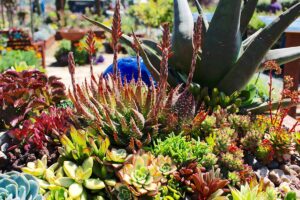
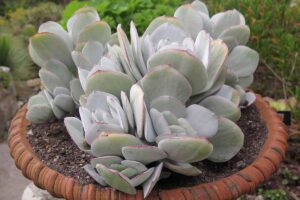
Gasteria spp.
Some houseplants provide a beautiful flush of greenery, others feature surprisingly fragrant blooms – and then there are the outliers, the ones that are so odd that you aren’t really sure why you’re attracted to them.
For me, gasterias aka ox tongues are in the latter category.
With leaves shaped like straps or tongues, these plants and their funky foliage have won a place in my heart as my all-time favorite succulent houseplant.

We link to vendors to help you find relevant products. If you buy from one of our links, we may earn a commission.
Gasteria is a genus of 29 succulent species native to South Africa and Namibia that have mostly stemless leaves shaped like triangles, spears, straps, or tongues.
This foliage grows either in a fan shape, with two opposite rows of leaves, or in a rosette or semi-spiral shape.
Usually they produce numerous offsets, creating a clumping growth habit.
These succulents can be grown as houseplants or outdoors in the landscape in Zones 9 to 11.
Ready to learn more? Here’s what I’ll cover:
What You’ll Learn
Gasteria is part of the Asphodelaceae family, which includes succulent relatives such as aloes, haworthias, and haworthiopsis, but also daylilies and red hot pokers.
Depending on the species, they can be as short as one inch tall or as large as two feet tall. These succulents tend to have a wider spread than height, ranging from four inches to two feet wide.
Quick Look
Common name(s): Gasteria, ox tongue
Plant type: Evergreen succulent
Hardiness (USDA Zone): 9-11 (outdoors)
Native to: Mexico, Central and South America, Southeast Asia
Bloom time / season: Usually spring and summer
Exposure: Part sun to light shade; bright, indirect light
Soil type: Succulent potting soil, well draining
Soil pH: 4.9-7.6, acidic to alkaline
Time to maturity: 2-5 years
Mature size: 4-24 inches wide x 1-24 inches high (depending on cultivar)
Best uses: Houseplant, rock garden, fairy gardens, planters
Taxonomy
Family: Asphodelaceae
Subfamily: Asphodeloideae
Genus: Gasteria
Species: Armstrongii, batesiana, bicolor, glauca, glomerata, pillansii
Some species have smooth leaves with a sharp point at the end, while others have foliage covered with small bumps known as tubercles.
Still others are so densely covered with tubercles that their leaves have an extremely rough texture.
They may have toothed leaf margins, or pearl-like bumps on the edges of their foliage, and some species have smooth leaf edges.
Leaf color and pattern also varies greatly depending on the species, variety, and cultivar.

Colors range mostly from light to dark green, to grayish or bluish green, although some cultivars have yellow, white, silver, cream, or pinkish orange variegation.
Plants develop reddish tones during periods of stress such as drought or intense sunlight.

Gasterias produce long inflorescences which bear red, pink, or orange blooms with bulbous bases.
If they are pollinated by sunbirds, hummingbirds, or botanically inclined humans, green fruits form, containing black seeds.
Ripe fruits will turn brown, crack open, and the seeds are dispersed by the wind.

In their native ranges, they tend to grow in savannahs and other semi-arid habitats, nestled in among other vegetation, rocks, or in the crevices of steep cliff faces.
While gasterias are adaptable and make wonderful houseplants, they can also be cultivated outdoors year-round in USDA Hardiness Zones 9 to 11, depending on the species.
How to Grow Gasteria
Gasterias are generally easy to care for, and while some species might have slightly different preferences, I’m going to describe the growing conditions favored by those most commonly found in cultivation.
Soil
Gasterias can be successfully grown in a wide range of growing mediums, provided it has sufficient drainage.
A good option to start with is a mix made of 50 percent organic materials and 50 percent mineral content, which will ensure excellent drainage.
These succulent plants can grow in acidic to somewhat alkaline conditions depending on the species – a pH range of 4.9 to 7.6.
Choosing a Pot
Gasterias have quite small root systems compared to the size of the vegetation – so pick a container that is just big enough to contain its roots rather than choosing a large pot for it to grow into.
Make sure it has drainage holes.
Two-inch pots will be the right size for the smallest gasteria specimens, while three- or four-inch pots are big enough for most others since these are slow growing plants, and most species are quite compact.
Light
In their native ranges Gasteria species grow primarily in shaded or semi-shaded positions – behind or under other types of vegetation or rocks.
Outdoors, they do best when direct sun is limited to about four hours in the morning, with bright, indirect light the rest of the day.

Indoors make sure your succulent receives plenty of bright light. You may need to check your lighting conditions with a light meter – aim for around 800 foot candles – and if needed, supplement with a grow light.
If the plant is losing its compact growth habit and its foliage is turning a lighter color (usually pale green), it is likely not receiving enough sun.
However, if it takes on a reddish color, it may be an indication that it is exposed to too much direct sun.
Water
While gasteria succulents are drought tolerant, regular watering will keep them looking their best.

You need to allow the growing medium to dry thoroughly between waterings.
In summer this may mean watering approximately once a week, while in winter, you may be able to go for a month between waterings, depending on the day length and temperature.
Avoid pouring water directly onto the vegetation – instead, water the surface of the growing medium or use the bottom-watering method.
It’s important not to water too frequently as soggy conditions can lead to rotting, you can use a moisture meter to guide you.
Temperature
Some Gasteria species are tolerant of light frosts – down to about 25 or 30°F, but others will sustain damage below 32°F.

If you like to keep your succulents outdoors during the summer months and aren’t sure which species you’re growing, play it safe and return the plant indoors before the temperature drops below 50°F.
In general, these succulents are happy at the range of temperatures commonly found indoors.
No upper heat tolerance has been established and gasterias tend to be tolerant of high heat as long as you provide protection from direct sun.
Humidity
Although some gasterias are adapted to humid coastal conditions, most of them will do just fine at humidity ranges between 40 to 50 percent.
Fertilizing
Fertilize gasteria only during the growing season using a mild, balanced fertilizer.
I like to use Dr. Earth’s Pump and Grow Indoor House Plant Food, which has a 1-1-1 NPK ratio, and apply it every time I water during the growing season.

You can find Dr. Earth’s Pump and Grow Indoor House Plant Food in 16-ounce pump bottles from Arbico Organics.
If you use a stronger product – up to 16-16-16 (NPK) is appropriate, apply this only once every three months during the growing season.
You may also add some compost or worm castings to the growing medium when repotting to help feed the plant.
Repotting
Gasterias should be repotted every three to four years.
You may need to repot sooner if the plant is growing in the wrong type of soil or the container it’s currently in lacks drainage holes.
Even if the plant has not yet outgrown the container it is currently growing in, it’s best to refresh the potting mix even if you aren’t going up a pot size.
Species and Cultivars to Select
Gasterias are a fascinating bunch, with 29 or more different species and hundreds of cultivars.
Let’s have a look at a few of these options!
Fuji Yuki
‘Fuji Yuki’ means the snow of Mount Fuji.
Thought to be a G. nitida cultivar, ‘Fuji Yuki’ has a clumping growth habit with fat, tongue-shaped leaves streaked in white, cream, and silver, with bits of green peeping through.

‘Fuji Yuki’ reaches up to five inches tall and three to 10 inches wide, growing either in two opposite rows, or in a spiral or partial rosette shape.
You’ll find ‘Fuji Yuki’ plants in 3.5-inch pots available from Planet Desert via Amazon.
Glomerata
G. glomerata, also known as Kouga gasteria, is one of the more compact members of this genus, reaching only four inches tall and spreading up to a foot wide via numerous offsets.

Composed of short, thick, grayish or blueish green leaves that are tongue or strap shaped, the foliage remains in two opposite rows as the succulent matures.
These succulent plants have a clumping growth habit, thus the species name glomerata.
Little Warty
‘Little Warty’ is a hybrid cultivar – a cross between G. batesiana and the hybrid, Gasteria ‘Old Man Silver.’
It features light and dark green variegated leaves and is the most popular and easiest to source of the gasterias, at least in North America.

With leaves covered by tiny tubercles, ‘Little Warty’ has both visual and physical textures that are fascinating to behold.
You’ll find ‘Little Warty’ specimens for purchase in your choice of a two- or four-inch clay or plastic pot from the Succulents Box Store via Amazon.
Read more about this cultivar here.
Want More Options?
Be sure to check out our guide, “23 of the Best Types of Gasteria Succulents” to help you choose the best cultivar(s) for your rock garden or indoor arrangements.
Propagation
There are a few different methods you can use to propagate new gasteria plants: from seeds, leaf cuttings, offsets, or divisions.
Let’s take a quick look at each:
From Seed
While the process of growing succulents from seed isn’t too difficult, there is a time commitment of about a year from start to finish.
- Sow seeds in moist seed-starting medium an eighth of an inch deep and a quarter of an inch apart.
- Use a fungicide or biofungicide such as Mikro Root, available at Arbico Organics to prevent damping off.
- Keep the potting medium evenly moist and use a heat mat to maintain temperatures of 77°F during the day, and 68°F at night.
- After germination, which takes one to three weeks, move the pots into a location where they will be exposed to bright, indirect light and continue to keep the medium moist.
- Approximately three months after germination transition to watering less frequently – down to once or twice a week, depending on your climate.
Keep these tender young seedlings in indirect bright light, and allow them to continue growing in the same container, transplanting only after a full year.
You can learn more about how to start succulents from seed in our guide.
From Leaf Cuttings
The best time to propagate ox tongue plants from leaf cuttings is in the spring or summer.
It’s a simple process of twisting off one of the bottom leaves from the gasteria, dipping it into fungicide, and leaving it in a dry, bright location to allow the wound to callus over the course of two weeks.

After two weeks, fill pots or a tray with moistened growing medium and set the leaf cuttings horizontally across the surface of the medium.
Cover just the callused wound end with a little of the substrate.
Keep in bright indirect light, with a few hours of direct sun at most, and keep the growing medium moist.
Expect the leaf to root within a few weeks, after which small plantlets will start to form at the wound.
Allow these to keep growing in the same pot for one to two years before transplanting.
Learn more about propagating succulents from leaf cuttings.
From Offsets
Most gasterias produce numerous pups, and you can remove these to start new plants.
Offsets should be at least one third the size of the mother plant, and the best time to separate them is in spring.

Start by removing the parent plant from its pot.
Carefully pull as many offsets as you want to separate away from the clump, and remove the growing medium from their roots.
Place the new plant into a pot filled with succulent potting soil.
Rather than watering right away, wait a week, then resume watering as normal.
Learn more about propagating succulents from offsets.
Transplanting
If you have purchased a new gasteria succulent and you want to pot it up, you’ll need a container that’s fairly snug, with about 30 percent more room to allow the plant to expand.
And it absolutely must have drainage holes!

Unpot the plant, remove and discard the potting medium, and inspect the roots.
If the roots look healthy, you can repot it straight away.
Trim any roots that look dead or mushy, then treat with a fungicide, and allow the roots to callus over for a week in a dry location in indirect, bright light.
Fill the new pot with a shallow layer of growing medium and insert the plant.
Adjust the amount of growing medium beneath the root ball so that the crown of the plant is about a half to one inch from the rim of the pot.
Finish filling in with growing medium and wait a week before watering.
Pests and Disease
Gasterias aren’t particularly attractive to most pests. Disease is fairly rare as well, though there are a few problems to look out for.
If you’re growing yours outdoors, both rabbits and deer may be tempted to take a nibble.
The usual common garden and houseplant pests may come to visit, such as scale insects, mealybugs, and aphids, though it’s not common.
Rotting in succulents is a problem that is typically caused by overwatering or potting medium that lacks drainage.
Ox Tongues Are No Yoke
Whether grown indoors or out, gasterias are sure to delight.
They can be used in mixed planters or succulent fairy gardens – but be sure to use companion plants that have similar light and water requirements, such as haworthias and haworthiopsis.
When did you first fall in love with gasteria succulents? For me it was a ‘Little Warty’ who charmed me from day one!
Feel free to share your stories (and photos) in the comments section below. And if you have any remaining questions about gasterias, drop them there as well!
And for more information about growing succulents, add these guides to your reading list next: