
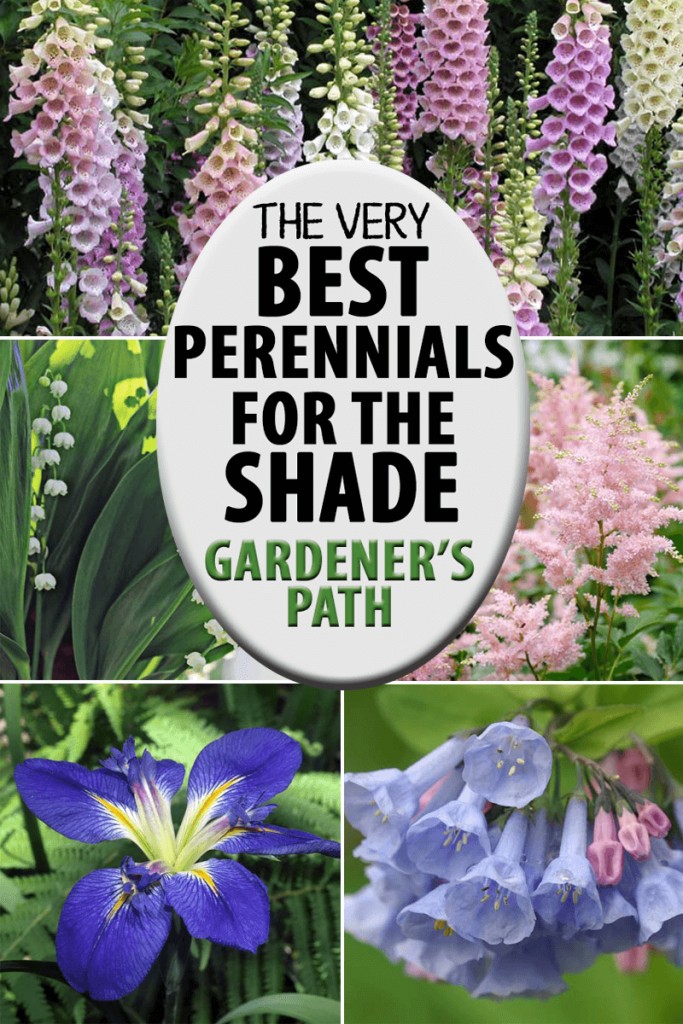

There’s no reason the shadier parts of your garden need to be bare, bland, and boring. Nor should you have to use annual plants that you’ll need to replace year after year.
Creating a colorful garden in shady parts of your yard can be challenging.
Maybe you’re like me and you bought a house with a forest of mature trees that shade practically every inch of your garden.
Or perhaps your outdoor space is mostly to the north of your home, leaving little space for sun-loving perennials.

We link to vendors to help you find relevant products. If you buy from one of our links, we may earn a commission.
Whatever your challenge, there’s a beautiful solution out there, from sweet little ephemerals that will come back spring after spring to long-blooming shrubs that add color for months at a time.
In this guide, we’ll take a look at 33 of the best plants that flower in the shade.
Here’s the lineup:
33 of the Best Shade-Loving Perennials
1. Anemone
Snowdrop anemones (Anemonoides sylvestris) produce abundant, fragrant white flowers with bright yellow centers and blue-green leaves that appear in late spring and early summer.

The plants grow about a foot tall and will spread wherever they find the moist, shady conditions they prefer.
Anemones thrive in Zones 2 to 9 where they’ll be perfect as a woodland ground cover that requires basically no maintenance.
Wood anemones (A. nemorosa and A. quinquefolia) are also spring ephemerals with similar looking flowers, though some might be pink, and they grow to a similar height.
These species are generally happy in Zones 3 to 8.
Learn more about how to grow anemones here.
2. Astilbe
The tall spikes of vibrant astilbe flowers (Astilbe spp.) are always a focal point in the garden, but don’t discount the ornamental value of the dense, fern-like foliage.
The feathery blossoms can grow on spikes up to five feet tall and are available in a variety of colors, such as white, pink, purple, and red. The flowers last for weeks from late spring through summer.
You can find astilbe cultivars that stay under eight inches tall and others that grow over four feet in height, so there’s probably a variety to suit any space.
I think these graceful beauties are a must-have in any shaded garden in Zones 3 to 9.
There are dozens of cultivars and hybrids to choose from, so find a color that adds the vibrancy you’re looking for and go to town!
I personally love ‘Maggie Daley,’ with her mauve-pink panicles that appear in midsummer.

You can find ‘Maggie Daley’ plants in #1 containers from Nature Hills Nursery.
Or, if you’re going with a softer, more elegant look, consider ‘Bridal Veil.’ The sweet, white blossoms on this favorite also appear in midsummer.

You can find ‘Bridal Veil’ available in #3 containers at Nature Hills.
3. Baldhip Rose
A rose in the shade? You betcha! Baldhip roses (Rosa gymnocarpa) grow in shady areas of western North America, Europe, and northwest Africa.
The flowers can be dark rose colored or such a pale pink they’re almost white.

The blooms are followed by fruits from which this species takes its name. The hips don’t have any sepals attached to them, making them look “bald.”
Of course, the flowers aren’t as huge and showy as some of the hybrids and cultivated types, but they produce five-petaled blossoms even in deep shade.
They bloom a bit better in partial sun, though.
When the flowers fade, you’ll still be treated to the gorgeous red hips in the fall which persist through the winter if the birds don’t get to them.
The plant grows to about five feet tall and wide in Zones 5 to 9, and will attract all kinds of wildlife. Perfect for the woodland or cottage garden.
Learn about how to grow roses here.
4. Barrenwort
Fairy wings, bishop’s hate, barrenwort, whatever you call Epimedium species, they’re delicate-looking plants with heart- or triangle-shaped leaves, and red stems.
But delicate they are not – these plants are tough and adaptable, spreading in shaded areas in Zones 4 to 9.
While a single specimen grows to about 18 inches tall and wide, depending on the species, all can spread via rhizomes and seeds.
Some have lime green, red, or multicolored leaves and heaps of brightly colored flowers in orange, pink, white, lavender, or yellow hues.

‘Amber Queen’ is wreathed in a crown of amber-gold flowers.
Roll out the red carpet for yours by picking one up in a #1 container at Nature Hills.
Or choose ‘Lilafee’ if you want some lavender blooms for darker corners of your yard.

Nature Hills Nursery has this one in #1 containers, as well.
Our guide to growing barrenwort has more info.
5. Bellflower
Bellflowers (Campanula spp.) produce little bell-shaped blossoms in clusters.
The plants come in all shapes and sizes, from creeping types that stay under two inches tall to larger species that can stretch over six feet high.
Most that we cultivate in our gardens are closer to around two feet and are hardy in Zones 3 to 9.
The majority have purple, pink, or white flowers, and when I say purple, I mean that there are some with such vibrant, deep violet leaves that they look like something out of a fairytale.
Some spread, forming carpets of color in shadier areas. Not all species do well in shade, so keep that in mind when looking for one to add to your garden.

Canterbury bells (Campanula medium) are technically biennials, but will self-seed in the garden. They also flower best in part shade with a couple of hours of direct sun.
Eden Brothers carries Canterbury Bells Mix in a mix of white, pink, and purple flowers.
6. Bergenia
Moisture-loving bergenia (Bergenia spp.) has large green leaves that act as a backdrop to highlight the huge clusters of bright pink, white, or ruby red flowers that appear in the spring.
Bergenia flowers best in partial shade, but it will still do so, to a lesser degree, in full shade.
These plants are among my favorites for livening up a shady patio.
They grow so well in containers and I like to tuck them in with some annual color like impatiens and some hostas for height.
It grows to about 18 inches tall in Zones 3 to 9, and there are dozens of fantastic cultivars that offer up all kinds of pretty colors, leaf variations, and sizes.

For example, ‘Miss Piggy’ has tall clusters of bright pink blossoms over dark green leaves.
You can find this cultivar available at Burpee.
Learn how to grow bergenia here.
7. Bleeding Heart
I’m never going to get over bleeding hearts grow rows and rows of little pink, white, or yellow hearts, like something out of a fairy tale.
These ephemerals reach around three feet tall when mature and the lacy foliage is pretty enough that I’d grow it even without the sweet little hearts.
The old-fashioned or common species (Lamprocapnos spectabilis syn. Dicentra spectabilis) comes from Asia, but there are Dicentra species native to almost all parts of North America.

‘Valentine’ is a gorgeous cultivar with blood-red petals.
It’s available in #2 containers at Nature Hills Nursery.
Or go with the species plant, which is the one with pink flowers that famously fills cottage gardens across the globe.

Eden Brothers carries bare roots in two, four, or eight packs.
Native Dicentra species act as hosts to indigenous fauna like butterflies, syrphid flies, bumblebees and other native bees.
Pacific bleeding hearts (D. formosa) have clusters of pinky-lavender blossoms, eastern bleeding hearts (D. exima) has deep pink flowers, and squirrel corn (D. canadensis) has lovely white blossoms.
So whether you’re trying to stick to natives or not, you’ve got options for Zones 3 to 9.
Learn more about growing bleeding hearts here.
8. Bletilla
Urn or hardy ground orchids, also called bletilla (Bletilla spp.), produce purple to cream flowers for weeks and weeks during the spring and summer.

This member of the orchid family gives you the long-lasting display of indoor potted orchids to the dappled shade of the garden.
Unlike many of the plants on this list, bletilla doesn’t need consistently moist soil to thrive.
In Zones 5 to 9, it will grow and spread via the pseudobulbs so long as there is plenty of organic matter to enrich the soil.
The plant grows to about a foot tall and each flower stalk has up to a dozen blossoms.
Our guide to growing terrestrial orchids has more information.
9. Bugbane
Many shade-loving flowering perennials bloom in spring or summer.
But bugbane aka baneberry (Actaea spp.) puts out its spikes of white or pink blossoms in the late summer and fall.

Bugbane’s other common name, fairy candles, should tell you how cute this plant is.
In Zones 3 to 8, the maple-like leaves grow about two feet tall, while the flower spikes can be up to six feet tall. When they appear, the butterflies, bees, and flies flock to the flowers.
The leaves are typically green, but there are types with deep purple or burgundy foliage.
Part of the buttercup family (Ranunculaceae), these plants are indigenous across North America, so look for a species that is native to your area to benefit local pollinators.
Find bugbane growing tips here.
10. Bunchberry
If you love dogwoods, you absolutely must add bunchberries aka dwarf cornel (Cornus suecica) to your Zone 2 to 9 garden.

They’re part of the dogwood genus, but instead of growing in the familiar tree-like form, the plants are creeping ground covers.
It looks like someone cut off stems of dogwoods and laid them on the ground. In the spring, the oval, pointed leaves are dotted with adorable white or pink flowers.
These plants are indigenous across North America in moist, woodland areas.
Dwarf cornel grows to about ten inches tall and thrives in acidic soil, making it perfect to fill in under conifers.
Learn more about growing dwarf cornel here.
11. Candyflower
The flowers on candyflower (Claytonia sibirica) aren’t huge and dramatic. They’re white, pink, or purple and fairly petite.
But when you see a carpet of the thick ovate or deltoid leaves dotted with blossoms, it’s hard not to be impressed.

Candyflower grows happily in dark areas and will spread wherever the soil is sufficiently moist. They bloom in late winter, during the time of year when other plants are dormant.
I love plants that do double duty, and candyflower is not just pretty, it is edible.
The leaves are sweet, juicy, and crunchy, coming from the same genus as the popular miner’s lettuce (C. perfoliata).
If you’re looking for more natives to add to your garden, this one is indigenous to the western part of North America.
You can grow them as annuals in Zones 2 and 3, but in Zones 4 and up they’ll come back year after year.
12. Corydalis
There are dozens of Corydalis hybrids that absolutely shine in the shade.
The tubular flowers are available in brilliant hues like blue, yellow, pink, and purple. C. lutea needs a bit more sun than most other hybrids, but it will also look good in shade.

My favorites include ‘Purple Leaf,’ with its bronze-tipped leaves and electric blue blossoms, as well as ‘Berry Exciting,’ with chartreuse foliage and pinky-purple flowers.
Depending on the specific type, they can grow anywhere from one to three feet tall in Zones 5 to 9 and produce flowers from early spring to midsummer.
Some put out a second flush in the summer and others die back during the hot months to return again in the fall.

Corydalis ‘Hillier Porcelain Blue’
While the individual plants don’t live a long time, they spread readily by seeds and roots.
‘Hillier Porcelain Blue’ has neon blue flowers, and you can find plants available at Burpee.
13. False Solomon’s Seal
I adore false Solomon’s seal (Maianthemum racemosum). It’s so pretty even when not in bloom, with lanceolate leaves on zig-zagging stems.

In late spring or early summer, long flower panicles emerge, and each of these can have up to 80 individual, star-shaped, white blooms. It’s a beautiful display.
These flowers are followed by pretty red berries which attract lots of birds.
False Solomon’s seal is perfect for native gardens if that’s something you’re interested in cultivating, as they grow indigenously throughout North America in Zones 3 to 9.
Solomon’s seal (Polygonatum spp.) looks similar, but this species isn’t native to North America.
14. Foam Flower
In shady woodlands across eastern North America, foam flowers (Tiarella cordifolia) fill the space with elegant star-shaped white or pink-tinged blossoms.

Perfect as either a native ground cover or in groupings, foam flower spreads slowly throughout the dappled sunlight under trees and shrubs, so long as the ground is nice and moist.
Drought is a killer of false miterwort, as it’s also known.
The plants are tolerant of cold winters, growing in Zones 4 to 9 and require basically no maintenance once established.
The attractive leaves grow to about six inches tall, topped with foot-tall spikes of flowers that truly resemble seafoam.
Beware that if you plant it near coral bells (Heuchera), the two will hybridize and produce something that differs from the species.
Some gardeners love to experiment with hybrid “heucherella,” as they are known.
15. Foxglove
Foxgloves thrive in dappled shade, especially in warm climates. The trick is to make sure they have plenty of water to keep them happy.
Where I live, you can find them all over the place growing wild in woodlands with lots of moisture.
Technically biennials, they’ll self-seed freely for a continual display year after year in Zones 4 to 9.
With many different cultivars, you can choose from compact, short varieties or those that grow taller than a toddler – in shades ranging from white to the deepest violet.
Can’t decide on one color?

The Excelsior Mix has a variety of raspberry, cream, and pink plants. Grab a packet, ounce, quarter pound, or pound of seeds at Eden Brothers.
It’s worth noting that in some areas, particularly the West Coast, foxgloves are listed as invasive.
If they’re a welcome addition in your area, check out our guide to growing foxgloves.
16. Goat’s Beard
Goat’s beard (Aruncus dioicus) is native to all parts of North America except for the Rocky Mountain region, with four varieties that each occupy distinct areas.
They produce showy white flower clusters held on tall spikes.

It slowly spreads throughout the garden via rhizomes, but it’s not aggressive.
When mature, a single plant can reach up to six feet tall, which makes goat’s beard an elegant option for an accent or border.
When in flower, the arching plumes of blossoms look like feathers nodding in the wind, earning it the alternate common name of bride’s feathers.
While it can bloom for weeks at a time in shady spots, the compound, toothed leaves are a beautiful addition to gardens in Zones 3 to 9 on their own.
17. Hellebore
You knew hellebores (Helleborus spp.) would be on this list. The plants in this genus are famous for their ability to flower even in fairly deep shade.
The flowers are large, colorful, and eye-catching. The fact that they pop up in the late winter or early spring in Zones 3 to 9 makes them even more special, adding color when the rest of the garden is sleeping.
For ongoing interest, pick a type that gradually changes color over the blooming period.
For example, ‘Pink Frost’ from the Gold Collection is a hybrid with huge flowers that start out as burgundy buds before opening into bright pink blossoms then fading to dark pink as they age.

The foliage is alluring, too. The veins are silver, contrasting against the deep green.
You can find ‘Pink Frost’ available from Fast Growing Trees.
Personally, I’m a huge fan of dark flowers and foliage. The deep purples, reds, and nearly-blacks are so unusual in nature that I think they make for a striking garden display.

‘Dark and Handsome’ is particularly deep and dark, with nearly black, double blossoms that persist for up to two months.
Burpee carries this member of the Wedding Party® series.
Learn more about hellebore care here.
18. Hosta
Hostas? Aren’t they just foliage plants? No! All hostas flower and some varieties have huge, colorful, long-lasting, fragrant blooms that are even more impressive than the leaves.
I totally get why these plants have become shade staples in Zones 3 to 9.
‘Fire and Ice’ has lovely green and white leaves that would be gorgeous enough on their own, but then the tall stalks of lavender flowers pop up in July and stick around through August.

You almost forget the super cool leaves are there.
You can find ‘Fire and Ice’ plants available at Eden Brothers.
‘Mouse Ears’ is another popular option because the tiny plant is packed with matte, blue-green, mouse ear-shaped foliage.

It’s easy to forget that come midsummer, you can hardly see the leaves for all the purple blossoms.
You can find this one at Eden Brothers too. They carry ‘Mouse Ears’ bare roots in packets of two, four, and 10.
Learn how to grow hostas here.
19. Hydrangea
Not all hydrangeas are made for the shade.
Many gardeners assume that all bigleaf hydrangeas (Hydrangea macrophylla) are fine in deep shade, but they really do best with at least four hours of direct light per day.
However, there are many cultivars, like ‘Big Daddy’ and ‘Lady in Red’ that thrive in less light.
The longtime favorite reblooming Endless Summer® (H. macrophylla ‘Bailmer’) is a fantastic option that will provide flowers all growing season long, even in shady spots.

Fast Growing Trees carries this beauty in one-, two-, three-, and seven-gallon containers.
Hydrangea blooms last for a long, long time and even as the flowers fade, the dried heads continue to add color.
Remember how I said that a lot of my yard is in the shade? Hydrangeas play a major role in my gardening and I don’t just stick to bigleaf types.
Many panicle hydrangeas (H. paniculata) do well in lower light, too.
One of my favorites, ‘Pinky Winky,’ only receives about two hours of shade per day and it still blooms beautifully with huge pink and cream flowers.

‘Pinky Winky’ Panicle Hydrangea
You can find ‘Pinky Winky’ plants in #1 and #3 containers at Nature Hills Nursery.
Our guide to growing hydrangeas has more information.
20. Iris
Some irises can bloom in shady conditions.
Crested iris (Iris cristata), Pacific coast iris (I. tenax), and table iris (I. aphylla) will all flower with purple, yellow, white, or pink flowers in dappled shade.

These species love lots of water and are generally hardy in Zones 3 to 9. The showy, long-lasting flowers stand out with their iconic shape that has inspired artists for centuries.
While the leaves are lovely when the flowers have faded, feel free to plant some summer bloomers like astilbe to add more color after the irises fade.
You’ll have to search a bit harder to find these species and their cultivars since they aren’t as popular as Siberian and other hybrids.
Our guide to growing irises can help you keep them happy.
21. Lamium
Often called deadnettle, lamium (Lamium maculatum) has fascinating foliage with spotted or splotched leaves in shades of green, silver, and gray, and pink, purple, or white blossoms.
A little bit of sun will make the foliage even more distinctive, highlighting the variegations, but lamium is perfectly happy in shade in Zones 3 to 9.
Most stay under a foot tall and spread rapidly, which can be a blessing if you struggle with weeds under your trees.

I’m partial to ‘Ghost,’ with its gray-green foliage and deep purple flowers.
You can find this cultivar available at Nature Hills Nursery in #1 size containers.

‘Beacon Silver’ has silvery leaves and bright pink blooms. You can find plants available at Burpee.
22. Lily of the Valley
The sweet, white, bell-shaped blossoms of lily of the valley (Convallaria majalis) nodding over elegant foliage add perfume and interest to even the darkest corners of the landscape.
The sword-shaped leaves are generally under a foot long, and the plant can spread up to two feet.
Beware, as lily of the valley can spread a little too enthusiastically, sending out rhizomes and seeds. The plant is listed as invasive or noxious in many regions in the eastern US.

Provided that it’s welcome in your region, you can enjoy the flowers from late spring through early summer in Zones 3 to 9.
You can find bare root lily of the valley plants available at Eden Brothers.
See our guide to growing lily of the valley.
23. Lungwort
Even if lungwort (Pulmonaria spp.) never flowered, it would still be an eye-catching focal point in the garden.
This shade-loving perennial grows in Zones 3 to 9, and sports silver-speckled foliage.

Then the vibrant pink, violet, or white bell-shaped flowers emerge in mid-spring and the plant is even more striking.
Growing to about a foot tall, some varieties have color-changing flowers that shift from pink to rosy-purple as they age. And like some hydrangeas, their flower color can be influenced by the acidity of the soil.
‘Raspberry Splash’ is a popular cultivar with leaves splotched with silver and two-toned fuchsia and deep purple flowers.

You can find ‘Raspberry Splash’ available at Nature Hills Nursery in #1 containers.
Learn more about lungwort here.
24. Mock Orange
Mock oranges (Philadelphus spp.) bloom in spring with sweetly-scented, white or cream flowers.

Most mock oranges do better in partial sun, but the western North American native P. lewisii will thrive in shade though it will generally produce fewer flowers than in part sun.
It grows up to 14 feet tall and 10 feet wide, and it does so rapidly, gaining several feet each year.
If it starts to become leggy in its shaded spot, give the shrub a hard prune after it has finished flowering.
Hardy in Zones 4 to 9, check out our guide to growing mock orange to learn more.
25. Oregon Grape
I grow a lot of Oregon grape plants (Berberis aquifolium, formerly Mahonia aquifolium) in my yard as they provide texture and color in shady spots year-round.
They bloom in spring with bright yellow, highly fragrant clusters of blossoms and the berries make an excellent jam.

Suitable for cultivation in Zones 6 to 9, ‘Compacta’ is a compact cultivar that stays smaller than the species plant, topping out at about three feet tall and four feet wide.
You can find one for your garden at Nature Hills Nursery.
Learn more about the wonderful world of mahonia here.
26. Rhododendron
Rhododendrons and azaleas (Rhododendron spp.) are staples in shady gardens.
Keep in mind that the flowers are less abundant in darker conditions, but the plants will grow happily even in deep shade.
There are seemingly endless options suitable for Zones 3 to 9, which can make choosing just one a bit overwhelming.
Narrow it down by color, size, and shape and then find a few that will fit.
If you want a large option, the stunning lavender rhododendron (R. catawbiense) grows to about 10 feet tall with a nice rounded shape.

It can be absolutely smothered in purple flowers.
Bring one home from Fast Growing Trees in a one-, three-, or five-gallon container.
If you need something a bit more petite, everyone will be talking about ‘Conversation Starter.’

It tops out at three feet tall and wide without pruning. Plus, it provides multicolored flowers with pink, white, and red hues.
It’s also available at Fast Growing Trees.
Learn more about growing rhododendrons here.
27. Spiderwort
Spiderwort, dayflower, or wandering dude, as they are known, are flowering plants in the Tradescantia genus.

Some have much showier flowers than others, but all species produce three-petaled blooms in varying sizes in the spring and summer. Not every species thrives in shade or partial shade, but many do.
Of the nearly 100 species, many are indigenous to North America, so they’re suitable for native gardens.
You can find species that grow anywhere from Zones 2 to 12. Bluejacket (Tradescantia ohiensis) has strappy, grass-like foliage and deep purple flowers.
Native to Ohio, it’s adaptable, attracts pollinators, and thrives in partial shade.
T. virginiana ‘Osprey’ has snow white flowers with mauve and yellow centers. ‘Bilberry Ice’ features dark mauve centers and pale mauve edges.
‘Blue and Gold’ is a hybrid with cute purple flowers that thrives in Zones 4 to 9.

You can find ‘Blue and Gold’ plants available at Burpee.
Our guide to growing spiderwort has more information.
28. Toad Lily
Toad lilies (Tricyrtis hirta and T. formosana) produce some pretty cool flowers.
They might be mistaken for orchids, with their bright color, eye-catching spots, and oversized tepals that bloom for weeks in the fall.

Originally from Japan and Taiwan, there are many popular cultivars available for Zones 3 to 9.
When not in bloom, the long, arching branches are laden with long, lanceolate leaves that somewhat resemble those of Solomon’s seal.
These plants reach up to three feet tall and do well in rocky areas, ideal for adding color to a shady rock garden.
Plant them close to benches or walkways so you can enjoy the petite pink, cream, white, or purple blossoms.

You can find bare root T. formosana available at Burpee.
29. Trillium
With 38 species of trilliums (Trillium spp.) indigenous to North America, there’s definitely at least one that will thrive in your area.

These glorious spring ephemerals are a mainstay in shaded areas, bringing color and texture with large leaves and often showy flowers in Zones 4 to 9.
Also known as wake robins or birthroots, these low-growing plants will cheerfully spread under trees and in other moist, dark areas.
It can take several years for the plants to reach maturity and start blooming. But in the meantime, enjoy the foliage, which can be extremely pretty with multiple colors and patterns.

The 16-inch-tall red trillium (T. erectum) is native to eastern North America and sports bright red blooms. You can find it available at Nature Hills Nursery.
In the Pacific Northwest and Rocky Mountain area, look for western trilliums (T. ovatum), which grow throughout the region.
If you’d like to learn more about these lovely flowering plants, read our guide to growing trilliums.
30. Twinleaf
In the forested area of eastern North America in Zones 4 to 9 grows the tantalizing twinleaf plant (Jeffersonia diphylla).

It’s an herbaceous spring ephemeral that pops up before the trees leaf out with butterfly-like pairs of leaves and bright white flowers.
The short-lived flowers are followed by funky green pods.
With a mature height of about 18 inches tall, the plants die back in late summer.
When you add twinleaf to your garden, you can feel good knowing that you’re helping to restore a native plant that is becoming endangered in its natural range.
31. Viburnum
Viburnums (Viburnum spp.) are appreciated for their large panicles of bright white blossoms that look like snowballs.

Not all species do well in shade but there are certain cultivars that thrive in gloomy spots.
The plants can grow from a few feet tall up to 20 feet, with tree-like or shrub-like shapes.
Some produce brilliant fall foliage and others flower for weeks and weeks.
‘Moonlit Lace’ maintains a pleasantly petite shape at just four feet tall and wide. It thrives in shade and produces creamy flowers in the spring and burgundy leaves in the fall.

You can find ‘Moonlit Lace’ available in three-gallon containers from Fast Growing Trees.
32. Violet
I’m not a huge fan of winter, but my spirits are lifted when the streambank violets (Viola glabella) and early blues (V. adunca) start popping up in the shaded areas of my garden, signaling the last days of the cold season.

While I prefer these species because they’re indigenous to my area, you don’t have to necessarily choose natives.
Many Viola species and hybrids will be perfectly happy in moist, shady gardens, coming back year after year with colorful blossoms in Zones 2 to 9.
There are hundreds out there to choose from.
If you want fragrance, choose V. odorata and its hybrids.
Or go for the classic Johnny-jump-ups, which do best in partial shade.

Burpee carries packets of 300 Johnny-jump-up seeds so you can add the happy purple and yellow flowers to your garden.
Violets are also some of my favorite edible flowers. Candied, baked in cakes, or topping salads, they’re fantastic.
Learn more about growing violets here.
33. Virginia Bluebell
Native to eastern North America, Virginia bluebells (Mertensia virginica) are beautiful wildflowers that pop up in moist, shady woodlands during the spring.

They dazzle in shady spots with delicate blue, violet, and pink flowers that entice the butterflies, bees, and hummingbirds.
The green foliage dies back to the ground during the summer as the temperature climbs, hiding out until the following spring to start the cycle over again.
You can find Virginia bluebell seeds from Everwilde Farms via Walmart.
Read our guide to growing Virginia bluebells for more information.
Liven Up the Shade!
Shaded areas often end up being ignored and left bare or covered in unwanted weeds. But with a little careful planning, you can fill them with bright, happy color.
There’s no reason that they can’t be every bit as colorful and full of blooms as sunny spots.
What are you planning to grow in the shady areas of your yard? Have any of the plants on our list piqued your interest? Let us know in the comments section below!
And for more information about adding interest to shady areas, add these guides to your reading list next:

Hello, how are you? I have a question about petunias- I had so so many seeds and I’m just so frustrated. I don’t know if this is an odd question but I bought a bag of Miracle Grow soil- could it be possible that it could be contaminated with anything (like diseases, bugs etc?) Reason I’m asking- I used a different soil mix on one pot because it was the last of it and I had the seeds and started growing great (but it was an error on my part why they didn’t continue and left the plastic wrap on… Read more »
It is certainly possible to get contaminated soil, but if some seeds are fine and others are not, that’s probably not it. My dad would actually cook his soil that he was going to use for seed sprouting (drove my mom crazy!). People tend to over-water indoor plants in general. The soil should be very damp for seeds but not wet. I over-watered my indoor seeds on more than one occasion. They sprouted and died. Also, sometimes when seeds sprout and then you water, if you aren’t using a very gentle watering can, you can disturb their delicate new roots,… Read more »