


Good trees do a lot more than offer shade. They act as miniature ecosystems while defining areas of the landscape, and they also provide the benefits of cleaner air.
Being in the presence of tall trees has positive psychological benefits, and there are few better gifts to future generations than a mature shade provider.
But trees that cast abundant shade and have strong growth patterns can provide situational uses too.
We link to vendors to help you find relevant products. If you buy from one of our links, we may earn a commission.
Think about hanging up a hammock in the backyard, or attaching a tire swing.
If you have children, think back to the memories you made as a child yourself playing under the shade of a giant tree.
15 of the Best Fast-Growing Shade Trees
There’s a Greek proverb that says, “A society grows great when old men plant trees whose shade they know they shall never sit in.” That’s some far-seeing wisdom right there.
But what if we could plant trees today and still appreciate some of that shade in a few short years?
A wide spectrum of species fit the bill for fast-growing, shade-providing staples in the yard. Read on to find the perfect selection for your landscape.
1. American Sycamore
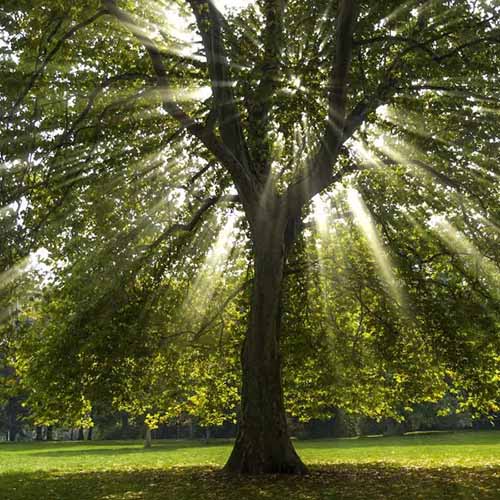
Ah, the American sycamore. Growing a total of 75 to 100 feet tall with an equally-sized spread, Platanus occidentalis is an excellent shade tree.
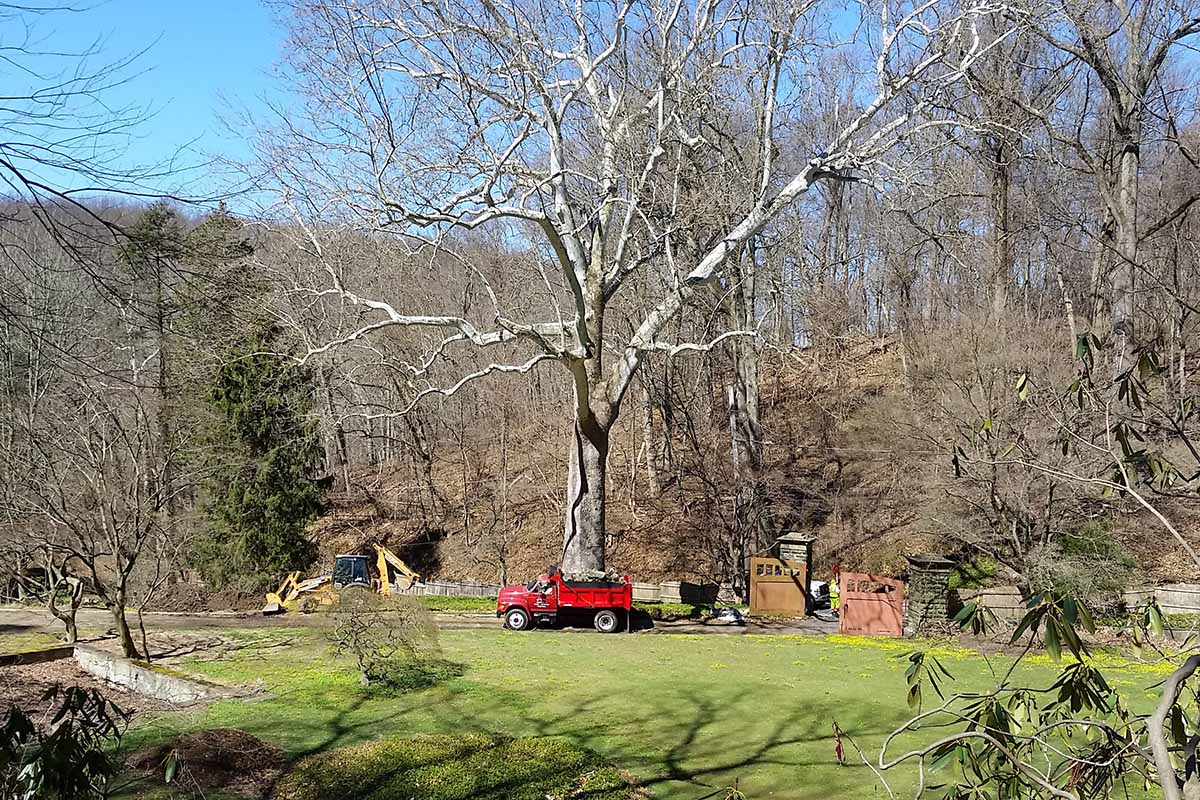
It’s a particularly handsome tree for Zones 4 to 9 with mottled bark and a strong, upright growth habit.
The American sycamore tolerates a variety of conditions but grows well in wet areas where it has room to spread out and do its thing.
This species requires a significant investment in maintenance and cleaning because of the bark and branch debris it sheds.
Like the weeping willow, if there’s a place available in your yard to let a tree go wild, this is an excellent candidate.
You can find American sycamore from Nature Hills Nursery.
Leaf and twig blight is a concern for sycamores but it can be controlled with adequate watering and fertilizing.
Most diseases and pests can be controlled with selective pruning of affected areas.
2. Bald Cypress
The bald cypress (Taxodium distichum) is synonymous with visions of the swamps in the deep south where its gnarled “knees” inch above the surface of the water.
Luckily, it is an adaptable species that can grow in many areas of the United States.
Like the dawn redwood, the bald cypress loses its needles in the winter and flushes new growth in the spring.
Suitable for cultivation in Zones 4 to 10, this tree tolerates most conditions, preferring full sun, but quickly adapts to wet areas and is a perfect candidate for that low point in your yard.
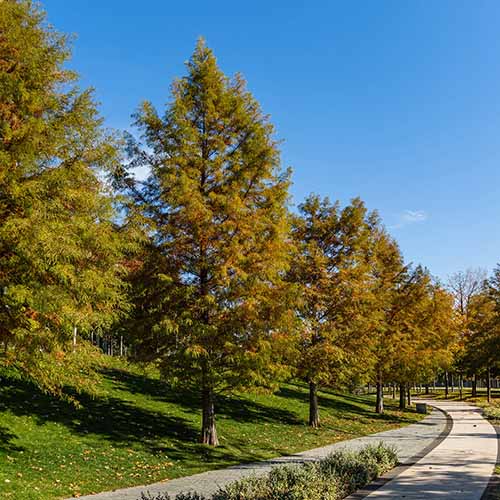
Bald cypress are available from Perfect Plants Nursery.
Reaching heights of 50 to 70 feet with a spread of 25 feet, bald cypress puts on one to two feet of growth each year.
Wildlife has a love affair with the tiny cones and prolific branching of the bald cypress.
Although the bald cypress is highly resistant to pests and diseases, the few that do tend to bother it are easily controlled by a good watering regimen. Most pests cause minimal damage.
3. Chilean Mesquite
It can be difficult to find a fast-growing shade tree that does well in some of the hotter climates of Zones 8 to 11.
The Chilean mesquite (Neltuma chilensis syn. Prosopis chilensis) offers some rather dense protection from searing sun, and it thrives in the hot and dry climate of the American southwest.
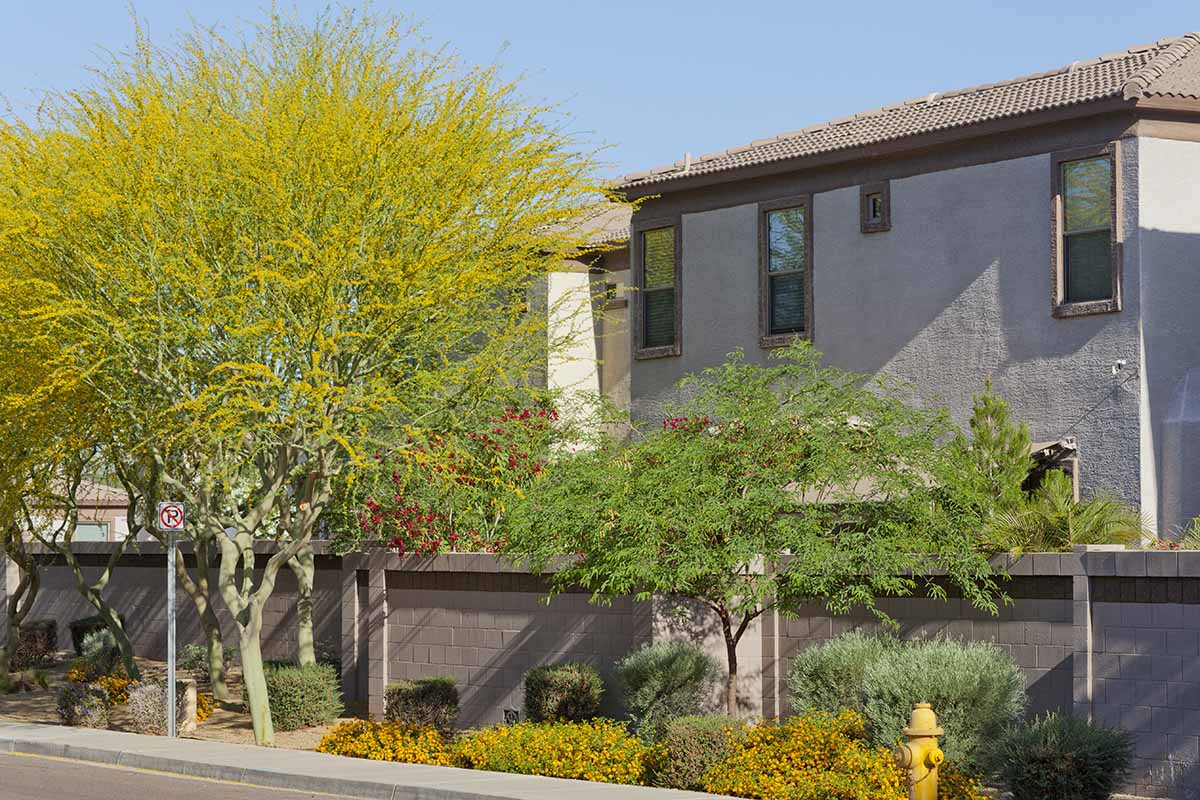
This species grows 20 to 30 feet tall and wide and puts on a foot of growth per year.
It is often seen on patios and along sidewalks, as it is one of the few plants that provides shade while growing in intense desert heat.
The foliage is semi-evergreen and the fruit pods are interesting to observers.
This guy can put out a lot of leaf debris, so be sure to keep a safe distance from pools and other easily-clogged areas of the landscape when planting.
Mesquite does well when planted in groups, but it can make do as a specimen tree, too.
4. Dawn Redwood
The famous dawn redwood (Metasequoia glyptostroboides) was discovered in a valley in China; previously, it was believed to be extinct since the age of the dinosaurs.
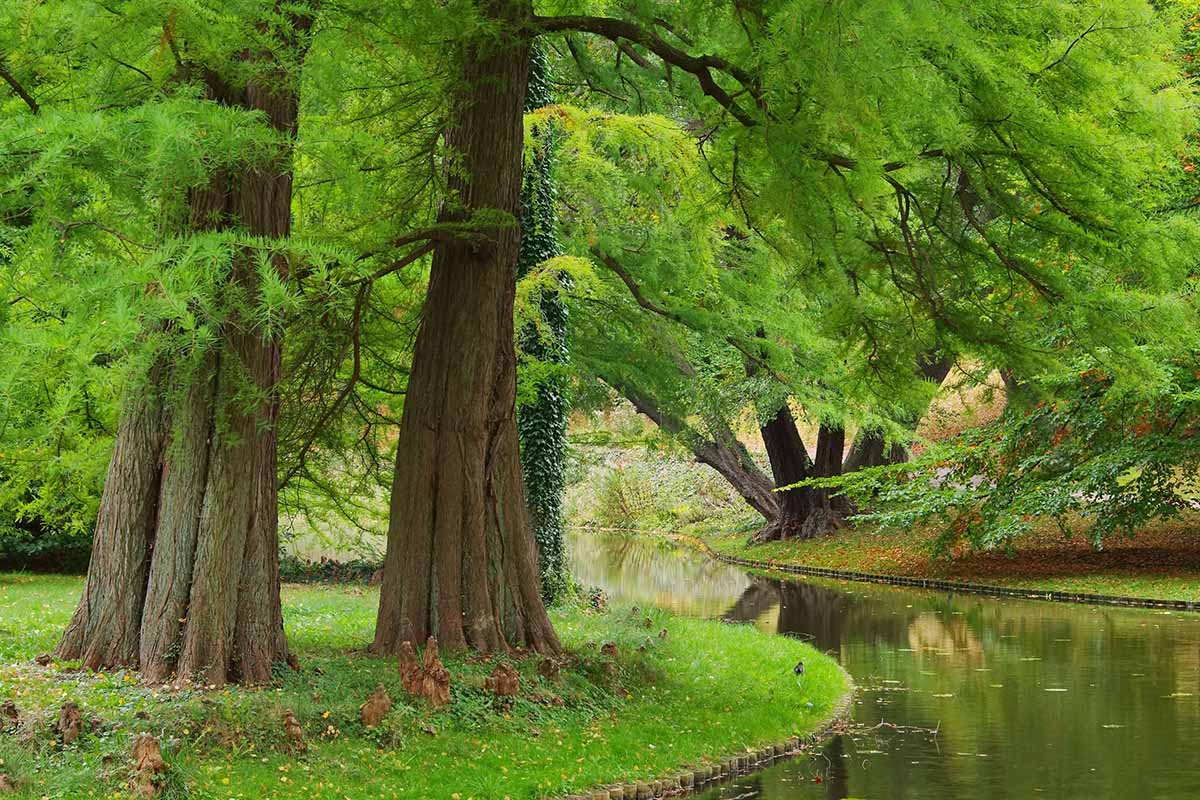
They put on up to two feet per year and can quickly reach towering heights offering a perfect pyramidal shape.
The bark is a beautiful color and has a gnarled appearance, while foliage is a luscious green.
Dawn redwoods require almost no maintenance, and they offer a fairly unique feature in that they lose their needles each winter.
They reach anywhere between 70 and 100 feet in height, and typically provide a 25-foot spread.
Dawn redwoods look great when grown in a line, or as singular specimens. They can grow in wet areas, but prefer moist rather than soaked conditions.
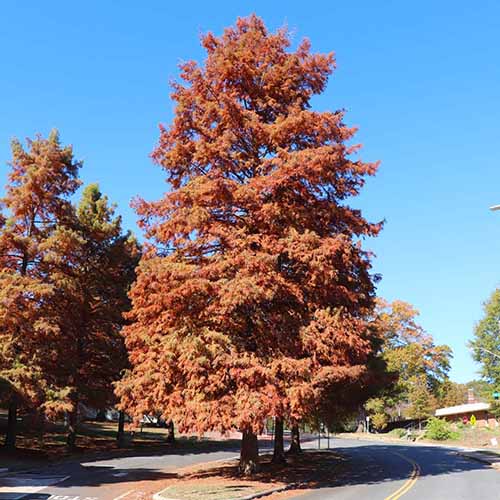
You can purchase dawn redwoods from Fast Growing Trees.
These trees will tolerate pollution, but require full sun and lots of space to grow.
Dawn redwoods are highly resistant to pests and diseases, and are only seriously affected by canker infections.
The only method of care for this infection is to remove the yellowing and dying back branches by pruning into healthy wood below the spread of the canker.
Learn more about redwood trees here.
5. Eastern White Pine
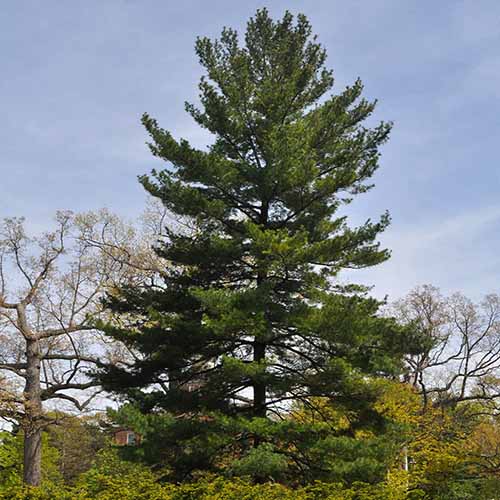
A personal favorite, the eastern white pine (Pinus strobus) is the ultimate in fast-growing shade tree for Zones 3 to 8.
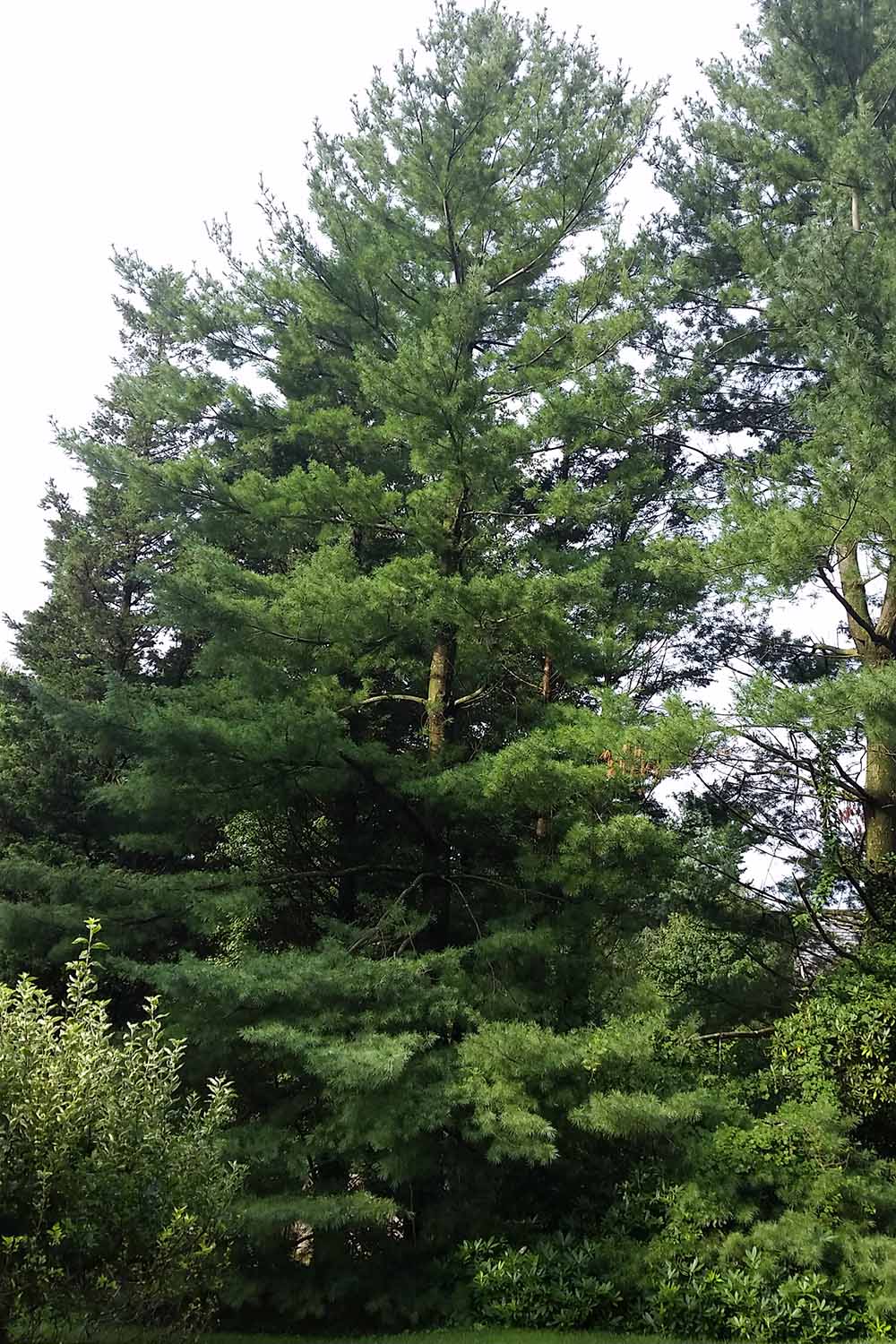
Its long, soft needles are shed after seven years of growth and offer a natural and easy mulch underneath the tree.
It grows anywhere between 40 and 80 feet tall with a spread of 20 to 40 – adding up to 24 inches per year.
This species tolerates almost any soil condition, although it prefers to be in a moist environment.
When planted together in a line, white pines act as both a wind buffer and a wall of shade.
A line of white pine and a chunk of quaking aspen make for a well-protected property, if you have the room for them to grow.
Eastern white pine saplings are available from Fast Growing Trees.
Truly a wild tree, the white pine does not do well in areas of pollution. Grow it away from streets where it could be impacted by soil compaction and road salts.
Older specimens can become knotty and gnarled, with weak branches prone to sudden breaking.
White pines are notably susceptible to pine weevils and rust. The most effective method of control is to maintain the health of a vigorous tree.
In the case of rust and cankers, prune infected areas before the infection reaches the trunk. White pines are home to a variety of animals and birds.
Check out our guide to growing pines to learn more.
6. Hackberry
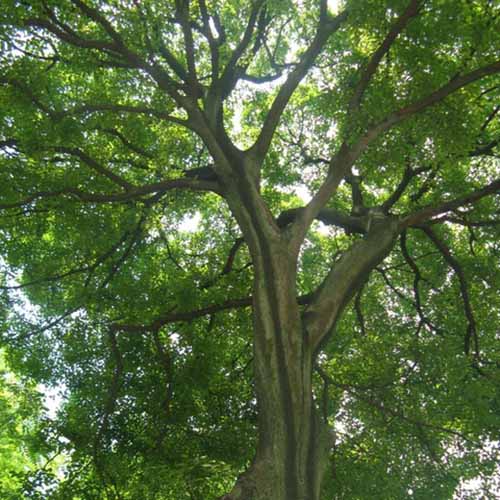
The hackberry (Celtis occidentalis) is one of the most adaptable and tough trees available and it is suitable for cultivation in Zones 3 to 9.
This native species thrives in a broad range of conditions from southern Canada to Florida, tolerating poor soils, drought, urban pollution, and extreme temperatures with minimal care required.
Hackberries develop a rounded, spreading crown with upright-arching branches, reaching mature heights of 40 to 80 feet with a 40- to 60-foot spread. Expect about a foot of growth per year.
Their deep root systems and strong wood stands up to high winds, making hackberries ideal for challenging sites where other species struggle.
The trees display yellow fall foliage and warty gray bark that becomes corky with age.
You can find hackberry available at Nature Hills Nursery.
When established, hackberries require little to no watering.
Small berry-like drupes ripen to deep purple in late summer and persist through winter, providing food for birds and small mammals.
The abundant fruit can create some mess on sidewalks and patios.
Our guide to growing hackberry has more information.
7. Leyland Cypress
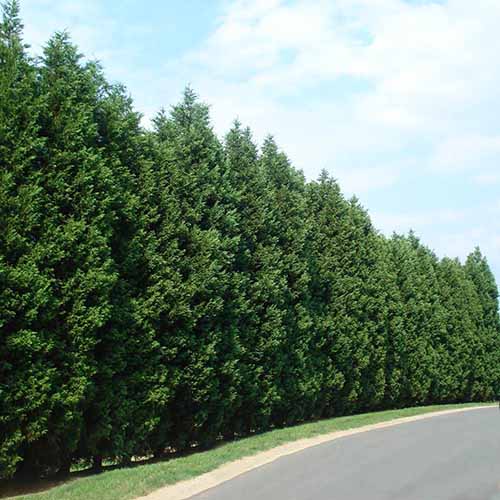
The Leyland cypress (× Cupressocyparis leylandii syn. Cupressus × leylandii) is a fast-growing evergreen hybrid perfect for quick privacy screens, suitable for cultivation in Zones 6 to 10.
This vigorous grower was appeared accidentally in Wales in the late 1800s from a cross between Monterey cypress and Nootka cypress.
The trees create dense screens and windbreaks in a short timeframe.
Leyland cypress develops a dense, columnar to pyramidal form, reaching mature heights of 60 to 70 feet with a 15- to 25-foot spread.
In its early years, it can grow three to four feet per year, slowing as it matures.
Plant in full sun in well-drained soil. It tolerates a range of soil types from sandy to clay, though it performs best with consistent moisture.
Space plants six to 10 feet apart for hedges, or allow more room for single specimens. The feathery, scale-like foliage is blue-green to gray-green year-round.
You can find Leyland cypress available in a variety of container sizes from Fast Growing Trees.
Leyland cypress requires regular maintenance to control its vigorous growth – without annual pruning, it quickly outgrows its space.
The shallow root system makes it prone to toppling in areas with hot summers, heavy wet snow, or high winds.
In the southern United States, Leyland cypress is susceptible to canker diseases caused by Seiridium fungus.
It is also vulnerable to bagworms, which can defoliate an entire tree in weeks.
8. Linden
The linden (Tilia americana), commonly called American basswood, is a stately native shade tree suitable for cultivation in Zones 2 to 8.
This beloved species has been cultivated in North American gardens since 1752.
American basswood develops a pyramidal form with large, dark green leaves displaying silvery undersides. The leaves turn golden yellow in fall.
At maturity, expect heights of 50 to 80 feet with a 30- to 50-foot spread, adding 12 to 24 inches of growth per year.
Plant in moist, deep, well-drained soil in full sun. Linden tolerates a range of soil pH levels and is moderately salt tolerant.

You can find American linden available at Nature Hills Nursery.
The sweetly scented yellowish-white flowers open in early summer, attracting dozens of bees and other pollinators.
Beekeepers prize linden honey as some of the finest available and the wood from American basswood is traditionally used for beehive frames.
The tree also serves as a host plant for several moth and butterfly species.
Learn how to grow lindens here.
9. Paulownia
When I first moved to Philadelphia, I marveled at what I first thought were sweeps of wisteria in the trees growing along the highway.

A few weeks later I learned that these were the flowers of the paulownia or Royal Empress tree (Paulownia tomentosa).
Suitable for Zones 6 to 9, this is a beautiful specimen that offers a 30- to 40-foot height with a similar spread, adding 24 inches per year.
The leaves on young specimens are massive and in the fall the foliage drops without changing color.
Despite being beautiful, paulownia is also plagued by weak and brittle wood, roots that pop through the surface of the soil, and a weakness to cold snaps in the spring.
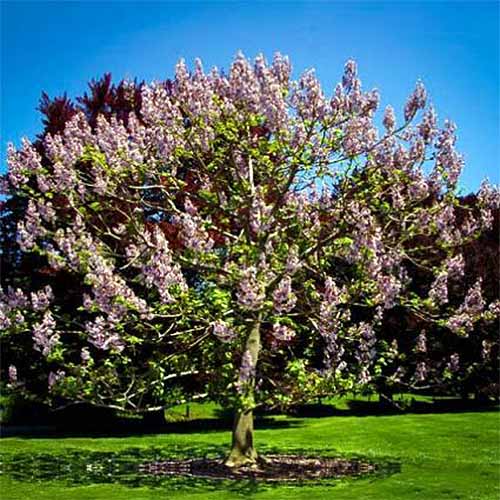
You can find paulownia available from Nature Hills Nursery.
They are also a very vigorous seeder; check locally to see if the paulownia is considered an invasive species in your area.
If paulownia has a more specific or pressing issue, it is that it is a voracious grower and will seed far and beyond your intended planting area.
10. Pecan
The pecan (Carya illinoinensis) is no stranger to Texas, where it is the state tree.
Offering delicious nuts and an incredible height and spread – 70 to 100 feet tall and 40 to 70 feet wide – few trees offer as many benefits as the pecan.

If you have room, plant three or four specimens to guarantee pollination and a crop of tasty pecans.
They tolerate a variety of soil types in Zones 6 to 9 and will add as much as 24 inches of height per year.
There are a handful of different varieties available, including Desirable, Elliot, Pawnee, Stuart, Sumner, and Hardy pecan.
The biggest downside to pecans is that they grow a large taproot, making it difficult to transplant except when they are very young and small.

You can find Elliot pecans available at Fast Growing Trees.
They can produce over 100 pounds of nuts a year.
Find pecan tree growing and care instructions here.
11. Quaking Aspen
Among the oldest and largest organisms on the planet, the quaking aspen (Populus tremuloides) is an excellent choice for a shade tree – if you have the room for it.

Hardy in Zones 1 to 7, it prefers moist soil, and shoots out suckers that will eventually grow into full-sized specimens.
This colony of trees can be a blessing if you have enough space, but can be problematic if planting in a more controlled area.
Quaking aspen earns its name from the unequivocally soothing sound of its leaves fluttering en masse in the slightest of breezes.
It grows to mature heights of between 30 and 50 feet with a spread of 20 to 30, adding two feet per year.
Remember that this tree grows in its own colony, and can form an effective, impenetrable shade screen when allowed to go wild.

This fast-grower is available from Fast Growing Trees.
With stunning yellow foliage in the fall, it requires a massive cleanup. Again, the quaking aspen is not a tree to grow in a controlled area.
When grown outside of its natural northern ranges, quaking aspen can be impacted by heat stresses and fungal problems.
This species is also a magnet for wildlife. Unfortunately, this wildlife can come in the form of pests such as aspen borers and tent caterpillars.
Borers can invite future fungal problems, and tent caterpillars cause branch die-off. Both can be minimized with proper watering and fertilizing, and insecticidal treatments.
Learn more about growing quaking aspen here.
12. River Birch
The river birch (Betula nigra) is an excellent addition to the landscape and is suitable for cultivation in Zones 4 to 9.

They grow best in clumps of several and can be used as specimens by themselves, but function optimally as part of a woodland garden.
River birches can reach mature heights of 40 to 70 feet with a 30- to 60-foot spread, putting on 13 to 24 inches of growth per year.
Birch trees grow in clumps, with older specimens dying and then being replaced by young ones.
Be wary of planting this fast-grower too close to the house or power lines. The catkins that fall in springtime can damage the paint on cars if allowed to mass up.

You can find Heritage® river birch available from Fast Growing Trees.
They both prefer well-drained soil but can tolerate drought; the river birch is the most resistant birch to the birch borer, a pest that can destroy birches.
13. Southern Live Oak
The adaptable and stately southern live oak (Quercus virginiana) is proof positive as to why oak trees are considered kings of the forest.

Although they are fast growing, oaks tend to be most successful when planted from nursery stock.
Their willingness to adapt to almost any soil condition makes them favored ornamentals in many areas of Zones 7 to 10, and their resistance to pollution makes them ideal street trees.
Add to that an incredible wind resistance, and the southern live oak makes for an ideal planting.
They grow to an impressive 50 to 80 feet tall, with a massive 60- to 100-foot spread, putting on up to 24 inches per year.
The live oak is resistant to hurricanes and the big storms that tend to rage across the southeast, but it is less resistant to freezing temperatures.
Growing a live oak on the northern limits of its range could be courting trouble.
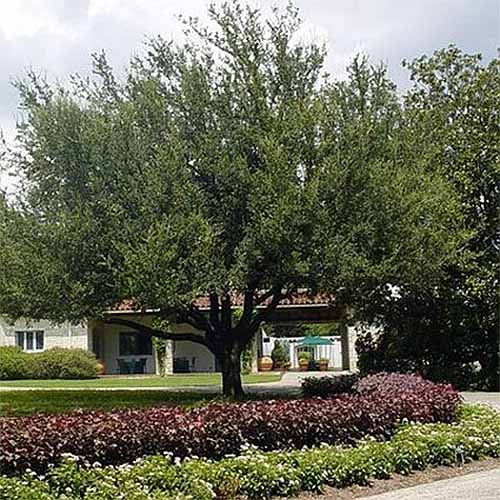
Southern live oak is available from Nature Hills Nursery.
It is also a habitat for other plants including Spanish moss, an image ubiquitous with the south.
If planted near a curb or sidewalk, the roots of the live oak will seem to “melt” over the stones; this is called thigmotropism and is an interesting feature of the live oak.
14. Tulip Popular
Tulip poplars (Liriodendron tulipifera) are some of the tallest trees in the eastern United States.
The tallest known specimen stands at 191 feet! They can put on up to 24 inches of growth per year.
Offering an attractive leaf shape and prolific flowering in the spring, tulip poplars are an excellent choice for shade in Zones 4 to 9.

Tulip poplars in #3 containers are available from Nature Hills Nursery.
They also stand proudly in any landscape, offering shade and towering authority. Tulip poplars do best in full sun where they are allowed to spread out and grow freely.
Their seedlings can sprout up around your lawn and around property lines, and probably in your neighbor’s yard, and their neighbor’s, and then their neighbor’s too!
Tulip poplars produce a mass of debris from flowers and branches to shed leaves. Watch for yellowing leaves in the summer, a sign of dehydration and then weakening of wood.
The limbs on old specimens are prone to breaking because the wood is soft. Parasitic wasps are beneficial for controlling the pests that bother these trees.
They are also less tolerant of pollution than others on this list.
Learn more about growing tulip poplars here.
15. Weeping Willow
Weeping willows (Salix babylonica) thrive in a more narrow growing zone – Zones 6 to 8 – than many others in this guide, but are an excellent choice for shade.
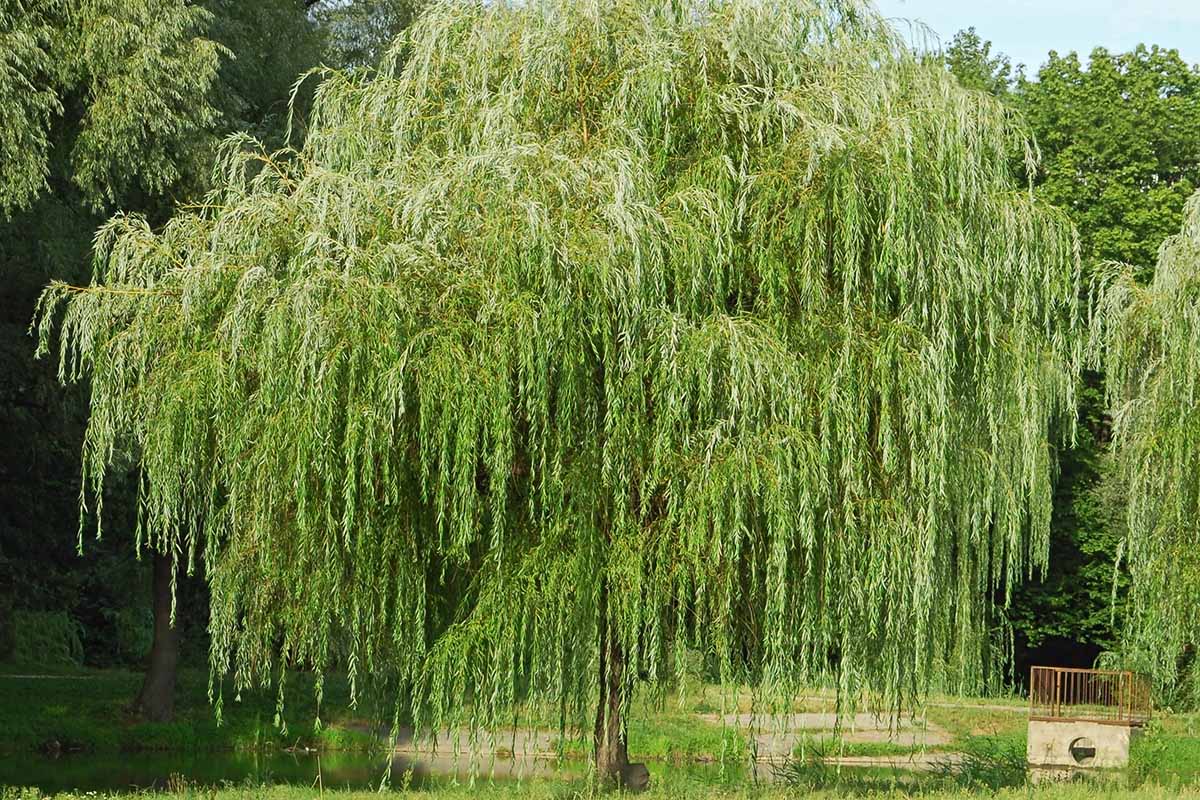
Capable of growing in full or partial sun, the weeping willow reaches a height of approximately 35 feet, and offers a massive 35-foot spread that effectively blocks out all sunlight.
This fast growing species can add two or more feet of growth per year.
Weeping willows will tolerate a variety of conditions, but are perfect for low-lying areas in particular, especially wet ones.
The trees can produce a ton of debris every year. Their leaves blanket the ground and broken branches require frequent maintenance.
Willows require consistent cleaning up to remove the ground of dead branches that prevent fungal problems in the future.
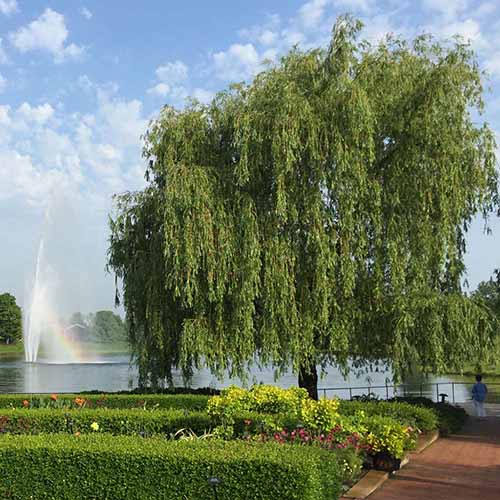
They can be purchased affordably via Fast Growing Trees.
Early structural pruning is vital to ensuring willows do not become a massive tangle of branches. The willow is susceptible to a disease called crown gall.
The crown gall itself negatively impacts the plant, but it also works as a pathway for other problems later on.
If your plant develops crown gall, the only effective method of control is to remove the specimen and wait a full two years before replanting another willow.
Learn more about caring for weeping willow trees here.
Tips for Planting Shade Trees
As with all plant selections, it’s vital to work within the framework your yard and property provides.
We can’t grow lavender in a swampy spot and a bald cypress can only be so happy in a dry, sandy location.
Location, Location, Location
Be mindful of areas in the yard that are especially wet or are near a septic or other utility line.
Some species are voracious consumers of water – great for drying up a wet spot, but eventual doom for a septic system!
If you’re in the US, remember to always call ‘811’ before any project involving digging. They can help you pinpoint the areas you should not dig in.
Similarly, be forward-thinking about the eventual size of your specimen.
That birch might look great on the corner of your house right now, but in five or 10 years it can rocket upwards and become a constant nuisance to your house.
Sidewalks, patios, driveways, power lines, and streets are some other areas to be mindful of when planting that will fill in that area sooner than later.
One of the benefits of a shade tree is that it provides a cooling area from the heat of the sun.
Consider planting these in the southern, western, or eastern areas of your property to maximize protection from the sun.
The most common mistake when planting is to think in the short term.
Right now a new willow is going to look great, but give it five or 10 years and it could completely take over that portion of your yard.
Take time when surveying the right location for your new shade provider.
Seriously, I can’t stress this enough. (And speaking of stress… did you know gardening is excellent for relieving it?)
Make sure the area can hold a large plant and isn’t going to cause a problem in the near or far future.
Just this past Labor Day weekend I was battling with a willow I foolishly planted too near my mother’s house. It took all day to get it under control, and it still isn’t finished!
If I had selected a better location when planting and considered the eventual size of the specimen, I wouldn’t have spent so much effort getting things under control.
Soil Drainage and Wet Spots
Soil conditions can make or break a new planting. If the soil is too wet or poorly drained (I’m looking at you, clay!) it will only exacerbate conditions leading to root rot.
At the very least, amend the soil during planting with something that promotes drainage, like compost or gypsum to break up the clay.
Diverting water from low-lying areas can help prevent “wet feet,” and so can the addition of rain barrels.
Some cities offer free rain barrels (and installation) whereas they are unfortunately not permitted in some regions – check your local regulations.
Keep in mind that some plants on this list thrive in wet conditions, but are still prone to root rot after being planted.
Fast Growers Can Also Be Messy, or Aggressive Growers
As great as a fast-growing tree is to the gardener, it can also problematic.
A few produce prolific seedlings (paulownia is one example), while others capitalize on taking up as much space as possible (like weeping willow).
Still others happily produce messy debris. The American sycamore litters its bark freely across the lawn, while the ginkgo tree covers the fall landscape with carpets of yellow-gold leaves.
On the note of ginkgos, be mindful to avoid planting female specimens. Female ginkgos produce a fruit that stinks the place up something terrible.
Nurseries typically only grow male specimens, so you don’t need to worry too much about that stinky fruit if you purchase from a reputable seller.
Types of Nursery Stock
Lastly, there are three types of nursery stock you’ll find available for planting. Each offers its own benefits and hindrances.
Ball and Burlap
Ah, the affectionately titled “B ‘n B.” These tend to be the largest available for planting from a nursery.
It’s not unusual to find a 14-foot-tall plant weighed down by a six-hundred-pound root ball wrapped in burlap and a wire cage.
These are incredibly taxing to plant, but they offer immediate gratification in their size.
B ‘n B trees are almost immediately established after planting, and their massive root ball holds them firmly in place.
Besides the size and logistics of planting a B ‘n B, the removal of the wire cage and burlap once it is in the ground can be a headache.
Plastic Pots
The nursery standard. These are available in sizes ranging from a one-gallon pot up to about a 50-gallon pot.
Large, established, and relatively easily portable, potted specimens are the most common option when purchasing a new landscape specimen.
Downsides include a tendency for these to be rootbound, therefore requiring extra attention and work to prep them for planting.
However, the root ball contained in the plastic pot helps guarantee minimal shock from transplanting and offers a solid bottom-heavy mass of root and soil, minimizing the need for staking and supports.
Bare Root
The easiest solution for planting a large tree is a bare root specimen.
Available from certain garden centers and via direct shipping, bare roots are the lightest option available. They help encourage a strong, healthy root structure.
The downsides include limitations on the size and the need for more regular staking and support to prevent the plant from collapsing until its roots are established.
Caring for Your New Tree
It’s vital to give new plantings a frequent and generous drink of water.
This is one of the key elements to a successful planting and that holds especially true for fast-growing shade providers. Putting out that much growth means they need a lot of water!
It’s tempting to give these fast-growers a beefy dose of fertilizer, but that can be detrimental in both the short term and the long run.
If you’re a conventional grower, rely on slow-release fertilizers applied at suggested intervals.
The shady friends mentioned here only need to be fertilized in the springtime, so that makes your life a whole lot more simple!
Enjoy the Shade, Friends
Once you’ve made your selection, it’s time to get to planting!
Before you know it, it will be time to bust out the lawn chairs and appreciate that break from the sun provided by the new addition to your landscape.
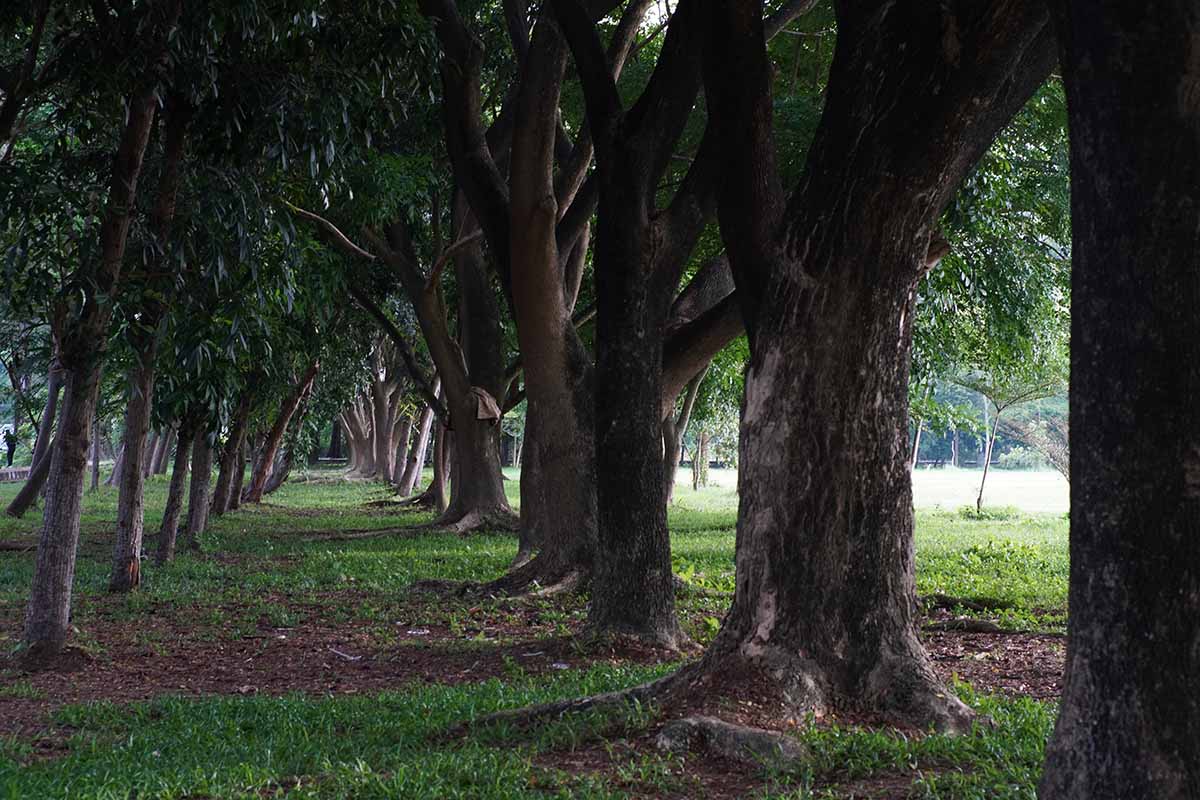
If you’ve planted with the goal of cooling your home, you may need to wait a few years to see the difference, but it’ll be that much more sweet when you get there.
Do you have other suggestions for shade trees to include in the landscape? Let us know in the comments section below!
And for more information about growing trees in the landscape, add these guides to your reading list next:

What is name of the trees in the above article? I am looking for a fast growing shade tree which will save plants from strong hot sun and save from heavy storms. Can you tell me the name of the above trees and growth rates please?
Hello, Nabeel! The Chilean Mesquite Tree could do well in hot sun, but it’s hard to pinpoint exactly what trees are best for your landscape without knowing the climate. If you could reply with the region where you’re interested in planting this tree, we can figure this out together!
I agree that location is important when planting a tree in your yard. It would make sense to find something that is both pretty and easy to grow in your area. My husband and I are looking for some trees for our yard, so we’ll have to consider our area.
Hello Mr. Suwak,
I’m from North India.
I would like to plant a tree in my yard for deep shade.
So please suggest me which tree I should plant,
(Tree should hv light wood which cannot be broken by strong storm and damage my house.)
Please suggest….!!
I have a Drake Elm that has been planted between 13-15 years. I have lost almost 1/2 the canopy and some of the large limbs are dead as well as small ones. I was told that I had too much dirt and mulch around the trunk and that I should fertilize with a slow release fertilizer 16-4-8 beyond the expanse of the limbs (also leaves are yellowing too early). Should I remove the dirt and mulch build-up around the trunk and replace with a stone>..what’s your take on this? I greatly appreciate your response, thank you.