

Forsythia spp.
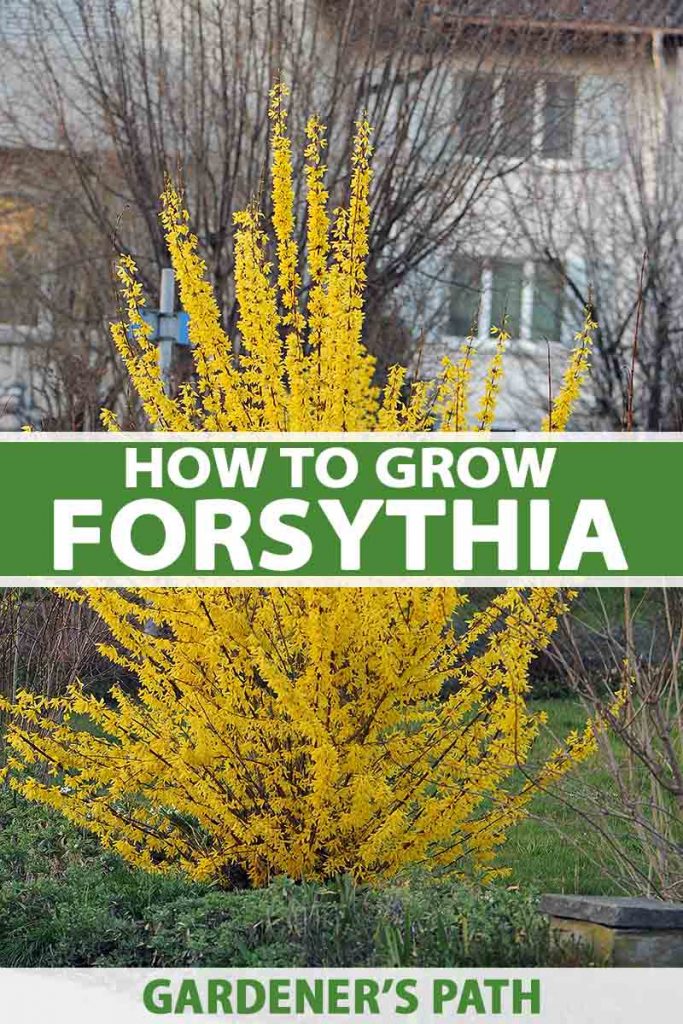
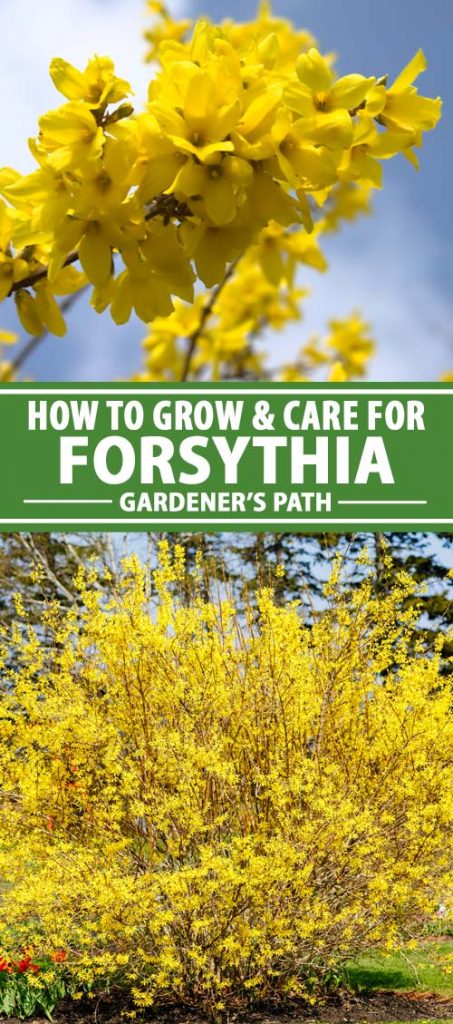
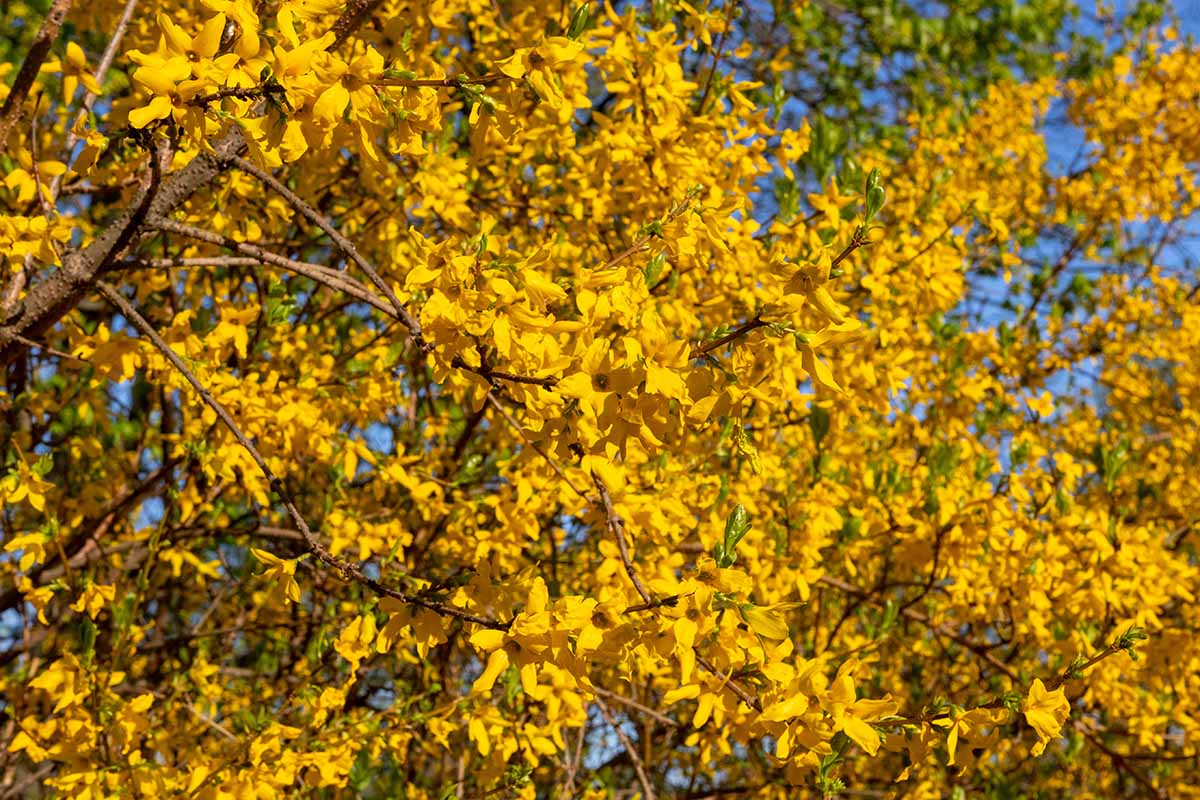
The Forsythia genus is a group of plants in the Oleaceae, or olive family. It includes 11 species of deciduous woody shrubs that bear bold yellow flowers in early spring.
Suited to gardeners in USDA Hardiness Zones 5 to 8, these plants are fast-growing and range in height from 12 inches to 10 feet tall.

We link to vendors to help you find relevant products. If you buy from one of our links, we may earn a commission.
In this article, you’ll learn how to cultivate and maintain forsythia in your outdoor living space.
Here’s what’s in store:
What You’ll Learn
Forsythia first became popular as a botanical attraction in Japan, China, and Korea before making its way to Europe in the early 1800s.
It soon spread to the United States and Canada where it became a garden staple.
Here in the Northeast where I live, it has naturalized to the point where many folks presume it is a native species.
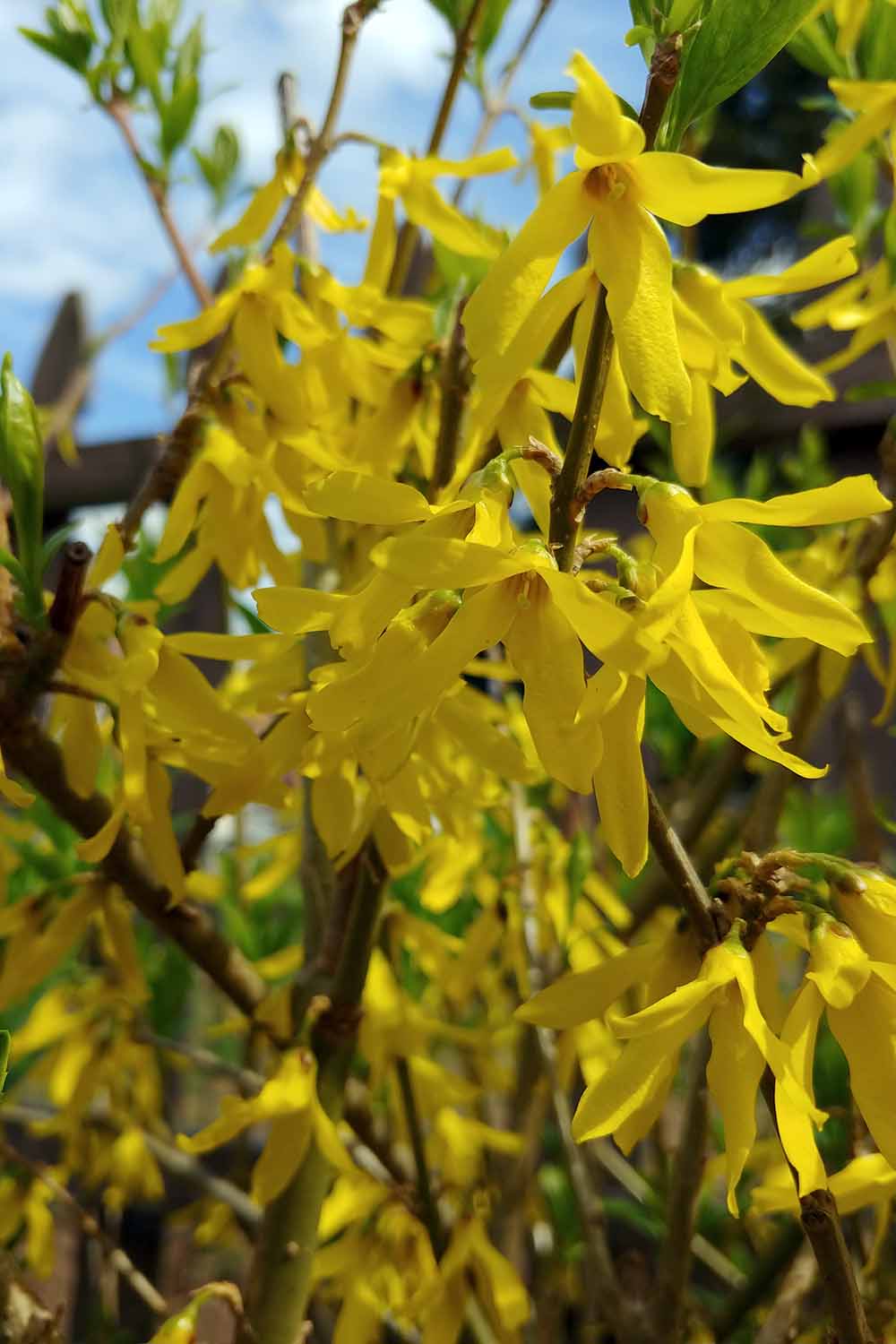
In the late 1800s, a plant was discovered in a German botanical garden that appeared to be the result of an unintentional cross between the two known forsythia species, F. viridissima and F. suspensa.
It was named Forsythia x intermedia, and would become the basis for many cultivated varieties.
Quick Look
Common name(s): Forsythia
Plant type: Woody deciduous shrub
Hardiness (USDA Zone): 5-8
Native to: Asia, Europe
Bloom time / season: Spring
Exposure: Full sun
Soil type: Average to organically rich, well-draining
Soil pH: 6.5-7.5, neutral
Growth Rate: Fast
Mature size: 2-10 feet tall by 2-12 feet wide
Best uses: Cut flower, foundation (small types), hedge, mass, mixed shrub border, privacy screen, specimen, perimeter
Taxonomy
Order: Lamiales
Family: Oleaceae
Genus: Forsythia
Species: Suspensa, viridissima, x intermedia
Today, common border forsythia, F. x intermedia, and its many named cultivars, are the most readily available plants on the market for the home gardener.
They are hardy shrubs that tolerate a variety of soils and exhibit excellent drought and salt tolerance.
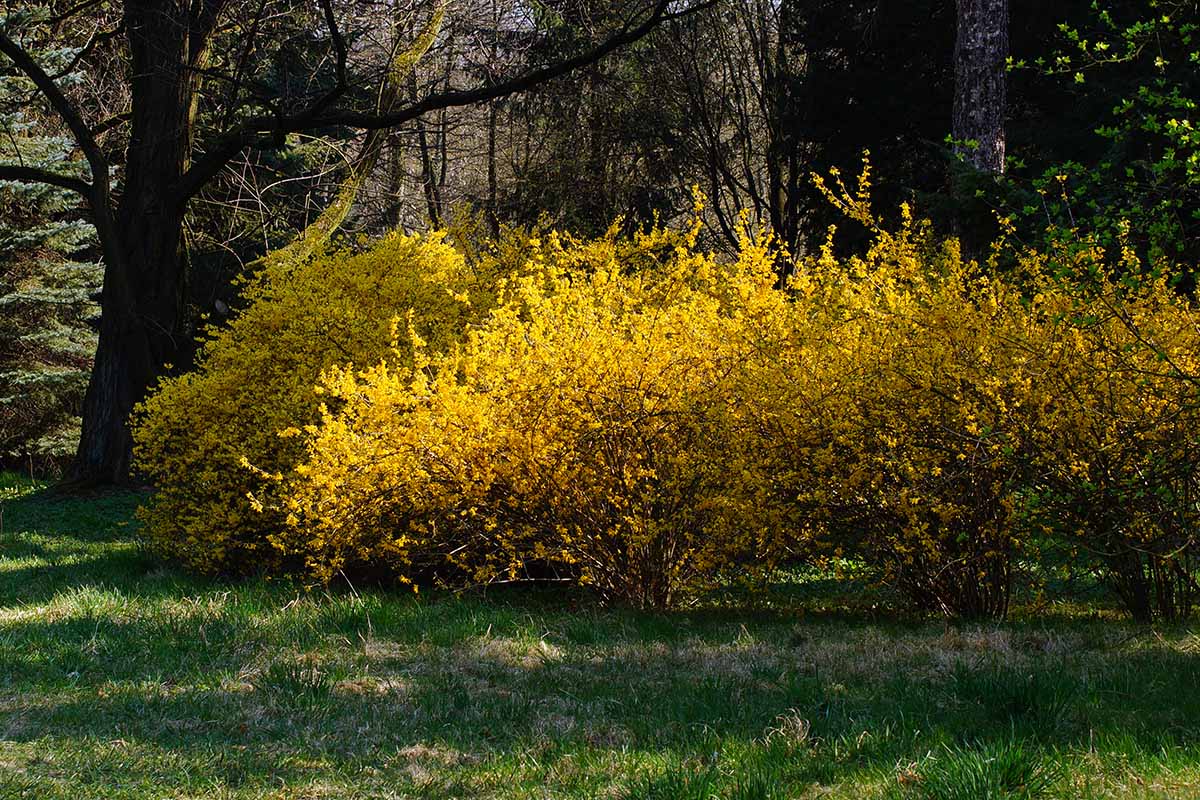
Flowering plants for the early spring garden all pair well with vibrant forsythia.
From hellebores and snowdrop to tulip and hyacinth, it’s the perfect backdrop to a panorama of multicolor blooms.
Use a large variety as a stand-alone specimen in a garden island of its own.
Or, plant a series of bushes along fences and property perimeters, where birds and small wildlife can take refuge.
Smaller types play well in mixed perennial and bulb beds and borders, where they add bold color in spring and punctuate summer plantings with their attractive, lance-like, serrated green leaves.

Create mixed shrub plantings with early rhododendron, flowering quince, and pussy willow, for a pretty place to take spring holiday photos with the family.
A versatile shrub that grows fast is a gardener’s best friend, when it comes to blocking an undesirable view or creating a privacy screen for the enjoyment of outdoor space.
How to Grow
There are two good times to plant forsythia – after it blooms, and just prior to winter dormancy.
First of all, you need to find a location for your new shrub.

Some dwarf selections are two feet tall and wide, while some full-size varieties top out at eight to 10 feet tall and 10 to 12 feet wide.
Be sure to take mature dimensions into account when deciding on a location.
Light
Choose a site with full sun. It is possible to grow forsythia in part shade, but you may have fewer blossoms.
Soil
Organically-rich soil is best, but even clay is okay, provided it drains well.

To improve drainage, incorporate leaf mulch or sand to loosen it up. The ideal pH may vary from a slightly acidic 6.5 to a slightly alkaline 7.5.
If you want to know your soil’s characteristics with certainty, you may contact the local extension of a land grant university about conducting a soil test.
Water
In the absence of a soaking rain, water each week during the growing season.
Too much or too little water may cause yellowing of the leaves.
In addition, in the first year of life, new shrubs benefit from a deep watering or two during winter dormancy if the weather is especially dry. Choose a day when the ground is not frozen.
Fertilizing
You can fertilize once just before bloom time with a well-balanced, all-purpose, slow-release fertilizer, per package instructions.
Cultivars to Select
There are 11 different species of forsythia. There was a time in the early 20th century when the upright, green stem variety F. viridissima was the reigning queen in American gardens.

Today, Forsythia x intermedia cultivars take center stage, with a host of options from which to choose.
Here are a few to whet your appetite for this bright yellow harbinger of spring!
Bronxensis
Straight from the New York Botanical Garden of 1940, F. viridissima ‘Bronxensis’ is a dwarf variety that tops out at a petite two to three feet tall.
Ideal for mass planting as a ground cover, a friendly low-profile hedge, or mixed border companion, this petite shrub offers the beauty of large varieties in a manageable package.
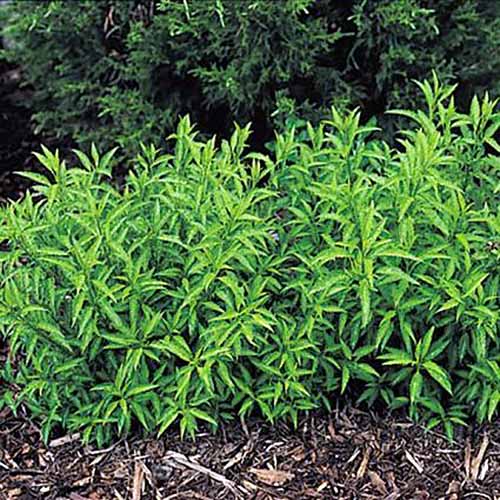
Its bright yellow blossoms appear a little later in spring than most, and the leaves are lush green in summer and bronze in autumn.
Find this cultivar available from Nature Hills Nursery.
Gold Tide Courtasol
This compact Forsythia x intermedia cultivar reaches a mature height of two to three feet, with a spread of four feet.
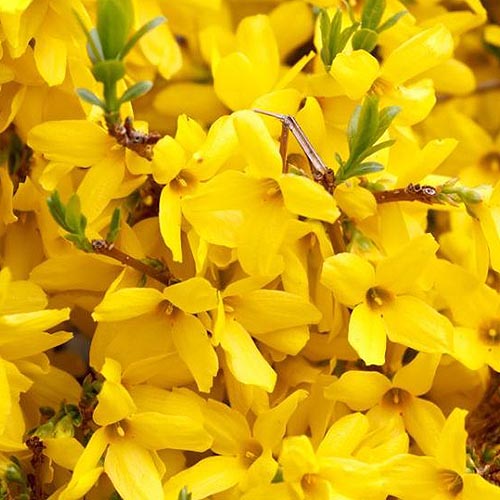
Well suited to foundation and border plantings, its lemon-yellow blossoms bid a cheerful welcome beside walkways and accented by bulb flowers.
You can find Gold Tide® plants available from Nature Hills Nursery.
Lynwood Gold
Generous clusters of bold yellow blooms line the upright branches of this six- to eight-foot-tall Forsythia x intermedia cultivar.
With spreads of eight to 10 feet, it makes an imposing privacy screen or specimen planting.

The foliage provides a cool backdrop of green in the summer months, before bronzing in the fall.
You can find plants in one-, two-, and three-gallon containers available at Fast Growing Trees.
Want More Options?
Check out our supplemental guide: 13 of the Best Forsythia Varieties for Glorious Spring Color.
Maintenance
As mentioned, different forsythia varieties are available in sizes ranging from 12 inches to 10 feet.
You have two options with this fast-growing shrub:
- Let it grow naturally, unimpeded and untrimmed.
- Prune it to a certain height and width, to fit neatly into a desired space, like a hedge.
The best time to prune is immediately after flowering. This is because flower buds begin to form soon after the blossoms drop, and by summer’s end, they are in place for next year.

If you were to prune at any other time, you’d cut them off and have few to no flowers the following spring.
Even if you choose a natural style, you should still prune occasionally. Remove dead or damaged stems to improve appearance and maintain good plant health.
Restore youthful vigor to older bushes by randomly cutting one-third of the old wood stems to the ground every three years or so.
Hedges are a bit trickier.
Prune deeply after flowering to maintain the desired shape. Pruning periodically throughout the growing season is not an option.
Pruning too late or too often is likely to cause poor flowering next bloom time.

As for cutting techniques, pruning to the ground encourages the growth of long, airy canes, and is well-suited to a rounded mound with arching branches.
Conversely, cutting mid-stem above a pair of leaves results in compact, branching growth more suited to well-controlled, but naturalistic border shrubs.
You may want to trim the lower branches to prevent self-layering, as it can create a ground cover you may or may not want.
As for sharply manicured hedges, take care not to let the center of the shrub die.
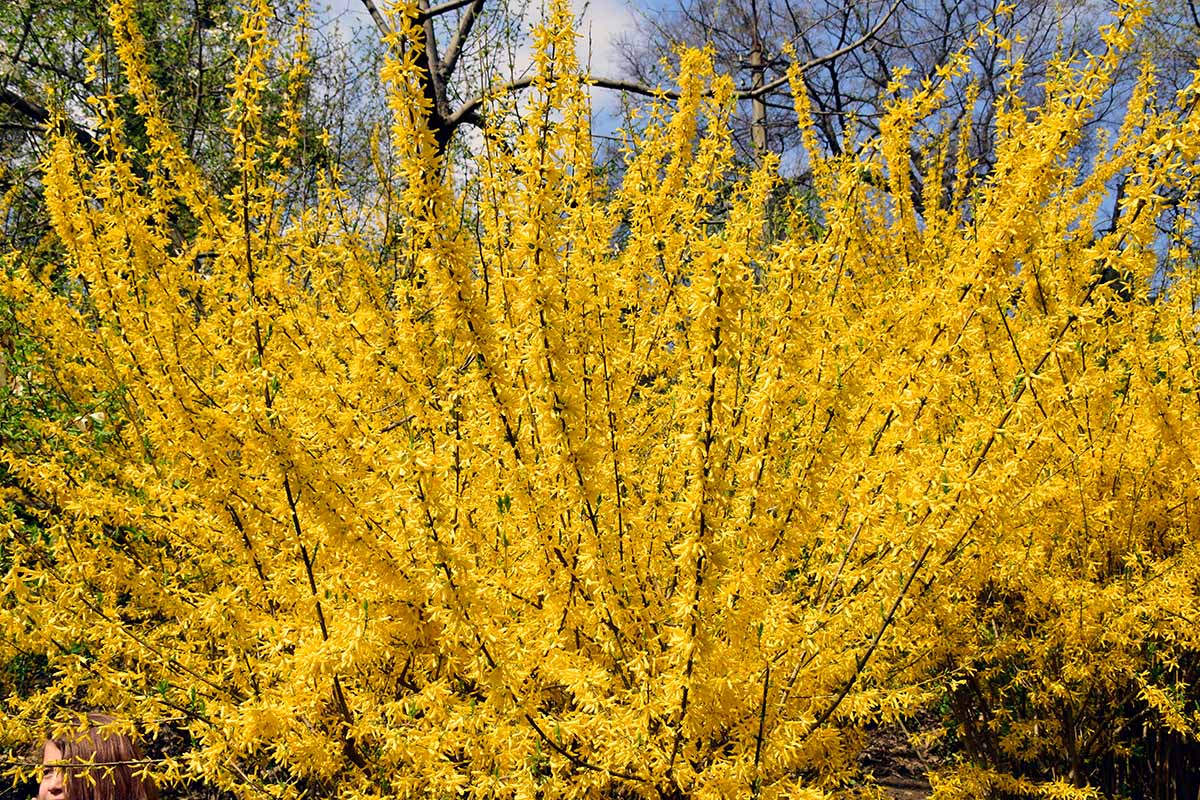
Constantly lopping off the top and sides tends to foster tip growth, but the middle receives little if any sun, and the wood there may become hard and lifeless.
Promote fresh inner growth by periodically cutting down a few hardwood stems at their point of origin, to be replaced by fresh growth.
Learn more about pruning forsythia shrubs here.
You may also apply a layer of mulch in the spring and/or fall. It helps with moisture retention and inhibits the growth of weeds. Place it about six inches out from the roots to avoid rotting.
Occasionally, your plants may experience a false spring and bud out prematurely.
Read our guide, How to Care for Cold-Damaged Forsythia, for tips on preventing and fixing freezing damage to your shrubs.
Propagation
Forsythia is stoloniferous, which means when a branch comes in contact with the soil it can take root and start another bush, so it is very easy to propagate.
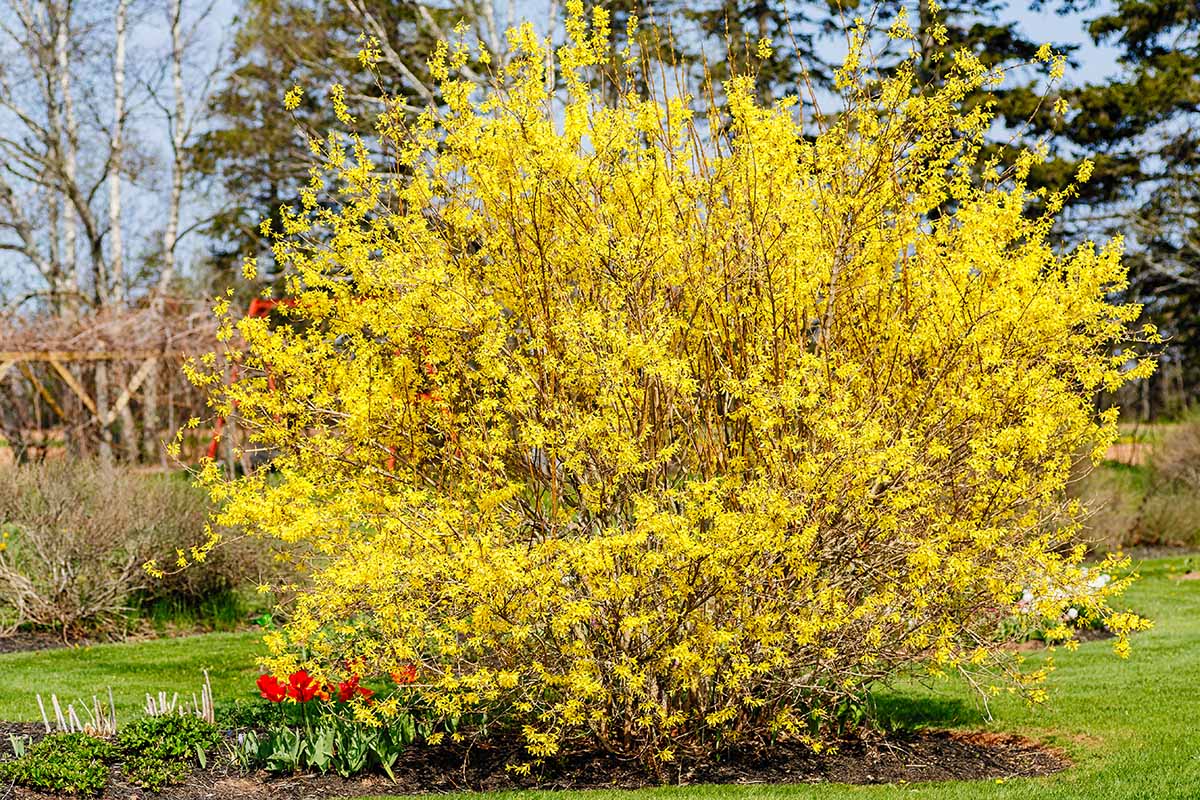
For beginning gardeners, or those who think they don’t have a green thumb, this is an amazing plant to experiment with to build confidence.
You’ll know what I mean when you learn that there are five ways to get your own plant started:
- Air Layering
- Tip Layering
- Division
- Stem Cuttings
- Seed
Read our full guide to forsythia propagation here.
The easiest way to get started with your own forsythia is to purchase rootstock that is either bare or burlap-wrapped, or small nursery starts in pots for transplanting.
Bare Rootstock
Online nurseries often supply bare rootstock because it is lightweight and cost effective to ship through the mail.
It consists of a rooted stem with all of the soil removed. When you receive it, in the fall, it needs to be watered and planted as soon as possible.
To do this, set the roots in a bucket of water while you work your garden soil to a depth of about 12 inches.
Amend the soil with compost, leaf mulch, or grit as needed to ensure good drainage.
Settle the bare roots into the soil so that the crown – where the roots and stem meet – is about an inch above ground level.
Backfill with soil and tamp it down. Water well. Tamp again to remove air pockets in the soil.
Burlap Bagged Rootstock with Soil
The roots and soil, with at least one established stem, are contained in a biodegradable burlap sack that should be planted directly into the ground.
This is the quickest, easiest method, but also the most expensive.
Prepare a bed of soil as described above.
Place the entire biodegradable bag into the soil so that the crown, where the stem meets the roots, is about an inch above ground level.
Backfill with soil and tamp it down. Water well, then tamp the soil again to remove air pockets.
Burlap bagged rootstock is best planted in the fall.
Nursery Pots
Garden centers often have pots ranging from quart to gallon sizes that contain one or more rooted stems in potting medium.
The stems may be short or tall, depending upon their age, and whether or not they have been pruned.
Work the soil as described above.
Unpot the plant and set it down so that the pot soil is at ground level.
Backfill with soil and tamp it down, water well, and tamp again to remove any pockets of air.
Pests and Disease
As a non-native plant, forsythia is less prone to infestation by local insect pests and the diseases they carry.
It is one of the rare plants that is unaffected by black walnut juglone toxicity, deer, or Japanese beetles.
Adequate drainage deters water-loving pests, such as snails and slugs, and inhibits root rot.
Diligent weeding, or the application of weed-inhibiting mulch six inches from the stems, also helps keep pests away.
However, even with best practices, there are a couple of issues that may arise while growing this shrub.
While pests aren’t usually a problem, there are some diseases to be aware of, including:
Galls
If you notice knob-like clusters of nodules on the stems of your plants, they may be galls.
It can be difficult for the home gardener to identify the exact cause.
It could be stem gall caused by the Phomopsis fungus, or crown gall caused by Agrobacterium tumefaciens – or a genetic deficit.
Whatever the cause, these have the potential to disfigure and weaken plants. The only solution is to cut off the affected branches.
Read more about managing galls on forsythia here.
Leaf Spot
Unsightly brown or black spots on the foliage may be caused by a fungus called Anthracnose. It can thrive in plants that are very dense, as the result of a buildup of humidity.
Space plants well to maintain good airflow.
If you have dense plantings, prune occasionally to allow air to penetrate the center of plants. And, don’t forget the importance of good drainage.
Pinch off affected leaves. Apply a fungicide to inhibit further damage.
Root Rot
This is a condition caused by microorganisms called Phytophthora that resemble fungi.
They infect the roots and foliage of woody plants, especially when conditions are too wet. Telltale signs are saturated ground, stunted growth, wilting, and rotting roots.
Avoid this condition by planting in soil with proper drainage and maintaining adequate airflow.
There is no treatment and affected plants must be dug up and destroyed. Do not throw infected plant matter on the compost pile, to avoid further spread.
Twig Blight
Twig blight, another problem that may arise from too much moisture, is caused by a fungus called Sclerotinia sclerotiorum.
It appears as a white coating on the outside of the stems. They may also appear black on the inside.
Avoid it with proper drainage and good airflow.
Remove affected branches and apply fungicide. Inhibit its spread by pruning to increase airflow, and always water at the soil level.
Always remember to sanitize cutting tools after removing stems that are damaged by pests or disease.
Your Forsythia, Your Way
Transitional flowers like forsythia are as bold as they are beautiful.
They burst open on a false-spring day only to find themselves laden with snow the next.
But no matter, they cling hopefully for two weeks or more, before reluctantly yielding to a profusion of serrated green foliage.
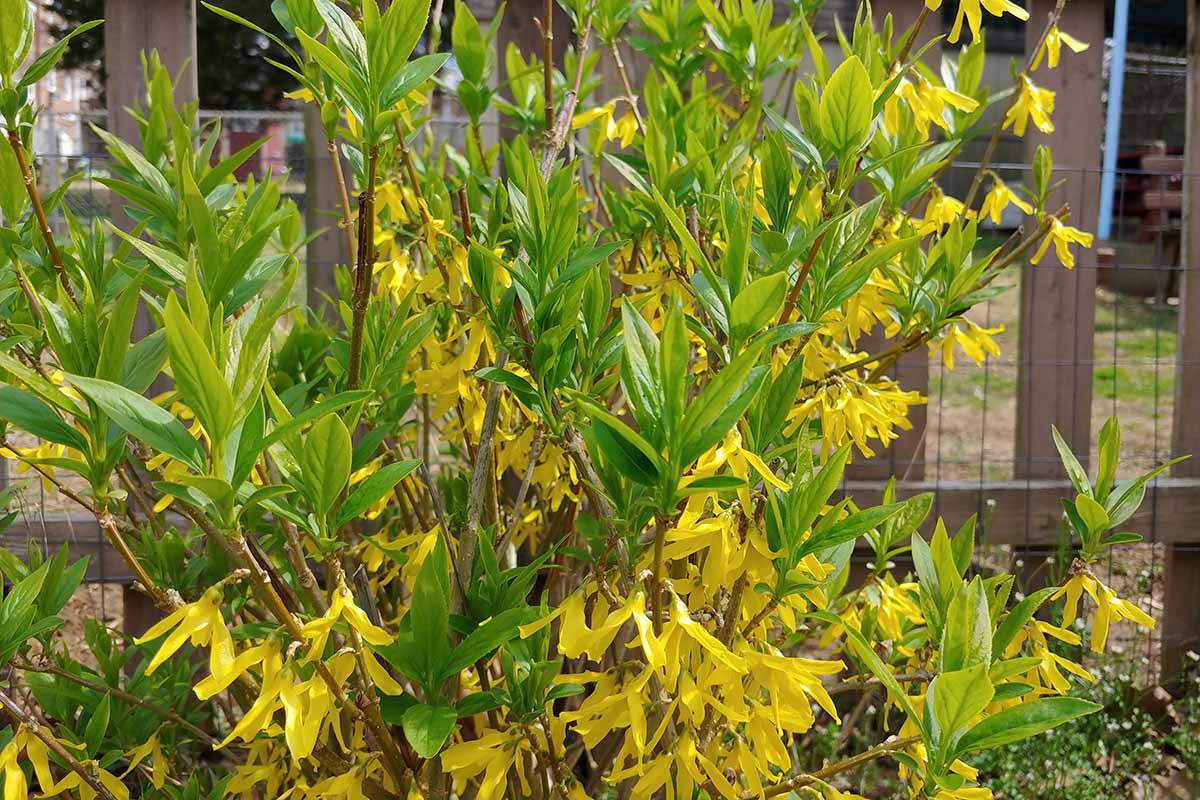
In the fall, many varieties bronze to shades of gold and burgundy, often remaining attached well into winter, with next spring’s swollen buds already visible.
It’s time to introduce a bush or two of one of spring’s brightest and most cheerful heralds to your landscape.
Whether you cultivate tousled mounds or manicured hedges, you can count on this vigorous plant to deliver for many years to come.
Are you growing forsythia in your garden? Let us know in the comments below.
If you’re looking for more flowering shrubs to grow in your garden you may enjoy reading the following:




What a wonderful, detailed article! I will definitely be back to learn more! Thank you.
Hi Angela –
Thank you. We are so glad you found it informative. Happy Gardening!
Just planted 32 gallon pots of Forsythia in a circle 12 inches apart and watered soil spot before planting with Root Stimulator [RS], watered base and roots with RS, then over the Forsythia with RS, 1 gallon of water per plant. No buds or flowers on bushes, now. The trimming is complicated. The article is very detailed and specific. DO YOU HAVE A PRINTED BOOKLET OF YOUR ARTICLE HERE ? I CANNOT PRINT IT. I hate to lose this invaluable information. 5-2-2021 Mgb.
Hello Mary Grace –
We’re glad you are finding the article to be a useful tool. All of our articles are available indefinitely online for future reference. We do not offer printed copies.
I keep articles like this in my Pinterest account – invaluable resources!
Comment I made has error. Planted 3 – 2 gallon bucket Forsythia plants…..not 32.