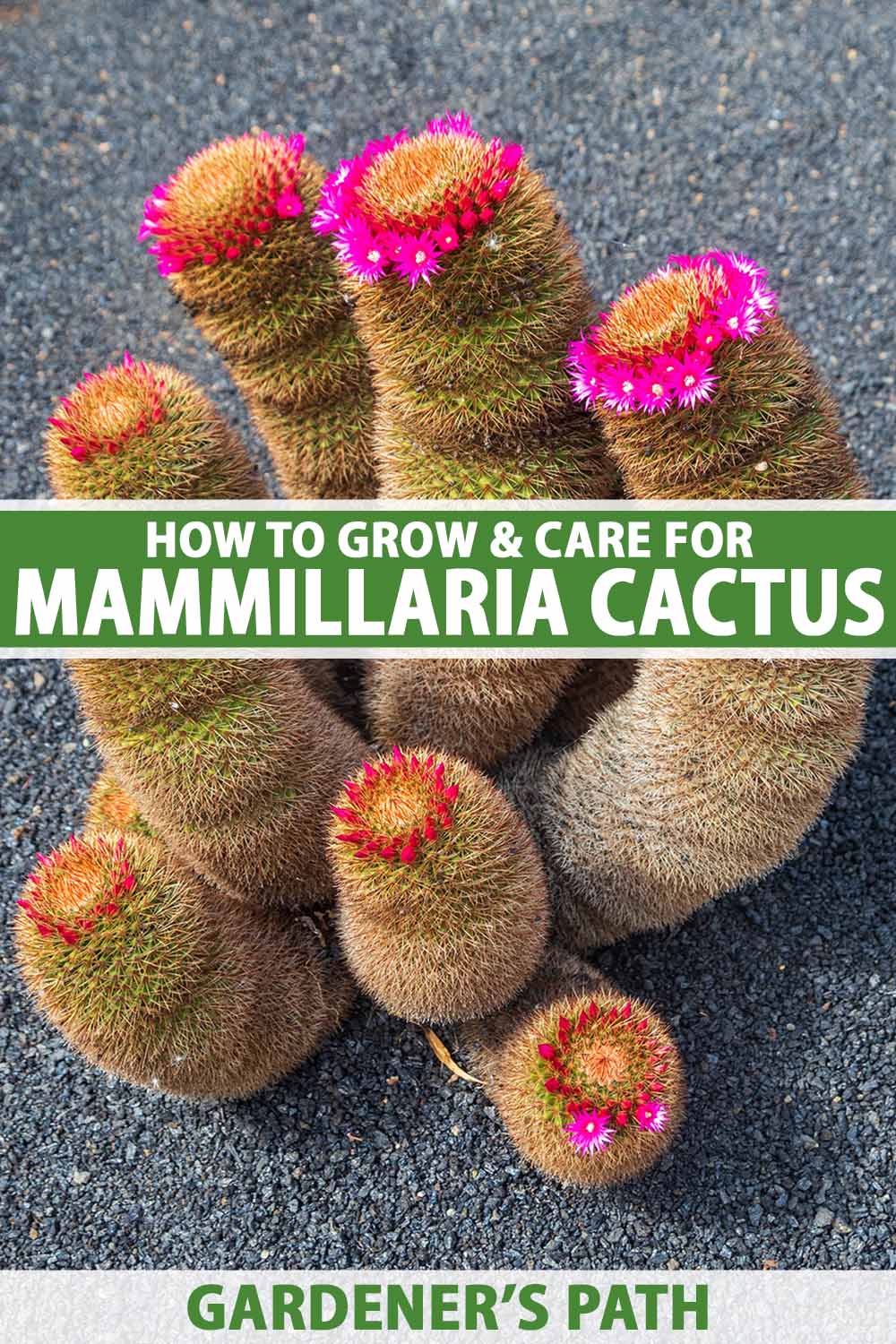
Mammillaria spp.
Cacti in the Mammillaria genus are globe or cylinder-shaped with nipple-like tubercules and hooked or straight spines.
Some sport single stems and others grow in mound-like clusters. They are suited to outdoor cultivation in Zones 9 to 11, and make easy-care houseplants elsewhere.
We link to vendors to help you find relevant products. If you buy from one of our links, we may earn a commission.
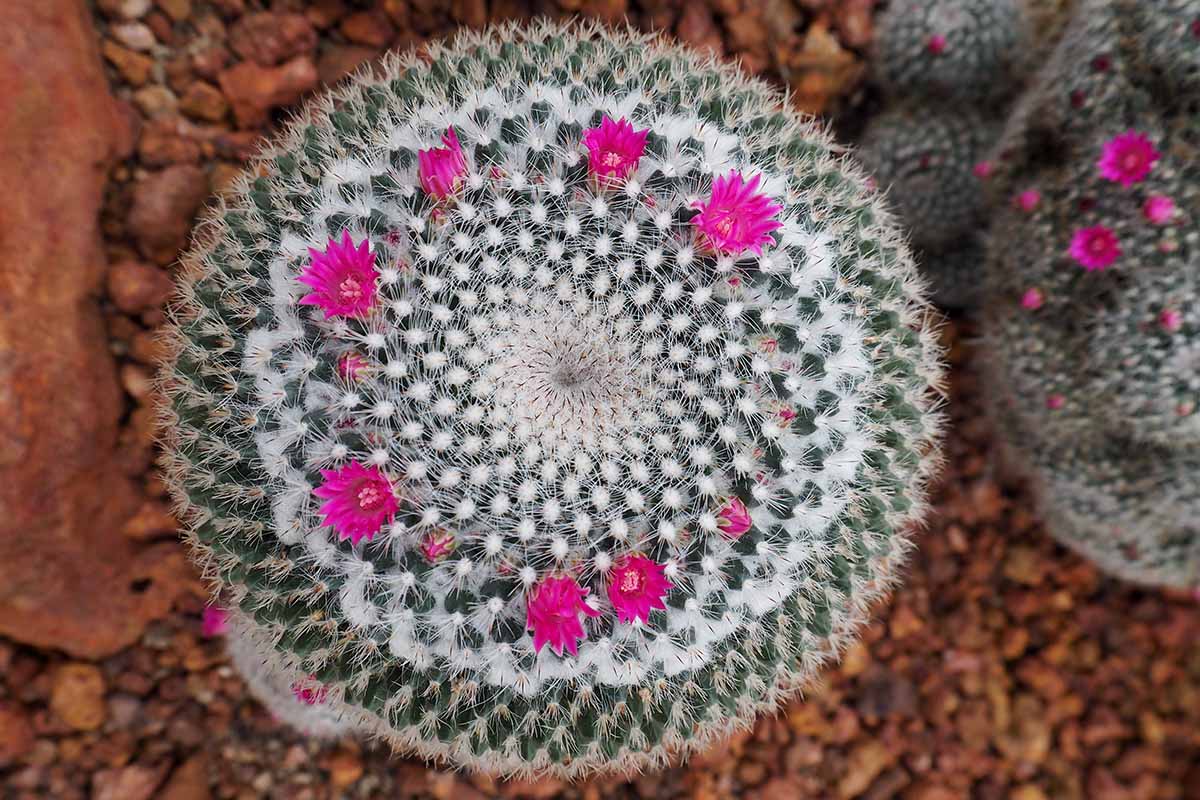
There are approximately 150 to 200 species in the varied Mammillaria genus, all with a unique characteristic: rather than having ribs like many cacti, the individual tubercles are arranged in spirals that intersect both clockwise and counterclockwise, a fascinating mathematical order called the Fibonacci sequence.
Read on to learn how to grow and care for these water-wise desert specimens in your outdoor or indoor living space.
Here’s what we’ll cover:
What You’ll Learn
Primarily native to Mexico, mammillaria are also endemic to the American Southwest, Caribbean islands, and northern South America.
Mature dimensions range from one to 16 inches tall and one to eight inches wide.
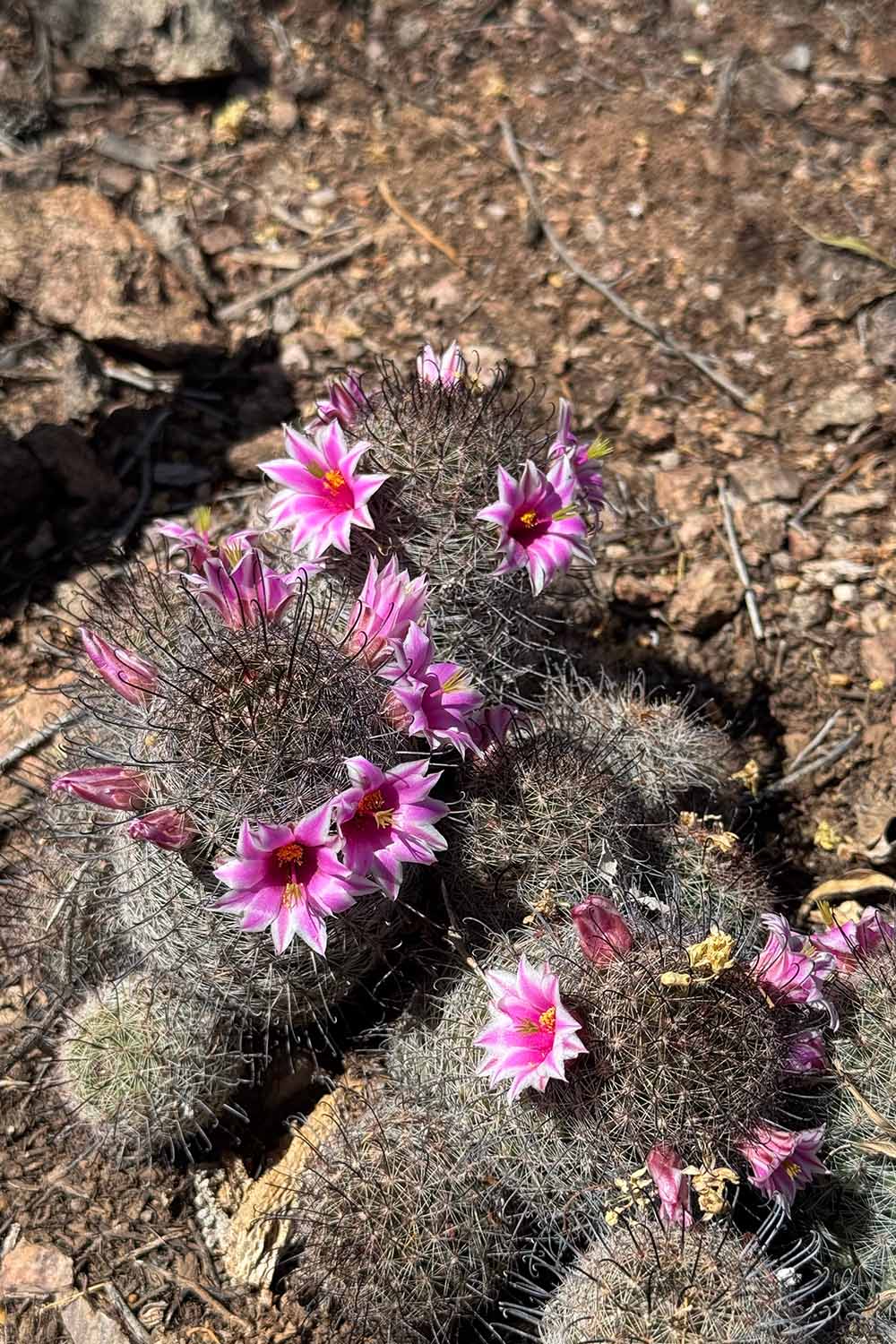
The flowers are funnel-shaped with green, pink, purple, red, white, or yellow petals.
Most often they appear in a ring near the apex, however some species bloom randomly.
Those who grow in-ground can expect to see flowers in the second year. Container gardeners may have to wait until year three.
Quick Look
Common name(s): Fishhooks, mammillaria, nipple, pincushion cactus
Plant type: Cactus
Hardiness (USDA Zone): 9-11 (outdoors)
Native to: American Southwest, Caribbean, Mexico, northern South America
Bloom time / season: Spring to summer
Exposure: Full sun to partial shade
Soil type: Gritty, average garden soil; cactus potting mix for pots, well-draining
Soil pH: 5.0-6.5, slightly acidic to neutral
Time to maturity: 3-10 years
Mature size: Up to 16 inches tall by 8 inches wide (depending on species)
Best uses: Bed, border, container, rock garden, xeriscape
Taxonomy
Order: Caryophyllales
Family: Cactaceae
Genus: Mammillaria
Species: Bocasana, carmenae, elongata, geminispina, longimamma, spinosissimaisii
Most species bloom in spring or summer, but some flower in the fall or late winter.
Tiny fruits may appear post-bloom. They are generally red, but may be green, magenta, white, or yellow. And while they are nontoxic, they don’t all taste good.
Mammillaria show well with other cacti and succulents in beds and borders, where similar cultural requirements make for easy maintenance.
They are also excellent additions to rockeries and native plant xeriscapes, where water-wise species are highly valued.
If you are container gardening, pot-up your favorites in decorative, well-draining vessels to enjoy on sunny patios or south-facing windowsills.
How to Grow
Mammillaria are accustomed to hot, sunny days, cool nights, and scant rainfall. They do not tolerate freezing temperatures or frost.
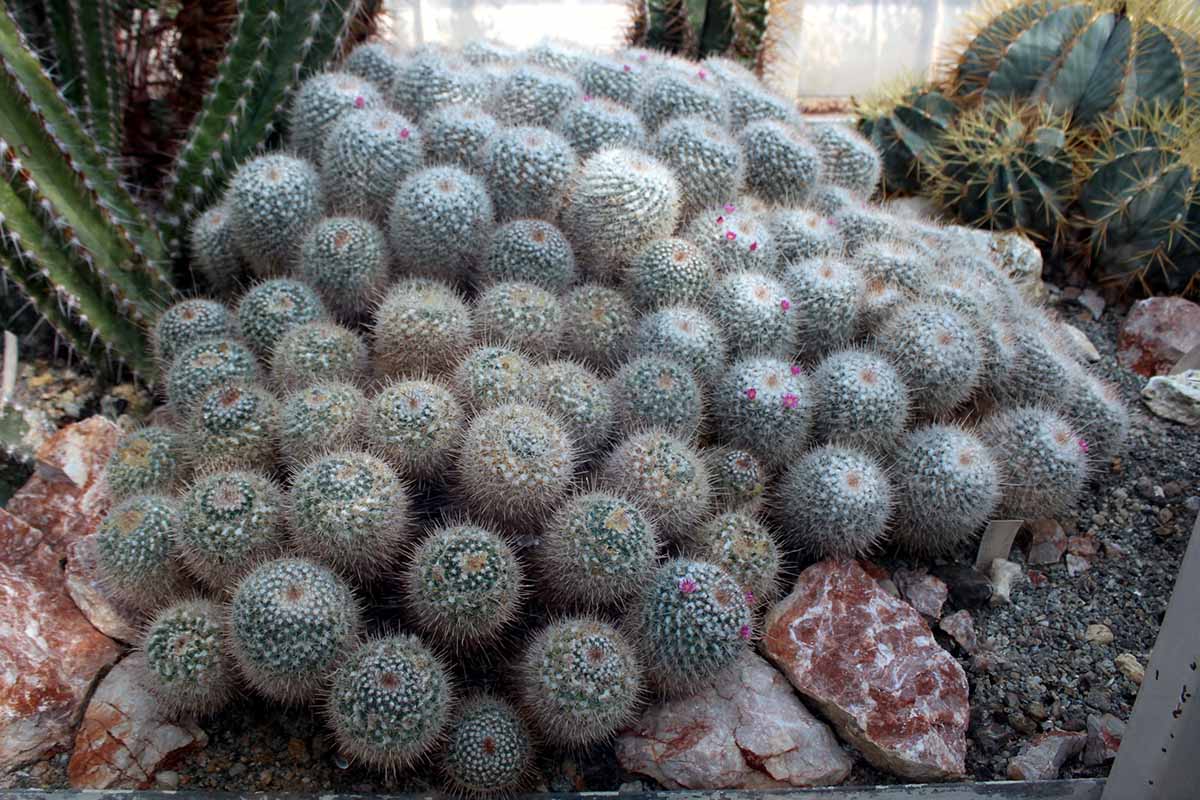
Suitable home gardens mimic these desert conditions.
Light
The sunlight in arid habitats is intense. Cactus seeds that sprout in rock crevices have some of the best germination rates as the fragile seedlings benefit from afternoon shade.
Gardeners should provide full sun outdoors. Those in the warmest regions may want to choose locations with morning sun and a bit of afternoon shade.
Place houseplants on a sunny windowsill. Rotate the pot weekly to prevent scorching and promote upright growth.
Soil
The ideal soil is loose, gritty, well-draining, and not overly fertile. The pH should be between 5.0 and 6.5, slightly acidic.
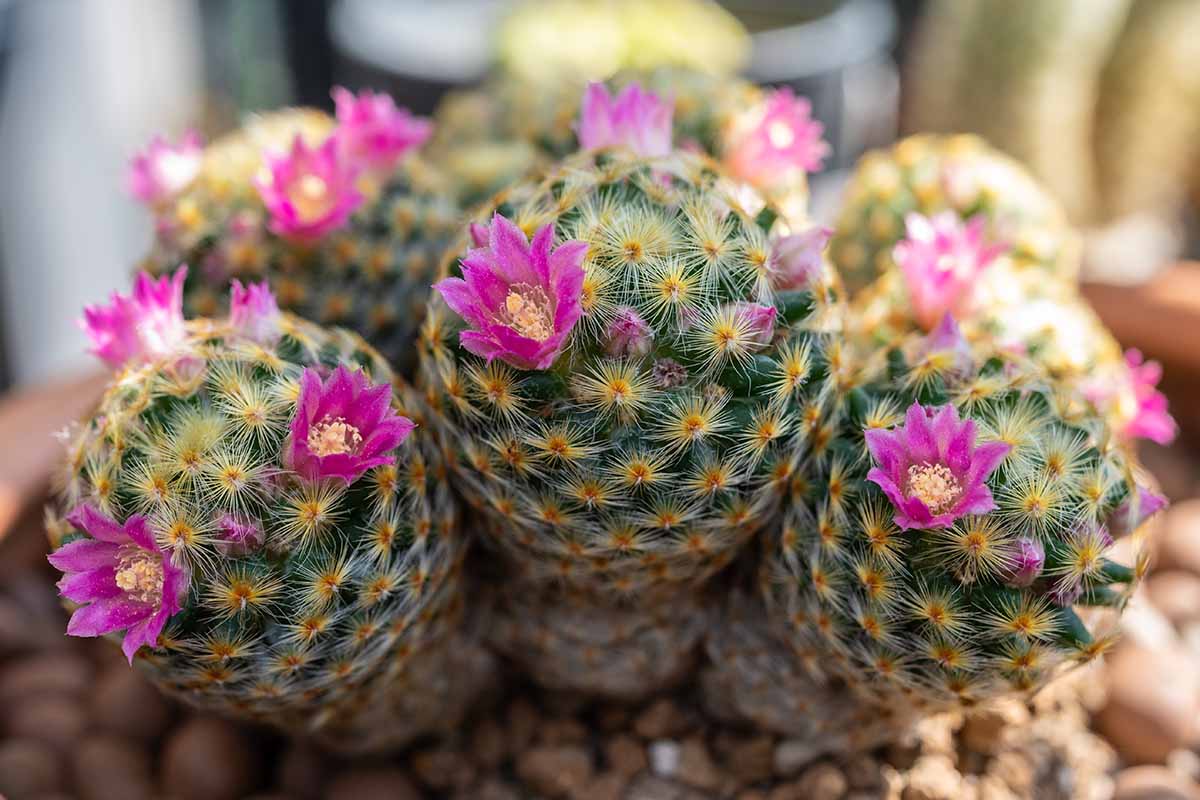
Select a high quality cactus and succulent potting mix for container plants.
I use a product from Hoffman that contains compost, peat moss, sand, and limestone. It provides nutrients while draining rapidly to prevent oversaturation.
Hoffman Organic Cactus and Succulent Soil Mix is available from Hoffman via Amazon.
You can also make your own potting mix with the instructions here.
Water
Germinating seeds and seedlings need consistent moisture. Water them before the soil is completely dry to keep it damp but not soggy. Use a moisture meter as a guide.
Once established in the garden or containers, water when the ground or potting soil is completely dry.
Indoor pots that are stored for the winter between 45 and 55°F to promote blooming do not require water, as discussed below.
See our guide to watering cactus houseplants for more information.
Fertilizer
Since they grow natively in depleted soil, you don’t need to fertilize your mammillaria plants.
If you do decide to feed, choose a very mild, low-nitrogen product, with an N-P-K ratio of 0.5-1-1. Dilute it to half-strength and apply it every two to four weeks from spring to fall.
I use Miracle-Gro Succulent Plant Food which is available from Miracle-Gro via Amazon.
Species and Cultivars
There are many exciting cultivars, forms, species, and variations of mammillaria to choose to start your outdoor or indoor display.
Here are some delectable options to whet your appetite:
Brain
M. carmenae has a petite stature of three inches tall and six inches wide. Each tubercle has a fountain-like tuft of golden bristles and cream to pink blossoms.
M. carmenae f. cristata is a naturally occurring mutation, aka variation, with curvy stems giving the plant a crested, brain-like appearance.
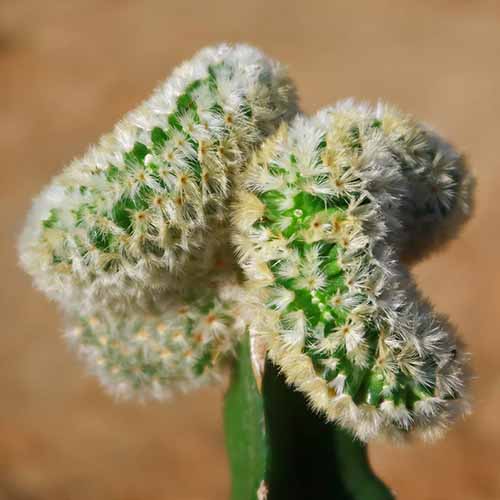
Mature dimensions are six inches tall and eight inches wide. The flowers are pink or white and bloom between late winter and early spring.
Because the Cristata variation grows slowly, it is often grafted to a faster growing cactus to jump start its progress.
Plants are available from Planet Desert.
Finger
M. longimamma produces a cluster of prominent, cone-shaped tubercles that resemble fingers.
Each cluster is about four inches tall with a spread of two inches. Because the globes grow in a clumping fashion, the diameter may spread between six and 12 inches.
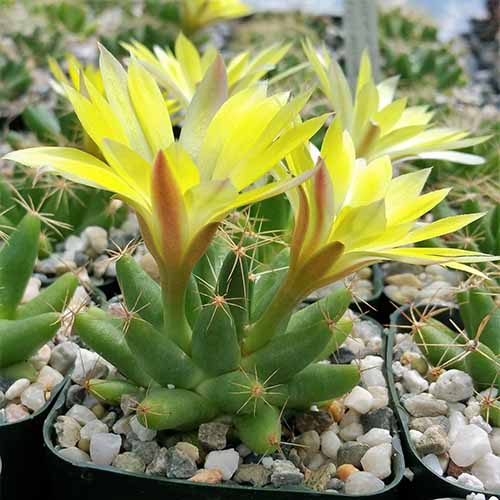
The bright yellow flowers are large in proportion to the globes and make a striking statement in late spring to early summer.
Plants are available from Planet Desert.
Lady Finger
M. elongata, the lady finger or gold lace cactus, has narrow columnar stems that point in all directions and measure four to six inches tall and half an inch to an inch wide.
They grow in dense clusters that may be 10 or 12 inches wide. The spring flowers are a pastel shade of pink, yellow, or white.
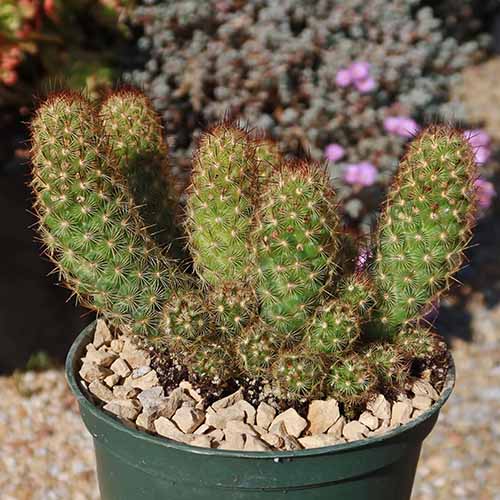
M. elongata ‘Copper King’ is a cultivated variety noteworthy for its richly colored red-orange spines that give the eight-inch stems a coppery sunset glow.
Plants are available from Planet Desert.
M. elongata also has a naturally occurring variation that resembles a brain.
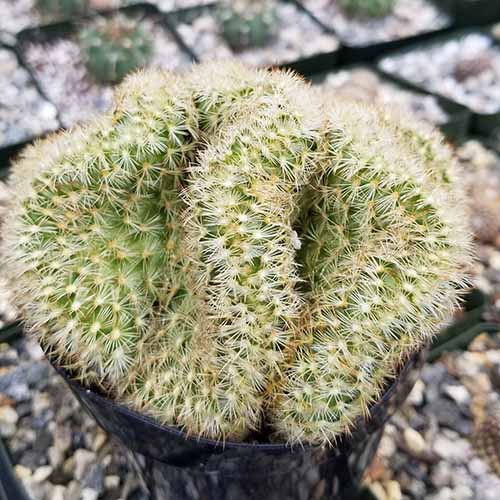
M. elongata var. cristata has pink flowers and undulating stems. It grows as a creeping ground cover with mature dimensions of six inches tall and 12 inches wide.
Plants are available from Planet Desert.
Powder Puff
The powder puff cactus, M. bocasana, has a globe shape and clustering growth habit.
Mature dimensions are two to five inches tall and two to three inches wide.
The reddish spines are curved and were used by fishermen in ancient times as bait hooks. Soft white hairs cover the cactus flesh.
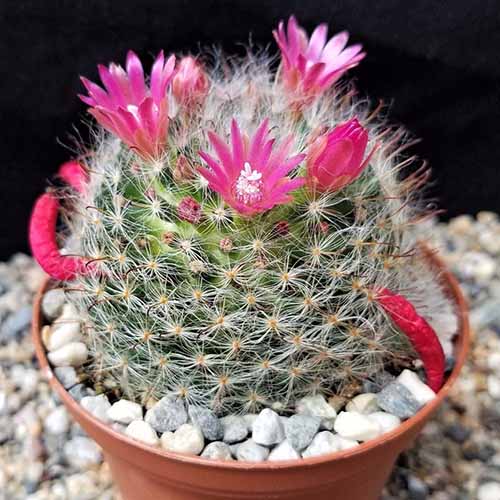
M. bocasana ‘Roseiflora’ is a cultivar with bright pink to rose blossoms that appear in late spring or early summer.
Plants are available from Planet Desert.
Spiny Pincushion
The spiny pincushion cactus, M. spinosissima, is one of the faster growing species. It has a columnar form and attains a height of approximately 12 inches.
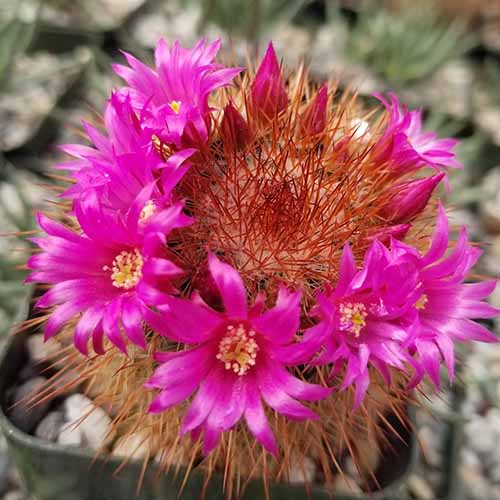
Magenta flowers form a decorative ring around this summer bloomer.
Plants are available from Planet Desert.
Twin-Spined
Twin-spined cactus, M. geminispina, has two long white spines per tubercle with white wool between them.
The flowers are rose- to red-hued and appear in a circular arrangement. Blooming occurs between late spring and fall.
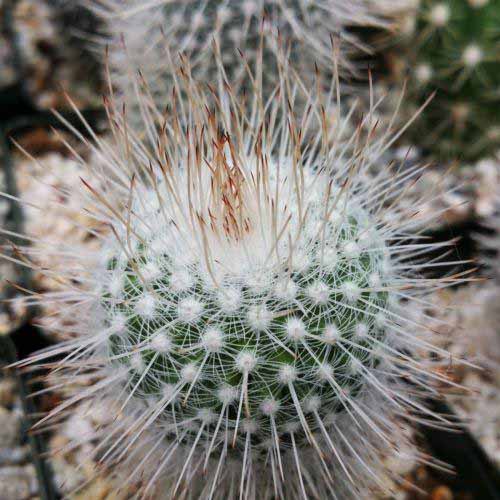
This species may grow as an individual stem or a multi-stemmed mound with many offsets. Mature stems may reach 10 inches tall and colonies may spread to 20 inches.
Plants are available from Planet Desert.
Maintenance
Desert cacti are low-maintenance plants. However, there are still a few tasks required to support healthy growth and blooming.
Repot your cacti as needed to maintain one to two inches of space between the root mass and the sides and bottom of the container.
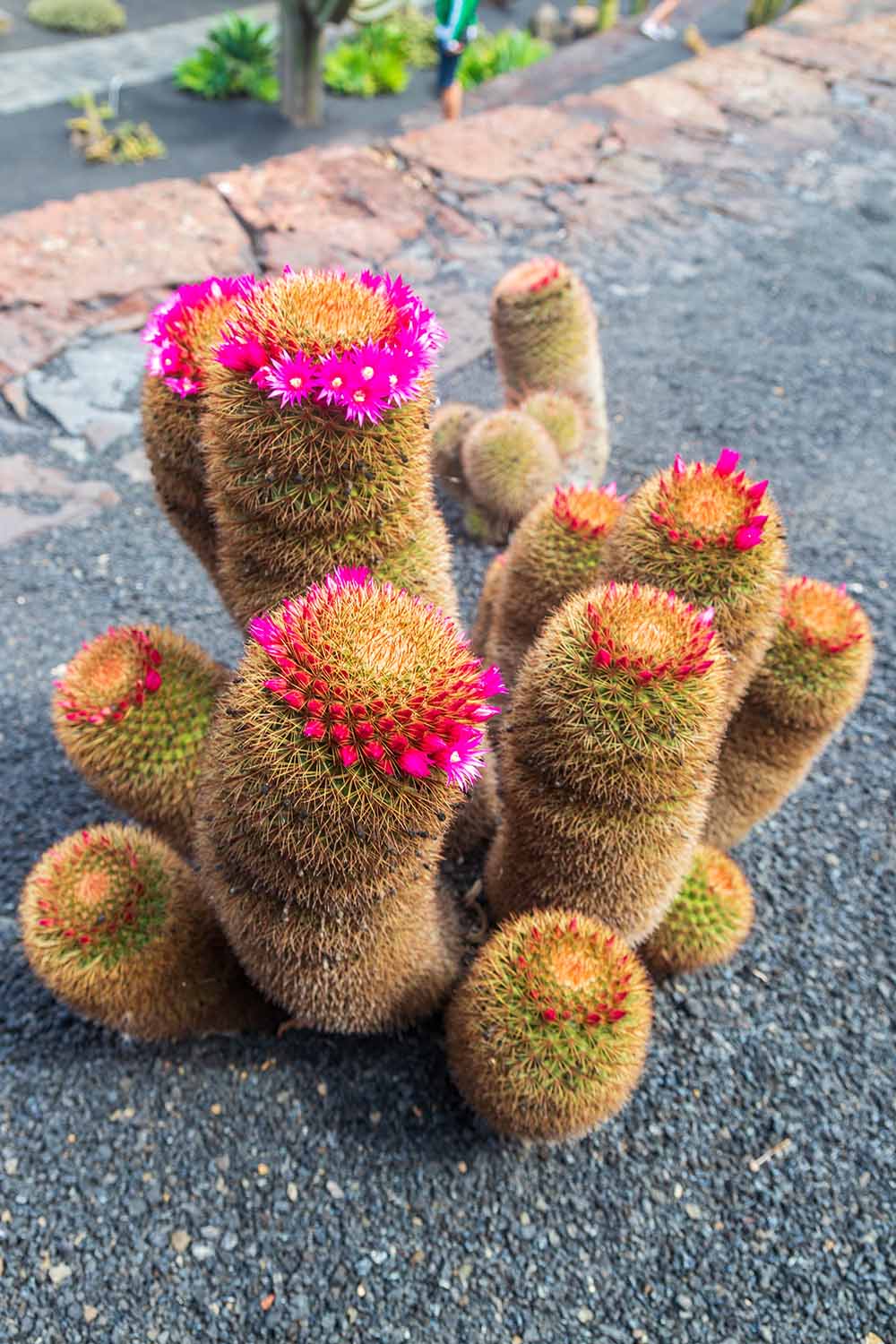
Choose appropriately sized vessels with ample drainage holes to prevent prolonged wetness and root rot.
Replace the growing medium each time you repot to replenish nutrients and prevent compaction.
To promote indoor blooming, place pots in a dry location with bright, indirect sunlight and a temperature between 45 and 55°F degrees for the winter. Do not water them.
Return the containers to their sunny windowsills in the spring, and resume watering when the soil is completely dry.
If you find your plants shading from green to red or turning brown, they are likely scorching from too much direct sun exposure.
Place them a foot away from the window and consult our guide to treating sunburn for information.
Propagation
To propagate mammillaria, you’ll need to collect or purchase seeds, or divide an offset from an existing plant.
You can learn more about propagating cacti here.
Let’s discuss.
From Seed
After the flowers bloom, they produce pods that resemble small chili peppers.
Let them soften and then detach from the plant. Wear gloves!
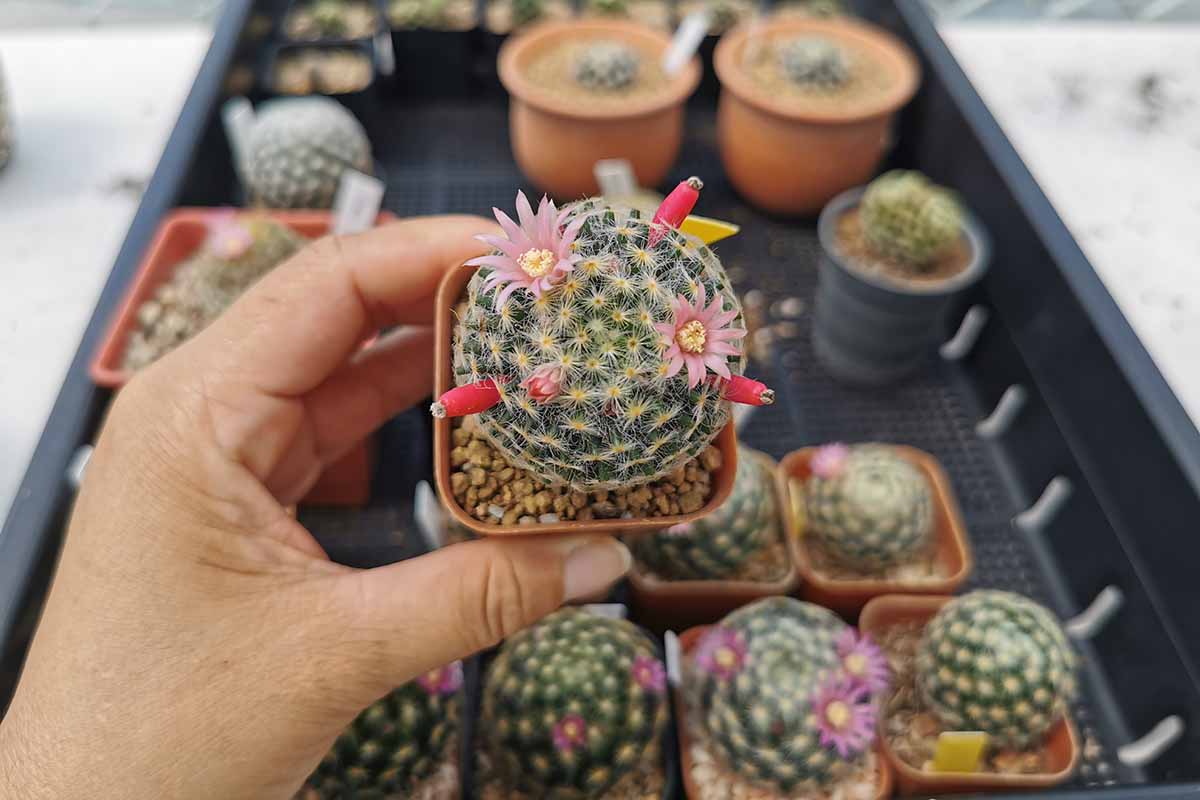
Place the pods on a clean cloth.
Use the tip of a knife to slice shallowly through them lengthwise.
Open them flat and gently scrape the seeds out of the gelatinous fruit and onto the cloth.
Blot off as much gel as you can and place the seeds in a fine mesh tea strainer and rinse gently.
Return the seeds to a clean cloth, pat them dry, and put the cloth out of direct sunlight overnight.
The next day, fill the cells of a seed starter tray three-quarters full of moist cactus and succulent potting soil.
Scatter several seeds in each cell.
Wrap clear plastic snugly over the tray to provide a humid environment.
Use a warming mat or select a location that maintains a temperature of 70°F.
Place the tray (with or without a warming mat) one to two feet from a sunny window where it will receive bright, indirect sunlight.
Loosen the plastic when the seeds begin to sprout, removing it altogether when the majority have emerged.
Maintain even moisture by misting before the soil completely dries out.
Allow the seedlings to remain in the seed tray until they begin to touch and crowd each other.
At this point you can transplant to larger pots.
Moisten the seed tray cells the day before you intend to transplant.
Select a well-draining vessel that is one to two inches wider and deeper than the root mass of the seedling(s) in a cell.
Fill it two-thirds of the way with cactus and succulent potting mix.
Taking care not to disturb the fragile roots, set the contents of each starter cell at the same depth as in the seed tray, with the crown, where the stem and roots meet, at or slightly above the soil surface.
You can place more than one seeding in a pot. Tamp and backfill to hold it firmly in place.
Do not water until the soil is completely dry. Set the pot on a sunny windowsill.
Alternatively you can transplant into the garden as discussed below.
By Offset Division
An offset is a “pup” that sprouts beside a parent. Not all species produce these but for those that do, it’s a simple method of propagating new plants.
When the offset is at least an inch in diameter, or one-third the size of the parent for smaller types, you can separate it from the parent with a gentle twist.
After dividing, set the offset on a clean cloth and place it out of direct sunlight until the severed end dries and forms a callus. This may take several days.
Once callused, it is ready for potting up or transplanting into the garden.
Select a well-draining container one to two inches wider and deeper than the division.
Transplanting
To transplant into the garden, work the soil in a sunny location to a depth of four to six inches until it is crumbly and free from debris.
Set the seedlings or offsets into the ground at the same depth as they were in the growing container.
Allow about eight inches of space between transplants to allow for mature dimensions without overcrowding.
Water when the soil is dry to a depth of about two inches.
Pests and Disease
When their cultural requirements are met, cacti are not prone to pests and pathogens.
However, moisture stress in the form of over- or underwatering makes them more susceptible.
Sapsucking mealybugs, scale, and spider mites favor hot, dry conditions.
Fungal and bacterial diseases may proliferate in overly wet environments. Proper watering is the best avoidance measure.
See our guides to cactus pests and cacti going soft for information on addressing infestations and infections.
So Many to Choose
The Mammillaria genus offers Zone 9 to 11 gardeners and houseplant aficionados a varied palette of species, natural forms and variations, as well as cultivars.
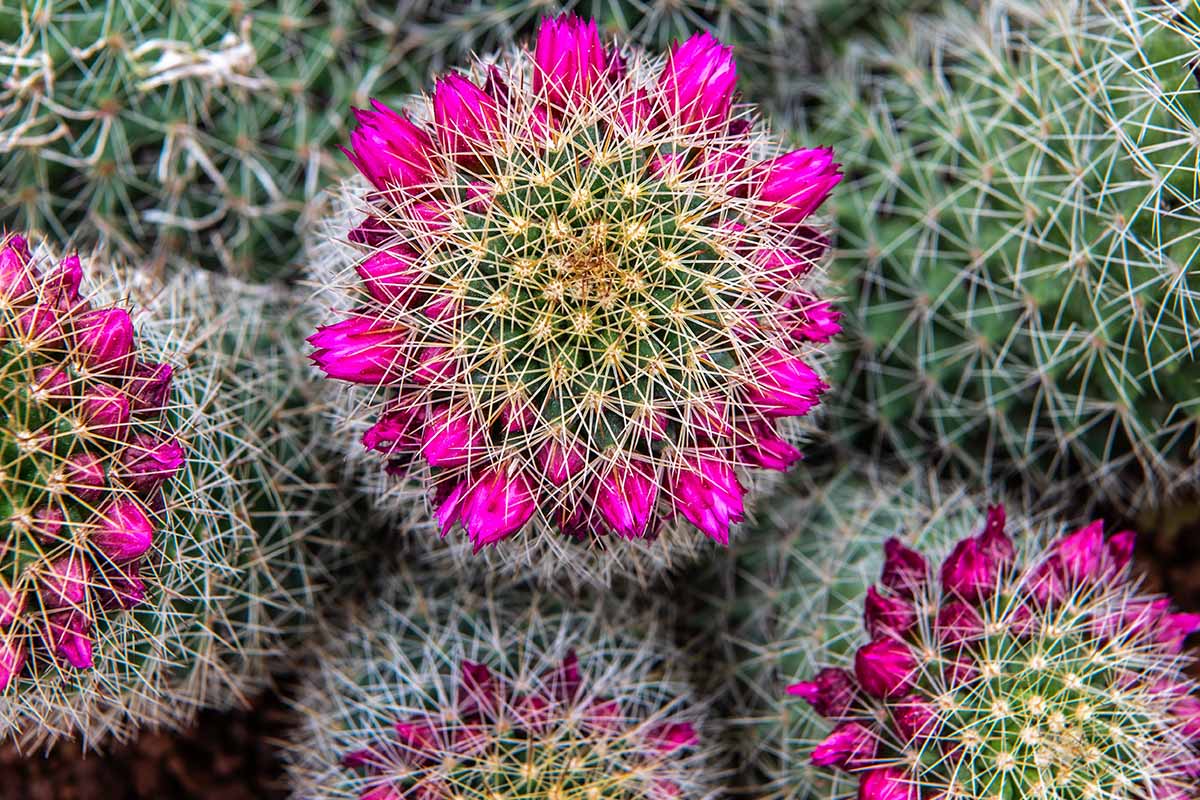
With delightful blossom crowns and water-wise ways, they are sure to delight. Which are your favorites? Are you ready to add them to your garden planner?
Do you grow mammillaria cacti? Please share your tips in the comments section below.
If you found this article informative and want to learn more about cactus cultivation, we recommend the following: