Sinningia speciosa (syn. Gloxinia speciosa)
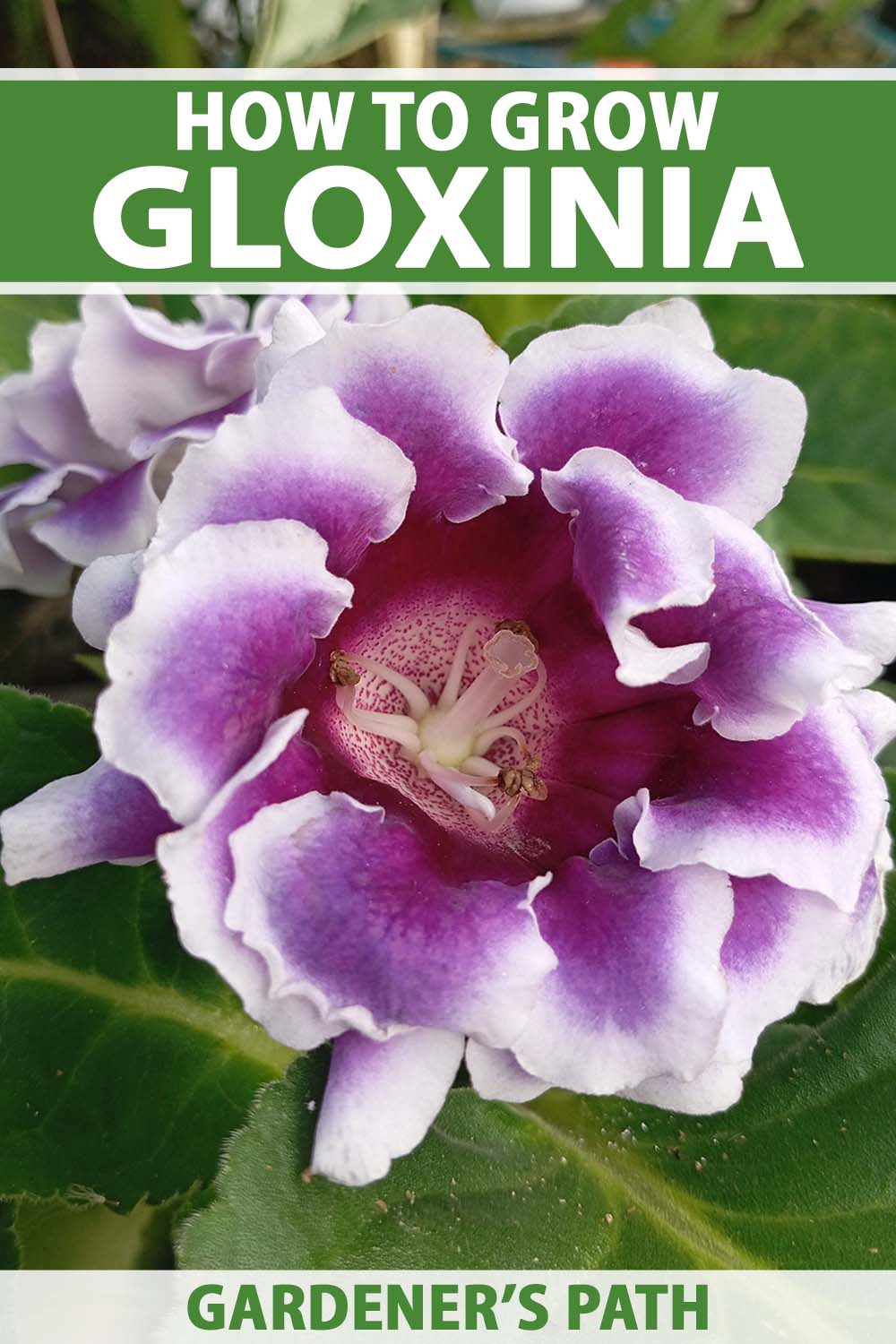
Gloxinia, Sinningia speciosa, is a showy tender perennial native to the tropical rainforests of Brazil, suited to outdoor cultivation in Zones 11 to 12.
The plants can also enjoyed as annuals, and with proper care, make outstanding houseplants.

We link to vendors to help you find relevant products. If you buy from one of our links, we may earn a commission.
While this species is related to the African violet, being a member of the Gesneriaceae family, it differs from its evergreen cousin, undergoing a leafless dormant period from late fall to spring.
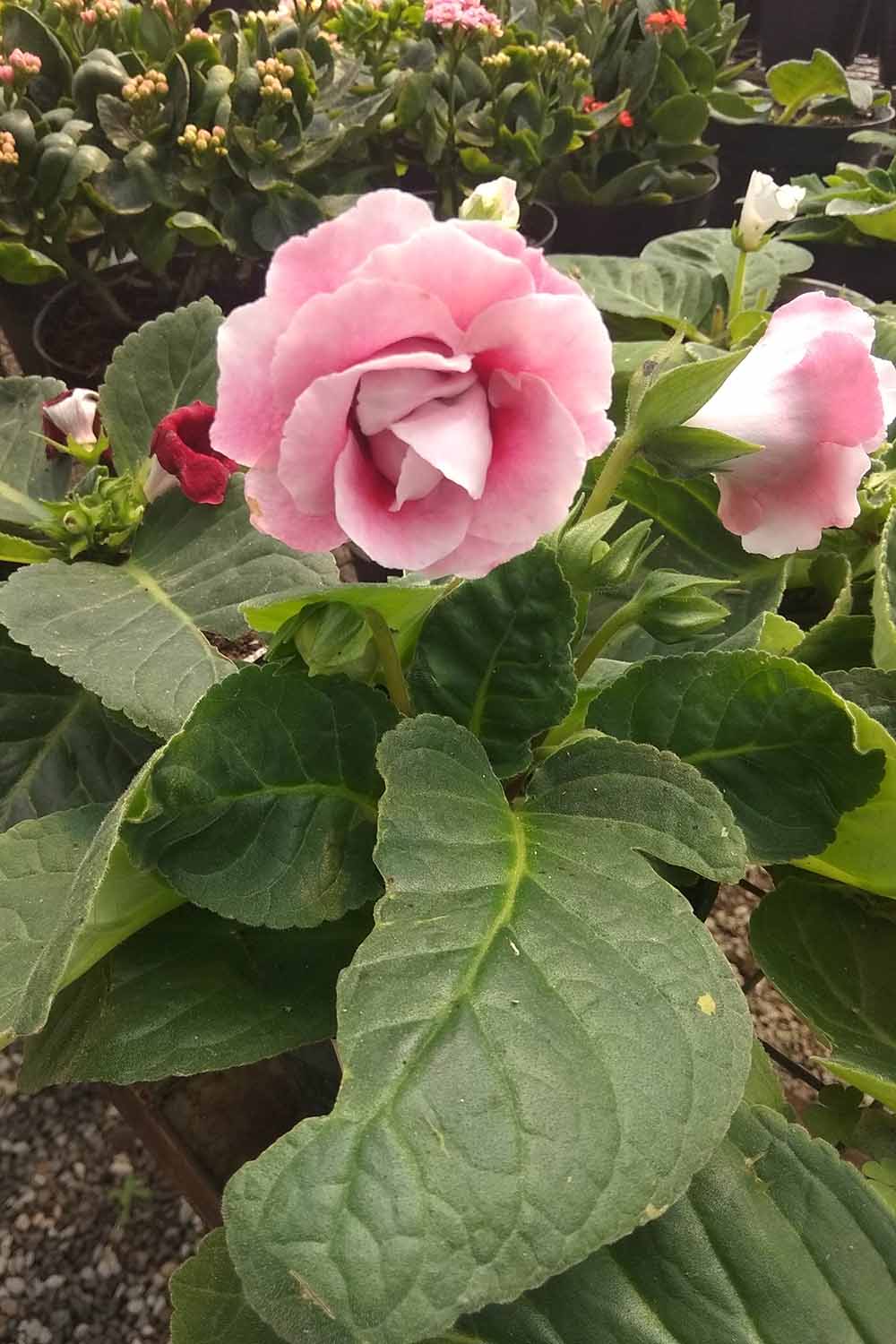
From spring through summer, it displays three- to four-inch funnel-shaped flowers in vibrant and often variegated shades of lavender, purple, red, or white.
The petals may be single or double, and ruffled or smooth. They perch singly or in clusters atop a compact rosette of velvety green serrated leaves.
This guide discusses how to grow and care for gloxinia indoors.
Here’s what we’ll cover:
What You’ll Learn
Before it was classified as a member of the Sinningia genus, this plant was known as Gloxinia speciosa. This is the origin of the common name.
True Gloxinia species do not have tuberous roots. Common names include Brazilian, florist’s, and tender gloxinia.
Quick Look
Common name(s): Brazilian gloxinia, florist’s gloxinia, gloxinia, tender gloxinia
Plant type: Perennial flowering tuber
Hardiness (USDA Zone): 11-12 (outdoors)
Native to: Brazil
Bloom time / season: Spring and summer
Exposure: Bright, indirect light, dappled shade
Soil type: Well-draining, moisture-retentive African violet potting mix
Soil pH: 5.0-6.5, slightly acidic to neutral
Time to maturity: 6 to 8 months from seed, 4 months from tubers
Mature size: 6 to 12 inches tall and wide
Best uses: Beds, containers, houseplants
Taxonomy
Order: Lamiales
Family: Gesneriaceae
Genus: Sinningia
Species: Speciosa
Note that there is also a hardy gloxinia, Incarvillea delavayi, named for its resemblance to the tender species.
It is native to China, grows outdoors in Zones 5 to 7, and is not usually grown as a houseplant.
Gloxinia is a tuberous plant with modest dimensions of six to 12 inches tall and wide.
It’s perfect for bedding or container gardening in the appropriate Zones. In cooler regions, it makes a robust houseplant.
How to Grow
The care regimen is not as easy as it is for some houseplants. However, once you experience the blooming and dormancy cycles, you’ll gain a better understanding of gloxinia’s needs.
To create a nurturing environment that mimics the Brazilian tropics, growers should meet these requirements:
Climate
Endemic to the Atlantic Coastal Forest biome region of Brazil, gloxinia is accustomed to average temperatures of 73 to 81°F with 77 to 88 percent humidity.
There are dry and rainy seasons, with spring and summer being the wettest.
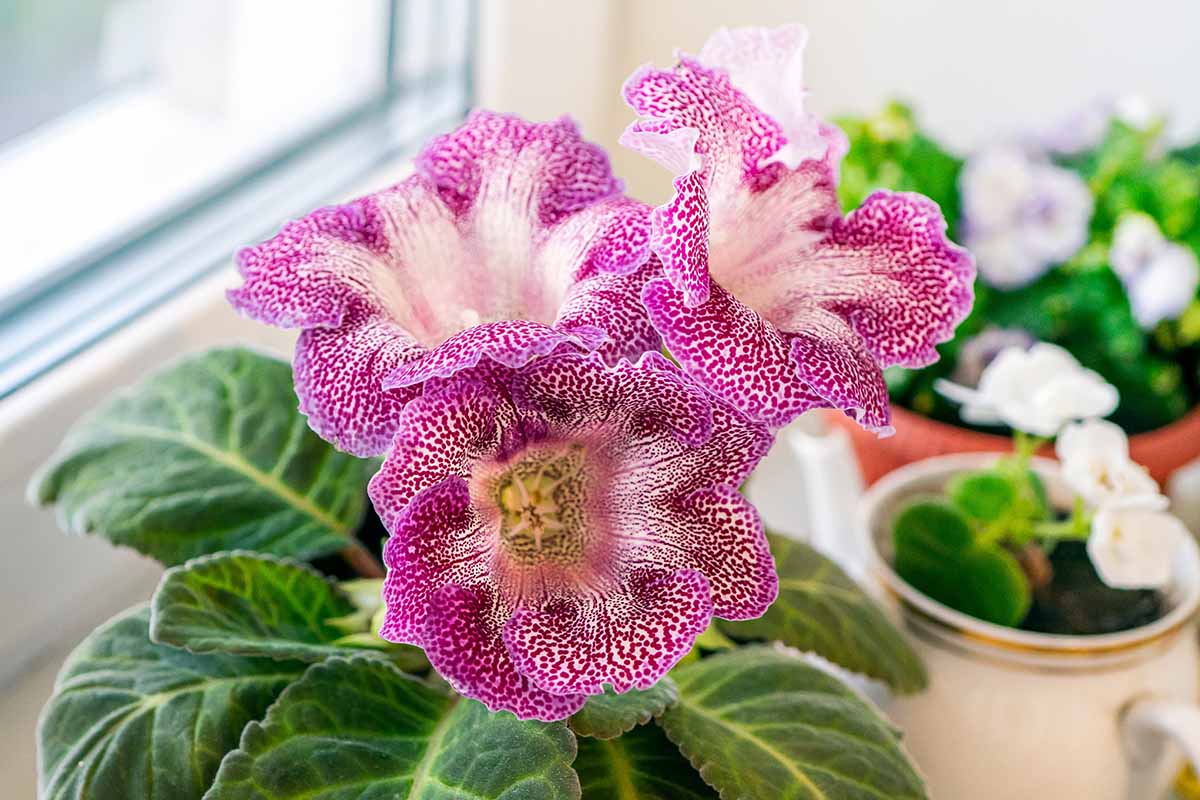
A location away from drafts that is 75°F during the day and at least 65°F at night is suitable for houseplant cultivation. Avoid temperature fluctuations, as they may cause leaves to drop off.
To increase the humidity around a potted specimen, place it on a bed of small stones arranged in a single layer in a shallow pan.
Add water sparingly until the level is just below the pot base and drainage hole, but not submerging them.
Light
In the wild, gloxinia grows in the dappled sunlight beneath forest trees. It tolerates full shade, but blooms better with sun exposure.
Indoors, provide bright but indirect sunlight, such as near an east-facing window. Avoid direct sunlight that may fade the flowers and scorch the foliage.
Soil
The native coastal soil is acidic, infertile, and sandy. Decaying organic matter enriches it with nutrients to support blooming.
Choose an African violet potting mix. It will have the appropriate 5.5 to 6.5 pH level, organic matter for healthy foliage and flowering, and inorganic matter for drainage and moisture retention.
African Violet Premium Potting Mix
This product from Midwest Hearth is a ready-to-use mixture of peat moss, perlite, and vermiculite. It is lightweight, well-draining, and moisture-retentive.
African Violet Premium Potting Mix is available from Midwest Hearth via Amazon in four- and eight-quart bags.
Water
In its natural environment, gloxinia grows during the wettest seasons of the year.
As a houseplant, it needs consistent moisture without oversaturation from spring through summer.
When the top inch of soil feels dry, water deeply until it runs from the drainage holes.
Use tepid water, neither too warm nor too cool, to avoid shock. Take care to water over the soil, not the foliage or tuber, to inhibit fungal disease and rotting.
Our guide to watering houseplants has more information.
Fertilizer
To support optimal blooming, feed each time you water using a well-balanced liquid plant food diluted to a quarter strength.
A product with an NPK ratio of 10-10-10 is sufficient.
Where to Buy
The time to purchase seeds or tubers is in late winter or early spring. You’ll find an array of named cultivars, including hybrid series, from which to choose.
Hybrid cultivars have the largest flowers and expand the natural color palette with pastels and variegated schemes.
The Brocade Series was developed by the Sakata Seed Corporation and offers a mix of double-petal blossoms in shades of blue, burgundy, purple, red, and white, often with white margins.
The foliage is dark green. Allow 20 to 24 weeks for maturity from seed.
Brocade Mix gloxinia seeds are available from Outside Pride via Amazon.
Additional cultivars you may come across when shopping include:
‘Carangola’ has white blossoms with purple throats and olive-green leaves.
‘Purple’ has purple flowers and dark green leaves.
However, it’s more likely to find more generic labels that simply list their color.
Maintenance
For a fuller, more uniform appearance, some folks “disbud,” or pinch off the first two spring buds to encourage clusters of blossoms rather than individual flowers.

Post-bloom, deadhead the spring flowers. When they fade, cut off the stems just above the foliage to encourage a repeat bloom in the summer. Remember to pinch off the first two buds for the best display.
When the second flush of flowers dies, reduce watering. Keep the soil slightly moist while the foliage also dies back. Discontinue fertilizing during the dormant period.
After the foliage has withered, dormancy begins and lasts through the fall and winter.
Place the pot in a location where the temperature remains between 60 and 65°F and keep the soil dry during dormancy.
In late winter to early spring, new growth appears.
This is a good time to repot in fresh soil before bringing the pot into bright, indirect sunlight for the growing season. Resume watering and fertilizing when the top inch of soil is dry.
Repotting every one to two years replenishes the soil and gives you the opportunity to increase the pot size if necessary.
Gloxinia likes a snug fit, so allow no more than an inch of space between the tuber(s) and the rim and an inch between tubers.
Standard pot depth is fine, as they sit high in the soil and have shallow roots.
Additional maintenance includes pruning off leaves damaged by pathogens, pests, or sunscald.
Propagation
To start plants, you’ll need seeds, leaf cuttings, tubers, or tuber divisions. You can also purchase a potted specimen in bloom in late winter or early spring.

Let’s consider each method.
From Seed
For a spring bloom, you’ll need to start seeds in early winter.
- Fill a seed starter tray three-quarters full of African violet potting mix and lightly moisten the soil.
- Scatter the tiny seeds over the surface of the potting mix.
- Press them down gently, but do not cover with soil as the seeds require light to germinate.
- Cover the tray with clear plastic wrap to create a self-watering greenhouse and set the tray in a location with bright, indirect sunlight.
- Use a heat mat if necessary to maintain an ambient temperature of 70°F.
- After the seeds sprout, remove the plastic wrap.
- Water as needed to keep the soil from drying out, but avoid oversaturation.
- When the seedlings have their first set of true leaves, thin them to one per inch.
Transplant the seedlings per the instructions below when they have three sets of true leaves.
From Leaf Cuttings
Select a healthy mid-size leaf that is neither the smallest nor the largest on the plant.
- Use clean shears to detach the leaf by severing the petiole or leaf stem near its point of origin.
- Prepare a four to six-inch pot by filling it three-quarters full of African violet potting mix.
- Dip the cut end of the petiole into rooting hormone powder.
- Use a pencil or chopstick to make a one-inch hole in the center of the soil.
- Gently insert the petiole into the hole.
- Tamp the soil to hold it firmly in place so that the bottom of the leaf is just above and not touching the soil.
- Moisten the soil.
- Put a clear plastic bag over the top and sides of the container, making sure it doesn’t cover the drainage hole.
- Place the pot in bright, indirect sunlight in a 70°F room.
When new growth appears, remove the bag and water when the top inch of soil is dry.
From Tubers
You can purchase tubers in late winter and you should plant them immediately.
- Fill a well-draining shallow container, approximately two inches deep, three-quarters full of African violet potting mix.
- Bury the tubers half an inch deep, with the smooth, rounded side down and the inverted, bumpy side just barely showing above the soil.
- Space multiple tubers at least three inches apart.
- Lightly moisten the soil.
- Place the pot in bright, indirect sunlight in a 70°F room.
- Keep the soil lightly moistened.
Once they sprout, transplant the tubers per the instructions below.
By Division
After a tuber sprouts in the spring, you can unearth it and use a sterile knife to divide it into multiple portions, each containing a leaf or leaf node at the top and roots at the bottom.
Plant each division per the instructions below.
Transplanting
Seedlings with at least three true leaves are ready for transplant to four- to six-inch well-draining containers filled three-quarters full of African violet potting mix.
Set them at the same depth they were in the seed-starting tray.

Similarly, if you transplant leaf cuttings or sprouted tubers to larger containers, replicate the original depth.
For divisions, set the crown, where the stem and tuber meet, slightly above the surface of the soil.
If you purchase a blooming plant in a nursery pot and want to put it into a more decorative one, select a comparable-sized, well-draining vessel and transfer the entire contents, replicating the original depth.
Reserving the original soil helps minimize transplant shock.
Pests and Disease
Gloxinia is not particularly prone to pests and pathogens when its cultural requirements are met.
Plants grown in overly wet or dry conditions are more likely to experience an infestation or infection.
Pests
Pests you may encounter include:
Aphids
Aphids are sap-sucking pests that prefer high humidity, warmth, and tender new foliage.
Telltale signs include clusters of soft-bodied insects, sticky honeydew trails, and leaf deformity, discoloration, and wilting.
Spray the insects with water to dislodge them and treat with horticultural neem oil.
Learn more about how to deal with aphids here.
Cyclamen Mites
Cyclamen mites favor humid, cool environments and infest leaf and bud nodes, causing growth anomalies and a failure to bloom.
There is no home treatment. Discard affected plants in the trash.
Foliar Nematodes
Worm-like soilborne foliar nematodes prefer high humidity and damp conditions. They cause leaf deformity and brown patches between the leaf veins.
There are no safe or effective treatments for indoor use. Dispose of plants with these symptoms.
Fungus Gnats
Fungus gnats are tiny black flies that lay their eggs in wet soil.
The larvae feed on the tuberous roots, particularly immature, tender ones, yellowing the leaves and stunting growth.
Use yellow sticky traps to catch winged adults. Sprinkle food grade diatomaceous earth (DE) on the soil to inhibit egg laying and kill emergent larvae.
Our guide to fungus gnats has more information.
Mealybugs
Powdery-white mealybugs thrive in warmth and humidity. These sapsuckers cause damage similar to aphids.
Spray the plants with water to remove them and follow up with a neem oil treatment.
Learn more about mealybugs here.
Spider Mites
Spider mites are sapsuckers that thrive in hot, dry environments. They cause stippling, tiny yellow or white dots that merge, discoloring the foliage and causing it to wilt.
The mites themselves are tiny, but you’ll usually see the fine webs they create.
Apply neem oil to treat an infestation or check out our guide to spider mites to learn more.
Thrips
Sapsucking thrips prefer heat and dry conditions. They leave silvery trails on the leaves as they feed. Treat them with neem oil.
Disease
The sticky honeydew trails left behind by sapsucking pests are a prime breeding ground for sooty mold that blackens the leaves, impeding chlorophyll production and resulting in stunted growth.
Remove any blackened leaves and treat the pests as discussed.
Diseases to be aware of are gray mold, root rot, and spotted wilt.
Fungi in the Botrytis genus may adversely affect foliage in cool, wet environments, causing a fuzzy coating of gray mold.
Remove affected flowers and leaves and dispose of them. Treat healthy portions preventatively with neem oil.
Thrips vector spotted wilt, an incurable plant virus that causes yellow spots that turn brown as plant tissue dies. Discard infected plants in the trash.
Root rot is a common problem in houseplants that are overwatered or cultivated in soil that lacks sufficient drainage. Learn more about root rot here.
A Bounty of Blooms
Tuberous tender gloxinia may not be the easiest houseplant to grow, with its demanding requirements for temperature, humidity, and watering, not to mention the potential for pests and pathogens.
However, the showy, funnel-shaped blossoms make the effort well worthwhile.

If you love a challenge and are looking for a new addition to your houseplant family, consider gloxinia for a bounty of blooms from spring through summer.
Do you grow gloxinia? Please share your tips in the comments section below.
If you found this article informative and want to learn about more houseplants, we recommend these guides next: