Herbs are woody or soft-stemmed herbaceous plants commonly used for culinary and medicinal purposes.
Some have a compact growth habit and play well with other garden flora, while others spread aggressively, choking out all in their path.
Despite their tendency to roam, these vigorous herbs offer compelling reasons to include them in your garden.
Many are remarkably drought-tolerant and cold-hardy, returning reliably year after year when more delicate plants fail.
We link to vendors to help you find relevant products. If you buy from one of our links, we may earn a commission.
The same aggressive nature that makes some herbs challenging also makes them perfect for gardeners who want low-maintenance abundance.
This article discusses invasive plant behavior, presents 21 herbs with the potential to dominate a growing space, and suggests ways to curb aggressive tendencies.
Here’s what’s in store:
21 Potentially Invasive Herbs
By USDA definition, an invasive plant is a non-native species that spreads uncontrollably, competing with native flora for water, sunlight, and nutrients, dominating gardening space to the detriment of animals, biodiversity, and humans.
When introduced plants pose a threat to agriculture and ecosystems, they are classified as invasive and banned from cultivation.
You may be wondering if all non-natives are invasive, and the answer is no.
Those that are, typically have aggressive habits of self-sowing seeds and producing vigorous root networks that crowd out other species in their path.
There are also native plants with aggressive habits, like bee balm, goldenrod, and obedient plant (Physostegia virginiana), but they are not classified as invasive because they don’t threaten the environment.
However, they pose a challenge to gardeners who wish to contain them.
The following 21 culinary and medicinal herbs have the potential to spread prolifically.
Please call your local county extension representative to determine if any are prohibited in your area if you are unsure.
Also, while we refer to the culinary and/or medicinal uses of the following herbs, we do not advocate their use without consulting a qualified healthcare professional, as they may interact with prescribed medications, causing adverse reactions.
1. Caraway
Caraway, Carum carvi, is suited to Zones 4 to 10 cultivation. Its musky, anise-like fruits, called seeds, give rye bread its licorice undertones. The leaves and roots are also edible.
These herbs are biennial, producing a long taproot and foliage in the first year, blooming and setting seed in the second.

They prefer full sun and moist, sandy, organically-rich soil. Mature dimensions are 24 to 36 inches tall and 12 inches wide.
Unharvested seeds fall and germinate the following year.
Caraway seeds are available from Eden Brothers.
Learn about growing caraway here.
2. Catnip
Catnip, Nepeta cataria, thrives in Zones 3 to 9. The fuzzy leaves of this herb have a long history of use as a digestive aid, plus they have a euphoric effect on cats.
Perennial catnip is a member of the mint family with similar leggy stems. Plants prefer full sun, average soil, and low to moderate moisture. They reach 36 inches tall with an equal spread.

Digging and dividing the rootstock in the spring thins overcrowded patches and can help mitigate the spread.
Catnip seeds and plants are available from Burpee.
See our catnip growing guide for more information.
3. Chamomile
Chamomile is prized for having aromatic flowers and leaves with a calming effect that is said to promote restful sleep and aid in digestion. There are two types: German and English.
German chamomile, Matricaria chamomilla, aka M. recutita, is an annual herb that grows in Zones 2 to 8, thriving in full sun with sandy soil and dry to moderate moisture.
Mature dimensions are 12 to 24 inches tall and nine to 12 inches wide. This species self-sows prolifically.

The English variety, Chamaemelum nobile, aka Roman or garden chamomile, is a perennial best suited to Zones 4 to 9 with a preference for full sun to part shade and moderately moist, sandy soil.
The species has a low profile of four to six inches tall and six to 12 inches wide, and multiplies via runners.
German chamomile seeds are available from Botanical Interests.
Our guide to growing chamomile has details.
4. Chervil
Chervil, Anthriscus cerefolium, aka winter chervil or French parsley, grows in Zones 3 to 9.
Its sweetly aromatic leaves hint of anise and are one of the “fines herbes” essential to French cooking.
Three types of this herb are available: common flat leaf, mild and curly ‘Crispum,’ and dark, flat leaf ‘Vertissimo.’
A cool-weather spring to summer annual for Zones 3 to 6 and a biennial in Zones 7 to 9, chervil produces a long tap root and a bushy clump of foliage in the first year and blooms and sets seed in the second.

Plants prefer evenly moist, organically rich loam and partial shade achieving mature dimensions of 12 to 24 inches tall and 12 to 18 inches wide, and they spread via robust self-sowing.
Winter chervil seeds are available from True Leaf Market.
Learn more about growing chervil here.
5. Chives
Chives, Allium schoenoprasum, are suited to Zones 3 to 9. Their hollow, grass-like leaves have a mild onion flavor that is best when eaten uncooked.
Cool-weather chives are spring-to-summer blooming perennial bulbs that prefer full sun to partial shade, sandy loam, and even moisture.

Plants mature to heights of 12 to 24 inches with an equal spread, and multiply via the production of bulb offsets that require regular division to contain.
Common chive seeds are available from Botanical Interests.
Check out our guide to growing chives here.
6. Comfrey
Comfrey, Symphytum spp., thrives in Zones 4 to 9. Its fuzzy, minty leaves and tuberous roots have a long history of use to help wound healing.
Perennial comfrey is an adaptable herb, thriving in full sun to full shade with poor to average soil and moderate moisture. Mature dimensions are 36 to 48 inches tall and wide.

The S. x uplandicum hybrid is best for the home garden as it is a sterile variety that does not self-sow.
However, the strong roots alone can readily increase its presence in the landscape.
Comfrey seeds are available from Earthbeat Seeds.
See our guide to growing comfrey for more information.
7. Dill
Dill, Anethum graveolens, is suited to cultivation in Zones 2 to 11.
The aromatic seeds and leaves, aka dill weed, have a somewhat grassy, anise-like flavor, most notably used to prepare dill pickles.
These herbs thrive in full sun with poor to average soil and moderate moisture. Expect heights of eight to 48 inches and a spread of four to 24 inches.

Although dill is an annual, abundant self-sowing often results in a flush of new plants the following year.
‘Mammoth’ is an outstanding cultivar that may achieve a height of six feet.
Seeds are available from True Leaf Market.
Read our guide to growing dill.
8. Epazote
Epazote, Dysphania ambrosioides, grows in Zones 4 to 12. The pungent leaves are used in traditional Central American and Mexican cooking and have an anise-citrus-creosote flavor.
An annual herb in cool regions and perennial in warmer ones, epazote thrives in full sun, tolerates various soils, and requires moderate moisture.
Expect a mature height of about 48 inches and a width of 18 inches.

In addition to being a prolific self-sower, epazote foliage contains ascaridole, a naturally occurring chemical compound that suppresses the development of neighboring plants.
Epazote seeds are available from True Leaf Market.
Learn more about growing epazote here.
9. Fennel
Common fennel, Foeniculum vulgare, and the sweeter Florence variety, F. vulgare var. azoricum, grow in Zones 4 to 9.
They have licorice-flavored seeds and vegetable-like bulbs.
F. vulgare is on Washington state’s noxious weed quarantine list, prohibiting its sale and distribution.
Florence fennel and cultivars of this bulbing variety are excluded from the banned list as these plants are less likely to become invasive as harvest time generally comes before flowering.

A cool-weather crop, fennel is a short-lived perennial or biennial that prefers full sun and moderately moist loam. Mature dimensions are 24 to 72 inches tall and 18 to 36 inches wide.
These herbs have a deep taproot. Those that flower before harvest time may self-sow.
Florence fennel seeds are available from Eden Brothers.
See our fennel growing guide for more information.
10. Feverfew
Feverfew, Tanacetum parthenium, grows in Zones 5 to 10.
It’s a bitter medicinal herb and the flowers and leaves have a history of use as a soothing agent for arthritis, digestive issues, and headaches.
Short-lived perennial feverfew is also cultivated as an annual and prefers full sun, sandy loam, and moderate moisture. Mature dimensions are 8 to 24 inches tall and wide.

Prolific self-sowing can lead to this herb naturalizing in areas where it’s not welcome.
Feverfew seeds are available from Botanical Interests.
Our feverfew growing guide has details.
11. Horehound
Horehound, Marrubium vulgare, is suited to cultivation in Zones 3 to 9 and has leaves that taste like a cross between licorice and root beer, the classic flavor of the signature hard candy.
This perennial herb prefers full sun to partial shade, sandy loam, and low moisture. Mature heights are up to 30 inches with a spread of 24 to 36 inches.

Like its cousins, mint, motherwort, and oregano, horehound increases its footprint in the landscape via runners and self-seeding.
Horehound seeds are available from Earthbeat Seeds.
You’ll find more information in our guide to growing horehound.
12. Horseradish
Horseradish, Armoracia rusticana, grows in Zones 2 to 9. Historically, the leaves, flowers, and roots were used medicinally.
Today’s consumers enjoy the roots as a hot and spicy condiment.

Perennial horseradish thrives in full sun to partial shade. It requires loose, loamy soil to accommodate the thick taproots, and moderate moisture.
Mature dimensions are two to three feet tall and wide. When harvesting, it’s essential to remove all rootstock to inhibit prolific spreading.
See our horseradish growing guide for more information.
13. Lemon Balm
Lemon balm, Melissa officinalis, is a perennial herb in Zones 3 to 7. The lemon-scented leaves have a history of use as a pain remedy and are often brewed into tea and jellied.
Plants prefer full sun to partial shade and do well in average soil with little supplemental water once established. Mature dimensions are one to three feet tall and two to three feet wide.

They are dynamic self-sowers.
Lemon balm seeds are available from Botanical Interests.
Our lemon balm growing guide has details.
14. Marjoram
Marjoram, Origanum majorana, aka sweet marjoram, is a perennial in Zones 7 to 9.
A cousin to mint, motherwort, and oregano, marjoram has long been used to treat aches and ailments and has a floral, piney flavor used in various types of cooking.
Plants prefer full sun and sandy loam, and have low water requirements. Mature dimensions are 12 to 24 inches tall and 12 to 18 inches wide.

The bushy clumps grow slowly but multiply readily via self-sowing and runners.
Sweet marjoram seeds are available from True Leaf Market.
Read our guide to growing marjoram here.
15. Mint
Mint, Mentha spp., thrives in Zones 3 to 11. Spearmint, M. spicata, and peppermint, M. piperita, are two popular species.
Historically used to relieve digestive upset, headache, and a host of disorders, mint is used worldwide to flavor food and products.
The various species of this perennial herb prefer full sun to partial shade and loamy soil. Water needs are high. Mature heights are two to three feet tall with an equal spread.

Mint reproduces rapidly via runners and self-sowing and can quickly take over areas of the garden.
You can find spearmint seeds available from Burpee.
Our guide to growing mint in the garden (without it taking over!) has details.
16. Motherwort
Motherwort, Leonurus cardiaca, grows in Zones 4 to 8 and has a history of use by herbalists to treat female discomfort and heart conditions.
It’s a perennial herb that thrives equally well in full sun or full shade, tolerates various soils, and has low water requirements. Heights soar to five feet with a width of three feet.

This species is a relative of mint that naturalizes via runners and self-seeding.
Motherwort seeds are available from Earthbeat Seeds.
Our motherwort growing guide has more information.
17. Oregano
Oregano, Origanum vulgare, is suited to cultivation in Zones 5 to 10. The somewhat bitter, camphor-like leaves give pizza sauce its zing.
Cultural requirements include full sun, average soil, and moderate water. Expect a height of 12 to 24 inches and a width of 18 to 24 inches.

Like mint, it self-sows and sends out runners.
Italian oregano seeds are available from Burpee.
See our guide to growing oregano for details.
18. Russian Tarragon
Tarragon, Artemisia dracunculus, grows in Zones 4 to 9.
The leaves of the Russian type, A. dracunculoides pursch, aka false tarragon, have a mild licorice flavor when the leaves are young but it fades as they age.
Perennial tarragon thrives in full sun with light afternoon shade in the warmest regions. It prefers loamy soil and moderate moisture.
Mature dimensions are 24 to 36 inches tall and 12 to 15 inches wide.
When shopping for tarragon herbs, if the listing doesn’t say “French,” it’s likely Russian, and unlike the non-invasive French varieties, will send out runners and self-sow.

If you know you prefer the mild flavor of Russian tarragon, cultivate it with the appropriate constraints.
Otherwise, choose the French variety for a full-bodied taste and a better-behaved herb.
Russian tarragon seeds are available from Eden Brothers.
Our tarragon growing guide has more information.
19. St. John’s Wort
St. John’s wort, Hypericum pyramidatum, grows in Zones 4 to 8. The flowers and fuzzy leaves have long been used in herbal medicine to ease a variety of complaints.
Cultivation of this herb is restricted in multiple western states and is listed as a noxious weed. It is highly toxic to livestock, so check before planting.

Perennial St. John’s wort prefers full sun to part shade and any type of moist soil, provided it drains well. Mature dimensions are two to five feet tall and one to three feet wide.
Plants spread via runners, and self-sowing.
St. John’s wort seeds are available from Eden Brothers.
20. Shiso
Shiso, Perilla frutescens, is a tropical herb suited to perennial cultivation in Zones 10 to 11 that grows as an annual elsewhere.
The green to purple leaves are sweet-nutty-citrusy and are used whole in various recipes.

It grows full sun to part shade with organically rich loam. Mature dimensions are 36 inches tall with a spread of 18 inches.
Vigorous self-sowing can lead to this herb becoming somewhat invasive.
Shiso seeds are available from Botanical Interests.
21. Sweet Woodruff
Sweet woodruff, Galium odoratum, is suited to Zones 4 to 8.
The whorls of narrow leaves have an aroma of fresh-mown hay and are used as a drink garnish and an ingredient in a white wine punch called “May wine.” The flowers are also edible.

Perennial sweet woodruff thrives in partial to full shade with moderately wet, average soil. It can tolerate drier soil in full-shade locations.
Mature dimensions are six to 12 inches tall and nine to 18 inches wide.
Plants readily naturalize via runners and self-seeding.
Tips for Controlling Sprawl
When the herbs you want to cultivate have aggressive tendencies, there are a variety of methods you can use to keep them from spreading.
Inhibit Seed Setting
Limiting or preventing self-sowing is one way to slow unwanted sprawl. Regularly pinch back the growing tips of the stems to prevent them from budding.

This also helps the plants to grow more bushy rather than leggy.
If buds form, pinch the budding stems off before blooming. After blooming, remove the flower stalks before the petals fade.
Learn more about deadheading here.
Plant in Pots
In addition to inhibiting seed setting, you can grow your herbs in pots to contain root sprawl.
Trim stems that creep over the sides of the containers to prevent them from rooting into the ground or a neighboring pot.

When growing in containers, remember that the soil tends to dry out faster than ground soil. Use a moisture meter to check them daily and water as needed.
Another strategy for root containment is to use plastic pots with a depth of 24 inches. Cut the bottom out and sink the bottomless pots directly into the garden soil.
Grow Near Pavement
If you have a garden bordered by a driveway, patio, or sidewalk, the hardscape effectively inhibits sprawl, and may be a suitable location for an herb with the tendency to roam.
Deadhead as needed to prevent seeds from falling on the hard surface and being swept onto neighboring soil by water and/or wind.
Use a Raised Bed
A raised bed offers another method of restriction. Consider dedicating an entire raised bed to a single type of herb to prevent competition.
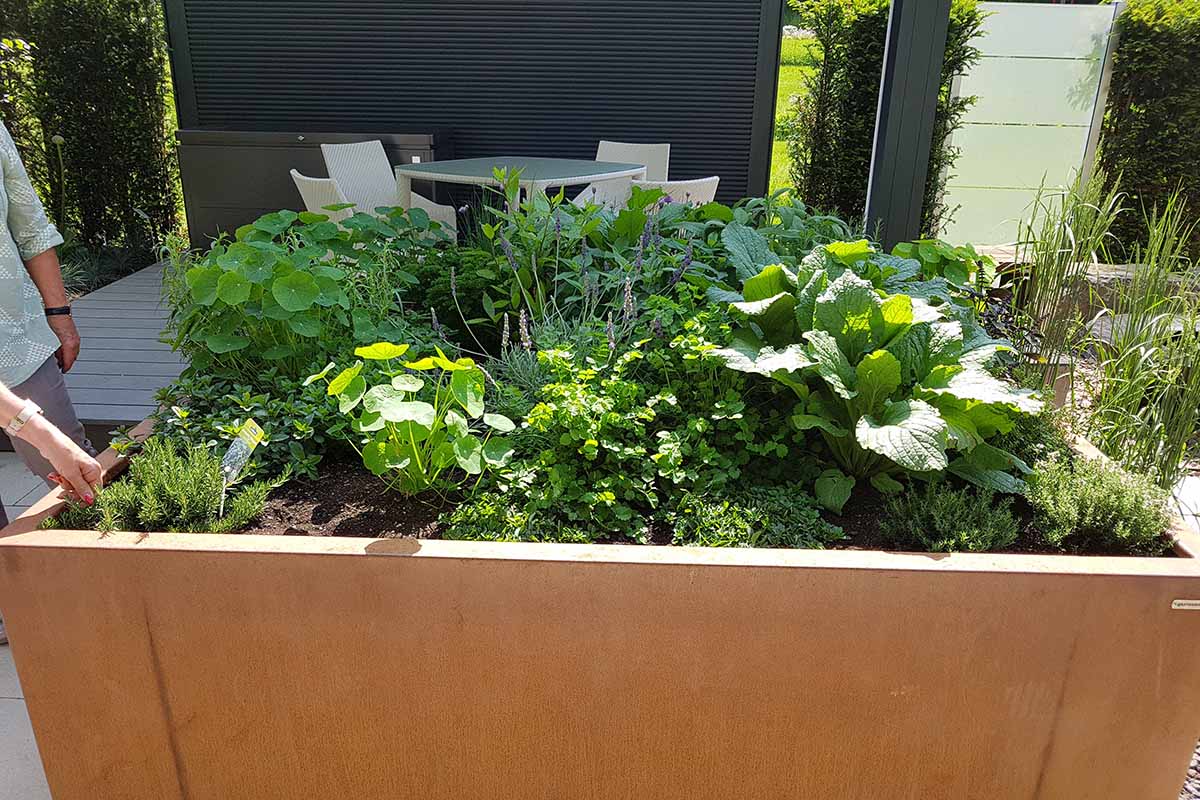
If it’s at least 24 inches deep, it’s unlikely that roots will escape their confines.
Our article about raised bed gardening has more information.
Vertical Gardening
A vertical growing structure turns limited space into abundant yields. It also restrains robust growth.
See our guide to vertical gardening for details.
Mulch and Weed
Spread mulch around your plants. In addition to aiding in moisture retention, it inhibits seeds that drop from settling into the ground.
Weed out and discard unwanted growth regularly to maintain control.
Finally, when you have species that multiply via runners, note that broken bits of roots left in the soil post-harvest are likely to regrow.
Keep the Upper Hand
There’s no need to do without fresh culinary and medicinal herbs because they become unruly when left to their own devices.
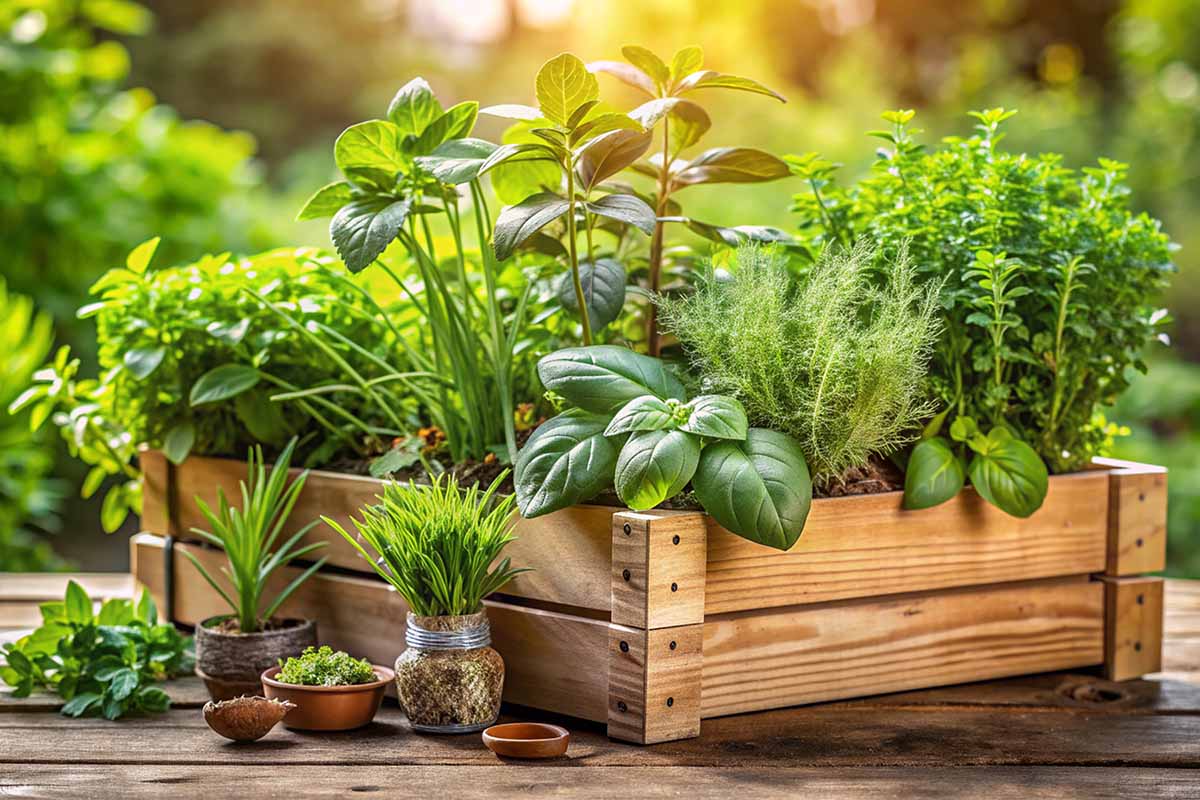
Practices like pinching and deadheading, containment methods like growing in pots, using pavement barriers, raised beds, and vertical structures can prevent self-sowing and restrict roots.
It’s time to add your favorite herbs to your garden planner. With suitable accommodations, you can keep the upper hand and enjoy abundant harvests.
How do you curb the growth of aggressive herbs in your outdoor living space? Please share your thoughts in the comments section below.
If you found this article informative and want to read more about cultivating herbs, we recommend the following: