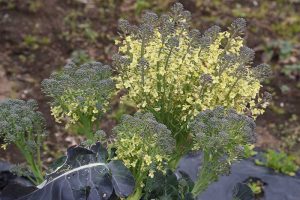
Asparagus, Asparagus officinalis, is a long-lived herbaceous perennial vegetable for Zones 3 to 10.
The plants prefer full sun and a deep, well-draining bed of slightly acidic, organically rich, sandy loam.

We link to vendors to help you find relevant products. If you buy from one of our links, we may earn a commission.
When established, asparagus plants achieve mature dimensions of up to eight feet tall and four feet wide, producing bountiful spring harvests of sweet, succulent spears measuring seven to nine inches long and three-eighths of an inch across.
Our guide to growing asparagus has all you need to know to raise plants in your garden.
This article presents 15 of the best varieties to grow at home.
Here’s our lineup:
Best Asparagus Varieties
Asparagus cultivars are available in green, purple, or greenish-purple.
Green types remain green when cooked, while those with purple tones will shade green. The ones with purple coloration contain anthocyanins, which have antioxidant properties.
You may have come across white asparagus. It is not a type, but rather the result of a technique called blanching in which spears are deprived of sunlight as they are developing.
This is accomplished by covering rows with dark plastic or mounding soil against the spears to shade them, preventing chlorophyll production.

Asparagus plants are dioecious, which means that there are separate male and female plants.
Only the females set seed and tend to be less productive than their robust, high-yielding male counterparts.
When propagating asparagus seeds, you have a 50/50 chance of growing male plants. If you purchase hybrid male bare root divisions, aka crowns, you will receive mostly, if not all, males.
Why would anyone want female plants? Yield isn’t the only factor to consider.
Some growers value open-pollinated, genetically diverse heirloom varieties for their unique flavor and succulence despite the less uniform spears and lower yields.
Also, the seeds can easily be collected for future planting.
The best quality asparagus spears are firm and straight, with tight tips and a smooth feel. Growing varieties unsuited to heat in warm Zones can cause the tips to be loose and unappealing.
There are early, mid, and late-season cultivated varieties to choose from. Crops that mature in early spring are usually the most tender and flavorful.
And now for 19 flavor-packed options!
1. Apollo
Early-maturing ‘Apollo’ produces smooth green spears accented by tight purple tips, ends, and bracts. The flavor is earthy with the grassy undertones typical of asparagus.
‘Apollo’ is a male hybrid. It is exceptionally cold- and heat-tolerant and resistant to Fusarium crown and root rot, as well as asparagus rust.
This cultivar matures to about three to four feet tall.
High-yielding ‘Apollo’ dates to 1984 and a breeding program that crossed California female cultivars with a robust eastern United States male asparagus to achieve outstanding quality and quantity.
2. Atlas
‘Atlas’ comes from Walker Brothers of New Jersey. It is a high-yielding early variety with smooth green spears and a hint of purple at the tips that prefers warm weather.
This cultivar is resistant to blight, Cercospora leaf spot, Fusarium crown and root rot, and rust. Mature heights are four to five feet tall.
Like ‘Apollo,’ ‘Atlas’ is a male hybrid that was bred in the 1980s using exemplary California cultivars and a vigorous eastern United States male variety.
3. Conover’s Colossal
Cold-hardy heirloom ‘Conovers Colossal’ was bred in the 1860s by New York produce merchant S. B. Conover. It is still prized by asparagus growers for its abundant yields.

Plants may be male or female. The male spears are extra thick, measuring up to one inch across.
Tender, moist, and exceptionally flavorful, the green spears blush purple at the ends, bracts, and tips.
Expect a mature height of three to five feet.
4. Erasmus
‘Erasmus’ was the first hybrid male purple asparagus. It’s a high-yielding option with mild, tight-tipped, deep purple spears so sweet they can be enjoyed raw.

Purple cultivars had a reputation for being low producers until ‘Erasmus’ was bred for the United Kingdom climate and tested in 2012.
Trials reported yields double to triple those of other violet-hued varieties and on a par with green, to the delight of growers worldwide.
Plants do best in temperate climates with warm summers and cold winters. In the warmest Zones, spears may turn green or brown. Mature heights are up to five feet tall.
5. Jersey Giant
Although breeding of all the “Jersey” asparagus types has been discontinued, ‘Jersey Giant’ is still available at the time of this writing.
It’s an early-season male hybrid with green spears accented by purple bracts and a nutty flavor.

High-yielding ‘Jersey Giant’ is cold-tolerant and resists Cercospora leaf spot, crown rot, Fusarium wilt, and rust. Mature heights are four to five feet.
Jersey Giant crowns and plants are available from Nature Hills Nursery.
6. Jersey Knight
Another discontinued but still available option is the early-season male hybrid ‘Jersey Knight.’
Similar in appearance to ‘Jersey Giant,’ it produces nutty-flavored green spears with purple bracts.

‘Jersey Knight’ is perfect for humid growing zones and all soil types, including heavy or clay soil. Mature heights are four to five feet tall.
Plants are resistant to Cercospora leaf spot, Fusarium crown and root rot, and rust.
Jersey Knight plants are available from Nature Hills Nursery.
7. Mary Washington
‘Mary Washington’ heirloom bred in the early 20th century for rust resistance.
Spears are green with purple tinged bracts and tips. The plants do not tolerate high heat, so you’ll need to harvest when the spears are just five to seven inches in the warmest Zones.

Mature dimensions are three to four feet tall.
‘Mary Washington’ seeds, plants, and crowns are available at Burpee.
8. Millennium
Bred in Ontario, Canada, at the University of Guelph, early-season ‘Millennium’ is a green-speared, cold-hardy, long-lived male hybrid that tolerates a range of soil types.
During trials in Michigan, it was found to be more vigorous and high-yielding after the first few years. As it matures, it delivers a crop comparable in quantity to a “Jersey” asparagus variety.

‘Millennium’ boasts excellent cold tolerance and a large number of male hybrids. Mature heights are three to four feet.
You can find plants available at Burpee.
9. Mondeo
Early-maturing, male hybrid ‘Mondeo’ was bred in Germany.
It offers exceptional cold tolerance, disease resistance, and high yields. The flavorful spears are green-tinged with purple at the tips and bracts.
Expect a mature height of about four feet.
10. Precoce D’Argenteuil
‘Precoce D’Argenteuil,’ or ‘Early Argenteuil,’ is an old and prized French heirloom. Hardy and early to ripen, spears are thick and flavorful.
Commercial catalog listings of ‘Precoce D’Argenteuil’ date to the 1800s. It was bred from the renowned ‘Giant Dutch Purple.’ There are early, mid, and late-season Argenteuil varieties.
Some call this cultivar “White Gold” when it is blanched and only the tips are rose-violet. Unblanched, the spears are light green with purple tips and bracts.
Propagated by seed, this early variety matures to four to five feet tall over three years and has a 20- to 30-year lifespan under ideal cultural conditions.
Seeds are available from Country Creek Acres Store via Amazon.
11. Purple Passion
Heirloom ‘Purple Passion’ was bred from the Italian cultivar ‘Violet di Albenga,’ a natural genetic mutation that grew purple instead of green and became a source for breeding purple cultivated varieties.
It’s a cold-hardy and heat-tolerant open-pollinated variety; male and female plants crop early with high yields.

The plants are less resistant to foliar diseases than most hybrid green varieties.
However, the spears are rich in antioxidant anthocyanins and so nutty and sweet you can enjoy them raw. They are tender and dusky purple to greenish.
Mature heights are three to four feet.
‘Purple Passion’ bare roots are available at Burpee.
12. Spartacus
‘Spartacus’ is a male hybrid that produces green spears with purple tips and bracts. It is suited to regions with warm summers and cold winters.
It produces high yields and was bred to replace the “Jersey” varieties. Plants are resistant to foliar diseases. Mature heights are three to four feet.
13. Sweet Purple
A cold-hardy purple variety of Italian origin, ‘Sweet Purple’ is a bold purple cultivar with sweet, nutty, tender spears that are delicious raw.

Plants may be male or female. This cultivar is resistant to crown rot, Fusarium wilt, and rust. Mature heights are four to five feet tall.
‘Sweet Purple’ crowns are available from True Leaf Market.
14. UC-72
‘UC-72’ was bred at the University of California, Berkeley, for resistance to Fusarium wilt, heat, and drought conditions.
It’s an open-pollinated cultivar with both male and female plants. The uniform spears are green with moderately tight tips and a distinctive earthy flavor.

Also known as ‘Mary’s Granddaughter,’ this type crops gradually in the first few years, building to high yields over its 10- to 15-year life.
Mature heights are four to five feet.
‘UC-72’ is available from True Leaf Market.
15. UC-157
Developed at the University of California, Riverside, ‘UC-157’ is an early-season cultivar with male and female plants best suited to cultivation in warm regions.
The green spears are smooth-textured with tight tips and a distinctive nutty flavor.

Expect a lifespan of 15 to 20 years with lower yields early on and increasing with maturity. Plants are drought tolerant and resist rust, Fusarium wilt, and crown and root rot.
Mature heights are four to five feet tall.
‘UC-157’ is available from True Leaf Market.
Abundant Spring Harvests
With 15 delicious varieties to choose from, it’s time to pull out your garden planner and mark down your favorite asparagus cultivars.

Do you grow asparagus? What are your favorite varieties? Please let us know in the comments section below.
If you found this guide helpful and want to learn more about growing asparagus, we recommend the following guides next: