Echeveria ‘Perle von Nurnberg’
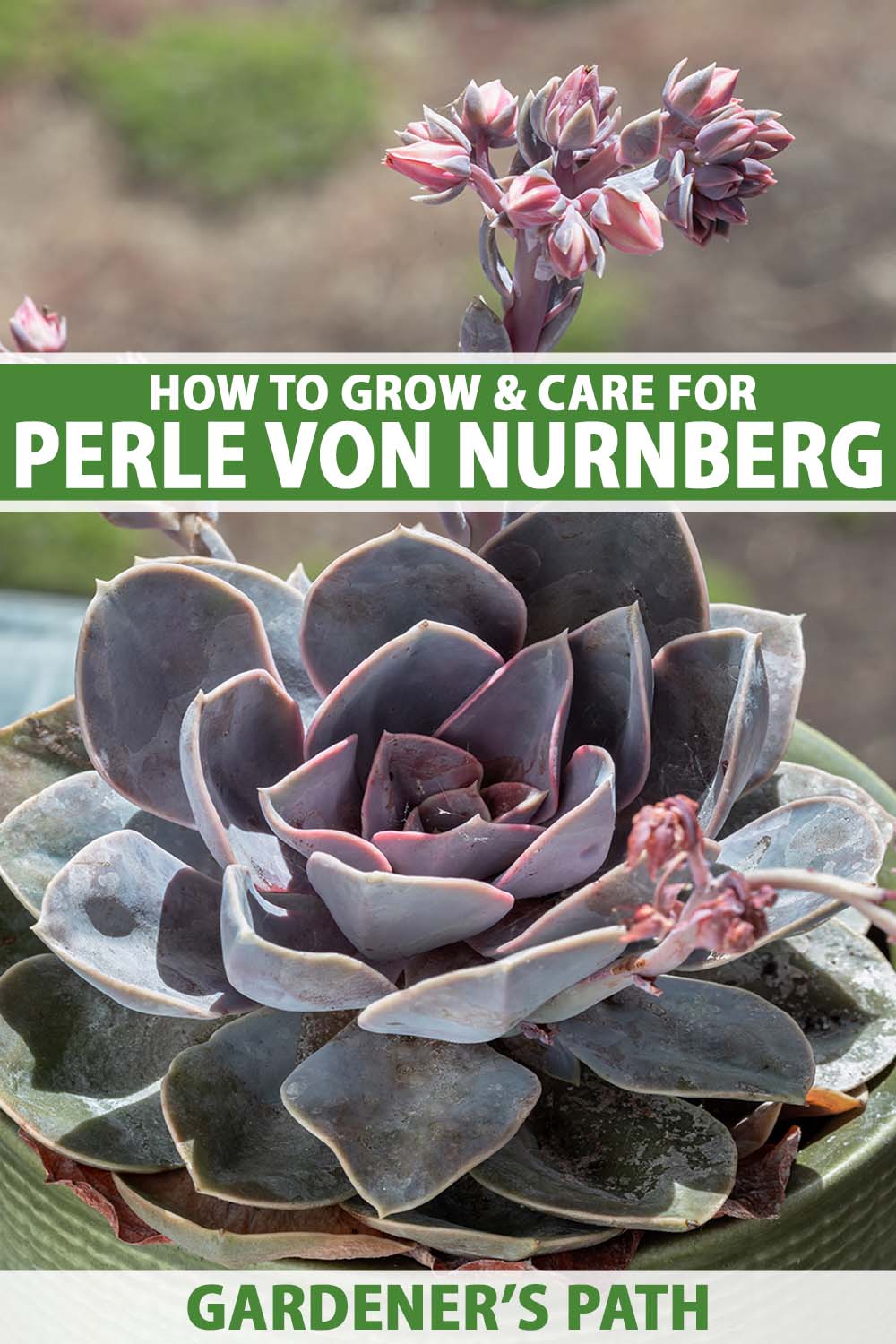
‘Perle von Nurnberg’ echeveria is a hybrid succulent bred in Germany in the 1930s.
The parents are E. gibbaflora ‘Metallica,’ a cultivar with a large rosette, metallic sheen, and seasonal color variations, and E. elegans, a species with a compact blue-green rosette and a silvery cast.
We link to vendors to help you find relevant products. If you buy from one of our links, we may earn a commission.
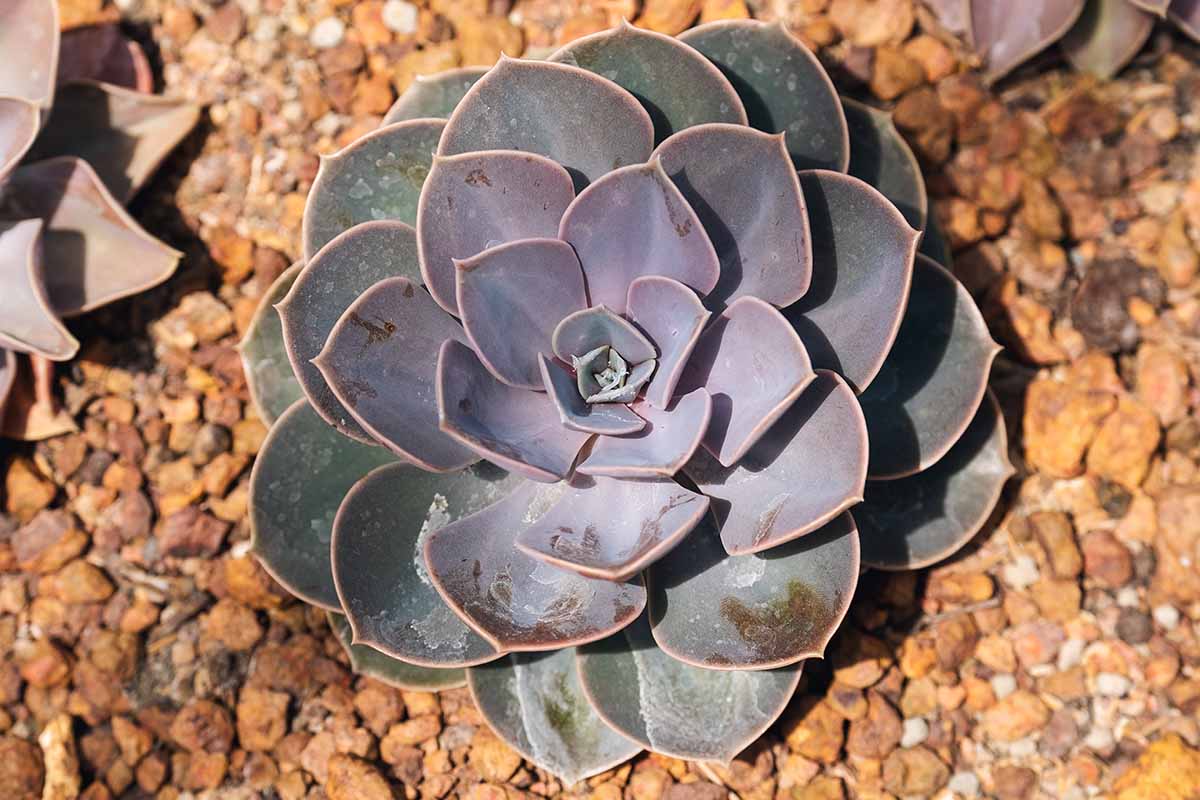
This popular hybrid features a single rosette of fleshy, spade-shaped gray-green leaves with lavender and pink highlights.
A coating of epicuticular wax, aka farina, gives ‘Perle von Nurnberg’ echeveria a pearlescent quality and protection from harsh UV rays.
Mature dimensions are eight to 10 inches tall and six to eight inches wide.
Our guide to growing Echeveria gives a broad overview of this large succulent genus.
This article focuses on how to grow and care for hybrid ‘Perle von Nurnberg’ echeveria.
Here’s what we’ll cover:
What You’ll Learn
In addition to a robust rosette, a mature ‘Perle von Nurnberg’ plant under ideal growing conditions produces one or more arching stems called inflorescences that bear bell-shaped coral blossoms.
Unlike other monocarpic echeveria that bloom and die, ‘Perle von Nurnberg’ lives to bloom again.
Quick Look
Common name(s): ‘Perle von Nurnberg’ echeveria
Plant type: Succulent
Hardiness (USDA Zone): 9-12 (outdoors)
Native to: Cultivated hybrid
Bloom time / season: Spring through summer
Exposure: Indirect sunlight
Soil type: Average, gritty, well-draining
Soil pH: 6.0-7.0, slightly acidic to neutral
Time to maturity: 2 years
Mature size: 8-10 inches tall by 6-8 inches wide
Best uses: Bed, border, container, green wall, houseplant, mass planting, rock garden, rock wall, xeriscape
Taxonomy
Order: Saxifragales
Family: Crassulaceae
Genus: Echeveria
Species: Hybrid of E. gibbaflora ‘Metallica’ and E. potosina
There are numerous ways to showcase this substantial rosette, from a bed or container specimen to a mass-planted succulent border.
If you live by the sea, you’ll find the sunshine, sand, and cool breezes to be a very agreeable growing environment for ‘Perle von Nurnberg’ echeveria.
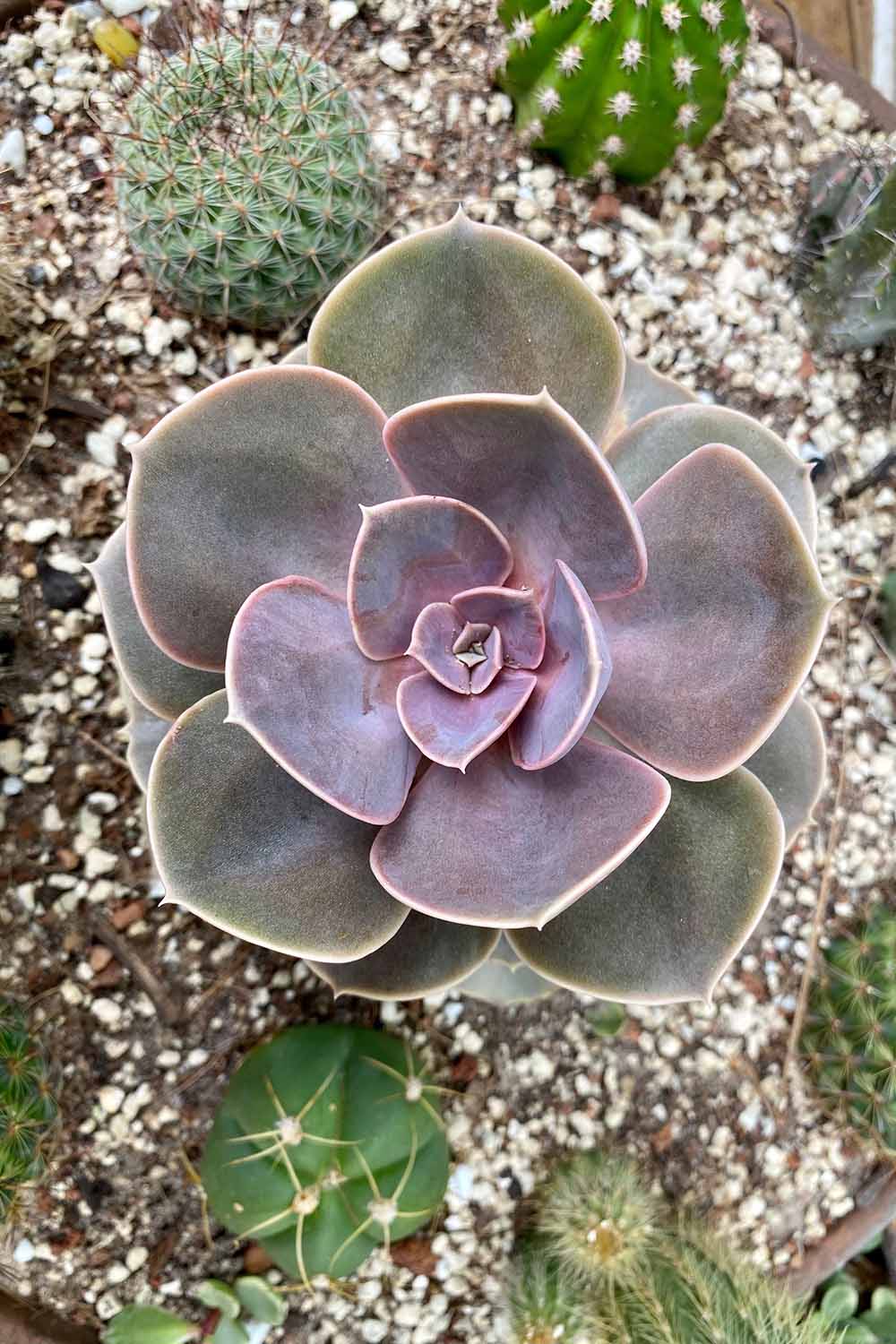
Insert plants randomly into a living green or rock wall for vertical interest, or a rockerie, where their pearly tones complement gray stones.
Scatter them as mid-story attractions in a xeriscape with taller and shorter succulent and cactus varieties.
For those outside the growing Zones, add one or more to a sunny window houseplant collection to bask in the warmth of a southern exposure.
How to Grow
Echeveria are native to semi-arid regions of Central America, Mexico, and South America, where they thrive at high elevations on well-draining rocky crags and in crevices.
Their comfort zone is temperatures between 65 and 80°F. They are not frost-tolerant and fail to thrive below 40°F.
Home gardeners should provide a similar environment. Those outside Zones 9 to 12 can grow ‘Perle von Nurnberg’ in containers to bring indoors for the winter, or enjoy year-round houseplants.
Light
Although echeveria thrives in full sun, gardens with morning sun and afternoon shade are best in the warmest regions.
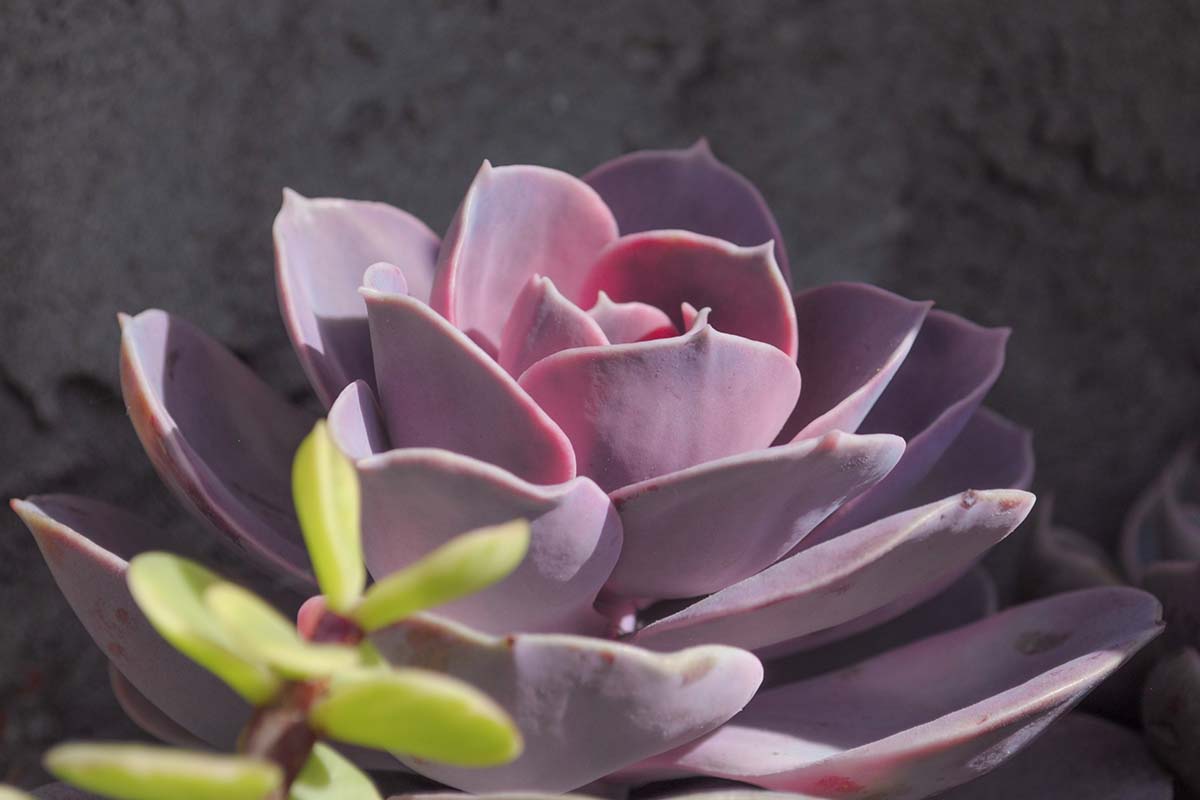
Houseplants do well on a south-facing windowsill. You can move them a foot away to prevent overexposure during peak summer heat.
Signs to watch for include discoloration and dry leaves.
If you don’t have a sunny window, consider using a grow light. Choose one from a reputable manufacturer that includes instructions.
Rotate windowsill pots weekly, and those under grow lights as needed based on light placement, to promote upright growth.
Soil
Gardeners should plant ‘Perle von Nurnberg’ echeveria in loose, gritty earth that drains well. The soil should be neutral to slightly acidic with a pH of 6.0 to 7.0.
Our article on how to make potting soil for succulents has all you need to know to mix a suitable substrate for indoor and outdoor potted specimens.
You can also buy a product containing perlite for good drainage.
Water
Echeveria have fleshy leaves and stems that store water for survival in arid conditions.
You can tell by looking at a succulent when it needs water. Firm, plump, smooth leaves are moist; bendable, thin, wrinkly ones are drying out.
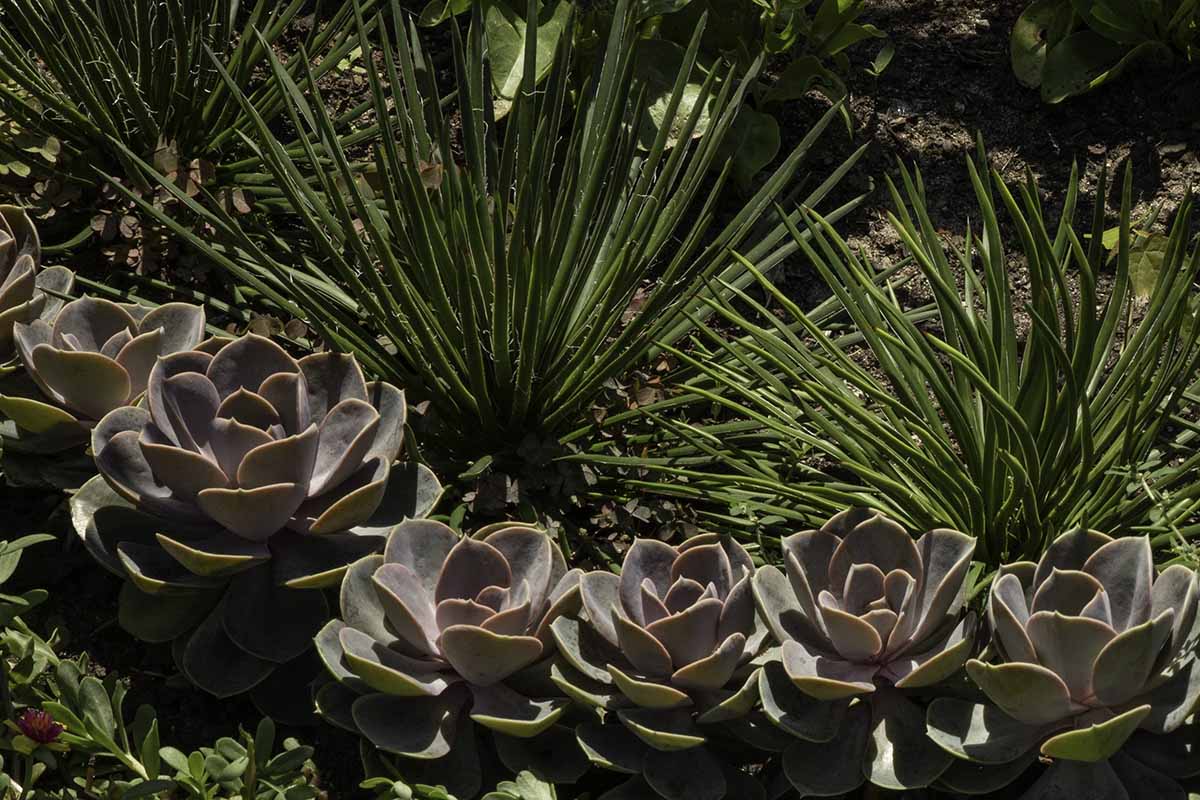
However, once a rosette shows visible signs of dehydration, moisture stress is well underway, and susceptibility to pests and pathogens is increasing.
Rather than rely on a dehydrated cry for help, invest in a moisture meter to guide you.
It is best to use the “soak and dry” watering method, letting the growing medium dry completely before watering again.
For in-ground ‘Perle von Nurnberg’ plants, water when the soil is dry to a depth of three or four inches, to avoid oversaturating the roots.
Container gardeners should wait until the potting medium is dry to the bottom of the pot before soaking it.
When you water, wet the soil, not the foliage, to avoid prolonged wetness and vulnerability to fungal conditions.
Fertilizer
Because echeveria grow in lean soil, they are not accustomed to an abundance of nutrients. You may feed ‘Perle von Nurnberg’ if you like, but it is not necessary.
If you choose to fertilize, use a liquid succulent food with a low-nitrogen content, such as a 0.5-1-1 nitrogen-phosphorus-potassium (N-P-K) ratio, and dilute it to half strength.

Feed once in early spring and again in early summer.
You might like Miracle-Gro Indoor Plant Food for Cacti and Succulents which is available from Miracle-Gro via Walmart.
Where to Buy
‘Perle von Nurnberg’ is easy to source from reputable merchants due to its popularity as a houseplant.
If the growing medium is completely dry, water deeply until it runs from the drainage holes.
Gradually acclimate your new succulent to bright sunlight by placing it about a foot away from a south-facing window.
After a week, set the pot on the windowsill, or transplant the contents to the garden or an outdoor container.
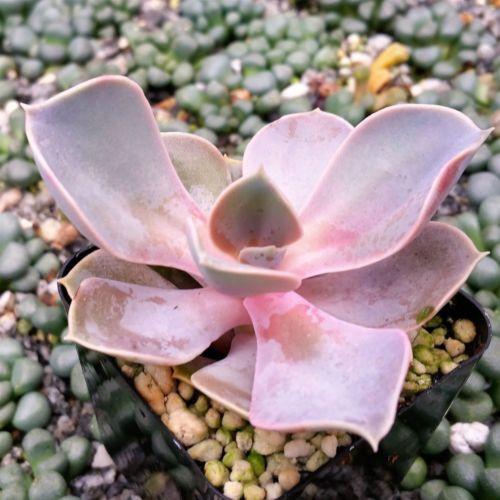
Echeveria ‘Perle von Nurnberg’
‘Perle Von Nurnberg’ is available from Planet Desert in four-inch starter pots.
Maintenance
Succulents are low-maintenance species.
Most grow slowly and do not need frequent repotting. The ideal container provides about an inch of space around and under the root mass.
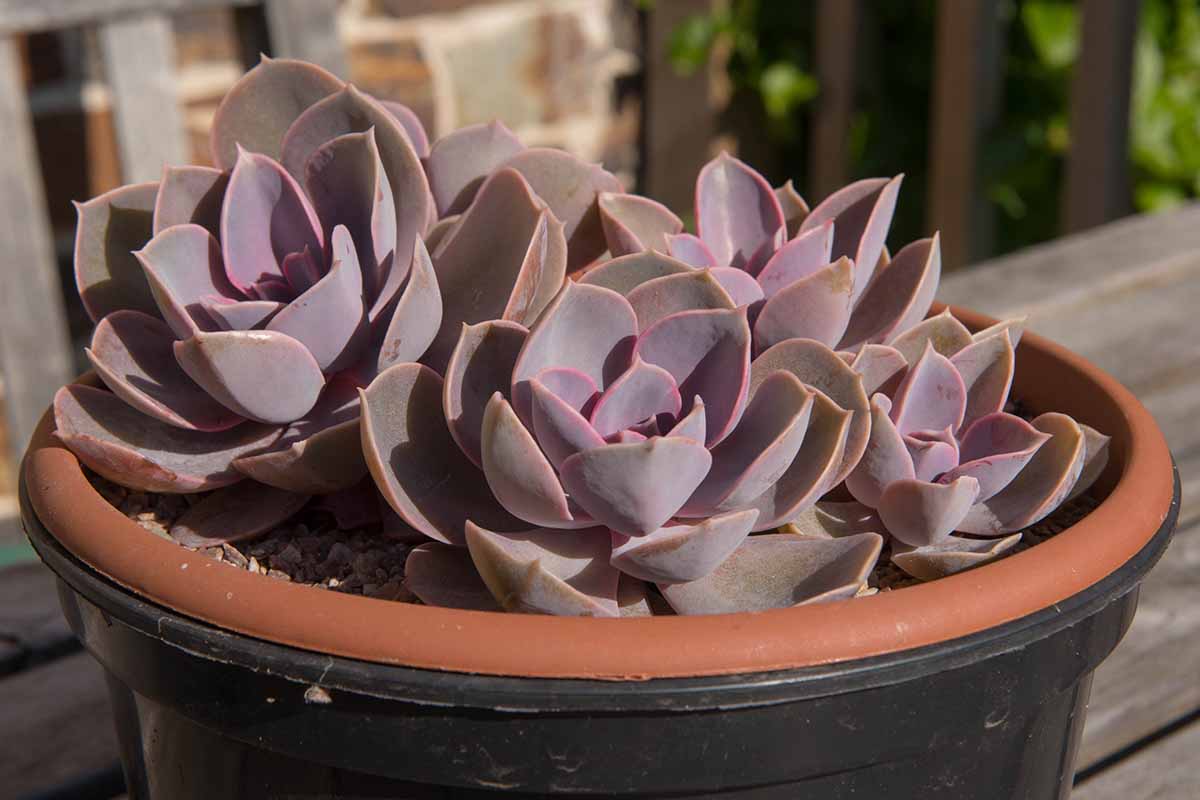
Multiple plants in larger pots should have an inch between them and an inch around and under the collective root mass.
Each time you repot, replace the depleted soil with fresh potting medium.
Sometimes a rosette in inadequate sunlight “etiolates,” or stretches, creating a long, thick stem and large spaces between the leaves.
When this happens, you can “behead” the rosette and transplant it per the propagation instructions below.
During the course of its life, the large lower leaves age, discolor, and drop.
You can snip them off as desired for aesthetics. When the stem becomes bare, elongated, and unsightly, you can cut off the rosette for a fresh start.
Additional maintenance for garden and potted specimens includes discontinuing fertilizer during the fall and winter.
Echeveria enter semi-dormancy during the winter, growing more slowly, and requiring less water.
In-ground specimens generally require no supplemental water during this time. However, if they appear wrinkled and dehydrated, water lightly over the soil to refresh them.
Those in Zones that freeze should bring pots indoors before the nighttime temperature dips to 40°F.
Outdoor container gardeners and houseplant growers should put pots in a 45 to 55°F location with bright, indirect sunlight for the winter to chill them appropriately for spring blooming.
Do not water them during this dormant period unless they appear moisture-stressed.
Return the pots to their regular places in early spring when the nighttime temperature is above 65°F. Resume soak and dry watering at this time.
Propagation
To grow a new echeveria, you can take leaf cuttings, stem cuttings, offsets, or a nursery start.
Because ‘Perle von Nurnberg’ is a hybrid, starting from seed is not a viable propagation option.
Leaf Cuttings
Gently twist off a few plump leaves from the middle of the rosette, where they are neither the youngest nor the oldest.
Fill a seed tray three-quarters full with cactus and succulent potting mix and lay the leaves on the surface about an inch apart. Set the tray in bright, indirect light.
The cut ends will callus, then send out roots, followed by tiny leaves.
Once roots appear, drip a few drops of water onto the soil beside them, keeping the parent leaves dry. Water again only when the soil has dried completely.
When new leaves emerge, moisten all of the soil without saturating it, and let it dry out between waterings.
The cuttings are ready to transplant when the new rosettes measure half an inch to an inch across.
You can also let the leaves callus and root on a paper towel instead of soil.
Once roots form, transfer them to a tray, burying just the roots, and water lightly so you don’t disturb them. Switch to soak-and-dry watering when leaves appear.
Stem Cuttings
A leggy rosette on a long stem is a good candidate. Cut the stem an inch below the rosette.
Choose a pot at least an inch wider than the rosette and fill it three-quarters full with cactus and succulent mix.
Set the cutting so the stem is buried and the rosette sits at or just above the soil line.
Keep the soil dry until roots form, which can take a few weeks or longer. A gentle nudge that doesn’t dislodge the rosette means it has rooted.
Then water lightly, and begin soak-and-dry watering when new leaves appear.
As with leaves, you can let the stem callus and root on a paper towel first, then pot it up the same way.
The stem left behind in the original pot will sprout new rosettes along its length that are just as easy to propagate.
By Dividing Offsets
Offsets, or “pups,” are babies that grow beside a parent, or, in the case of a beheaded rosette, along the stem. They are easy to detach to make a new plant.
To divide a rosette that is beside a parent, wait until it is at least a third the size of the parent. Loosen the soil around the offset and gently tease it out of the soil.
Select a pot that is an inch wider than the rosette and has a standard depth. Fill it three-quarters full of cactus and succulent potting mix.
If the rosette has roots, make a shallow well in the soil and set the rosette into it just deeply enough to cover the roots. Backfill to hold it in place.
Wait a week to 10 days before watering well.
If it does not have roots, you’ll have to let the offset form a callus before planting.
To remove an offset growing along a beheaded stem, wait until it is at least an inch in diameter, then use a clean knife to sever it from the stem.
Set it on a paper towel in bright, indirect sunlight to form a callus. When the bottom is hard and dry, it’s ready to plant.
Fill a three-inch pot three-quarters full of cactus and succulent potting medium.
Place the rosette on the dry soil, pressing it gently to hold it firmly in place. Water when roots have developed.
See our guides to propagating succulents and propagating succulents from offsets for more information.
Transplanting
When transplanting an established cutting, offset, or nursery start to another container, the soil should be dry.
Take note of the depth in the original pot so you can replicate it in the new one or in the ground.
Choose a well-draining vessel with an inch of space below the root mass, and between the root mass and the pot sides, for room to grow and receive water.
Fill the new pot a third of the way with cactus and succulent potting soil.
Lift out the contents of the old pot, remove most of the old soil, and hold the plant over the new soil.
Backfill to hold it firmly in place at the original depth. The crown, where the stem and roots meet, should be at or slightly above the soil surface to promote drainage.
Wait a week before watering well.
Pests and Disease
Healthy plants are less susceptible to pests and pathogens than unhealthy ones.
Meeting cultural requirements reduces the risk of both. However, there are some with which you should be familiar.
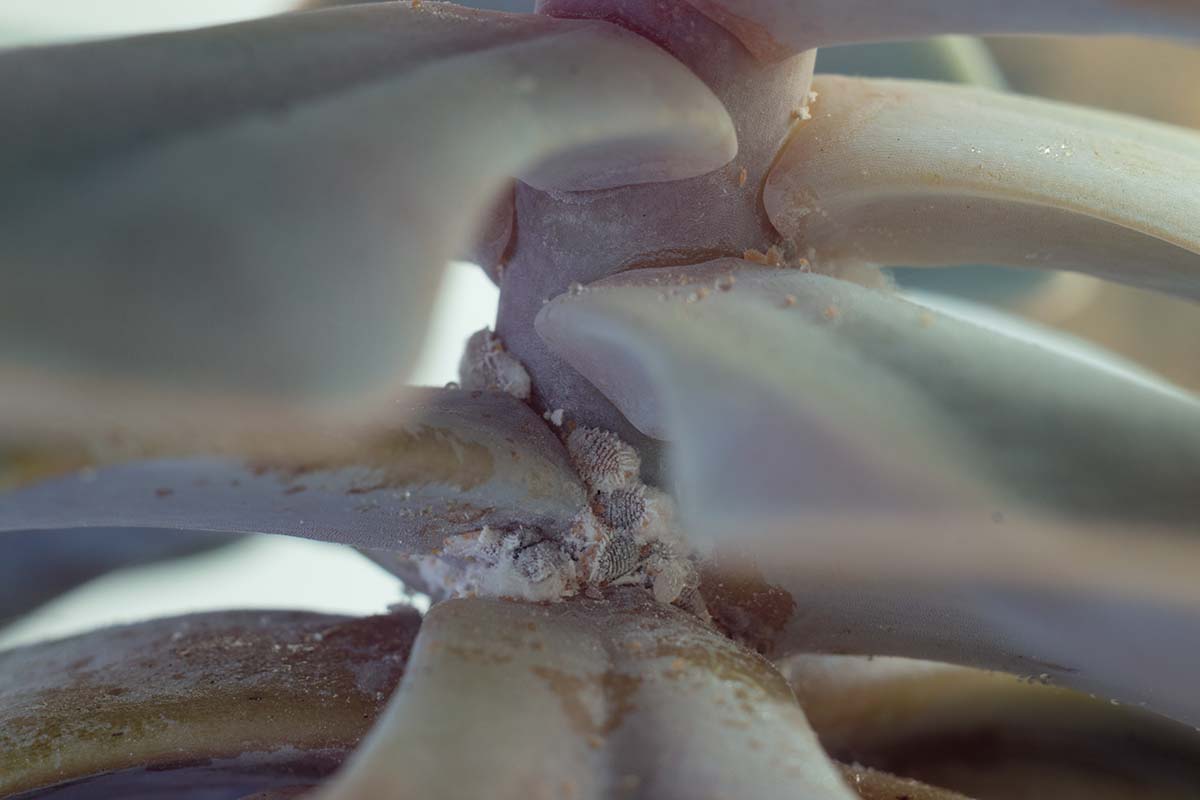
Sapsucking insects, including aphids, mealybugs, and spider mites, prefer hot, dry conditions and underwatered foliage, often targeting houseplants.
Their feeding causes discoloration and growth stunting, as well as the spread of botanical diseases.
A firm spray with the hose or faucet and an application of organic neem oil usually knock down an infestation.
Vine weevil larvae love thick-stemmed succulents and cozy potting soil, and night-feeding adult beetles chew moist leaves.
Eradicate them in both stages by introducing beneficial nematodes to garden soil to feed on the larvae, and handpick the adults and drop them into a pail of soapsuds.
Change the container soil to prevent reinfestation.
In overly wet soil, echeveria roots may rot. When foliage is wet, it may also turn sodden.
Unpotting, rinsing the roots, and cutting away rotten portions may save a plant from root rot. Pinching off mushy leaves and stem portions may restore a rosette to health.
Learn more about rotting in succulents here.
A Star Among Succulents
‘Perle von Nurnberg’ is a standout in succulent gardens and potted displays, with its eight-inch pearlescent rosette and bell-like coral flowers.
Water-wise and low-maintenance, what more could anyone ask?
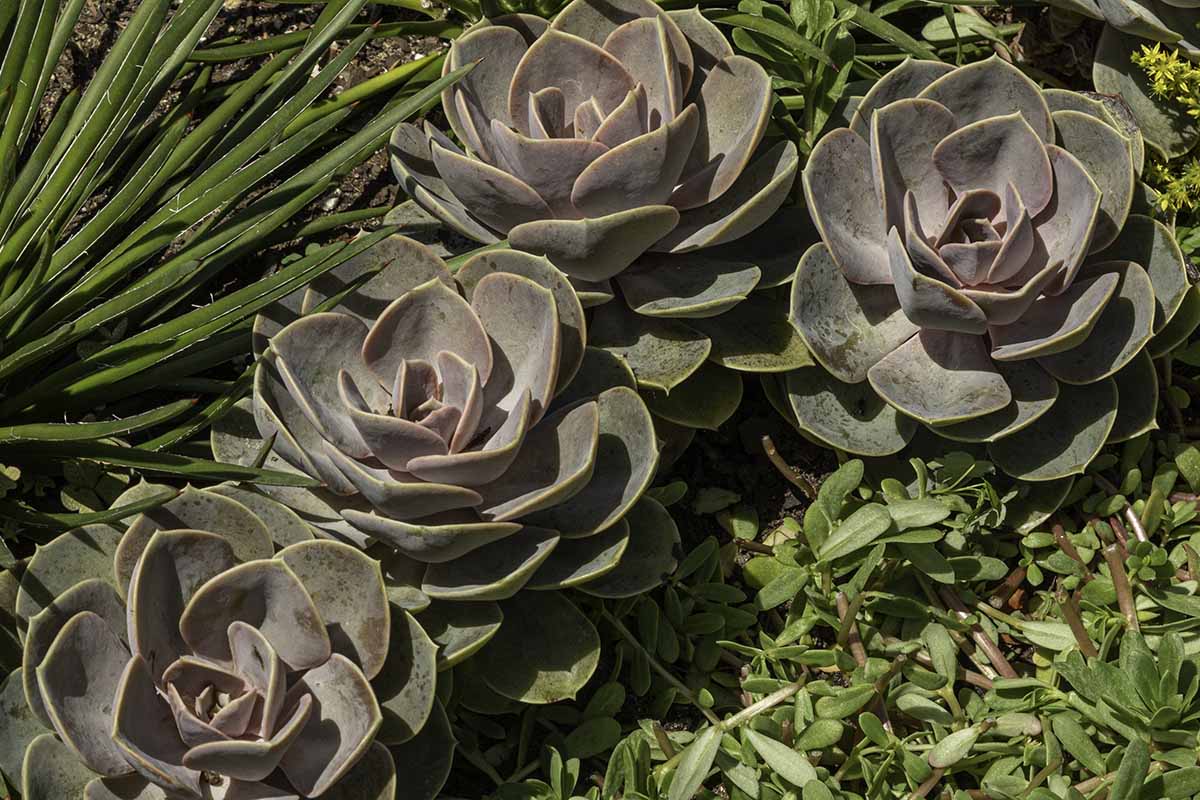
Sun-loving succulents and cacti are some of the easiest plants to grow.
Their varied colors, forms, and textures make them fun to group into collections with similar cultural requirements.
Are you ready to showcase ‘Perle von Nurnberg’ in your living space? Add it to your garden planner today!
Do you have a favorite Echeveria species or cultivated variety? Please share your thoughts in the comments section below.
And for more information about growing Echeveria succulents, add these guides to your reading list next: