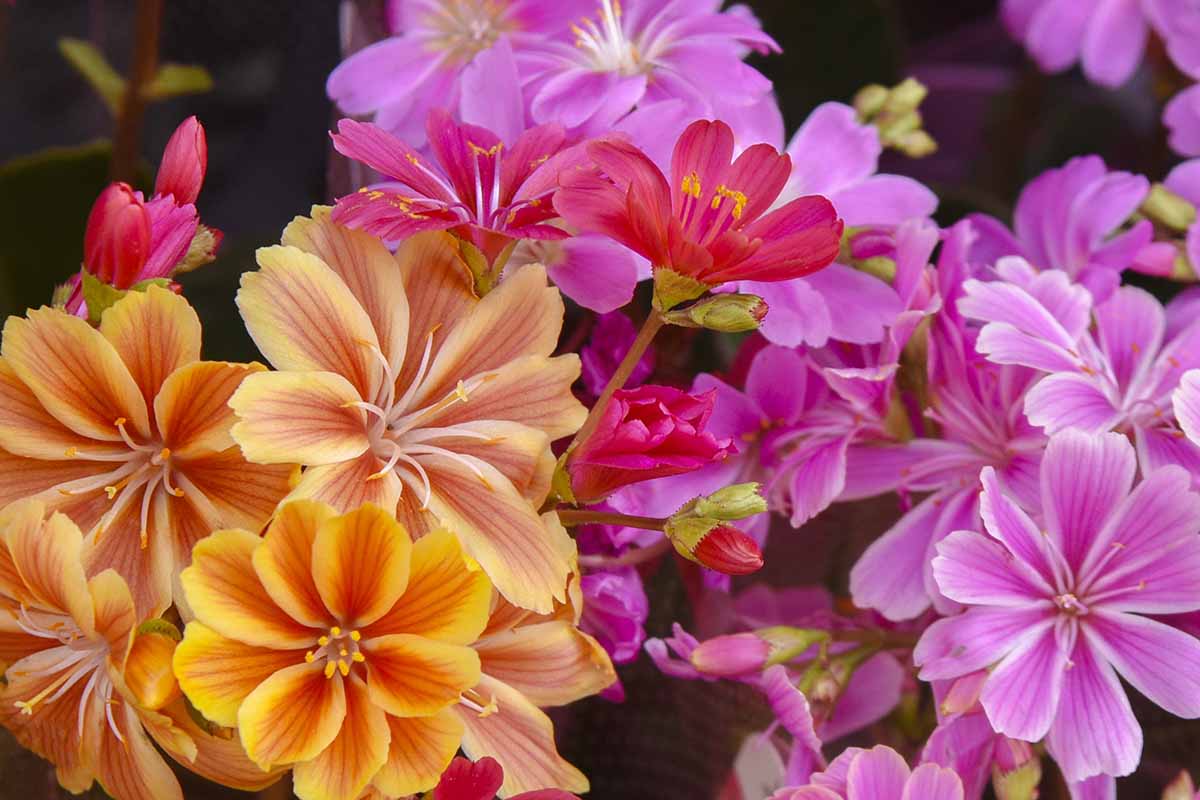
Kalanchoe is a genus of succulent plants in the stonecrop family, Crassulaceae, with over 100 recognized species.
Most are native to Madagascar and parts of Africa, though some occur in Asia.
They tolerate a range of conditions, adapt well to containers, and require relatively little maintenance, making them popular as both houseplants and in warm-climate gardens.

With a variety of growth habits, foliage shapes, and flower colors to choose from, there is a kalanchoe suited to almost any indoor or outdoor display.
In our guide to growing kalanchoe we cover how to cultivate these low-maintenance succulents.
This article highlights 35 notable species, hybrids, and cultivars worth considering for your collection.
Here’s the list:
35 of the Best Kalanchoe Varieties
Most kalanchoes are suited to outdoor cultivation in USDA Hardiness Zones 10 and 11, though some can tolerate conditions outside this range, which we’ll note as we go.
Plants grown outdoors in the ground typically reach their maximum size, while those kept in containers indoors usually grow to about half that.
Many species develop their most vibrant colors when exposed to some stress, such as drought or temperature extremes. Under ideal conditions, the foliage often takes on more subdued tones.
Enough housekeeping. Let’s look at our first option:
1. Alticola
While it’s attractive in the garden, K. alticola also makes an excellent houseplant thanks to its compact size and distinctive coloring.
This Madagascar native grows to about a foot tall and features thin, ovate to heart-shaped leaves in lime green.
When the kalanchoe plant is stressed, the leaf edges and undersides develop splashes of red.
The horizontally stacked arrangement of the foliage adds unique texture to container or indoor displays.
2. Beach Bells
Beach bells (K. manginii) is a petite kalanchoe that stays under a foot tall, with small, thick, oval leaves.

It makes a striking display when clusters of orange-red, bell-shaped flowers cover the plant.
Native to Madagascar, it received the Royal Horticultural Society’s Award of Garden Merit in 2002.
The cultivar ‘Tessa’ has thick, oval leaves edged in red. In late winter it sends up long stalks topped with red, tubular flowers.
Plants grow up to a foot tall and about two feet wide. Adaptable and resilient, ‘Tessa’ is an excellent choice for indoor growing, and earned the RHS Award of Garden Merit in 1993.
3. Common
Common kalanchoe (K. rotundifolia) is, as the name suggests, one of the more widely available species.

It has round leaves in shades of yellow-green or blue-green, often flushed with red, and usually covered in a silvery, gray, or white bloom.
The foliage forms in dense clusters along stems that can grow up to four feet tall.
Beautiful even without flowers, it becomes even more striking in fall and winter when clusters of reddish-orange blooms appear.
4. Copper Spoons
Copper spoons is an apt description for K. orgyalis. Its thick, spoon-shaped leaves taper to a point and have a cinnamon-rusty hue on the upper surface with gray-green undersides.

Both the foliage and stems are covered in fine hairs. In late winter to early spring, tall terminal clusters of bright yellow flowers appear.
Native to Madagascar, this kalanchoe species grows up to four feet tall.
5. Coral Bells
Coral bells (K. uniflora) takes its common name from the profusion of coral or sometimes lavender colored, bell-shaped flowers that cover the stems for months at a time starting in late winter.

Native to Madagascar, it typically grows with a prostrate or climbing habit, remaining low but able to clamber up to about three feet.
The round, succulent leaves can resemble those of trailing jade (Peperomia rotundifolia), though coral bells often have purple leaf margins that set them apart.
6. Desert Surprise
Desert surprise kalanchoe (K. humilis) earns its common name from the tiger-like stripes on its green and purple splotched leaves.

The patterning can resemble reptile skin, making this plant a striking sight in its native southeastern African habitat.
It grows up to three feet tall and produces purple or purplish-green blossoms, adding even more interest to its display.
7. Donkey Ears
The foliage of donkey’s ears kalanchoe (K. gastonis-bonnieri) does, indeed, resemble the long, soft, fuzzy ears of a donkey.

The thick, lanceolate foliage is green with brown splotches, covered in fine hairs, and older leaves often develop a peachy hue.
Native to Madagascar, it can reach up to three feet tall at maturity.
Mature plants send up tall stalks topped with clusters of tubular, pinkish to reddish flowers, typically blooming in late fall to winter.
8. Dragonfire
For vivid foliage, ‘Dragonfire’ is a standout choice.
Bred in California in 2015 from the paddle plant kalanchoe, K. luciae, and an unnamed parent, this hybrid resembles that species, with jade-green leaves that fade to ombre red at the tips.

The red coloration is both more intense and more extensive than in its parent.
In late winter to spring, mature plants produce clusters of small, tubular flowers in shades of yellow to cream, rising above the foliage.
9. Elephant Ear
Not to be confused with Colocasia, this elephant ear is a kalanchoe also known as feltbush (K. beharensis).

It can grow up to five feet tall, with large, olive-green leaves shaped like elongated triangles. The margins have a faint orange hue and are softly crinkled.
Native to Madagascar, it is more cold-tolerant than many other Kalanchoe species and can grow in Zone 9.
In 2002, it received the Royal Horticultural Society’s Award of Garden Merit. Mature plants may produce clusters of small, yellow flowers in winter to early spring.
10. Elk Antlers
‘Elk Antlers’ resembles a cluster of fallen antlers dyed green. While its exact parentage is unclear, it likely includes K. synsepala, as the two look very similar.
This kalanchoe cultivar remains much smaller than the species, rarely exceeding a foot in height.
The long, narrow, branched leaves develop red margins in bright light.
Mature plants may produce clusters of small, yellowish flowers in late winter to spring, though the foliage is the main attraction.
11. Fang
‘Fang’ is a hybrid of K. beharensis and K. tomentosa, with an upright, bushy growth habit on a shrub that can reach about three feet tall.

The obovate leaves of this kalanchoe are silvery green and covered in fine hairs, with unusual growths called tubercles on the undersides that resemble clusters of fangs.
It produces pinkish flowers in summer, though the plant is primarily grown for its distinctive foliage. ‘Fang’ received the Royal Horticultural Society’s Award of Garden Merit in 2012.
12. Faust’s
Faust’s kalanchoe (K. faustii) is native to Morocco and produces tubular, lemon-yellow flowers in summer.
Even when not in bloom, its obovate to acuminate leaves are a focal point. The blue-green foliage has rippled, serrated margins often edged with a rosy hue.
This species grows to about two feet tall.
13. Flapjacks
The flat, round leaves of flapjacks (K. thyrsiflora) resemble a stack of pancakes – if pancakes came in acid green with red edges.

While the foliage typically stays under two feet tall, the plant can reach up to six feet when in bloom. Native to South Africa, it is hardy in Zones 10 to 12.
Often confused with K. luciae, this kalanchoe species is less common in cultivation.
Flapjacks have smaller leaves than paddle plants and produce fragrant yellow flowers, typically in late winter to spring.
You can find flapjack plants in four-inch clay pots available at Walmart.
14. Florist
Florist’s, widow’s thrill, Christmas, or flaming Katy kalanchoe (K. blossfeldiana) is one of the most popular species in the genus, often appearing in homes and stores around the holidays.

This evergreen plant grows to about 18 inches tall and produces bold red blossoms in winter on tall stems, with cultivars also available in yellow, pink, white, and orange.
The leaves are ovate with scalloped edges. It received the Royal Horticultural Society’s Award of Garden Merit in 2012.
You can find three-packs of plants available at Walmart.
Learn more about growing flaming Katy kalanchoe here.
15. Flower Dust Plant
The leaves of flower dust plant (K. pumila) are fleshy, gray-green, and ovate with a powdery coating, hence the common name.

Look closely and you’ll see that each leaf has a toothed edge often tinted with purple.
This bushy kalanchoe species grows to about a foot tall and produces bright purple, pink, or reddish blossoms. It received the Royal Horticultural Society’s Award of Garden Merit in 1993.
16. Lavender Scallops
Lavender scallops kalanchoe (K. fedtschenkoi) originated in Madagascar but is popular around the world thanks to its fleshy blue-green leaves with, you guessed it, scalloped edges.

In bright sun or during drought conditions, the leaf margins take on a blush hue. It’s a beautiful foliage plant that grows up to two feet tall.
Actually, it might be a bit too popular. It has escaped cultivation in some warm areas of North America.
Several variegated forms are sold under different names, including ‘Aurora Borealis,’ ‘Variegata,’ ‘Rainbow,’ and ‘Marginata.’

These have green leaves edged in lavender and marked with irregular creamy patterns. In some, the cream splotches extend well into the center.
They usually grow a bit smaller than the species, reaching about 18 inches tall.
17. Marnier’s
Marnier’s kalanchoe (K. marnieriana) is a standout for its flat, oval, paddle-like leaves, which are arranged opposite one another and fold slightly to resemble open clamshells.

The foliage is blue-green with shades of purple and red that look almost airbrushed. Growing to about two feet tall, it makes a striking display even without flowers.
When it does bloom, tall stalks carry rose-pink and red bell-shaped blossoms that last for weeks. Flowering can occur in flushes from spring through fall.
18. Mealy
The name might not be the most appealing, but mealy kalanchoe (K. scapigera) is attractive enough to make up for it.
It forms rosettes of round leaves with red margins at the ends of short, reddish-copper stems. Reaching about 18 inches tall, it is topped with clusters of reddish-orange blossoms in summer.
19. Milky Widow’s Thrill
Milky widow’s thrill (K. laxiflora) has scalloped, ovate blue-green leaves edged in raspberry pink, making for an eye-catching combination.

Native to Madagascar, this kalanchoe species grows to nearly two feet tall. Long stalks of reddish-orange flowers appear in winter to spring, creating a striking display.
20. Millot’s
The gray-green, ovate leaves of Millot’s kalanchoe (K. millotii) have scalloped edges and are covered in a fuzzy white coating that begs to be touched.

Reaching about three and a half feet tall, it makes an impressive statement in the garden or as a large container specimen.
In summer, long stalks carry clusters of yellow-orange blossoms, adding even more appeal to this Madagascar native.
21. Mother of Millions
Mother of millions (K. delagoensis syn. K. tubiflora), also known as chandelier plant, produces plantlets along the margins of its long, narrow leaves.

Reaching up to six feet tall, this Madagascar native has a somewhat sparse growth habit but makes a strong architectural statement.
Check out our guide to growing mother of millions.
22. Mother of Thousands
Mother of thousands (K. daigremontiana) is instantly recognizable for the rows of tiny, round plantlets that line each leaf margin.
My niece says they resemble Christmas lights, but to me it looks like they’ve been colonized by some strange alien life.

This Madagascar native grows to about three feet tall. Each plantlet can be removed and grown into a new plant, which gives the species its name.
The leaves are green with a purple margin and purple splotches on the underside, though some variations in color occur.
It has also naturalized in warm parts of the United States, South America, and southern Europe.
The pink-edged cultivar ‘Pink Butterfly’ is particularly striking with variegated leaves.
Read our guide to growing mother of thousands next!
23. Paddle Plant
Paddle plant aka flapjack paddle plant (K. luciae) is aptly named for its round, thin succulent leaves, which are stacked like a cluster of paddles.

This South African kalanchoe grows up to eight inches tall and produces small white blossoms in winter. It received the Royal Horticultural Society’s Award of Garden Merit in 2012.
‘Oricula’ is a natural variety that grows about twice as tall as the species, with longer leaves that may curve or twist.
The tips develop a rosy hue in bright light, intensifying to bright red in cooler conditions. Mature plants produce clusters of tubular yellow flowers in late winter to spring.
Learn more about flapjack paddle plants here.
24. Panda Plant
Whether you call it panda plant, pussy ears, or chocolate soldier, K. tomentosa is a charming species with fuzzy gray-green leaves edged in reddish-brown.

Native to Madagascar, this kalanchoe grows to about a foot and a half tall. Its easygoing nature and attractive foliage earned it the Royal Horticultural Society’s Award of Garden Merit in 1993.
Flowers are uncommon indoors, but when they appear, they are small, tubular, and yellowish with red markings, usually blooming in spring.
Learn more about growing panda plants here.
25. Penwiper
Penwiper (K. marmorata syn. K. somaliensis) has gray-green leaves mottled with purple, creating a striking pattern on plants that grow to about 18 inches tall.

In spring, tall stems carry clusters of bright white blossoms that stand out like small stars above the foliage.
Native to central and eastern Africa, this kalanchoe is popular in cultivation worldwide and received the Royal Horticultural Society’s Award of Garden Merit in 2002.
26. Pies From Heaven
Pies from heaven (K. rhombopilosa) has gray leaves marked with reddish-brown splotches, shaped like ruffled triangles.
Native to rocky, dry areas of Madagascar, it stays fairly small, growing to about eight to 12 inches tall.

Despite its size, the distinctive foliage makes a bold visual impact. In summer, it produces clusters of small, pale yellow flowers.
White pies from heaven (K. rhombopilosa var. argentea syn. K. rhombopilosa var. alba) is a natural variety with silvery white, triangular leaves.
It lacks the reddish-brown splotches of the species but is otherwise identical in size and form.
27. Silver Spoons
Silver spoons kalanchoe (K. bracteata), sometimes called silver teaspoons, is often confused with K. hildebrandtii (described below), and the two do look similar.

One way to tell them apart is by size, since silver spoons grows to about five feet tall at most, and by the flowers, which are red to orange rather than white.
Native to Madagascar, it has hairy green and silver leaves held on long petioles, giving them the appearance of silver spoons.
28. Silver Teaspoons
With ovate, two-inch-long green leaves covered in silvery hairs, silver teaspoons kalanchoe (K. hildebrandtii) lives up to its name.

The leaves are held on long petioles, giving the impression of a cluster of silver spoons on a stand.
Indoors it grows up to three feet tall, and outdoors it can reach three times that height. In spring, it produces delicate, urn-shaped white blossoms.
A fellow Madagascar native, it closely resembles K. bracteata, and the two are often sold under the same name, so it’s important to check the botanical name when purchasing.
29. Six-Angled
Red-leaved, six-angled, or bushveld kalanchoe (K. sexangularis) grows to about three and a half feet tall with fleshy, oval, or heart-shaped green leaves edged in wavy notches.

The branches are reddish as can be the margins of the young leaves.
Red-leaved, six-angled, or bushveld kalanchoe (K. sexangularis) grows to about three and a half feet tall with fleshy, oval, or heart-shaped green leaves edged in wavy notches.
The branches are reddish, as can be the margins of young leaves.
In winter, it produces bright yellow-green blossoms. This South African native thrives in Zones 9 to 11.
30. Snow White Panda
Snow white panda plant (K. eriophylla) is covered in a dense mat of white hairs that cloak the succulent green leaves and stems, giving it a soft, fuzzy appearance.

Native to Madagascar, this kalanchoe stays petite, reaching only about four inches tall. In late winter to spring, it produces small clusters of white flowers, sometimes tinged with pink.
31. Suarez
The Suarez kalanchoe (K. suarezensis syn. K. poincarei var. suarezensis) grows to about three feet tall, with lanceolate green leaves flushed with blush-red, held on long petioles emerging from a central stem.
The foliage is attractive on its own but in summer the plant becomes positively striking when masses of red and yellow flowers cover it.
32. Tarantula
I had a pet tarantula when I was a kid, and I can definitely see the resemblance between Harry the Very Scary Tarantula and this kalanchoe hybrid (K. x ‘Katapifa’).
The thick, elongated, rounded leaves stand upright like a spider with its legs in the air.

When it bursts into bloom, spiders will be the last thing on your mind. Large, double, bright pinkish-purple flowers blanket the plant, attracting hummingbirds and bees.
This hybrid was created in the Netherlands by well-known succulent breeder Leonardus Johannes Maria van der Knaap from two unnamed parents, and it’s worth growing for both its foliage and its flowers.
33. Walking
Walking kalanchoe (K. synsepala) has elongated leaves shaped like antlers, somewhat resembling those of staghorn ferns (Platycerium spp.), but thicker and more succulent.

Native to Madagascar, it grows on unbranched stems up to a foot and a half tall. In summer, it produces clusters of white and pinkish-red flowers.
34. Wendy
‘Wendy’ is a hybrid kalanchoe cultivar that produces clusters of bright pink and cream, lantern-shaped flowers in spring and summer.
When not in bloom, its succulent green leaves with toothed margins provide year-round appeal.
Its exact parentage is uncertain, though it is thought to be a hybrid of K. manginii and K. porphyrocalyx. It is sometimes sold as a cultivar of one of these species and is also known as pearl bells.
‘Wendy’ received the Royal Horticultural Society’s Award of Garden Merit in 1993.
35. Widow’s Thrill
Native to Madagascar and the Comoros, K. beauverdii, commonly called widow’s thrill or Beauverd’s widow’s thrill, features wiry stems bearing lance-shaped, purple-black leaves.

More unusual than traditionally beautiful, this kalanchoe draws attention with its striking form and color.
In late winter and early spring, purple-gray-green, bell-shaped flowers hang from the stems. This species can grow between four and eight feet tall.
Keeping Up With the Kalanchoes
A handful of kalanchoe species get most of the attention, but there are dozens of other striking and unusual options worth growing.

Did one on this list catch your eye? Or do you have a favorite we didn’t include? Share your thoughts in the comments section below!
And for more information about growing succulents, check out these guides next: