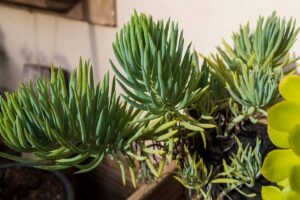
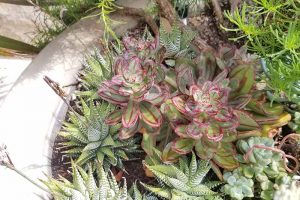
x Graptosedum spp.
Loved for their pastel rosettes and petal-like leaves, x Graptosedum succulents are a favorite among succulent fanatics and for water-wise gardeners.
Whether cascading from low dish planters or adding texture to rock gardens and xeriscapes, graptosedums are eye-catching additions to any succulent collection.

We link to vendors to help you find relevant products. If you buy from one of our links, we may earn a commission.
Graptosedums are fleshy plants that grow in attractive rosettes, and produce star-shaped flowers.
These are hybrid crosses of species from two separate genera – Graptopetalum and Sedum.
By crossing members of these two botanical groupings, breeders develop unique features, and there is a great deal of variation from cultivar to cultivar.
In this article, we’ll explore what makes these succulents so special, how to care for them, and why they deserve a spot in your collection.
What You’ll Learn
Also known as mother of pearl plants, graptosedums display a lot of variety, some have elongated leaves and others exhibit chubby, compact foliage.
Colors also vary depending on the specific cross, with some appearing in minty shades of blue, and others taking on warm orange or cool mauve tints.
They typically top out at six to 12 inches tall and can spread up to 18 inches wide.
While they make lovely houseplants when enough light is available, these succulents can also be grown outdoors in USDA Hardiness Zones 9 to 11.
They are ideal in rock gardens, xeriscapes, hanging baskets, or as ground covers, as long as they are provided with the right growing conditions.
Quick Look
Common name(s): Graptosedums, mother of pearl plant
Plant type: Evergreen succulent
Hardiness (USDA Zone): 9-11
Native to: Horticultural hybrid
Bloom time / season: Winter to spring
Exposure: Full sun to light shade
Soil type: Cactus or succulent mix
Soil pH: 6.0-7.0, slightly acidic to neutral
Time to maturity: 1-2 years
Mature size: 6-12 inches tall by 18 inches wide
Best uses: Container gardens, ground covers, hanging baskets, rock gardens
Taxonomy
Order: Saxifragales
Family: Crassulaceae
Genus: x Graptosedum
Cultivars: ‘California Sunset,’ ‘Darley Sunshine,’ ‘Francesco Baldi,’ ‘Ghosty,’ ‘Miul’
Even if you know how to grow and care for succulents, it’s worth learning about the specific recommendations for graptosedums, since not all have the same requirements.
Keep reading for specifics about how to grow graptosedum:
How to Grow
Graptosedums can be grown either outdoors in locations protected from an abundance of rain or indoors if conditions are right. Here’s what you’ll need to know.
Light
These succulents thrive in intense light and require at least six hours of direct sunlight a day.

If you are growing indoors, a south-facing window may provide enough light for at least part of the year, but you may need to use a grow light if the plants start to lose their compact shape and beautiful coloring.
Locations with less light will result in leggy, etiolated graptosedums. Rather than compact rosettes, leaves will be held apart from each other, and specimens may look sickly.
Soil
Choose a growing medium that has excellent drainage, with grit supplied from materials like pumice, gravel, or sand.

Many commercial potting mixes don’t have enough drainage for these plants, even those marketed for use with cacti and succulents, so making your own gritty mix is a good idea.
Learn how to make your own potting soil for succulents here.
Water
Water graptosedums deeply but infrequently, allowing the soil to dry out completely between waterings. Avoid watering too frequently, as this can lead to rotting.
Also, avoid pouring water directly onto the rosettes. You can do this with the help of a narrow-spouted houseplant watering can.
Water even less frequently in the winter when growth slows and the days are shorter.
Temperature and Humidity
Graptosedums are hardy to about 20°F, so only grow them outdoors year-round if you are in Zones 9 to 11, as mentioned earlier. In colder zones, they will thrive at indoor temperatures, so long as you provide adequate light.

To encourage flowering, you’ll need to provide a month of temperatures below 60°F by locating houseplants near cool windows during wintertime, or letting them remain outdoors during cool fall weather.
These succulents prefer low humidity and are well-suited to dry environments.
Avoid placing them in overly humid or poorly ventilated areas, as excess moisture can promote fungal issues or rot.
If you live in a region colder north of Zone 9, be sure to bring your graptosedums indoors for the winter.
Learn more about overwintering succulents here.
Fertilizing
Feed these succulents once a month during the growing season of spring and summer with a diluted, balanced fertilizer or a succulent-specific formula, such as Dr. Earth Succulence Plant Food.

Dr Earth Succulence Plant Food
You can find this product available at Arbico Organics.
There’s no need to apply fertilizer in the winter when the graptosedum is dormant. Be sure to follow the manufacturer’s instructions on whatever product you choose.
Cultivars to Select
There are many different types of graptosedums you can add to your collection. Here are a few that are the easiest to source:
California Sunset
With short, pointed leaves, the rosettes of ‘California Sunset’ look like beautiful flowers, especially when the grayish-green foliage turns reddish orange in intense light.
A hybrid of G. paraguayense and S. adolphi, this cultivar grows up to 12 inches tall with a spread of 9 inches, and produces white flowers.
You’ll find 2.5-inch ‘California Sunset’ plants for purchase from the CTS Air Plants Store via Amazon.
Darley Sunshine
With elongated, faceted green leaves that take on a mauve coloration in bright light, ‘Darley Sunshine’ grows up to about eight inches tall and five inches wide.
Blooms, if they appear, are white or yellow.
You can purchase a two-inch ‘Darley Sunshine’ plant from the Sprout N Green Store via Amazon.
Miul
‘Miul’ has pleasantly plump, pale blueish-green leaves with a pink tint, forming beautiful, compact rosettes.
This cross between G. amethystinum and S. clavatum typically reaches about eight inches tall, with a spread of up to 16 inches. It blooms with yellow flowers spotted with red.
Pick up a two-inch ‘Miul’ graptosedum from the Sprout N Green Store via Amazon.
Maintenance
Trim leggy stems to encourage compact growth and remove any dead or shriveled leaves at the base of the plant. Cuttings from pruned stems can be used for propagation.
If your graptosedum starts to outgrow its pot, with roots emerging from the drainage holes or rosettes spilling over the side, you’ll need to repot.
Choose a container just slightly larger than the current pot and make sure it has adequate drainage holes. Fill the pot three-quarters full of well-draining growing medium.
Unpot the succulent, carefully remove any excess soil from around the roots and settle it in place.
Propagation
Graptosedums can be propagated from leaf or stem cuttings.
Seed propagation isn’t recommended since these are hybrids and if they do produce seed, it may not be viable and it’s unlikely that the resulting plants will grow true.
You can also transplant offsets or established specimens.
From Leaf Cuttings
Leaf cuttings are a simple way to create new plants, but they require patience and dry conditions.
- Gently twist off a plump, healthy leaf at its base.
- Set the leaf in a dry location out of direct sunlight to allow the end to callus for several days.
- When a callus has formed, place the leaf on top of dry soil.
- Avoid watering until roots have begun to form, within a few weeks.
After roots are visible and new growth begins, water lightly.
From Stem Cuttings
Stem cuttings involve cutting off a rosette and rooting it.
- Use clean, sharp scissors or pruning shears to cut a healthy rosette with about one to two inches of stem attached.
- Place the cutting in a dry location with indirect light for about a week so it can form a callus.
- After the cut end has formed a callus you can plant it in a two- to four-inch nursery pot filled with growing medium.
Wait at least a week before watering to give the cutting time to root and reduce the risk of rot.
From Offsets or Transplants
Offsets appear at the base of a mature graptosedum and can be removed and replanted when they’re large enough to handle. Wait until early spring or summer to separate offsets.
Carefully remove the offset or the entire plant from its container, loosening the old soil from around the roots.
Some growers like to give succulent roots a trim at this point, cutting back about a third of their growth.
Place the offset into a two- to four-inch pot or if you’re transplanting an established plant, set it in a pot just slightly larger than the existing one.
Wait a week to 10 days before watering to allow the roots time to settle.
You can learn more about propagating succulents from offsets here.
Pests and Disease
Graptosedums aren’t particularly bothered by pests or disease if they are grown in optimal conditions. Here’s what to be on the lookout for:
Pests
Check new or outdoor-grown plants for pests before bringing them inside. Quarantine new additions for two to three months if possible.
The main pests you’re likely to encounter are aphids, mealybugs, and scale.
Aphids
Aphids are small, soft-bodied insects that may cluster on new growth or flower stalks.
These pests suck nutrients from plant tissue, causing distortion and leaving behind a sticky residue called honeydew that can encourage the growth of mold.
Learn about controlling aphids here.
Mealybugs
Mealybugs are a common pest for graptosedums and other succulents, often appearing as small, cottony clusters on stems or in foliage nooks.
These pests feed on stems and leaves, weakening the plant. To treat an infestation, isolate the specimen and dab affected areas with a cotton swab soaked in rubbing alcohol.
Our guide to mealybugs has more information.
Scale Insects
Scale insects can attach themselves to the stems and leaves, appearing as small brown or gray bumps.
They feed by sucking plant juices and can cause yellowing, wilting, or stunted growth.
Gently wipe these insects off with cotton swabs.
Learn more about managing scale insects here.
Disease
Root rot is a serious issue for graptosedums, typically caused by watering too often and/or poorly draining soil.
Symptoms include mushy stems and soft leaves that drop from the plant.
If caught early, you can try and save the plant by removing it from its pot, trimming away all affected roots, and replanting in dry, well-draining soil.
Prevent root rot by watering only when the soil is completely dry and using a well-draining growing medium.
Learn how to prevent and manage rotting in succulents here.
Grab a Bunch of Graptosedums
These beautiful, low-maintenance succulents are a lovely addition to any plant collection.

With the right amount of sunlight, well-draining soil, and careful watering, graptosedums will thrive both indoors and out.
Are you growing graptosedum in your houseplant collection or perhaps as part of a water-wise landscaping strategy? Let us know what you love about these plants in the comments section below!
And for more information about growing succulents in your home or garden, add these guides to your reading list next: