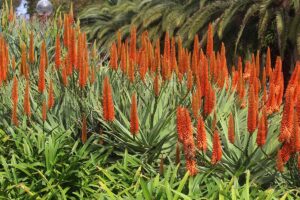
x Graptosedum ‘California Sunset’
Glowing with warm hues, x Graptosedum ‘California Sunset’ deserves a spot in your dish planter, rock garden, or among your collection of succulents.
These plants provide loads of visual interest, their muted to fiery colors make them perfect for combining with other succulent species.
With attractive, densely arranged rosettes of fleshy leaves, ‘California Sunset’ charms with its color palette and its beautiful textures.

We link to vendors to help you find relevant products. If you buy from one of our links, we may earn a commission.
Also known as x Graptosedum ‘Peach Blossom,’ this hybrid is a cross of Graptopetalum paraguayense and Sedum adolphi and brings texture and visual interest whether grown indoors or out.
In this article, we’ll cover how to grow ‘California Sunset’ succulents, how to care for them, and why you might want to give them a spot on your windowsill or in your ornamental garden.
What You’ll Learn
‘California Sunset’ is a greenish pink succulent that has bronze overtones.
These hybrids take on orange to deep red coloring in bright light, and produce sprays of star-shaped white flowers in springtime.
Houseplant lovers can grow these plants in sunny windowsills or under grow lights, while gardeners in USDA Hardiness Zones 9 to 11 can grow them outdoors year-round.
‘California Sunset’ is gorgeous when grown in hanging baskets or containers or as a ground cover in rock gardens.
The plants can be combined with species that have similar growing requirements, such as echeverias, as long as the right conditions are available.
Quick Look
Common name(s): ‘California Sunset,’ ‘Peach Blossom’
Plant type: Evergreen succulent
Hardiness (USDA Zone): 9-11 (outdoors)
Native to: Horticultural hybrid
Bloom time / season: Winter to spring
Exposure: Full sun to light shade
Soil type: Cactus or succulent mix, well-draining
Soil pH: 6.0-7.0, slightly acidic to neutral
Time to maturity: 1-2 years
Mature size: 18 inches wide by 6-12 inches tall
Best uses: Houseplant, container gardens, ground covers, hanging baskets, rock gardens
Taxonomy
Order: Saxifragales
Family: Crassulaceae
Subfamily: Sempervivoideae
Genus: x Graptosedum
Cultivar: ‘California Sunset’
Whether you plan to grow ‘California Sunset’ indoors under a grow light, or outside in a rock garden, you’ll want to make sure you master its basic growing requirements, which are pretty simple.
Our guide to growing graptosedum provides general instructions for cultivating these hybrids.
How to Grow
Growing this graptosedum isn’t hard. Like many succulents, it’s drought tolerant when established and requires little attention when grown in ideal conditions.
Here’s what you’ll need to know:
Light
To keep the rosettes beautiful and compact, direct light is a must – at least six hours daily or the equivalent from a grow light.
Lack of light can cause legginess which detracts from its appearance.

Position it accordingly outdoors or look for a south-facing window indoors.
Depending on your location, a south-facing window will probably not provide enough direct sunlight all year long, so you may have to place the plant outdoors during the summer months for optimal exposure.
Soil
Like most succulents ‘California Sunset’ requires potting medium with excellent drainage.
A regular commercial potting soil is unlikely to be sufficient unless you amend it with added grit such as sand or pumice.
Even most bagged mixes formulated for cacti and succulents may fall short, so either mix in additional grit to a commercial mix or make your own.
Find tips for making your own potting soil for succulents here.
Water
‘California Sunset’ is drought tolerant and can survive long periods without water – but that doesn’t mean you never have to water it or that you should only water it small amounts at a time.

Allow the growing medium to dry thoroughly between waterings and then water deeply to ensure the soil is wet throughout.
And rather than watering the top of the foliage, pour water over the growing medium, perhaps with the help of a houseplant watering can with a narrow spout.
Learn more about watering succulents here.
Temperature and Humidity
As mentioned earlier, you can only grow this graptosedum outdoors year-round in Zones 9 to 11, as they are cold tolerant to about 20°F.
Gardeners growing these hybrids outdoors in colder zones should move the plants indoors for the winter.
Read about succulent winter care here.
In addition to protection from temperatures that are too cold, if you want to encourage flowering, situate the plant in a cool location during the fall, at a temperature above 20°F but below 60°F.
Unlike species such as prayer plants which need high humidity to stay healthy and beautiful, ‘California Sunset’ is well-suited to dry environments and should be kept out of humid situations to avoid fungal problems. That means don’t try growing it in a terrarium.
Fertilizer
As graptosedums adapted to poor soils, they need little fertilizer – only once a month during spring and summer.
Be sure to feed only with a succulent-specific formula, such as Dr. Earth Succulence Plant Food.

You can purchase a 16-ounce pump bottle of Succulence Plant Food from Dr. Earth via Arbico Organics.
Follow the manufacturer’s directions for applying this or any other fertilizer.
Where to Buy
You can ask at your local nursery if they have a decent succulent section – but you might have better luck finding this graptosedum cultivar online.
You can purchase 2.5-inch, live ‘California Sunset’ specimens for purchase from the CTS Air Plants Store via Amazon.
Maintenance
Graptosedums don’t need much maintenance, but a little upkeep along with good choices for light, soil, and water will keep them looking as swoon-worthy as an evening at the beach.
Remove any dried-up leaves from the bottom of the rosette when you water to keep them looking tidy.
If your ‘California Sunset’ plant becomes leggy you can prune off a rosette and propagate it as described later in this article.
Wait until the specimen has outgrown its pot to repot, using the method described below. Check the root ball, which should fill the pot before repotting.
Be sure to choose a new container that has drainage holes and is only one size larger.
Propagation
One of the fun parts of growing succulents like ‘California Sunset’ is how easy they are to propagate. For this hybrid, stick to cuttings or offsets for the best results.
From Leaf Cuttings
Since you can grow a brand new specimen from a leaf cutting, this method allows you to propagate lots of new plants.
However, it can require some patience as plantlets don’t grow very quickly from leaf cuttings.
Here’s how:
- Remove a healthy, plump-looking leaf, taking care to detach it cleanly from the stem.
- Place the leaf in a dry location away from direct sunlight for the cut end to callus over. This will take around a week.
- After the wound end of the leaf is callused over, place it horizontally on dry growing medium.
- Check the cutting every few days. When you notice roots growing from the callus, you can begin watering.
A plantlet will grow from the callus as well and this can be transplanted when it outgrows the container.
From Stem Cuttings
A new plant can also be propagated by removing a section of stem with a rosette from the parent.
- Use a pair of sharp, sterilized scissors to cut off a healthy rosette along with a section of stem that’s one to two inches long.
- As with the leaf cutting method, allow the wound end of the stem cutting to callus over in a dry location out of direct sunlight for a week.
- Once the stem cutting has callused, insert it in a two- or four-inch nursery pot filled with gritty growing medium.
Rather than watering right away, wait for a week or two to allow the cutting to root. If you give a little tug on the rosette and you notice resistance, the cutting has begun to root.
From Offsets
Succulents like ‘California Sunset’ produce offsets, also known as pups, which can be removed from the parent and grown as new specimens.
However, there’s no obligation to remove offsets, as they can help create a fuller pot when allowed to remain with the parent plant.
If you’d like to propagate an offset, remove it from the parent and let it callus over before repotting it.
Learn how to propagate succulents from offsets here.
Transplanting
Wait until spring or summer to transplant these graptosedums, to ensure they have time to establish new roots before winter.
When you’re ready to transplant, remove the succulent from its pot and brush off the growing medium from the outer edges of the root ball. If the root ball is tightly tangled, loosen up the outer edges with the tines of a fork or a chopstick.
If you’re transplanting into a container, choose a new pot that is just one size larger than the current one. Be sure the soil has plenty of grit, as explained in the how to grow section above.
Place the root ball into the new pot, or in the ground, filling in with soil around the sides of the root ball. Avoid packing extra growing medium on top of the roots, though.
Wait up to ten days before watering the newly transplanted succulent to prevent fungal problems.
Pests and Disease
‘California Sunset’ succulents aren’t known for being plagued by pests or disease, but since issues do sometimes arise, it’s best to know what to watch for:
Pests
Be sure to check new specimens after purchase and inspect them after they have been outdoors for the summer.
Some of the most common pests you’ll encounter are aphids, mealybugs, and scale insects.
Aphids
Look for aphids on the undersides of leaves or on stems, where they feed on plant tissue, causing distorted leaves.
Aphids also leave behind trails of honeydew, which can be a telltale sign of a pest infestation, as well as potentially leading to fungal issues.
Learn how to control aphids here.
Mealybugs
Mealybugs are common houseplant pests, and can be easily identified on these succulents since they look like white fluff.
These pests suck nutrients from leaves and stems, and can kill the plant if left untreated. Root mealies can also feed on roots in the soil, hidden from plain view.
Read our article about how to deal with mealybugs.
Scale
Scale insects can be as difficult to treat as they are to see, they resemble small bumps on plant stems or leaves.
These pests feed on plant sap and can cause yellowing and wilting. You can remove any you see with a cotton bud dipped in rubbing alcohol.
Learn how to identify and control scale insects here.
Disease
If you see mushy foliage dropping from this plant, check for root rot, a condition caused by overwatering and poor drainage.
Since it can be difficult to salvage rotting succulents, ensure that the plants are grown in optimal conditions.
Read our guide to preventing and managing rotting in succulents here.
Enjoy a California Sunset Every Day
Growing ‘California Sunset’ in your rock garden or as a windowsill plant will provide you with warm, sunset colors that you can depend on, day after day.

Just remember to give these succulents plenty of direct sunshine, excellent drainage, and infrequent watering to keep them looking perky and healthy.
Are you growing ‘California Sunset’ or other types of graptosedum? Drop your photos, thoughts, and questions in the comments section below!
Whether you’re growing succulents in your home or garden, you’ll find more informative guides here: