Opuntia microdasys
The bunny ears or polka-dot cactus, Opuntia microdasys, is an ornamental specimen native to Mexico and neighboring Arizona.
It’s suited to cultivation in USDA Hardiness Zones 9 to 12 and as a houseplant elsewhere.
The flat, fleshy, segmented leaf-like stems of cacti are called cladodes, pads, or paddles.
Those in the Opuntia or prickly pear genus are typically covered in long, sharp spines to ward off desert predators.
But when they sprout in adorable pairs with fuzzy polka-dots, the cactus looks more like a cuddly bunny than a prickly menace.

We link to vendors to help you find relevant products. If you buy from one of our links, we may earn a commission.
However, don’t be fooled by its whimsical demeanor, the fuzzy appearance of the bunny ears cactus is created by short barbed bristles called glochids.
They are thin but quite sharp, readily detaching and causing pain to those who come in contact with them.
Our guide to growing prickly pear cactus offers an overview of the Opuntia genus.
This article discusses everything you need to know to grow O. microdasys. Here’s what we’ll cover:
What You’ll Learn
Bunny ears cactus plants grow densely, paddle atop paddle, until they appear almost shrub-like.
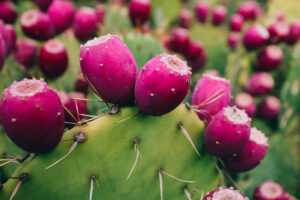
They have gold glochids and yellow blossoms from spring through summer, followed by reddish-purple fruits called prickly pears.
After growing slowly for up to 20 years, mature dimensions are two to three feet tall and four to six feet wide.
While Opuntia pads are edible, and large-paddled species like the barbary fig, O. ficus-indica, are commercially cultivated for consumption, the small, glochid-covered paddles of bunny ears are not generally consumed.

Home gardeners will instead find ornamental uses for O. microdasys, including to inhibit erosion, as a rock garden feature, a water-wise xeriscaping choice, and as potted specimens.
Growers in cooler regions can enjoy plants indoors, where they are unlikely to bloom, but add a southwestern flair to room decor.
Quick Look
Common name(s): Angel’s wings, bunny ears, polka-dot cactus
Plant type: Cactus
Hardiness (USDA Zone): 9-12 (outdoors)
Native to: Northern Mexico into Arizona
Bloom time / season: Spring and summer
Exposure: Full sun
Soil type: Loose, lean, rocky/sandy, well-draining
Soil pH: 6.0 to 7.5, slightly acidic to neutral
Time to maturity: 20 years
Mature size: 2-3 feet tall by 4 to 6 feet wide
Best uses: Ground cover, houseplant, patio pot, rockery, xeriscape
Taxonomy
Order: Caryophyllales
Family: Cactaceae
Genus: Opuntia
Species: Microdasys
In addition to the primary species and a cultivated variety, there are two naturally occurring variations.
White bunny ears, O. microdasys var. albispina, aka O. microdasys albata, has white glochids.

Crested or wavy bunny ears, O. microdasys var. pallida f. cristata, has irregularly shaped, twisted, light-green paddles and bright yellow glochids.
There is a related species native to Mexico and Texas called the blind prickly pear cactus, Opuntia rufida, aka O. microdasys subsp. rufida.
It has reddish-brown glochids, yellow flowers, and reaches heights of four to five feet tall and four to eight feet wide.
The name comes from the danger it poses to livestock when the wind disperses glochids into the air and the animals’ eyes.
Growers should take care when working with plants and keep children and pets away.
How to Grow
While bunny ears cactus sounds cute and cozy, its natural habitat is anything but.
Shallowly rooted in hardscrabble earth, this species thrives in a perpetually dry environment, receiving little rainfall.

During periods of active growth, it endures high heat and scorching sunlight daily, followed by cool nighttime temperatures.
In winter dormancy, when the sunlight is less intense, it thrives in the 50 to 65°F range, tolerating occasional dips to 20°F.
Home cultivation should mimic these conditions as follows:
Light
Provide a full sun location. With at least six hours of daily exposure, the paddles will be firm, upright, and richly hued, and outdoor plants are primed for a healthy bloom.
Indoors, place pots in bright, indirect sunlight near a south- or west-facing window. Avoid direct sunlight through glass as it may cause sunburn or scorching.
Rotate weekly to expose all sides to the sun. Alternatively, a grow light can be used.
Soil
The best ground soil for cacti is not overly fertile and has rocks and/or sand for excellent drainage.
Potted specimens need a light mixture which contains ingredients like peat moss, perlite, sand, and vermiculite. You can easily make your own cactus potting soil, or purchase it.
The ideal soil pH is slightly acidic to neutral, between 6.0 and 7.5.
If your garden soil is too alkaline, amend it with sulfur in the fall to acidify it for the following growing season. Add horticultural sand to improve drainage.
Water
Cacti store moisture in their fleshy foliage to sustain them during dry weather.
During the growing season, water them when the top one to two inches of soil are dry, or about every two to four weeks, depending on when it rains. Use a moisture meter as a guide.
Allow indoor and outdoor pots to dry completely before watering them again.
Fertilizing
If you choose to fertilize, use a mild product with the percentage of nitrogen lower than phosphorus and potassium, like 2-7-7 (NPK), to avoid overstimulating foliar growth resulting in a spindly form.
Apply it in the spring and summer. You don’t need to fertilize during fall and winter dormancy.
I use this product from Schultz which has an NPK ratio of 2-7-7 to support optimal health.
It is suitable for indoor and outdoor use. Apply it in the spring and summer per package instructions.
Schultz 2-7-7 Cactus Plus is available from Schultz via Amazon.
Where to Buy
You can often find bunny ears cactus available at nurseries that specialize in cacti and succulents. Alternatively, you can shop online.

Bunny ears is available from Bubbleblooms via Walmart in four-inch pots.

You can also find crested bunny ears plants in four-inch pots from Bubbleblooms via Walmart.
‘Caress’ is a cultivar that came to the United States from Europe, but its origins are unclear.
It has blunted and flattened glochid spines that cause no pain when touched, hence the name ‘Caress’.
Plants sprout bright green paddles that shade grayish-green as they age.
The flowers on outdoor specimens are light yellow, and mature dimensions are 16 to 24 inches high and up to five feet wide.
Maintenance
Cacti need little else besides sunshine, well-draining soil, and water. When pruning is required, it’s best to do it in late spring to early summer, a time of active growth.
Use clean shears to remove damaged or diseased paddles. Slice cleanly through the base where one segment joins another. Avoid getting the “wound” wet – it will soon form a hard callus.
There are additional reasons to prune, including to:
- Reduce overcrowding that puts some paddles in shade, reduces airflow, and invites pests and pathogens.
- Eliminate the rubbing of pads in proximity that causes wounds vulnerable to infestation and infection.
- Balance top-heaviness and reduce the risk of breakage.
- Remove pads that are dragging on the ground and susceptible to disease, pests, and wounding.
Our cactus pruning guide has more information.
If you grow bunny ears in a pot, you’ll need to repot every few years to replenish the soil and provide extra space as the plant matures. You can learn more about repotting cacti here.
Growers in regions that freeze should bring pots indoors for the winter.
Supply bright, indirect sunlight and water before the pot completely dries out. Moisture needs will be reduced during winter dormancy. Learn more about watering cacti here.
If you grow the plants in-ground and an unusual freeze is predicted, cover your plants with lightweight burlap anchored by stakes until the danger is over.
If snow is predicted, use washtubs or buckets for protection. Our guide to caring for frozen and frost-damaged cacti has more information.
Propagation
Supplies you may need for propagation include pruners, rubber-tipped tongs, thick gloves, and tweezers for removing pesky glochid spines.

To start a plant, you’ll need seeds or cuttings. Let’s discuss.
From Seed
Purchase seeds or harvest them in the fall from the fruits of an existing plant.
Extract the seeds from the pulp, wash and dry them thoroughly. When dry, store them in an airtight container until the following spring.
- In the spring, scarify the seeds with a nail file, rubbing them lightly to break the tough outer coat.
- Soak the seeds in warm water overnight.
- Fill a seed starter tray three-quarters full of potting medium.
- Sow one or two seeds per cell.
- Barely cover them with an eighth of an inch of soil.
- Water lightly and cover the tray loosely with plastic wrap.
- Place the tray on a heating mat set to 75 to 80°F and find a spot with bright, indirect sunlight away from drafts.
- Remove the plastic when the seeds sprout.
- When the seedlings have one set of true cactus-like cladodes, thin them to one per cell.
At about three inches tall, transplant the seedlings to the garden at 48- to 72-inch intervals, or place each in a four-inch pot.
Alternatively, you can direct sow seeds in the spring in loose, sandy garden soil.
Place one or two seeds every 24 to 36 inches. Cover them with an eighth of an inch of soil.
Water lightly and maintain even moisture during germination, but don’t allow the soil to become waterlogged.
When the seedlings have several sets of true leaves, thin them to 48- to 72-inch spacing.
From Cuttings
Cactus cuttings are easy to take and grow faster than seeds.
Here’s how to propagate from cuttings:
- Select a long, mature paddle and detach it by snapping or cutting where it joins the one underneath.
- Set it on some kitchen paper in a dry location out of direct sunlight to form a hard callus over the cut end.
- Choose a well-draining pot. It should be one to two inches wider and deeper than the paddle when it is buried a third of the way down.
- Fill the pot three-quarters full of cactus potting mix.
- Push the callused end of the paddle into the soil until the bottom third is buried.
- Tamp the soil firmly to hold it upright and water well.
- Put the pot in a location with bright, indirect sunlight.
- Water when the pot dries out completely.
When you see evidence of new growth, you can transplant into the garden or a larger container.
Transplanting
When your seedling or cutting is ready for transplant, or if you have purchased a plant, choose a location with full sun and loosen the soil as deep as the container and twice as wide.
Water the plant the day before. Unpot and place the contents of the container at the same depth as the plant was growing in its original container.
Tamp firmly to hold the plant upright. Water when the top one to two inches of soil are dry.
Alternatively, you can grow permanently in containers that you can place outdoors in warm weather and bring indoors for the winter in cold climates.
Choose a container one to two inches wider than and deeper than the root mass. Avoid overly large pots that may stay wet too long and cause rotting.
Pests and Disease
You shouldn’t face too many pests and pathogens when growing O. microdasys.
In addition to being a food source, cacti provide much-needed moisture for desert birds, rabbits, and rodents. Consider installing netting if they are troublesome.
Pests
You may encounter the following pests outdoors and indoors:
- Cochineal Scale (Dactylopius coccus)
- Mealybugs
- Spider Mites
These sapsuckers feed on the juices in foliage, causing deformity, discoloration, and stunting.
Mealybugs prefer moist conditions but like cochineal scale and spider mites, they can also appear in dry heat.
Avoid over- and underwatering and treat affected flora with organic insecticidal neem oil.
Our guide to common cactus pests has more information.
Disease
Phyllosticta pad spot is a fungal disease that thrives in moist conditions and appears as black spots on the foliage.
It spreads readily via rainwater and overhead irrigation. Remove affected pads and dispose of them in the trash.
When watering, soak the soil at ground level to avoid splashing the foliage. There are no effective treatments.
Root rot can occur with overwatering. Tell-tale signs are discoloration, foul odor, mushy texture, and wilting.
You may be able to salvage unaffected portions to propagate new plants. Rotten plant parts will not recover.
Not a Snuggle Bunny
It may not be cuddly, but bunny ears cactus is cute when potted up as a houseplant. In the yard, it earns its keep as erosion control in xeriscapes.

When you mind the glochids, you’ll find plants attractive and easy-care. Where will you feature yours?
Do you grow bunny ears cactus? Please share your tips for success in the comments section below.
If you enjoyed this article and want to read more about cactus cultivation, we recommend the following: