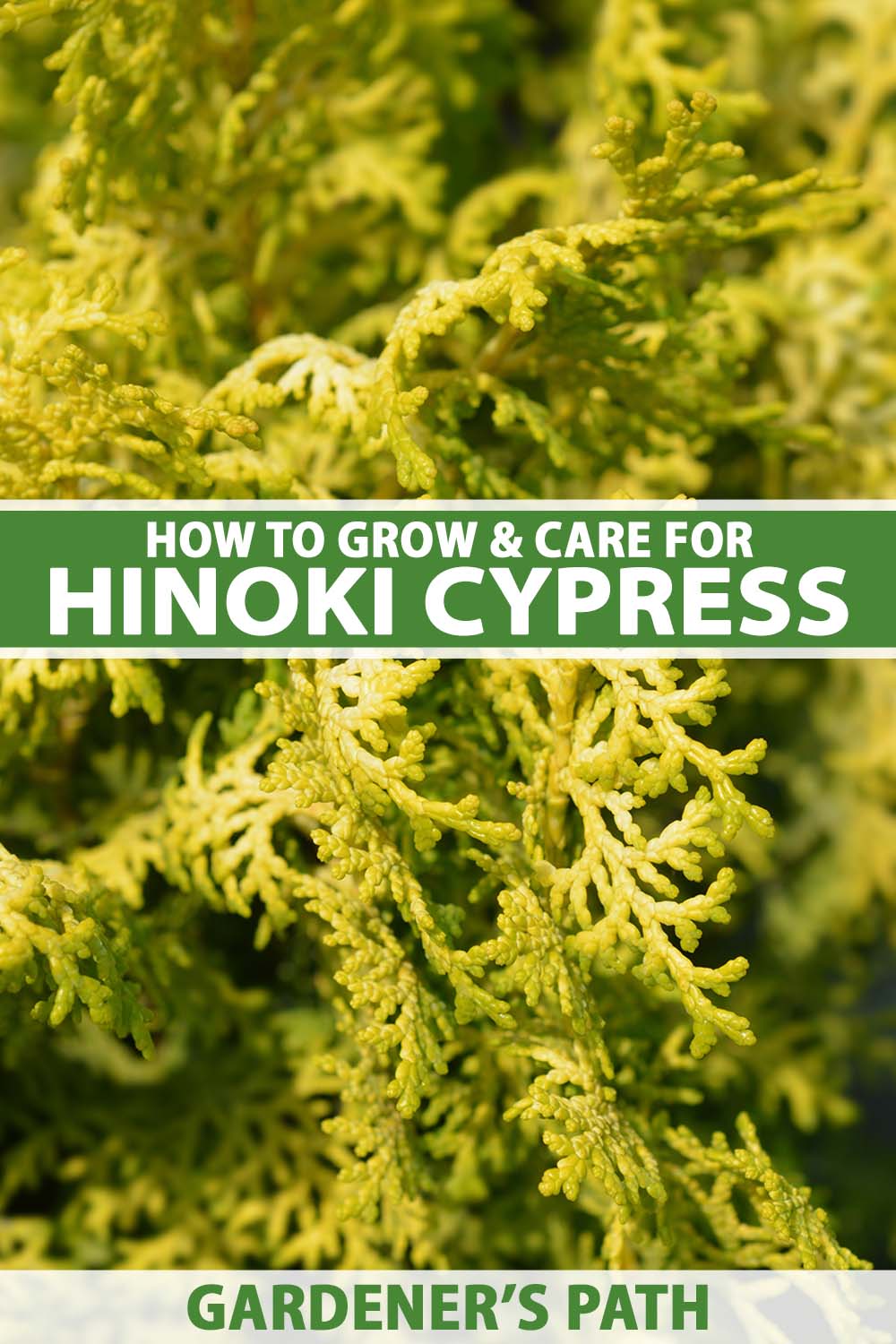
Chamaecyparis obtusa
Hinoki cypress (Chamaecyparis obtusa) is a slow-growing evergreen conifer native to Japan that’s sure to draw the eye.
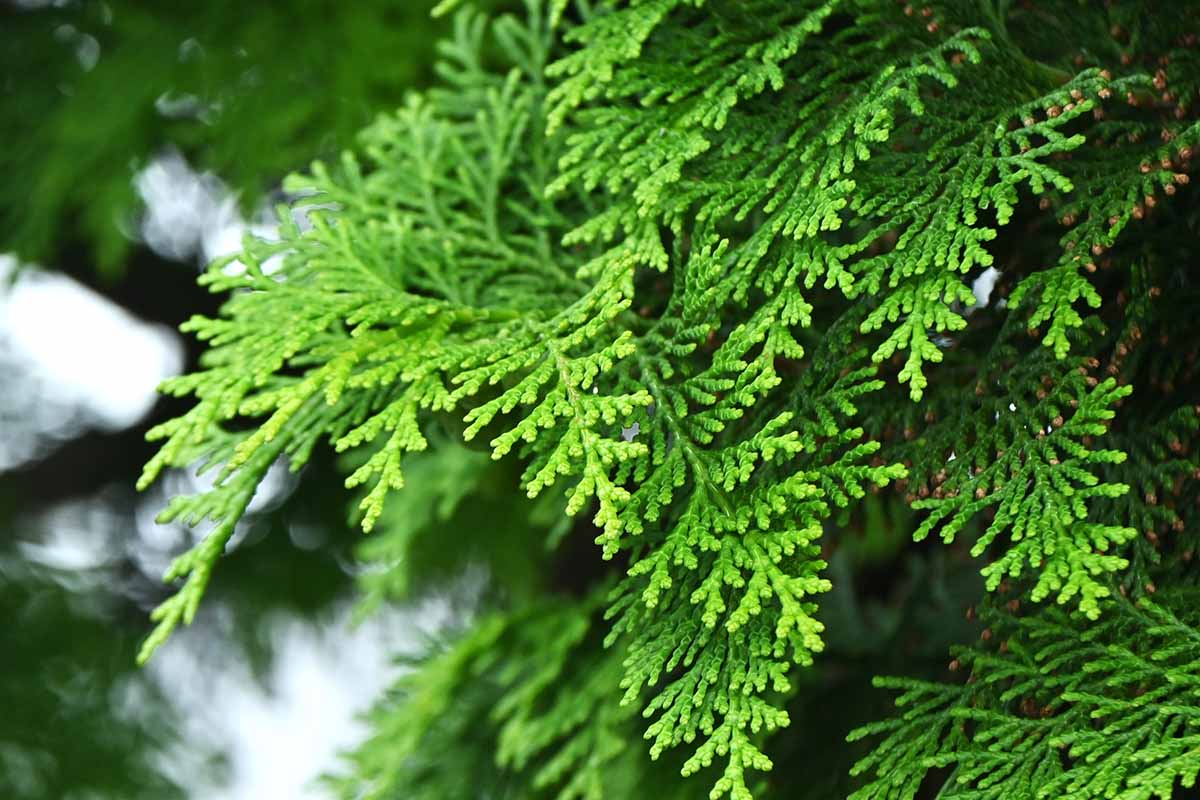
With soft, fern- or thread-like foliage growing in undulating waves and whorls on trunks that contort, twist, and dance, they’re hard to miss.
I don’t know what business any tree has looking so good. Who does the hinoki cypress think it is, anyway?
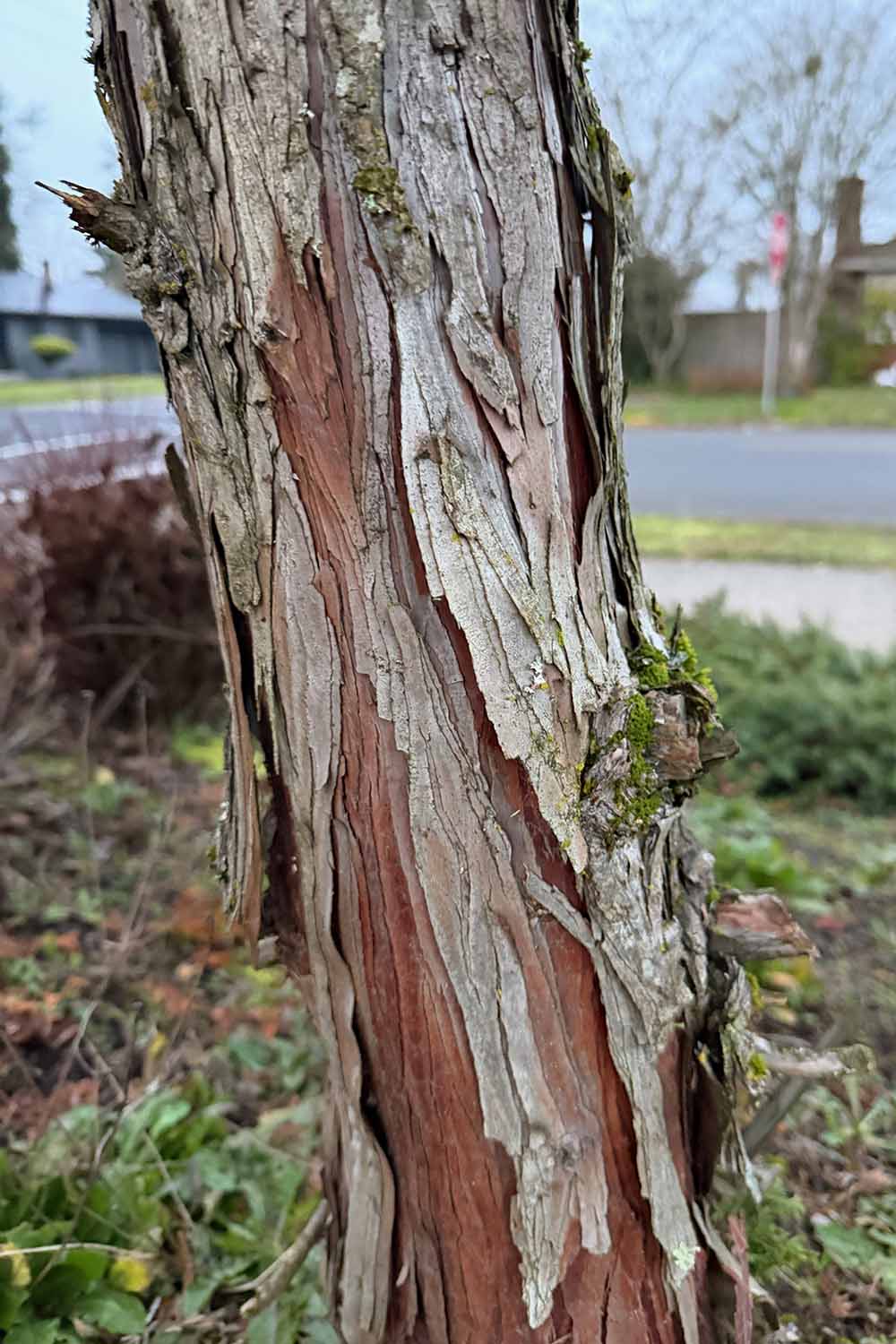
Underneath the characteristic foliage, peeling, reddish bark adds another layer of texture.
We link to vendors to help you find relevant products. If you buy from one of our links, we may earn a commission.
But a hinoki cypress isn’t just a feast for the eyes, crushing the foliage releases a heavenly cedar-like scent.
Just brushing against one in your yard is enough to fill the air with its fragrance.
The name “hinoki” is often said to mean “fire tree” in Japanese, so named because the wood is used in traditional fire rituals. But experts say that the word simply translates to “cypress.”
Despite the common name, hinoki is not a true cypress (Cupressus).
Whatever the origin, today, when someone says hinoki cypress, I picture one of the prettiest trees I’ve ever clapped eyes on.
Sadly, the tree is endangered in its native Japan, but it has become a popular ornamental across the globe.
So why not help carry on its legacy by adding one to your garden? That’s what we’ll go over in this guide, plus a lot more. Here’s what we’ll cover:
What You’ll Learn
In its native habitat, hinoki cypress can grow up to 120 feet tall, though in cultivation it usually tops out under 80 feet.
Cultivars span a wide range of sizes, including many petite and dwarf varieties, and the species is also a popular choice for bonsai.
The Japanese value this tree not only as an ornamental but for its strong, durable wood, which has been used to build temples, shrines, gates, soaking tubs, and to produce oils.
Many ancient and valued structures throughout Japan were built using hinoki timber.
These are also remarkably long-lived trees. The oldest known specimen, located on Japan’s Yakushima Island, clocks in at over 1,100 years old.
Quick Look
Common name(s): Hinoki cypress, hinoki false cypress, false cypress
Plant type: Evergreen conifer
Hardiness (USDA Zone): 4-8
Native to: Japan
Bloom time / season: Spring cones, evergreen
Exposure: Full to partial sun
Soil type: Organically-rich, loose, well-draining
Soil pH: 5.0-6.0, slightly acidic
Time to maturity: Up to 20 years
Mature size: 2-120 feet tall by 2-25 feet wide, (depending on cultivar)
Best uses: Specimen
Taxonomy
Order: Cupressales
Family: Cupressaceae
Genus: Chamaecyparis
Species: Obtusa
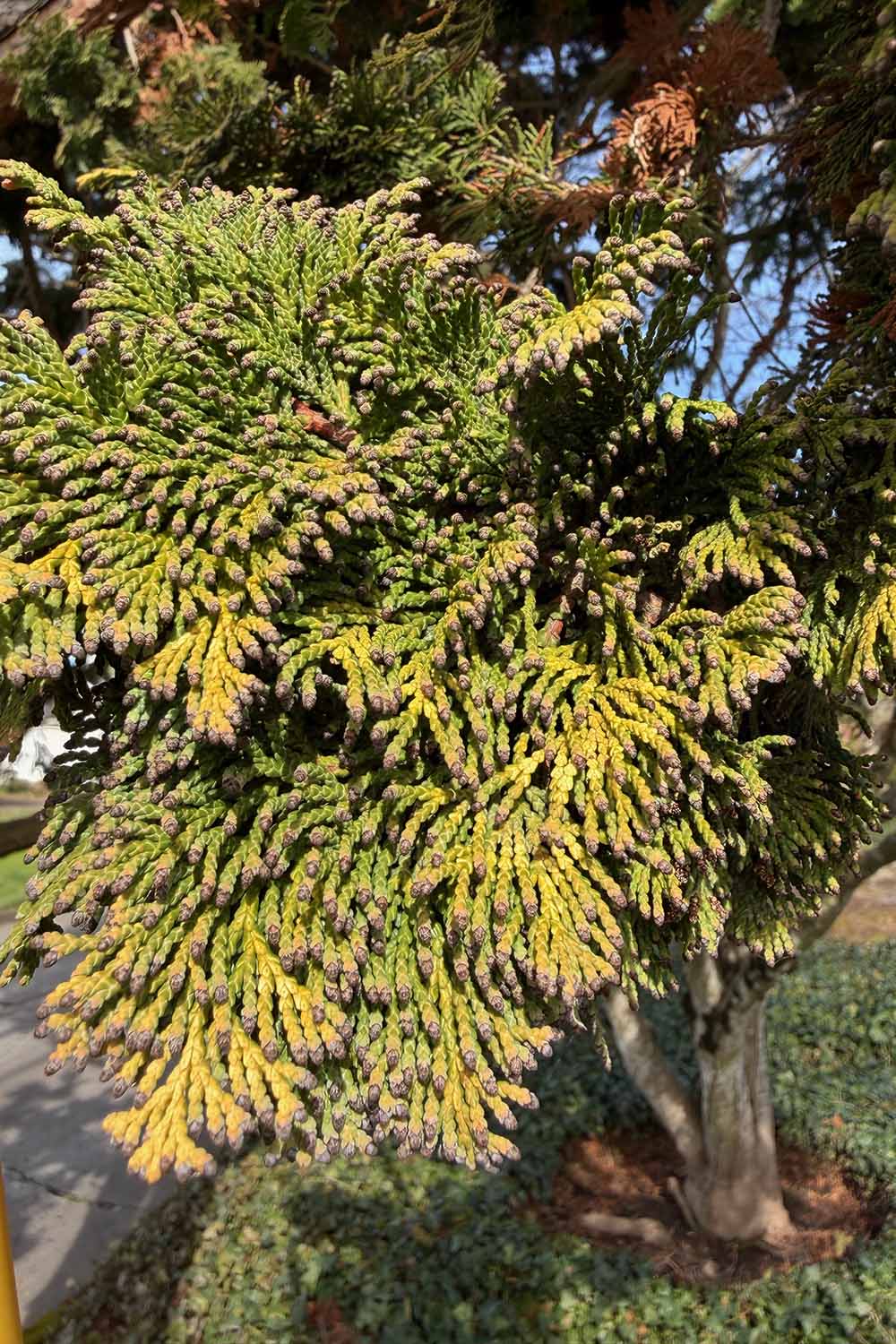
Hinoki cypress trees are monoecious, meaning they carry both seed and pollen cones on a single tree rather than on separate male and female plants.
In spring, pollen cones appear on the outer branches and release allergy-inducing pollen, while the round seed cones grow further inside the tree.
The first hinoki cypress was introduced to North America in 1862 by doctor-turned-plant importer George Hall, shortly after Japan opened up to trading with the West.
It has since been bred further to create cultivars that suit almost any space.
Regardless of which you choose, here’s how to make sure it thrives.
How to Grow
Suitable for cultivation in USDA Hardiness Zones 4 to 8, you can expect your tree to gain about a foot of height per year until it reaches its ultimate size.
Most mature over decades, but they will reach close to their ultimate height in 15 to 20 years or so. Happy trees grow faster, and happy trees need good soil.
Soil
The soil you plant your tree in should be rich, loose, and well draining.
You’ll often hear gardeners telling you to amend the soil before planting if you don’t have nice, loamy soil.
While you can go ahead and do that, just know that a fully-grown tree likely has a root system well beyond what you will be able to amend.

Eventually, those roots are going to tap into that heavy clay or whatever you were trying to improve in the first place.
Soil also tends to revert to its original state over time.
Just ask anyone with heavy clay who spends hours every year trying to amend the soil that was perfectly loamy just a few months earlier.
If you’re working with heavy clay or heavy soil, you’re better off choosing a dwarf or compact cultivar and planting it in a raised bed or container.
Hinoki cypress are sensitive to alkalinity, so your soil should be slightly acidic to neutral, with an ideal pH of between 5.0 and 6.0.
Light
While they do best with full sun or just a touch of shade during the hottest parts of the day, hinoki cypress will also grow in partial shade.
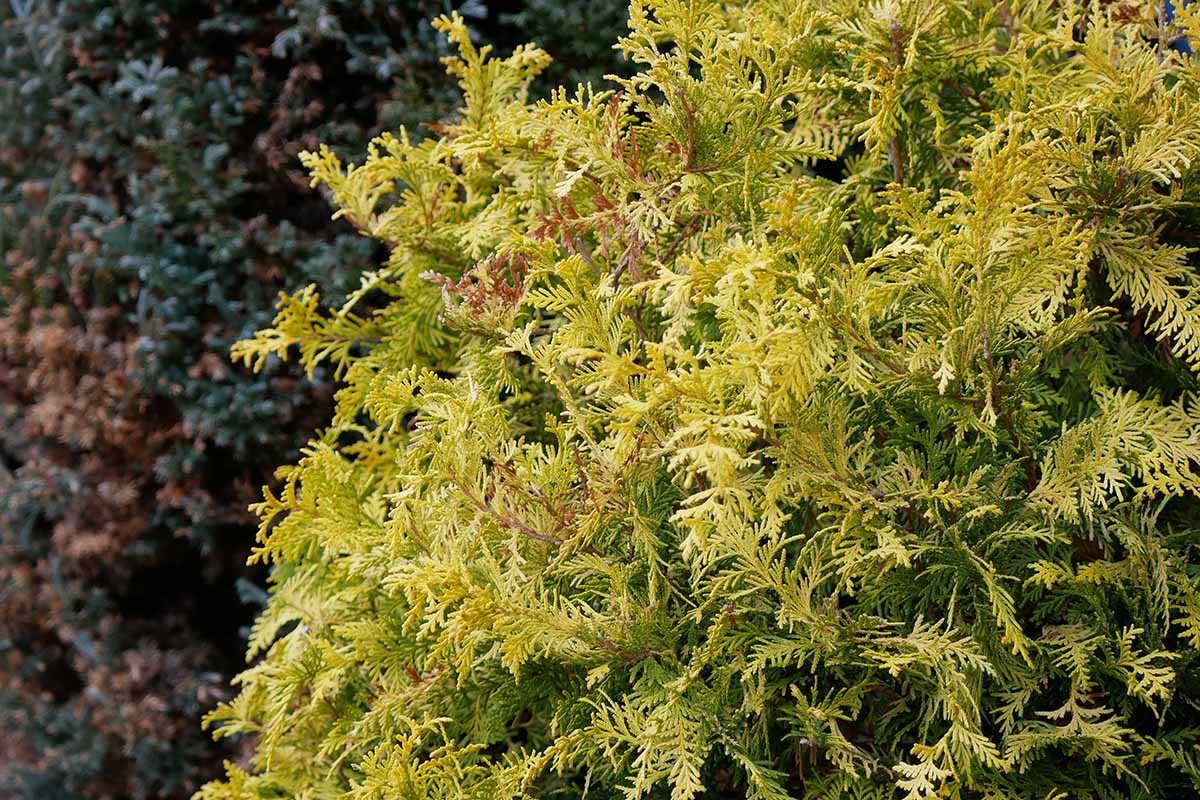
Just don’t expect them to be quite as dense or full.
Shadier conditions also mean the soil will dry out more slowly, which can increase the risk of root rot if drainage isn’t adequate.
Water
Young hinoki cypress trees need more water than mature specimens. When the tree is young, don’t allow the soil to dry out completely.
When the top inch or two of soil is dry, it’s time to water. Once the tree is established, it will tolerate some drought.
You don’t need to give mature trees any water except during extreme heat and drought.
Fertilizer
Depending on your soil quality, you might not need to fertilize your hinoki cypress at all.
That’s why it’s best to test your soil before you start tossing in fertilizer.
You might find that your soil is already rich in nutrients or you may discover it’s a bit low in nitrogen, which is common.
Armed with the results, you’ll know exactly what to add so you aren’t over-or underfeeding. Reach out to your local Extension office for testing resources in your area.
While you can buy tests online, their accuracy varies widely, and these tests aren’t tailored to your specific region.
Cultivars to Select
You won’t usually see the straight species in home gardens, but the many cultivars are becoming increasingly popular with home growers.
There are plenty of dwarf options for smaller spaces, along with varieties spanning a wide color range, from deep bronze and bright gold to every shade of green imaginable.
Contorta
‘Contorta’ is an acrobat. The narrow branches twist, twirl, and spiral in a compact, dense shrub-like shape.
It reaches just four to eight feet tall and three to four feet wide at maturity, which happens slowly over decades.

In ideal conditions it can grow a little bit larger, but it tends to stay quite petite.
‘Contorta’ is sure to be a statement piece in the garden, whether in a container or in the ground.
You can find ‘Contorta’ in #3 containers available at Nature Hills Nursery.
Fernspray
‘Fernspray has flattened sprays of foliage that strongly resembles those of a fern on a shrub-like tree that reaches up to 12 feet tall and just four feet wide.

It has an interesting pyramidal form with gracefully curving branches.
Nature Hills Nursery carries this cultivar in #3 containers.
‘Fernspray Gold’ is similar in shape, though about two-thirds the size of ‘Fernspray.’
It has yellow-golden-tipped leaves that turn even more intense in the cooler months. It won the Award of Garden Merit (AGM) from the Royal Horticultural Society in 2012.
If you’d like to give this one a try, grab yours at Nature Hills Nursery.
Gracilis
Often called “slender hinoki cypress,” ‘Gracilis’ has a narrow, conical shape with gracefully angular branches that arch outward informally from a central trunk.
What makes it extra appealing is the dense, full growth that makes the straight species look positively sparse by comparison.

The shape makes it ideal for narrow spots or as a living fence.
You can find ‘Gracilis’ available from Fast Growing Trees in packs of one or four to suit your needs.
Kosteri
‘Kosteri’ usually goes by Koster’s hinoki false cypress, and was named for the Dutch nursery Koster and Son, where it was discovered.
It’s a slow grower that gradually matures to a mere four feet tall and wide, at most. It maintains a slightly rounded, pyramidal shape without any pruning.
The foliage takes on a slight bronze hue in the colder months.
Nana Gracilis
‘Nana Gracilis’ is one of the most popular cultivars. It was awarded the RHS Award of Garden Merit in 1993 and has only gained more attention and accolades since.
Young plants have a compact, rounded shape that gradually becomes more conical as the tree matures to its full six feet tall and four feet wide.

It has gracefully arcing branches and a dense growth habit, and is more shade tolerant than the species.
You can find ‘Nana Gracilis’ plants available at Fast Growing Trees.
Snowflake
‘Snowflake’ is as charming as its name suggests.
It grows in a compact, round shape that may eventually reach four feet tall and wide given several decades.

While the shape is appealing, that’s not what makes ‘Snowflake’ especially fabulous.
The fern-like leaves are variegated with pale creamy golden tips when the foliage is young.
Bring home this unique option from Maple Ridge Nursery in a three-gallon pot.
Tempelhof
‘Tempelhof’ has more of a shrub-like than tree-like shape, typically without a strong central leader.
It grows to about eight feet tall with a pyramidal or conical shape and incredibly dense growth. The leaves take on a bronze hue in the winter.

It was cultivated at L. Konijn & Company’s Tempelhof Nursery in Boskoop, The Netherlands in 1964. You can find plants available from Nature Hills Nursery.
Maintenance
Left on their own, hinoki cypress develop a naturally interesting shape without any intervention.
That said, you can prune to manipulate the shape further, or simply stick to maintenance pruning to keep the tree healthy – the choice is yours.

Shaping involves looking at the tree and deciding if there are branches that should be removed to produce a pleasing appearance.
You might also cut or pinch back branch tips to encourage bushier growth. It’s almost like training a bonsai, only in giant size.
Maintenance pruning means removing any branches that are broken, dead, diseased, or rubbing against another branch.
In either case, use clean tools and make all cuts just in front of a branch or cleanly at the trunk.
Don’t cut into old wood if you can avoid it, because the tree might not send out new growth there and you’ll be left with a bare stump.
Cuts can be made at any time of year, but if you’re doing heavy pruning, late winter before new growth starts is ideal. Just make sure the wood isn’t frozen when you cut.
Propagation
If you want to try growing hinoki cypress by seed, feel free. Just treat it as a fun experiment and don’t be too disappointed if germination is poor or if the seedlings don’t thrive.

Starting this species from seed is genuinely difficult, and even if you succeed, there’s no guarantee the resulting tree will look anything like the parent.
For reliable results, cuttings are the way to go. The process is far more predictable, and the new tree will be a genetic replica of the parent plant.
From Cuttings
Take cuttings in spring or summer to give them the best chance to establish before the winter dormant season.
Look for a soft, pliable branch tip roughly the diameter of a pencil or slightly smaller, take a four- to six-inch cutting, making the cut at an angle to maximise surface area.
Dip the cut end into powdered rooting hormone.
Fill a six-inch pot with a loose, rich potting medium, water well, and poke a hole in the center with your finger or a pencil.
Insert the cutting so it’s buried by about an inch and firm the soil around it so it sits upright.
Place the pot in a sunny spot outdoors and keep the soil consistently moist.
Leave the cutting to grow and mature in the pot through the season, then transplant it the following spring.
Transplanting
Before you remove the tree from the pot, dig a hole about twice as wide and the same depth as the growing container.
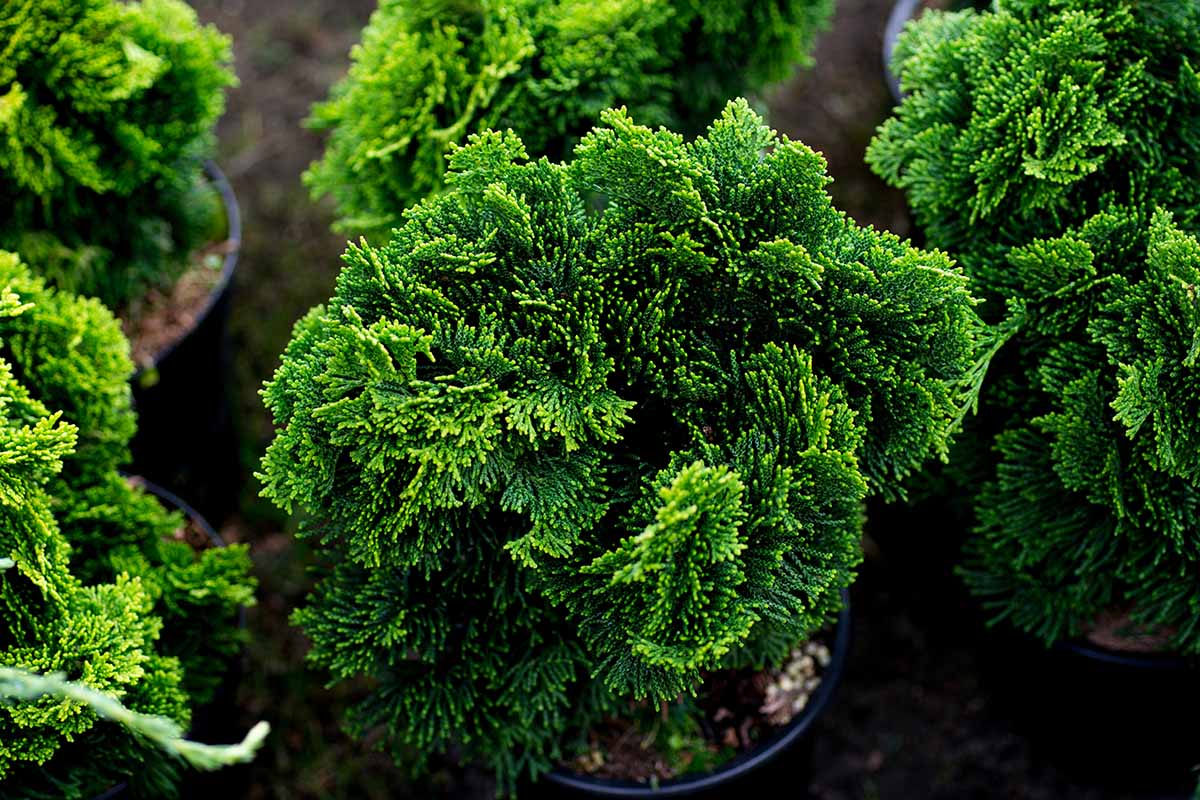
Remove the tree and gently loosen up the roots. If you can do so without breaking them, try to spread the roots out and away from the center.
Set the tree in the hole and fill in around the roots with soil. You want the top of the soil line in the pot to match the soil line in the ground.
Water well, and if the soil settles too much, add more.
Keep the soil moist but not wet for the first year. Mulch around the base of the tree can help the soil stay moist. Just ensure that the mulch isn’t touching the trunk.
Pests and Disease
Compared to some domesticated junipers or arborvitae, hinoki cypress trees are downright resilient.
There are a few pests and diseases that can occur, but as far as pests go, none of them really pose a serious threat to the plant, especially when established.
Pests
Spider mites and scale are common on evergreens of all kinds, plus you might see bagworms on your trees.
Bagworms
Bagworms give me the heebie-jeebies. I’d rather walk face first into a nest of webworms than have to deal with these icky little crawlers.
Bagworms are the larvae of moths in the Psychidae family and despite the name, they aren’t actually worms.
These non-worms weave cocoon-like bags out of silk and plant material to protect themselves, carrying their bags along as they feed on foliage.
Over time, both the larva and bags grow larger and larger.
Then, as if this wasn’t nightmarish enough, the pests then create a balloon out of webbing and they use this to float to other trees! That’s right, floating worms.
A large enough infestation can partially or even fully defoliate a tree, though bagworms rarely kill a hinoki cypress.
Brave souls can pluck the bags off by hand, toss them in a sealed garbage bag and put it in the trash.
If there are too many to reach, the tree is too large, or the thought of plucking them makes you scream like an Edvard Munch painting, sprays work too.
A product containing Bacillus thuringiensis kurstaki is highly effective if you apply it at the right time.
It won’t kill adults or older caterpillars, but this beneficial bacteria, the active ingredient in Bonide Thuricide will decimate younger larvae.

Check with your local Extension office to find out when bagworms are active in your area. In most parts of North America, that’s late spring or early summer.
Pick up a quart or gallon of a ready-to-use spray or a 16 ounce concentrate at Arbico Organics.
A spinosad spray is also useful.
Scale
Scale insects including juniper scale (Carulaspis juniperi), minute cypress scale (Carulaspis spp.), or Maskell scale (Lepidosaphes maskelli) will feed on hinoki false cypress.
A small infestation typically isn’t much of a problem, but a large infestation on a young plant can yellow the foliage and stunt growth.
Scale can be controlled with insecticides and physical control.
Read all about how to control scale here.
Spider Mites
Spider mites are tiny sap-sucking arachnids related to ticks.
They thrive in hot, dry conditions, so they’re rarely a problem outside of summer, but in the warmer months you might notice fine webbing on your trees, along with yellow stippling on the foliage.
Our guide to spider mites will walk you through everything you need to know to treat them.
Disease
Selecting an appropriate planting site will go a long way toward avoiding disease.
Planting in a depression where water collects, or in heavy, soggy soil, significantly increases the risk of a disease taking hold.
Plant in well-draining soil, on a slope, or in a raised bed and you’ll be much better off. The first disease we’ll talk about is one you can largely avoid with the right site and watering habits.
Root Rot
Root rot happens when the soil is too moist for too long.
Waterlogged roots can’t breathe or grow properly, and can develop lesions that water molds and fungi exploit to infiltrate the root system – a vicious cycle that usually ends in plant death.
Rotting roots turn mushy and dark, but aboveground everything may look perfectly fine at first.
Eventually you’ll notice general decline like dying twigs and branches, slow or no growth, or a wilted appearance.
If you catch it early, drench the soil with fungicide and reduce watering as much as possible. But often, by the time symptoms are visible, there’s little that can be done.
Juniper Blight
Juniper blight primarily infects juniper, unsurprisingly, but the fungi responsible (Phomopsis juniperovora and Kabatina juniperi) can also infect hinoki cypress, though it’s much less common.
When a plant is infected, the new shoots will die, and sunken lesions form at the base.
A Kabatina infection also causes purple-tipped foliage when young, before turning brown, and you may see black fungal spots on the foliage and branches.
In both cases, remove infected branches and adjust your watering so water goes directly to the soil rather than splashing on the plant.
Phomopsis can be treated with a copper fungicide spray, but unfortunately Kabatina does not respond to fungicide treatment.
Elegant, Long-Lived, and Eye Catching
There aren’t many plants that I don’t like, but some plants hold a special place in my heart, and hinoki cypress is one of them.
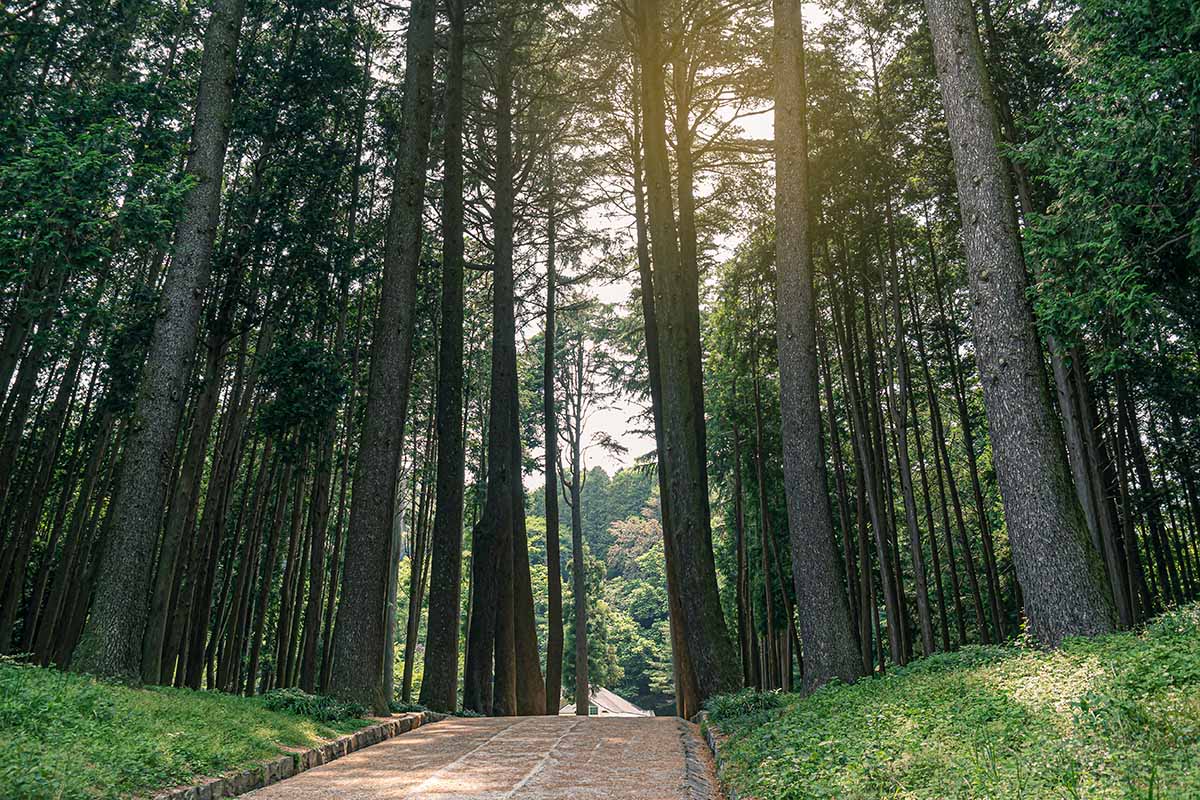
They’re so elegant, they smell incredible, and they look like something straight out of a fairytale.
While they can’t grow everywhere, if you’re lucky enough to live somewhere they can, consider yourself blessed by the tree gods. You get to grow something special.
How will you enjoy yours? Will you use it in a Japanese garden? Plant it near a patio as a focal point? Perhaps let it grow into a magnificent specimen tree? Let us know in the comments section below!
If you’re looking for some more ideas for trees to add to your landscape, here are a few guides to check out: