Pachira spp.
The money tree, aka Guiana, Malabar, or water chestnut (Pachira aquatica), is a broadleaf evergreen perennial native to wetlands and marshes in Mexico and northern regions of South America.
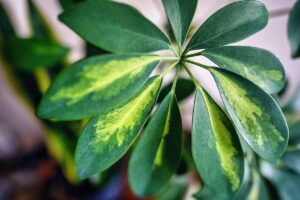
This species bears five-lobed, hand-like leaves. When young, the bark is green and pliable, becoming gray, corky, and rigid as it matures.
The trunk may swell as it stores water during periods of ample moisture, an adaptation that helps the money tree survive occasional dry spells.

We link to vendors to help you find relevant products. If you buy from one of our links, we may earn a commission.
Suited to outdoor cultivation in USDA Hardiness Zones 10 to 12, money tree is also a popular houseplant believed to bring good luck and contribute to positive Feng Shui in the home.
In the wild, money trees can reach up to 60 feet tall, but when cultivated as a houseplant they top out at about six to eight feet.
This article discusses all you need to know to grow a money tree indoors as a houseplant.
Here’s what we’ll cover:
What You’ll Learn
In its native habitat, the money tree produces showy, fragrant flowers in spring, with yellowish-white petals and dense brush-like red-tipped stamens.

Large pods follow, containing seeds historically used in traditional medicine. Indoors, potted specimens rarely bloom.
Those grown as houseplants often feature several straight trunks braided together for decorative appeal. Some growers train them as bonsai specimens.
Quick Look
Common name(s): Money tree, Guiana chestnut, Malabar chestnut
Plant type: Broadleaf evergreen perennial
Hardiness (USDA Zone): 10-12 (outdoors)
Native to: Mexico, Central America, northern South America
Bloom time / season: Spring (rare indoors)
Exposure: Bright, indirect light
Soil type: Loose, moisture-retentive, well-draining
Soil pH: 6.0-7.0, slightly acidic to neutral
Time to maturity: 5-10 years
Mature size: 6-8 feet high and wide as a houseplant
Best uses: Bonsai, floor or table houseplant, rain garden
Taxonomy
Order: Malvales
Family: Malvaceae
Genus: Pachira
Species: Aquatica, glabra
Like lucky bamboo, another tropical ornamental, money trees are frequently adorned with red ribbons or charms to symbolize prosperity.
A closely related species, the Guinea or French peanut, P. glabra, has cream-colored flowers with matching cream stamens, and smooth, gray bark.
Even in its early stages of growth, the stems are noticeably swollen.
It’s not unusual to find P. glabra foliage grafted onto P. aquatica trunks in commercial specimens and the species are often listed interchangeably on the houseplant market.

A legend tells of a financially challenged Taiwanese farmer who prayed for a miracle, found the tree growing in his field, and was able to sell the seeds for a profit, hence the name “money tree.”
The species is also prized for having a lifespan of 50 to 150 years.
P. aquatica is not the only plant referred to as a “money plant.”
Others include golden pothos (Epipremnum aureum), Chinese money plant (Pilea peperomioides), and silver dollar plant (Lunaria annua).
According to the ASPCA, P. aquatica is considered nontoxic to cats, dogs, and horses.
How to Grow
Choose an indoor location for your money tree with bright, indirect sunlight that is out of the way of any HVAC drafts.

Examples include three feet from a south-facing window or in front of a westerly window with a sheer curtain. Direct exposure may cause leaf tip burn.
Ideal indoor conditions are temperatures of between 65 and 85°F and 50 percent humidity.
Potting Medium
Use a well-draining container at least two inches wider and deeper than the root mass of the money tree for a snug fit.
Fill it three-quarters of the way using a potting medium formulated for succulents.
If you need a recommendation, I use Hoffman Organic Cactus and Succulent Soil Mix contains the essentials: compost, perlite, and sand.
Hoffman Organic Cactus and Succulent Soil Mix
Organic Cactus and Succulent Soil Mix is available from Hoffman via Amazon.
Water
Water when the top few inches of soil are dry. When you water, aim the watering can at the soil, not over the stems or leaves.
Continue until it runs from the drainage hole. If you use a drip saucer, discard the excess to avoid standing water that may lead to root rot.
During fall and winter dormancy the pot will dry out more slowly.
Fertilizer
Fertilize your money tree monthly during the growing season with all-purpose liquid houseplant food diluted to half strength. There’s no need to fertilize in the winter when the plant is semi-dormant.
Miracle-Gro Tropical Houseplant Food has a 1-0.5-1 nitrogen, phosphorus, potassium, or N-P-K ratio and micronutrients to support lush foliar growth.
Miracle-Gro Tropical Houseplant Food
Apply it once a month during the spring and summer.
Miracle-Gro Tropical Houseplant Food is available from Miracle-Gro via Amazon.
Repotting
Young specimens can grow quickly, putting on as much as two feet per year before slowing down with age.
Repot every two to three years as the plant matures, moving up in two-inch increments. Avoid placing a small plant in a large container, which can lead to excess moisture and root rot.
Where to Buy
You’ll find they are called by a variety of common names including money tree, braided money tree, or Guiana chestnut.
When shopping, consider that single-trunk specimens have a lanky, bare stem, whereas braided plants offer visual interest at the trunk level and a canopy that sprouts from multiple stems.

You can find braided specimens in a six-inch or three-gallon pots available from Fast Growing Trees.
Maintenance
Rotate the container once a week to ensure even light exposure and upright growth.
Wipe dust from the leaves monthly using a damp cotton cloth, then follow with a dry one to remove excess moisture.
If you notice brown tips, move the pot slightly farther from the light source and avoid overfertilizing. Consider switching to non-fluoridated water if browning and leaf drop continue.

Yellowing leaves and soft stems are typically signs of overwatering. Remove discolored or damaged leaves using clean garden shears. Cut each leaf at the base of its petiole.
Prune dead or unhealthy branches just above a leaf node or where they meet a main stem to encourage healthy new growth.
In spring, remove unwanted stems to maintain shape, but avoid cutting more than half of any healthy stem to prevent shock.
Always prune evenly to preserve structural balance and appearance. You can use healthy trimmings for propagation. To manage height, pinch back top growth as needed.

To create or extend the braided trunk, weave young, flexible stems loosely together, leaving about an inch of space between them.
Secure the braid gently with soft gardener’s tape. Remove leaves that sprout along the braided section to define the trunk and promote top growth.
Propagation
Money trees can be propagated from seed or stem cuttings. It’s possible to graft or air layer but those methods are beyond the scope of this guide.
From Seed
Seeds have a high germination rate, often near 100 percent and typically sprout within five to 10 days.
Sow seeds at a depth twice their width in a seed tray filled three-quarters full with a well-draining, moisture-retentive medium.
Look for a mix containing compost or peat moss, perlite, and sand. A pre-made succulent blend works well, or you can prepare your own.
Water gently and keep the soil evenly moist, not saturated. Place the tray in a location with bright, indirect light.
From Cuttings
Stem cuttings taken in the active growing seasons of spring and summer root easily in water or soil.

To root in water:
- Sanitize garden scissors with a 10 percent bleach solution (nine parts water to one part bleach)
- Select a young, tender stem and cut a six- to eight-inch length just below a leaf node.
- Remove any lower leaves and place the cut stem in a glass of tepid water.
- Keep the glass in bright, indirect sunlight and change the water daily.
When the roots are about four inches long, transplant into soil.
Alternatively, you can root in soil:
- Fill a six-inch, well-draining container three-quarters full of succulent-style potting mix.
- Dip the cut end into rooting hormone powder and insert the cutting two inches deep into the soil.
- Water well.
- Place the pot in bright, indirect sunlight.
- Water when the top few inches of soil are dry, erring on the side of dryness to avoid rot.
New leaf growth indicates successful rooting.
Pests and Disease
Money trees are generally resilient and are not prone to problems but may encounter a few common pests and moisture-related diseases indoors.
Pests
Scale and spider mites thrive in hot, dry environments. Maintain adequate humidity to deter them.

Spider mites also favor dusty conditions, so wipe the leaves with a damp cloth monthly. If infestations occur, treat affected areas promptly with neem oil.
Mealybugs, which look like flecks of white flour, prefer warm, moist conditions. Avoid overwatering and use neem oil to control outbreaks.
Neem Oil is an effective fungicide, insecticide, and miticide that is effective for treating many common houseplant insects and pathogens.

You can find Bonide Neem Oil available from Arbico Organics.
Disease
Root rot is the most common disease issue, typically caused by overwatering and poor drainage.
Symptoms include yellowing leaves, soft stems, and general wilting. Affected roots may appear dark, slimy, and emit a foul odor.
Remove any damaged roots and foliage using sanitized shears. Rinse the healthy roots, clean the container thoroughly, and repot in fresh, well-draining soil.
In severe cases, take stem cuttings from healthy portions of the plant for propagation and discard the rest.
Learn more about how to deal with root rot here.
Try Your Luck
Indoor tropical specimens create an ambiance of freshness and vitality, perhaps accounting for the Feng Shui positivity attributed to many species by growers over the centuries.

Are you growing money trees? Let us know in the comments section below!
And for more information about growing houseplants, add these guides to your reading list next: