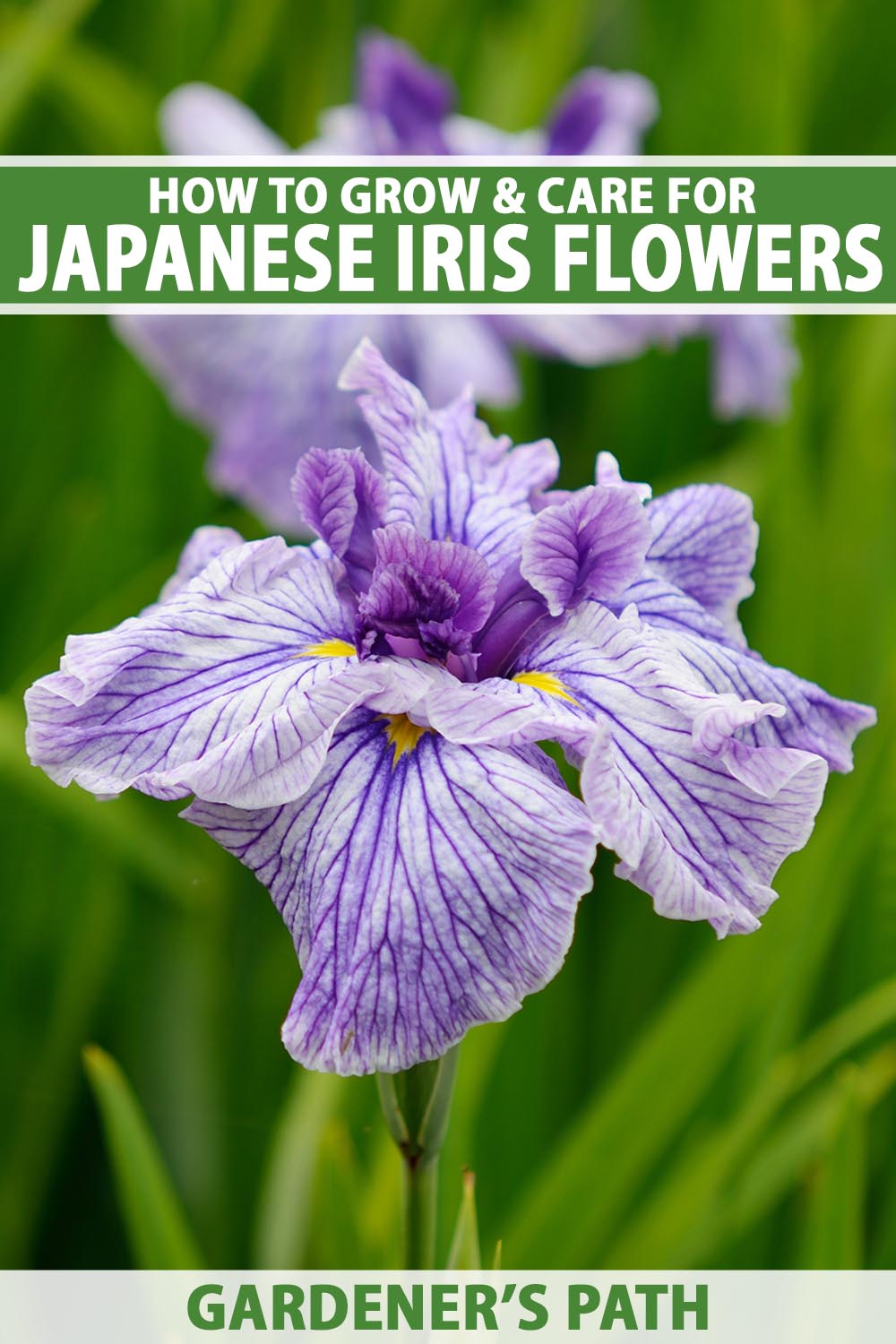
Iris ensata
I must have a special kind of luck. Of the three houses I have owned, every single one had a vibrant patch of Japanese irises (Iris ensata syn. I. kaempferi) growing happily.
Each time it was in a spot that can typically become oversaturated now and then. Next to a hose bib, alongside an irrigation canal, or near a rain spout.
These gloriously gorgeous plants are so adaptable that they’ll thrive in areas of the garden where other plants would struggle. And I admit that I’ve even been a bit neglectful.
The only time I’ve ever done anything beyond enjoying their beauty is to split off a few rhizomes when I wanted to spread them somewhere else.
We link to vendors to help you find relevant products. If you buy from one of our links, we may earn a commission.
So why Japanese irises and not one of the many other species?
Well, for one, Japanese cultivars have some of the largest flowers in the genus. They can be up to 10 inches in diameter! These sit atop stalks that grow up to five feet tall.
For another, they can grow in occasionally flooded or wet areas, which can be challenging to fill.
Plus, they’ve been in cultivation for centuries, so breeders have had a long time to develop some exceptionally beautiful cultivars.
Whether you inherited a garden full of them, or you’re ready to plant them in your space, this guide will walk you through how to care for Japanese irises from beginning to end.
Here’s what you can expect:
What You’ll Learn
If you want to get technical, three species of Iris are native to and cultivated in Japan, known as Japanese irises.
These are ayame (I. sanguinea), hanashōbu (I. ensata), and kakitsubata (I. laevigata).
We’re going to focus on I. ensata because that’s by far the most common species outside of Japan and what gardeners usually mean when they say “Japanese iris.”
But they all enjoy similar growing conditions. I. ensata and I. sanguinea are indigenous to Korea, Russia, and China, in addition to Japan.
I. ensata can grow up to five feet tall, though they seem to stay closer to two feet tall in garden conditions, and a single plant can spread about two feet wide.
When grown in ideal conditions, the rhizomes will spread and there is no limit to how far they can extend.
Don’t worry, they’re not invasive despite their gregarious nature.
While they’re sometimes confused with bearded (I. germanica), and Siberian irises (I. sibirica), Japanese types bloom later in the year and grow in Zones 4 to 9.
They’re at full display in mid to late summer, which is later than the spring-blooming Siberian and bearded irises.
Quick Look
Common name(s): Japanese flag, Japanese iris, water iris
Plant type: Rhizomatous, herbaceous perennial
Hardiness (USDA Zone): 4-9
Native to: China, Korea, Japan, Russia
Bloom time / season: Summer
Exposure: Full to partial sun
Soil type: Organically-rich, moisture-retentive
Soil pH: 5.0-6.5, slightly acidic to neutral
Time to maturity: 1 year
Mature size: 5 feet tall by 3 feet wide
Best uses: Border, containers, rain garden, water garden
Taxonomy
Order: Asparagales
Family: Iridaceae
Genus: Iris
Species: Ensata, laevigata, sanguinea
Japanese irises have strappy, sword-shaped, linear leaves (known as ensiform) that grow up to two feet long.
In fact, the specific epithet, or the second part of the botanical name “ensata” means sword-shaped. At the center is a distinct midrib or vein running along the entire leaf.
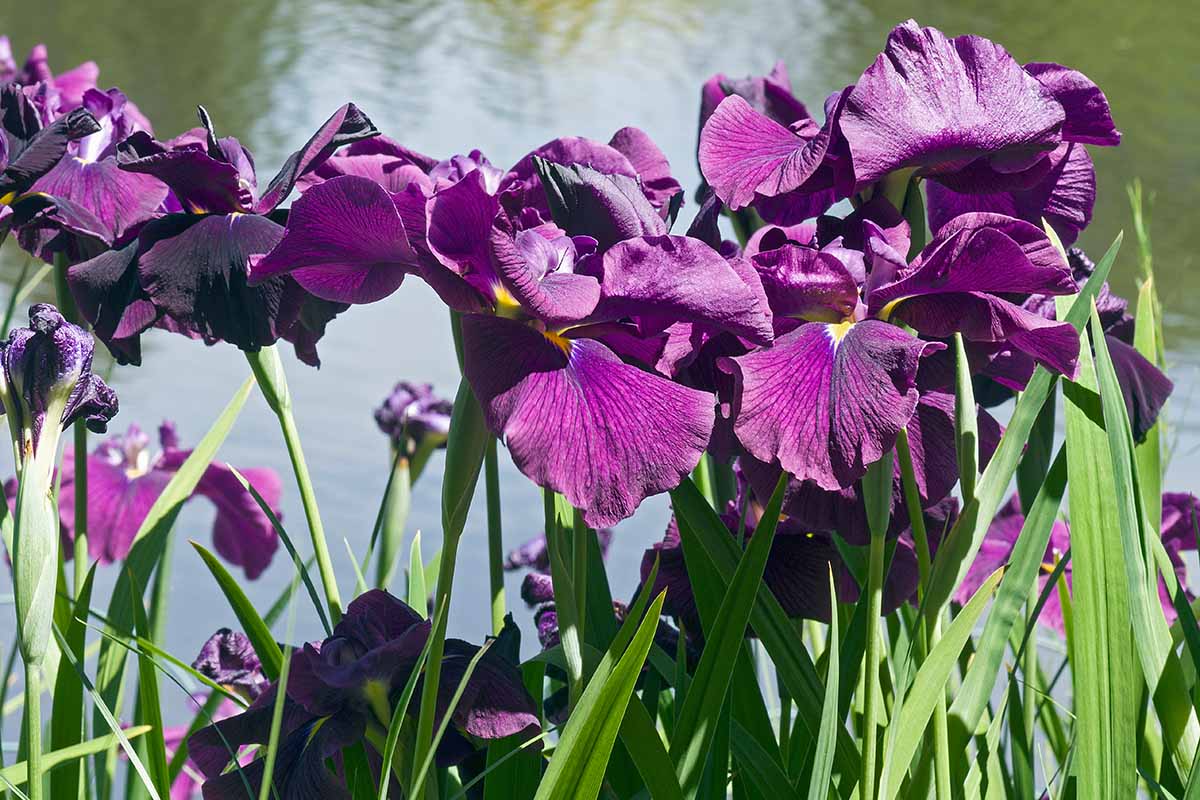
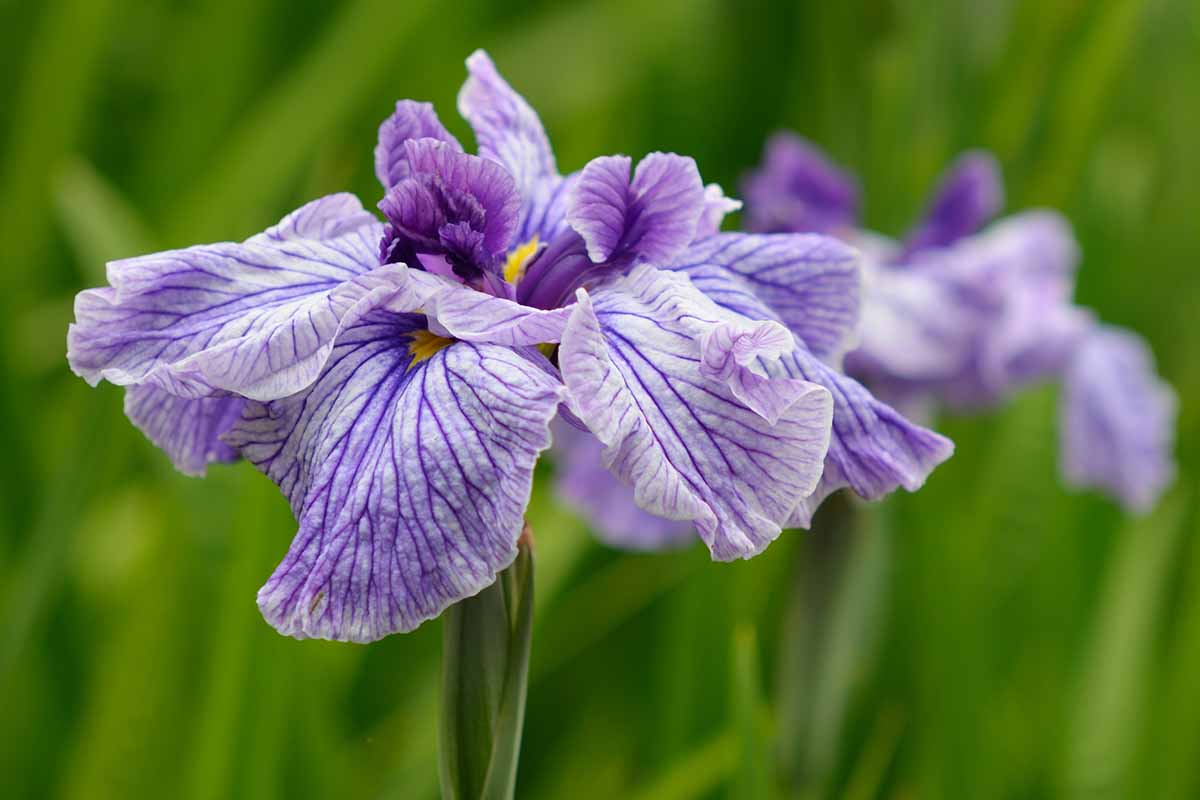
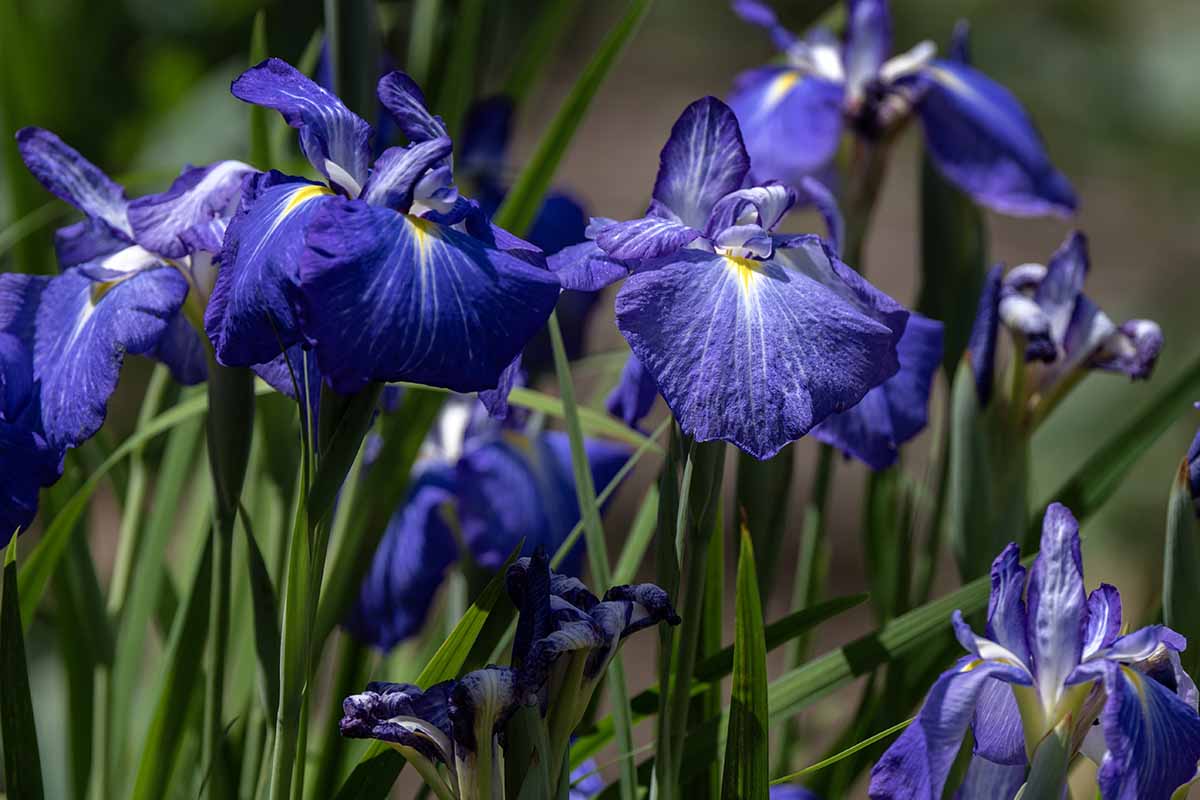
When in bloom, the flower stalks can extend another two feet above the leaves, holding beardless irises in single, double, or peony form.
Beardless just means that they don’t have the bushy, frilly lower petals on their blossoms that some irises do.
The species originally had reddish-violet falls with a yellow stripe, called a signal, down the center and deep purple standards.
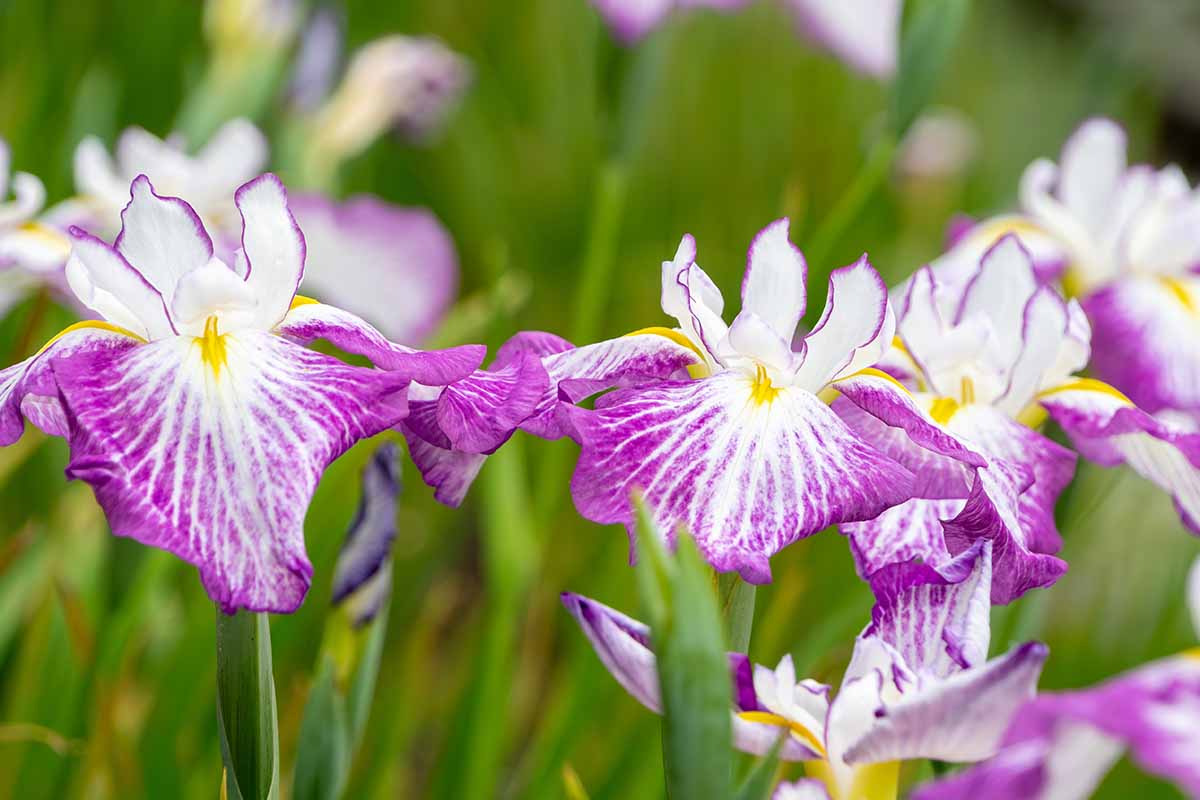
This is a good time to talk about the anatomy of an iris flower. They have upright petals known as “standards” and drooping petals known as “falls.”
Often the standards are distinct in color and shape from the falls. The beard, which is lacking in Japanese irises, is the fuzzy little growth at the center of the upper part of the falls.
While purples and lavenders are most common, you’ll also find them in blue, pink, and white.
Breeders are attempting to introduce a yellow cultivar into the mix by cross-breeding with yellow flag iris (I. pseudacorus).
The binomial, Iris, is the Greek name for the goddess of rainbows, a reference to the range of colors that the flowers in this genus include.
Underground, they have a stout, creeping rhizome.
How to Grow
A lot of Iris species will just coast along despite being in less-than-ideal conditions.
But Japanese irises are highly influenced by their growing conditions. Anything less than ideal and the flowers and plants will be smaller, thinner, and the quality of flowers will be reduced.
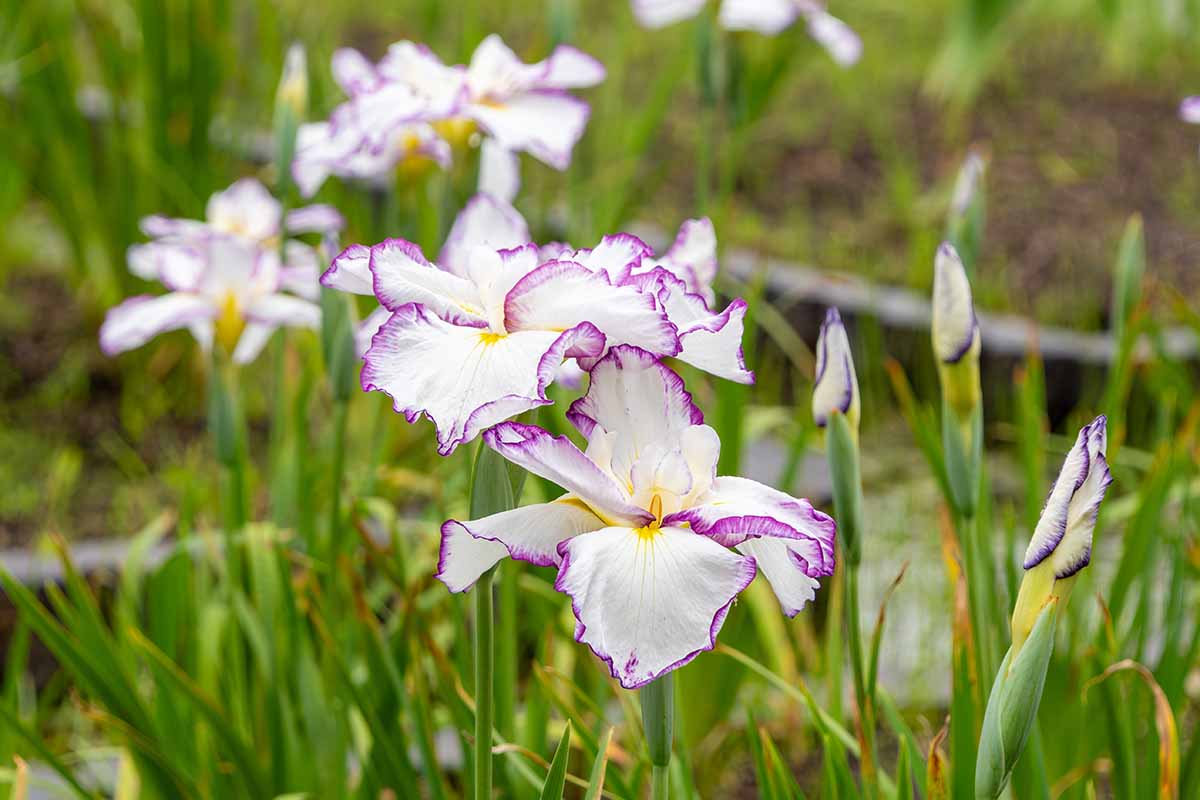
I’m lucky in that I have had areas that receive a lot of moisture during the spring, summer, and fall, but dry up somewhat during the winter.
That’s what these plants prefer, and it’s not necessarily common. You can’t plant these in a pond, for example, because the roots won’t tolerate standing water during the winter.
To get around this, some gardeners choose to grow Japanese irises in pots and submerge them at the edge of a pond during the growing season.
They then remove the pots during the winter and move them to a drier spot.
Light
These plants will thrive anywhere from full to part sun.
They won’t do well in full shade and I’ve found that flowering is reduced in partial shade.
For the best growth and largest blossoms, the plant needs at least six hours of sun each day.
They don’t enjoy locations with hot sun all afternoon, though, especially if planted against a brick or cement wall or fence. This can burn the flowers and leaves.
In hot climates or if you are growing next to west-facing walls or fences, give them a bit of shade in the hottest part of the afternoon.
Soil
Do you ever get tired of hearing about plants that need well-draining soil? It’s like, that’s great, but I have an area with poorly draining soil. What the heck do I do with it?
Plant Japanese irises, that’s what.
Japanese irises plants need organically-rich soil that is either consistently moist or downright wet, which means water retentive, poorly-draining soil is ideal.
The soil should be slightly acidic, with a pH of 5.0 to 6.5.
Water
Japanese iris are sometimes called water iris, so that should give you a clue about what kind of conditions they enjoy.
They do best in areas that are consistently moist or even a bit boggy. Like I said, all of mine have thrived near water sources like a leaky hose bib or an irrigation canal.
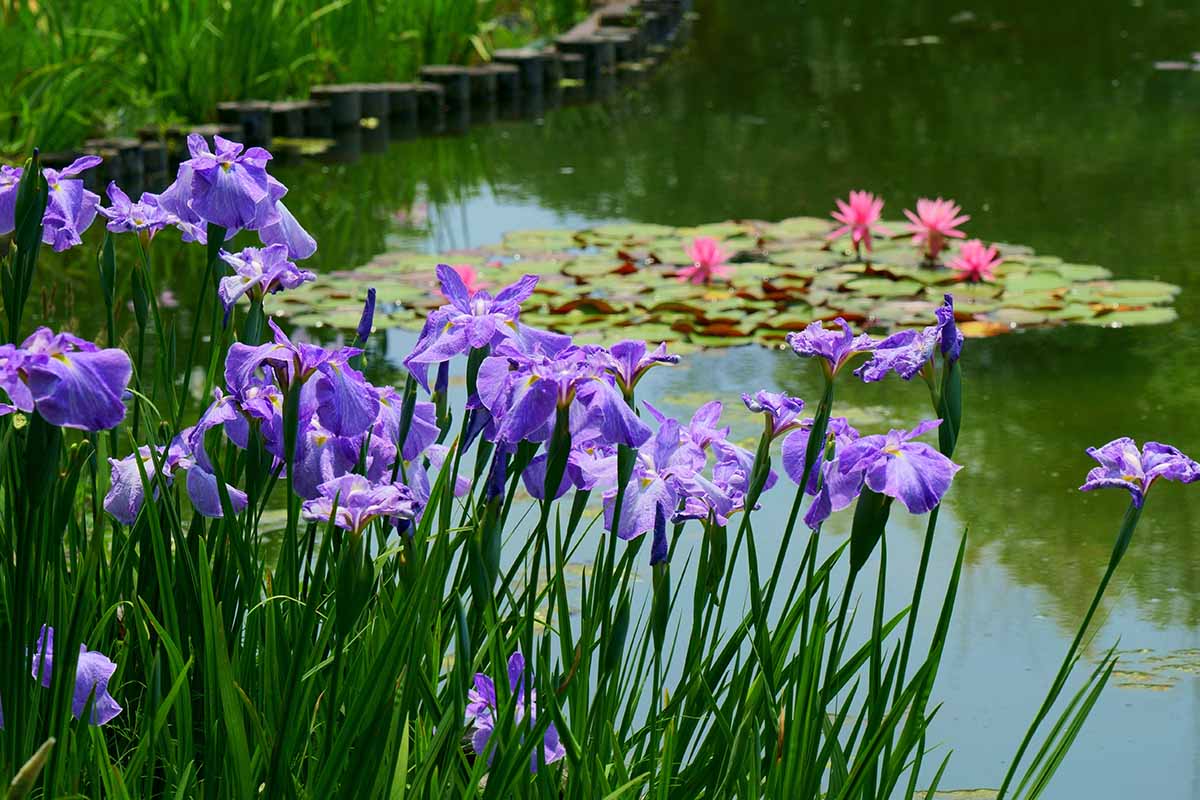
But one year the irrigation canal that watered my yard needed repairs, and we didn’t have water coming through all summer. The irises? They were fine.
The same goes for when we fixed that leaky hose bib. So while they prefer boggy or moist conditions, they’ll adapt to drier areas.
They’re also perfectly happy in standing water up to six inches deep or so, but only for a limited time. More than a month and the crown will rot.
The exception is during the winter months. When the plants are dormant, they won’t tolerate standing water. Moist soil is fine, but standing water will rot the rhizomes.
If the blossoms are small and unimpressive, the first suspect should be lack of water. If the leaves start turning yellow, it could be that your water is too alkaline.
Fertilizer
Mulch with two to three inches of well-rotted compost around the plants in the spring. This provides nutrients but it also helps the soil retain moisture.
If your soil is naturally rich, you won’t need to do more than add compost.
But if it’s lacking, which you can determine with a quick soil test, you’ll also need to add fertilizer.
It’s best to feed in the spring before blooming and, if your soil is really depleted, again after blooming.
Don’t allow the soil to dry out for a few weeks after feeding, as this can result in root burn from the fertilizer.
Cultivars to Select
Gardeners in Japan have been cultivating these plants for centuries. There are cultivars that can be traced back 500 years.
While the species has flowers that consist of three standards and three falls, known as singles, breeders have created other forms as well.
You will find doubles, which have six falls and no standards, as well as peony forms, with up to 12 falls and no standards. It’s common to find cultivars with small standards.
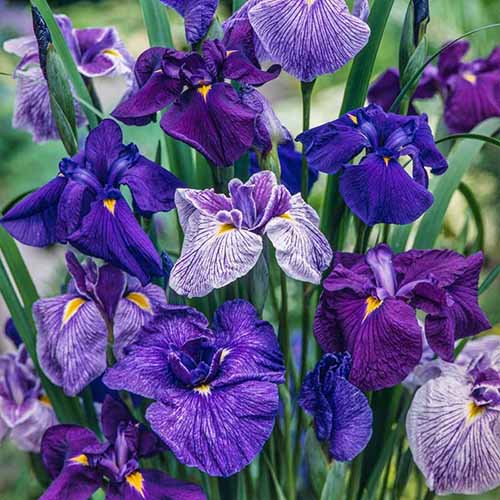
If you aren’t particular about the cultivar, Eden Brothers sells a fun mixture of blue varieties. You can pick up packs of six, 12, or 18 rhizomes from them in the fall for planting.
But if you’d rather have some say in exactly what your flowers look like, here are a few cultivars I’d recommend:
Alpine Majesty
Purple might be the standard, but if you want to branch out, ‘Alpine Majesty’ offers up massive snow white double blossoms with golden yellow throats.
It’s also a tall Japanese iris, reaching up to four feet when it’s in the right conditions.
When a plant really wows, the Royal Horticultural Society (RHS) in England will hand out its coveted Award of Garden Merit. ‘Alpine Majesty’ nabbed one in 2005.
Frilled Enchantment
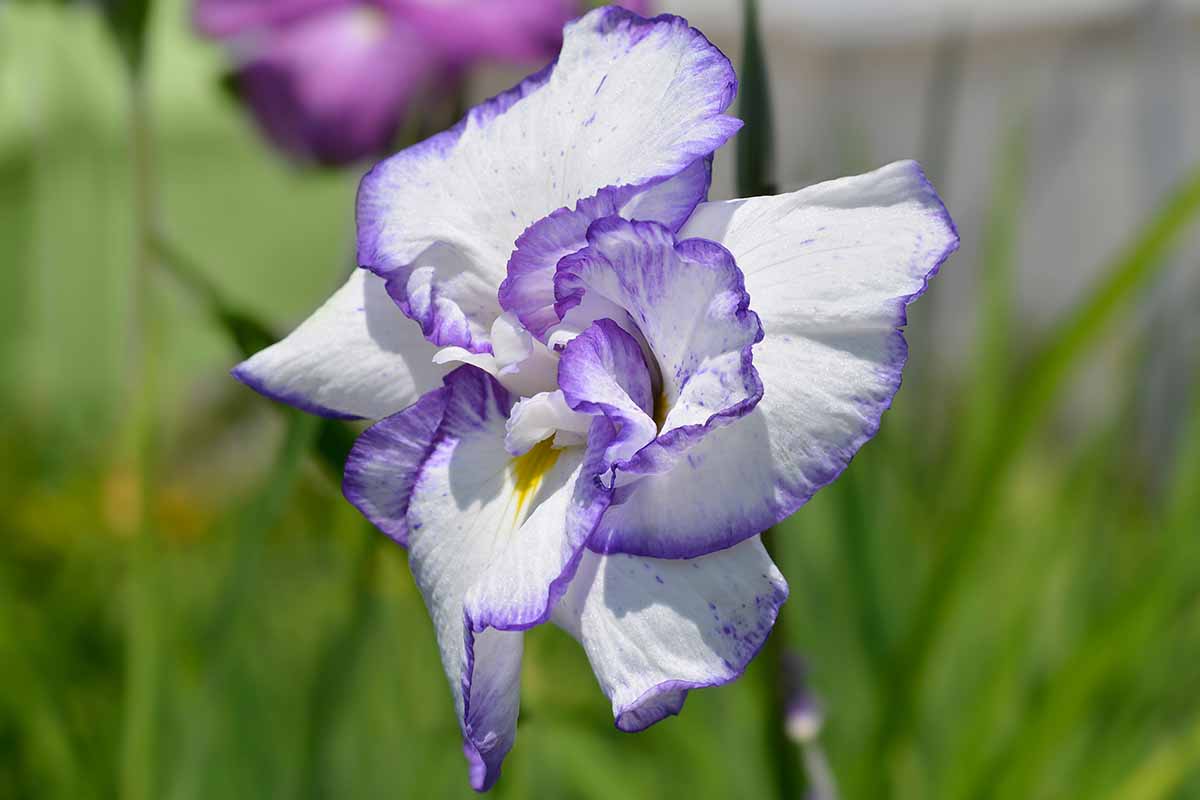
This winner of the RHS Award of Garden Merit in 2005 is a frilly show-off with huge, ruffled, double flowers in hues of purple and white, edged in vibrant pinky-magenta.
The flowers appear on stalks that grow nearly four feet tall on a vigorous plant.
It was bred out of ‘Kurume-Dome’ and an unknown parent in the early 1950s by Walter Marx of Walter Marx Gardens.
Royal Pageant
‘Royal Pageant’ was bred in the early 1950s from ‘Rose Anna’ and an unknown parent, and the world of Japanese irises is better off for it.
The petals are pale mauve with vibrant, deep, reddish-purple veins and a golden signal, all accented against bold purple styles.
It’s a long-lasting bloomer, too. The huge blossoms open up earlier than most Japanese irises and stick around until the others have all faded.
Rose Queen
‘Rose Queen’ is one of my personal favorites. The single blossoms are faint pink on the edges, gradually transitioning to deep purple rose at the center with a bright yellow throat.
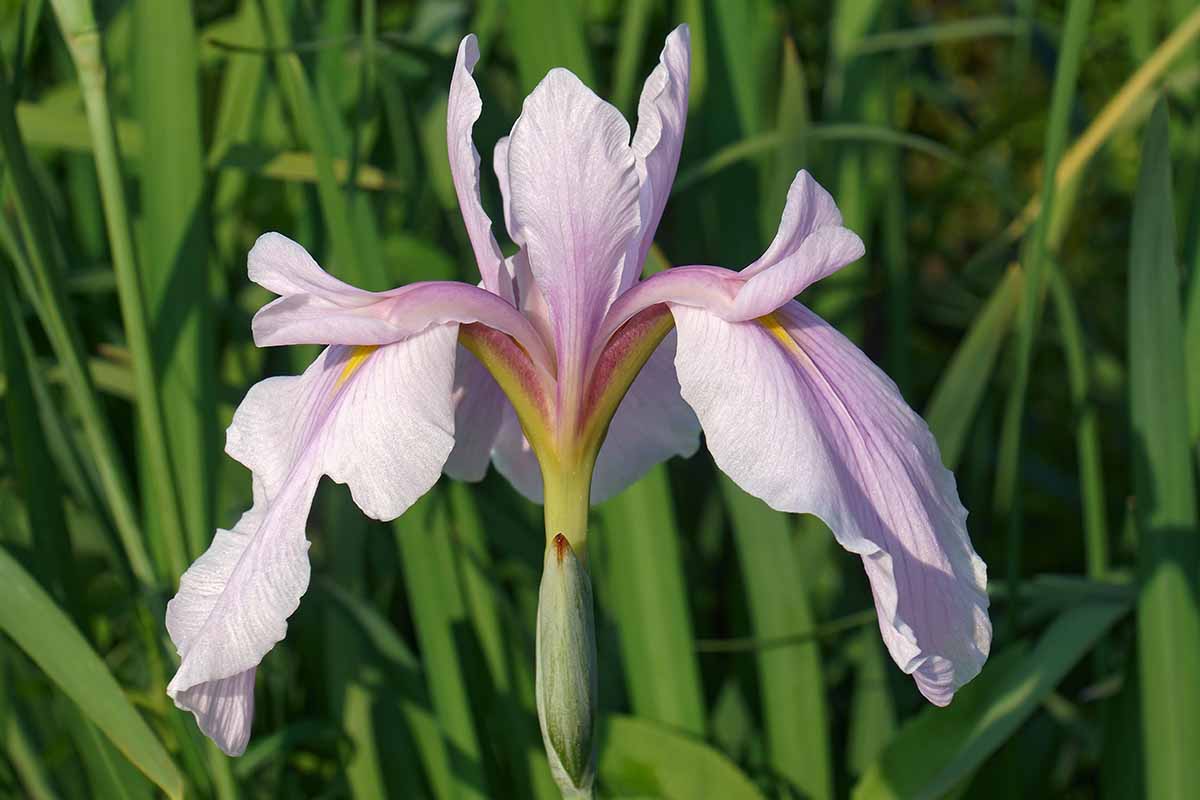
When in bloom, the stalks can reach up to three feet tall. Each plant produces heaps of flowers, which is no-doubt part of the reason the RHS gave it the Award of Garden Merit in 1995.
Variegata
Most irises are background plants when they aren’t in bloom.
The greens are lovely, but they’re not a showstopper, unless you grow ‘Variegata.’
The cream and green foliage makes for a beautiful display even when the large purple flowers aren’t in bloom. Honestly, it’s beautiful enough to grow as a foliage plant.
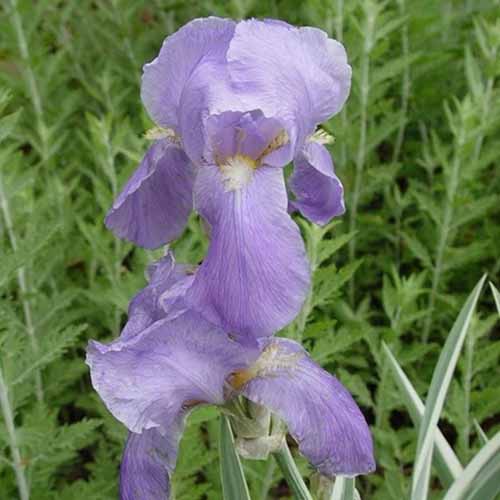
‘Variegata’ was given the Award of Garden Merit by the RHS in 1995.
You can find ‘Variegata’ available at Nature Hills Nursery in #1 containers.
Maintenance
You should divide your plants every four years or so as discussed below.
While dividing isn’t strictly necessary for the health of the plant, it will encourage bigger blossoms in the following year.
Remove any yellow or brown foliage in the fall. You can also cut the entire plant down to a few inches tall, but in areas without heavy snow, just leave them be.
You don’t have to deadhead the spent flowers as it won’t encourage new reblooming. But if you find the appearance unattractive, go ahead and snip the flower stalk off at the base.
If you live in a region that is too cold or wet during the winter, you can always lift the rhizomes out of the ground and store them for the winter.
Propagation
With Japanese irises, there are two good ways to propagate them. Buy or get your hands on some rhizomes or divide an existing plant.
From Rhizomes
Rhizomes should be planted in the fall. The rhizomes should be planted two inches deep and about 18 inches apart.
To get them in the ground, dig a hole that is just deep enough to accommodate the rhizome. It should be nearly poking out of the ground.
Set the rhizome in the hole. Just barely cover with soil and water well.
By Division
The best time to divide your Japanese iris plants is after flowering.
Dig down about nine inches deep and an inch or two wider than the base of the leaves.
Use your spade to carefully lift the clump out of the ground.
Gently brush away the soil or wash it off with a gentle stream of water from the hose.
Tease apart the rhizomes by hand.
Set the rhizomes in a bucket of water as you work so that they don’t dry out.
Replant the separated rhizomes as discussed above.
Learn more about dividing irises here.
Pests and Disease
Deer and rabbits aren’t interested in irises which is great news for gardeners who struggle with our furry friends in the garden.
There are a few insect pests that can’t wait to take a bite out of your plants.
Pests
Aphids will occasionally feed on irises. They aren’t such a big deal except that they can spread mosaic virus, which we talk about in a bit.
The first pest we’re going to talk about is a seriously bad one.
Iris Borer
The iris borer (Macronoctua onusta) is by far the most damaging pest iris growers will face. It’s not the adults, which are big, brown, night-flying moths, that are the problem.
The larvae, which look like two-inch-long pink caterpillars, hatch in the spring and start feeding on the foliage, tunneling their way down into the rhizome.
After chewing up the rhizome, they move into the soil, pupate, and the adults then emerge. The female will lay her eggs on the plants in late summer.
Aboveground, the leaves turn brown and collapse and if you dig up the rhizomes you’ll find holes and tunnels. The feeding opens up the plant to attack from bacterial soft rot.
The first step is to clean up any debris from around the plants to deny the adults a place to lay eggs.
To kill any eggs or emerging larvae in the soil, you can introduce beneficial nematodes.
The most common nematodes for pest control are Heterohabditis bacteriaphora, Steinernema carpocapsae, and S. feltiae.
Your best bet is to use a product that contains all three, like Triple Threat.

Triple Threat Beneficial Nematoes
Grab packs of five to 500 million at Arbico Organics and follow the instructions for application.
If you examine your plants and find the tiny holes that the larvae make when tunneling into the foliage, you can crush them by pressing the leaves between your fingers.
Once they get down into the rhizome, there isn’t much you can do.
If you see yellowing or browning leaves, dig up and examine the rhizomes. If you see tunnels or the larvae, destroy the rhizomes.
Thrips
There are several species of thrips that will feed on your plants. Iris thrips (Bregmatothrips iridis, Iridothrips iridis) and gladiolus thrips (Taeniothrips simplex) are the most common.
They feed on the leaves, bracts, and petals using their sucking mouthparts to pierce plant tissue.
When thrips are present, you might observe russeting, black areas, yellow spots, deformed growth, and bloated or black flower buds.
You can spray your plants to control the adults. This is especially effective in the spring.
Products containing the beneficial fungus Beauveria bassiana are excellent at controlling thrips.
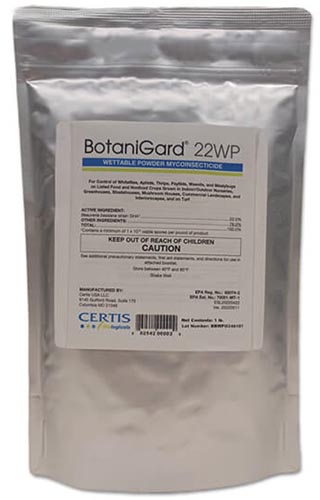
Grab BotaniGard® 22WP from Arbico Organics and follow the manufacturer’s directions.
Learn more about controlling thrips here.
Disease
Rhizome rot can develop if the soil is too wet, especially in winter, or as a result of damage from borers.
Prevent it by ensuring good drainage, watering appropriately, and keeping borers at bay.
There’s one more disease to worry about:
Mosaic
Iris mosaic is an extremely common viral disease spread by aphids.
The symptoms show up as yellow streaks or shapes on the leaves and mottled or striped flower petals, though not all infected plants will be symptomatic.
You can’t cure the disease and the symptoms might appear one year and disappear the next.
All you can do is dispose of heavily affected plants to prevent the virus from spreading and work to keep aphids at bay.
Elegance, Color, and Interest
Stately Japanese irises provide outsized flowers and bold color in the landscape. These easygoing plants add elegant interest especially in challenging spots.
How will you use your Japanese irises? Are you going to add some pretty foliage to an occasionally flooded area?
Or make them the background of a garden display? Share all your ideas with us in the comments section below.
And for more information about growing irises in your garden, add these guides to your reading list next: