
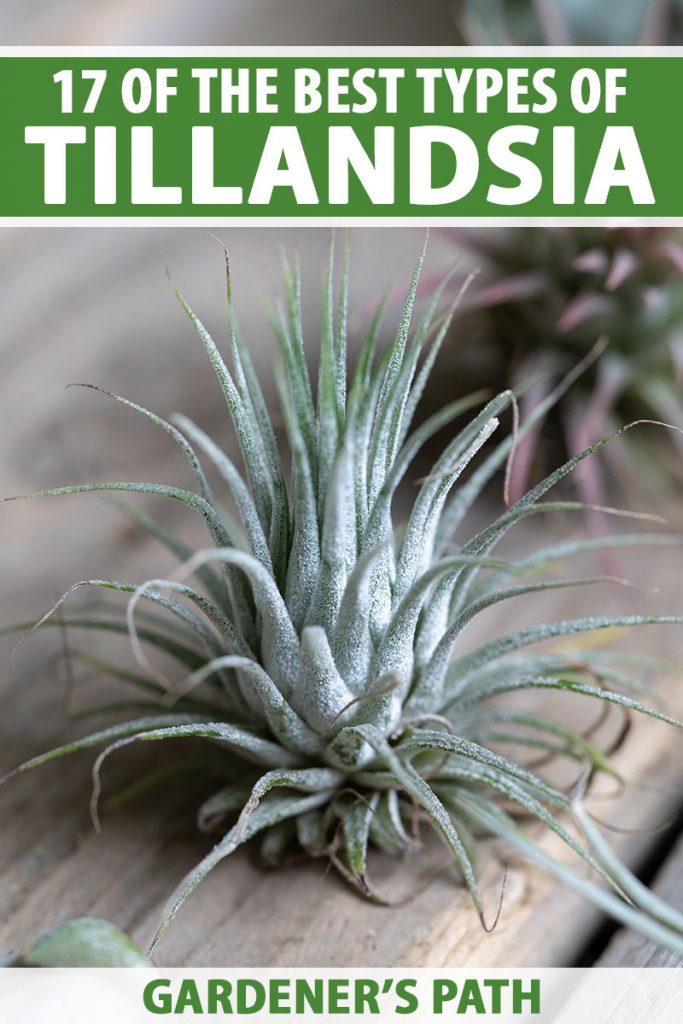

Tillandsia are members of the Bromeliad family. They are epiphytes that use their roots to cling harmlessly to surfaces such as trees and rocks for support, instead of using them to absorb nutrients.
Commonly known as air plants, there are two types: mesic and xeric.
The first come from tropical rainforest regions where moisture is abundant, and the second, from dry desert climes.

We link to vendors to help you find relevant products. If you buy from one of our links, we may earn a commission.
In our guide to growing Tillandsia air plants, we discuss all you need to know to cultivate these funky, unusual plants.
In this article, we round up 17 of our favorite species, to guide you in building a collection of your own.
Here’s the lineup:
17 Outstanding Tillandsia Species
Tillandsia of the xeric variety have a fuzzy or silvery look, lighter color, and flattened leaf shape.
This is because they are covered in moisture-absorbing trichomes that help them endure drought conditions in desert climes.

They require the least amount of water, on the order of a light misting twice a week, plus a monthly dunking in water.
Mesic varieties, on the other hand, have darker foliage that is smooth and often curly.
They are accustomed to rainforest humidity, and like to be misted every other day, or dunked weekly. You may also give them a deep 30-minute soaking once a month.

Plants tolerate temperatures between 50 and 90°F.
Take care to gently shake or invert plants to rid them of excess moisture. Don’t use moss as a base, and avoid wetting display surfaces, to avoid rotting.
Both types do well in bright, indirect sunlight. Xerics can tolerate the brightest light, but still benefit from protection from the most intense afternoon rays.
Most varieties generally flower once, dying afterward, to be replaced by emerging offsets or “pups.”
Bloom periods vary from a number of days to several weeks, or even months. Varieties with especially long-lasting flowers are noted below.
And finally, some Tillandsia species are available in small, medium, and large sizes, so take this into account as you plan your collection.
Now, here are 17 of our favorites and the key physical attributes of each individual species:
1. Aeranthos
Tillandsia aeranthos is a xeric variety with light green leaves that have a silvery cast.
The foliage is pointed and stiff, extending outward from the center to form a rosette. In the brightest light, it may have a purple hue.

As it grows, the rosette telescopes to heights of six to eight inches.
From this pale and unassuming foliage, stunning blossoms rise on elongated stems, or inflorescences.
With pink-purple bracts and a ring of blue-purple petals, they resemble tiny fuchsia flowers.
2. Albertiana
You’ll recognize that Tillandsia albertiana is a mesic type by its smooth, dark, fleshy leaves. They have a yellow-green hue that may darken toward a purple shade.

A key identifying characteristic is its “distichous” foliage pattern. Like that of a fir tree, the leaves are arranged in a repeating pattern of opposing rows.
Mature heights range from two to four inches.
The flowers of this variety have three bright red petals and may last a week.
3. Andreana
Like a small tuft of wispy grass, mesic Tillandsia andreana has narrow, fleshy leaves that are pale green and needle-like.

A delicate beauty, it dislikes temperature fluctuations more than most.
Heights range from four to six inches.
The reward for catering to its care is a blush of red followed by the emergence of an upright coral-red flower.
You can find T. andreana plants available from the Ragnaroc Store via Amazon.
4. Brachycaulos
The flat green leaves of xeric Tillandsia brachycaulos are a bright mid-green, and resemble those that emerge from the top of a pineapple.

The foliage may have a purple or red cast, and grows in a telescoping fashion to heights of eight to 10 inches.
Upon blooming, the foliage blushes magenta-red, and erect purple blossoms appear.
You can find two- to three-inch T. brachycaulos plants available from Garden in the City via Amazon.
5. Bulbosa
Mesic Tillandsia bulbosa has fleshy, dark green leaves that resemble the squiggly tentacles of an octopus.

They protrude from a base that resembles a layered onion, and may reach heights of 8 to 18 inches.
When flowering, the upper leaves turn red, and from their center, a small-statured red bract emerges that contains a purple-petaled blossom.
An unusual feature of this plant is that in the wild, it exists in symbiosis with ants that make their home in its hollow bulb-like stem bases.
Keep this in mind if you give your plants outdoor time in the summer months. They won’t hurt the plant, but may invade your home.
You can find five-packs of T. bulbosa plants available from Garden in the City via Amazon.
6. Butzii
Resembling a little squid, the distinguishing feature of mesic Tillandsia butzii is the mottling on its tentacle-like green leaves.

The foliage originates in a rounded bulb-like base and may grow up to 10 inches long.
Like T. bulbosa, it may host ants if placed outdoors.
Red inflorescences open to purple flowers.
You can find six- to nine-inch T. butzii plants available from Ragnaroc via Amazon.
7. Capitata
This type may resemble Tillandsia brachycaulos, with its spider plant-like leaves, but two differentiating characteristics are that this type is xeric, with the classic silvery cast trichomes make, and it blushes peach-pink just before blooming.

There are a number of T. capitata varieties available, ranging from green to purple. Heights may exceed 10 inches.
At flowering time, the center leaves blush peach before a purple flower emerges from the rosette center.
You can find T. capitata plants from Garden in the City via Amazon.
8. Caput medusae
A xeric variety, Tillandsia caput medusae has silver-gray trichomes on snake-like winding green leaves that resemble the hair of the mythical Medusa.

Growth is telescoping with laterally spreading foliage, and heights range from six to eight inches.
During flowering, you’ll see a pink blush at the center of the plant first, followed by red/yellow bracts that open to purple/white blossoms.
Like T. bulbosa, ants may make their home in the base of this plant, so be aware of this if you give it time outdoors.
You can find Medusa available from the Air Plant Shop Store via Amazon.
9. Chiapensis
Tillandsia chiapensis is a xeric species with rosettes of arching to curly, trichome-covered light-green foliage that may blush to purple.

Heights vary widely, from two to 12 inches.
When in bloom, pale pink quill-like spikes with purple flowers rise from the center.
10. Concolor
Xeric Tillandsia concolor boasts light green to yellow trichome-covered leaves that resemble those of a spider plant. They are noteworthy for their firmness.

Heights are between seven and nine inches.
At blooming time, the foliage blushes red and green quill-like spikes rise from the center to reveal magenta blooms.
More adaptable than some, it can handle bright light to shade.
You can find T. concolor in packs of three available from the Air Plant Shop Store via Amazon.
11. Cyanea
T. cyanea is a mesic variety with a cluster of medium green, spider-like leaves.

Heights range from eight to 10 inches.
Plants produce a hot pink quill-like spike with three-petaled purple-blue flowers on its edges.
This plant has roots that are able to take up nourishment, and unlike other species, it also thrives in potting soil.
You can find T. cyanea in four-inch pots available from Ragnaroc via Amazon.
12. Didisticha
Tillandsia didisticha is a xeric type with stiff, arching gray-green foliage in the shape of a loose rosette.

This is a large variety that can reach 12 inches tall.
The flower is a salmon-colored inflorescence with tiny white blossoms.
13. Funckiana
T. funckiana is a xeric type that looks like a cluster of light green balsam fir needles coated with a light dusting of snow.

Soft to the touch, it may wind or stretch upright, to a length of about eight inches.
Its flower is a long red tubular blossom that gracefully emerges at the tip of the narrow leaves.
14. Ionantha
The rosettes of xeric Tillandsia ionantha aka sky plants, start out silver-green and change in shade to take on red tones at bloom time.

This type has a petite stature, reaching mature heights of one to three inches.
When the tubular purple blossoms burst from the rosette’s red center, the effect of green, red, and purple creates a miniature horticultural tapestry.
Find T. ionatha from the Air Plant Shop Store available via Amazon.
Learn more about growing sky plants here.
15. Recurvata
Tillandsia recurvata, aka small ball moss, is a rounded xeric type with narrow silver-green leaves that resemble the twigs in an intricate bird’s nest.

In the brightest light, the foliage may have a reddish cast.
Mature heights reach six to 12 inches.
The flower is a rather nondescript spike of green to red, on a green inflorescence.
16. Usneoides
Also known as Spanish moss, Tillandsia usneoides is a xeric variety that is unique in that it grows in a downward direction, clinging and hanging from host surfaces in the wild.

Like a mass of tangled gray-green hair, foliage may exceed 20 feet in length.
The flowers are brown and nondescript, but they have a pleasant nighttime fragrance.
17. Xerographica
With its trichome-covered spring green foliage, xeric Tillandsia xerographica is one of the largest, sturdiest, longest living air plants.
Its wide leaves are deeply curled in a compact, rounded form.

It’s a pleasant home companion that can withstand both direct and indirect sunlight, sometimes growing as large as three feet wide and twenty-four inches tall over a lifetime of twenty years or more.
Flowering consists of a green inflorescence up to 15 inches tall, with red and green coloration.
Learn more about growing xerographica air plants here.
Get Creative with Collectible Tillandsia
Tillandsia are very versatile plants. In USDA Hardiness Zones 8 to 11, they grow well outdoors, and in all zones, they make easy-care houseplants.
In addition, with a little dab of floral glue, available from Amazon, they make eclectic wearable accessories and gift-wrapping decorations. And while they don’t require soil, they do need water, so keep that in mind as you imagine the possibilities.

And finally, plants grown indoors don’t get the nutrients they would get if they were in their natural habitat. You can provide supplemental nutrition with fertilizer.
A product you may like is this air plant fertilizer from Cute Farms via Amazon. Mix it per package instructions, for a monthly dunk or soak.
Choose your favorites and get started. There are so many to collect, I know you’re going to have fun!
And for more information about growing air plants and epiphytes, add these to your reading list next:


I identified several of mine. Thank you.
Wish I could Id the two varieties of native Florida giants I have.
Do you know what kind and name this plant is?
I can’t upload the photo ????
Hi Cristiane, I’ve managed to retrieve your pictures, and Nan will be along to have a look and help you identify it. 🙂
Hi Christiane –
It looks like you have a lovely corkscrew rush, aka Juncus spiralis, Juncus effusus ‘spiralis’. A perennial for zones 5 to 11, it achieves mature dimensions of 12 to 18 inches tall and wide. It is a water plant that requires consistent moisture and does best with full sun to part shade.
I know this image is not spanish moss. I think it is a kind of lichen that is often found on the same trees./uploads/2020/12/Tillandsia-Usneoides-Growing-on-a-Tree.jpg
I live in Orlando, Florida and we have a lot of both
Hello Monique –
Great catch! The photo is indeed not of Spanish moss, T. usneoides, but rather a beard lichen in the Usnea genus. We’ll update accordingly. Thanks!
Hello, I recently purchased a beautiful air plant from a place near the ocean in Southern California. It was outdoors, and they told me they hardly watered it, but near the ocean it is also quite humid. I’m trying to determine the exact variety so I can properly care for it. I have it in the corner of a south facing window, in a room with 40%-55% humidity and 65* – 80*. I’ve owned it a couple of weeks, and have spritzed it twice a week, starting with what look like roots at the top, then all the leaves. Unfortunately,… Read more »
Hi Robert, I’ve managed to retrieve your picture and attached it here.
Hi Robert – What a beautiful plant! It appears to be a Tillandsia mima chiletensis. It should do well with bright, indirect sunlight in a room with a daytime temperature of 65-85°F and a nighttime temperature of 50-65°F. Watering options include misting, rinsing, and soaking. You can mist every few days, rinse the leaves twice a week, or soak the entire plant once a week. If you rinse or soak, lay the plant on paper towels to absorb excess water before returning it to its regular location. Once a month, you can dilute liquid plant food to 1/4 strength and… Read more »
Nan, Thanks for the reply. I’d like to try & just water it once a week. I can’t really think of a way to soak it, so yesterday I held it in the shower, which I guess would be considered a good rinsing. What would be early signs of that not being enough water? I also included a picture of the top of the plant in the last post. There were what looked like roots to me, but after looking more closely, it was clear they weren’t part of the plant, and I removed them, as well as cut away… Read more »
Hi Robert, I’ve found your other picture and attached it here 🙂
Hi Robert –
You’re welcome.
Watering in the shower is an excellent idea when soaking is not an option. Air plants take water in through their leaves, so the more leaves you get wet, the more water absorbed. The first sign of under watering is usually browning at the leaf tips.
The dry, wired bit at the top appears to be short roots, desiccated foliage, and live foliage, and is likely the origin of the robust collection of “pups” below.