Mammillaria bocasana
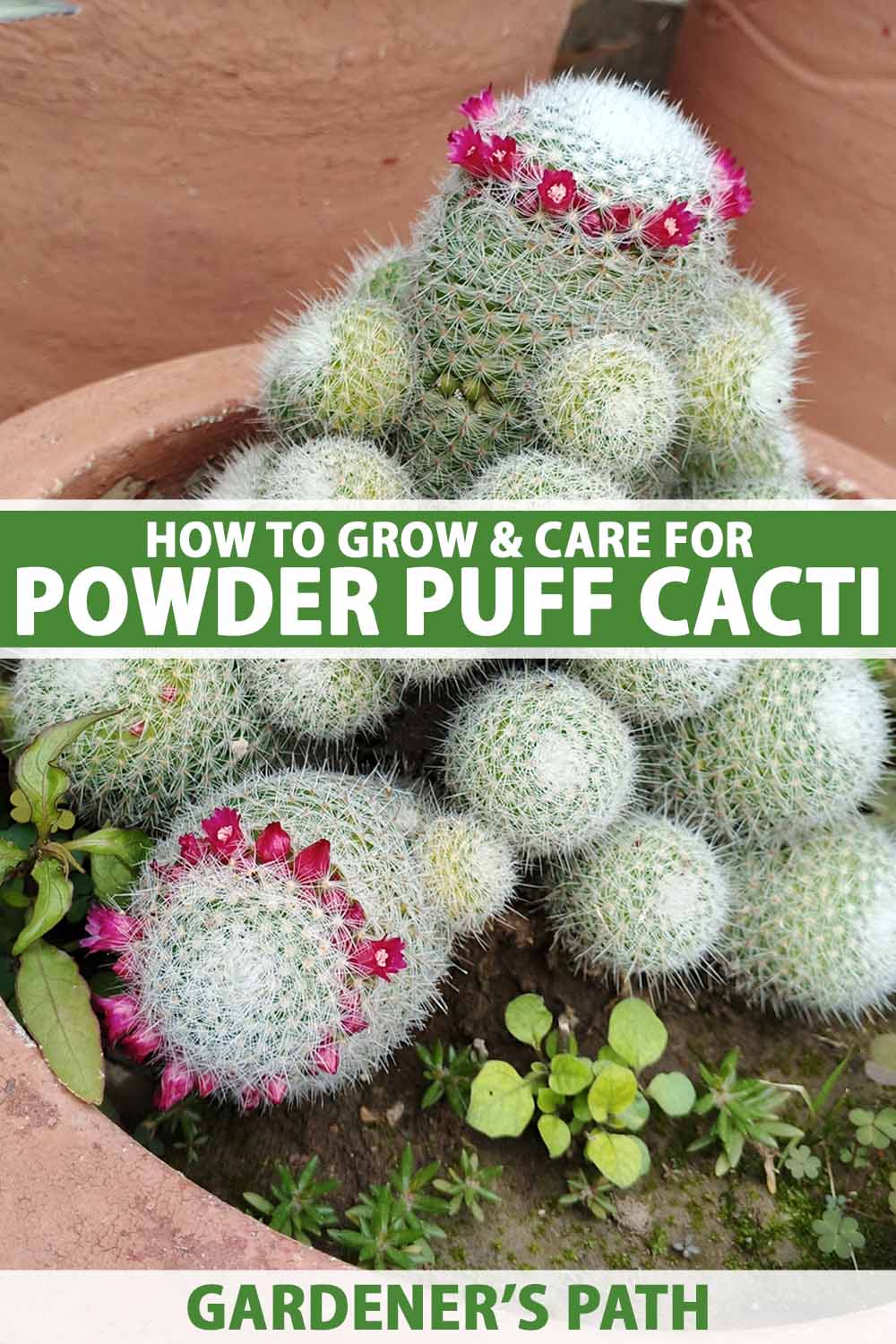
Powder puff cactus, Mammillaria bocasana, is a Mexican species suited to Zone 9 to 11 gardens and houseplant cultivation.
It has a globe-like shape that elongates as it matures, and low-profile dimensions of two to five inches tall and two to three inches wide.
A clustering growth habit and the production of offsets broaden its garden footprint.
We link to vendors to help you find relevant products. If you buy from one of our links, we may earn a commission.
Our guide to growing Mammillaria provides a broad overview of this large genus of cacti.
This article focuses on the unique characteristics and cultural requirements of the M. bocasana species.
Here’s what we’ll cover:
What You’ll Learn
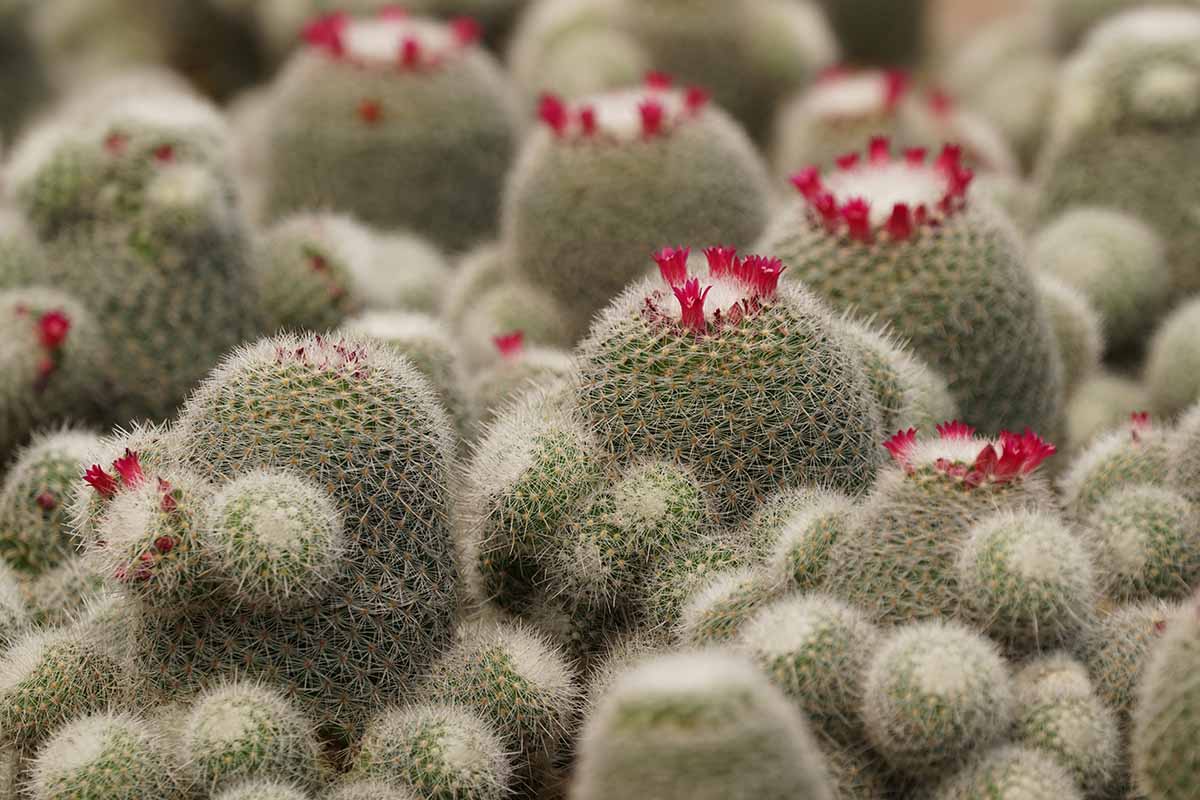
Powder puff cacti have bumps called tubercles on their surfaces, from which reddish hooked spines and silky white hairs project.
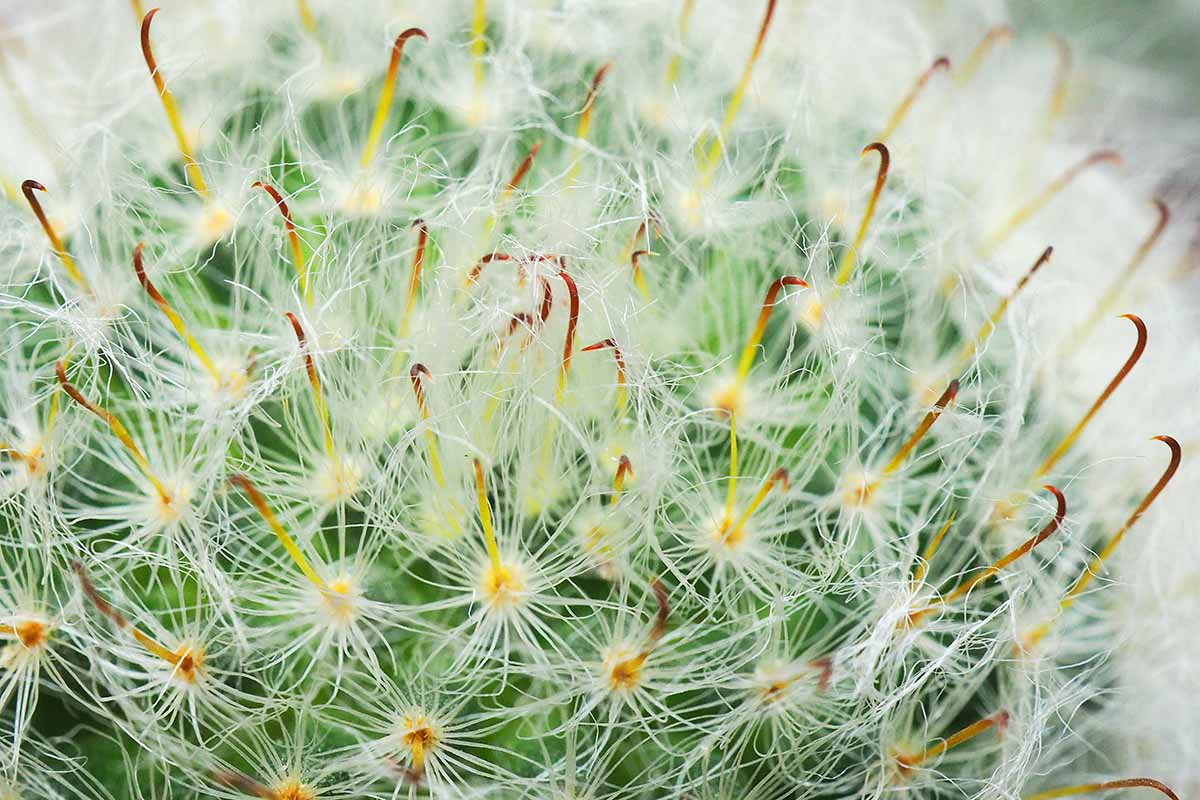
They are arranged in a left- and right-spiraling configuration called the Fibonacci sequence.
The sharp hooks protect the fleshy, water-storing stems from predators and were used as fishhooks by indigenous Mexicans.
The hairs function as a sun shield and aid in moisture retention.
From spring to summer, pink, white, or yellow flowers bloom in a circular, crown-like pattern near the top of each stem.
Post-bloom, there are non-toxic reddish fruits with tiny seeds inside.
Quick Look
Common name(s): Powder puff cactus, powder puff pincushion, fishhooks, snowball cactus
Plant type: Cactus
Hardiness (USDA Zone): 9-11 (outdoors)
Native to: Northeast Mexico
Bloom time / season: Spring to summer
Exposure: Full sun to partial shade
Soil type: Average, gritty, well-draining; cactus and succulent potting soil for containers
Soil pH: 5.0-6.5, slightly acidic to neutral
Time to maturity: 5-10 years
Mature size: 2-5 inches tall by 2-3 inches wide. Clusters up to 12 inches wide.
Best uses: Beds, borders, containers, houseplant, rock garden, xeriscape
Taxonomy
Order: Caryophyllales
Family: Cactaceae
Genus: Mammillaria
Species: Bocasana
Cacti with a petite stature thrive in beds and borders with other succulents of similar size that share their requirements for soil, sun, and water.
They do well in outdoor and indoor containers, with their shallow roots and low water needs.
Powder puff cacti are stars in low-profile rock gardens, where their floral crowns and texturally rich hairs, spines, and tubercles contrast with smooth stones.
Like most desert cacti, they are drought-tolerant once established and are excellent choices for Zone-appropriate low-water xeriscapes.
How to Grow
To make powder puff feel at home in your space, you’ll need to replicate its native habitat.
Northeast Mexico receives minimal rainfall and features arid and semi-arid regions, with daytime temperatures averaging 72 to 100°F and nighttime temperatures from 47 to 75°F.
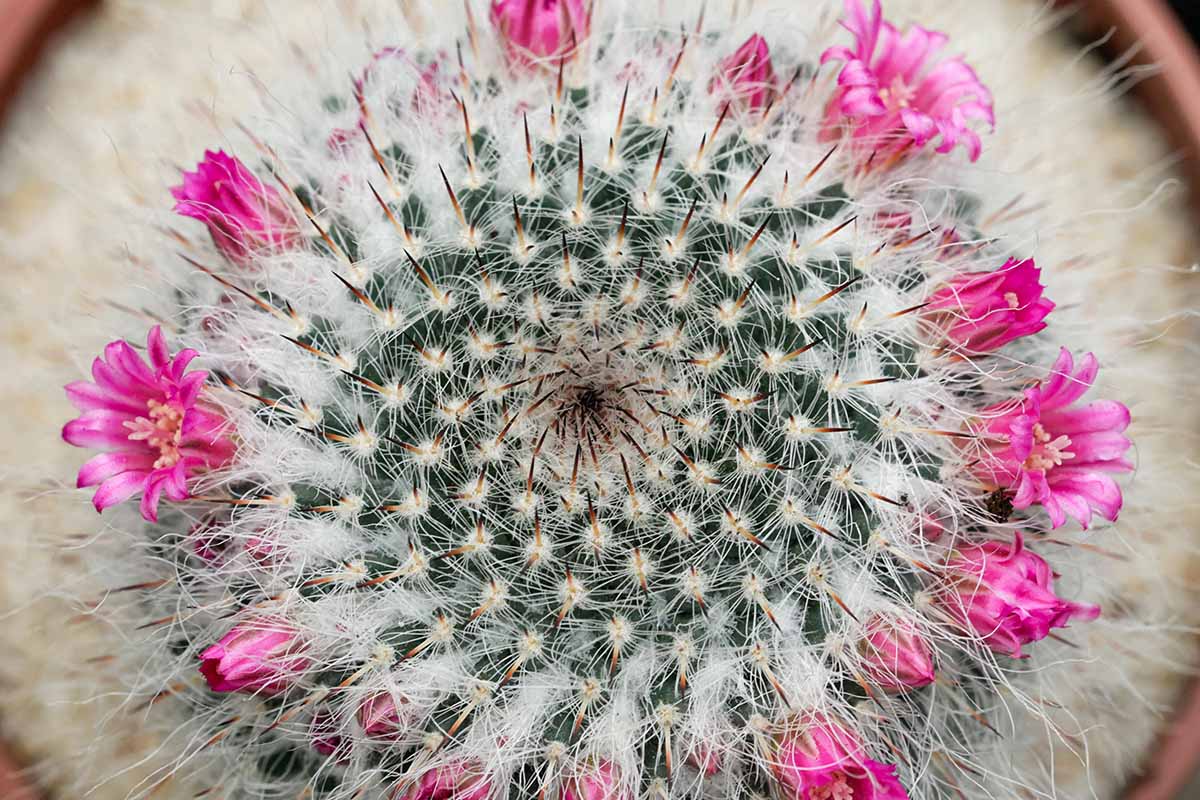
M. bocasana tolerates dips below 32°F in completely dry soil; in wet soil, it would freeze and rot.
Home gardens in Zones 9 to 11 with similar climates are suitable. Otherwise, bring pots indoors for the winter, or consider year-round houseplant cultivation.
Light
In the wild, powder puff grows in full sun, where the silky hairs enable it to endure intense direct sunlight and retain adequate moisture.
It also thrives in the dappled shade of larger plants, which is especially beneficial at the tender seedling stage, and goes a long way to perpetuating the species.
Growers should select full sun locations unless they are in the warmest regions, where afternoon shade is beneficial.
Houseplants do well on a sunny east-facing windowsill.
If you choose a southern exposure, you may have to put up a sheer curtain to prevent cactus sunburn during the summer months. Rotate the pot weekly to prevent leaning.
Soil
Desert soil is dry and gravelly with minimal nutrients.
The earth in a cactus garden should be gritty, not overly fertile, and well-draining.
The ideal pH is 5.0 to 6.5, or slightly acidic.
For container gardening, you can make your own cactus soil or purchase a commercial product.
Water
Cacti thrive in low-moisture environments because they are adept at water storage. However, they perform best in the home landscape when they don’t suffer from moisture stress.
A moisture meter is a useful watering guide.
Germinating seeds and seedlings require soil that is consistently moist but not soggy.
Potted specimens require water when the soil completely dries out.
Garden plants are drought tolerant once established. However, they benefit from a deep soaking when the soil dries to a depth of two inches.
Our guide to watering cactus houseplants has more information for indoor gardeners.
Fertilizer
Feeding your plants is optional. Because mammillaria are accustomed to low-nutrient soils in the desert, they are not heavy feeders.
If you want to boost their nutrition, use a low-nitrogen product to avoid burning the roots and retarding growth.
This one from Miracle-Gro has a 0.5-1-1 nitrogen-phosphorus-potassium (N-P-K) ratio.

Miracle-Gro Succulent Plant Food
Dilute it to a quarter strength and apply every two to four weeks during the spring and summer.
Miracle-Gro Succulent Plant Food is available from Miracle-Gro via Walmart.
Cultivars to Select
In addition to the straight species, you’ll find cultivated varieties to choose from. Let’s take a look.
Fred
‘Fred’ is almost entirely spineless. Its form is rounded and varies from montrose, or asymmetrical, to cristate, or crested.
It grows in a clumping fashion and has a mature height of about three inches.
The delicate stems may be green or pink/red.
They are flush and full during the growing season, shrink during winter dormancy, and refresh in the spring, when they produce pink or white flowers.
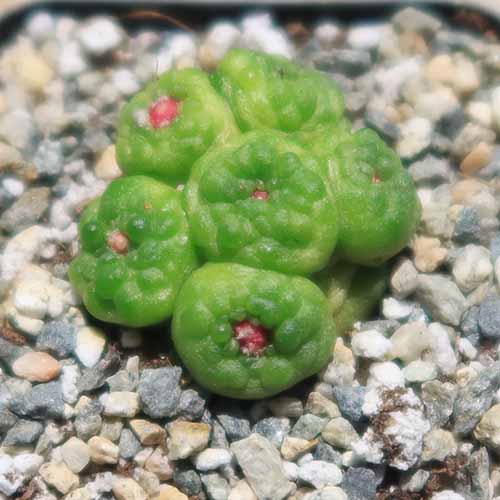
If you are gardening outdoors, choose a partially shaded location, or one with early morning or late afternoon sun, to avoid peak exposure sunburn.
Indoors, place pots on an east-facing windowsill, but set them a foot away during peak summer heat to avoid scorching.
Plants are available from Planet Desert.
Multilanata
‘Multilanata’ is a cultivated variety with more silky white hairs for a fuzzier appearance and better protection from direct sunlight.
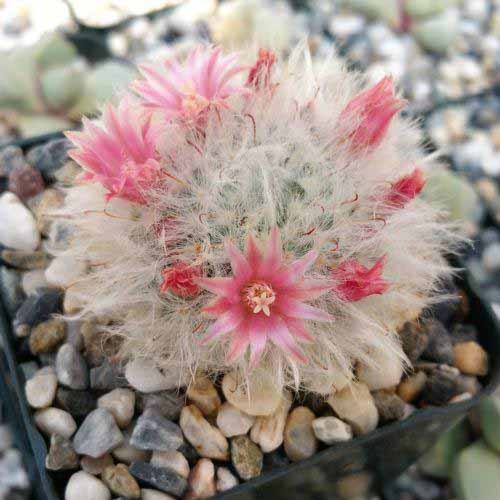
Each globe grows to a height of three to five inches. The flowers may be creamy yellow or pastel pink.
Plants are available from Planet Desert.
Roseiflora
‘Roseiflora’ is a cultivar with bright pink blossoms and a height of approximately five inches.
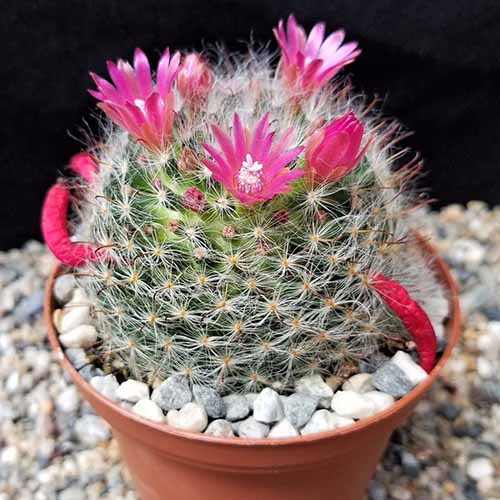
It has the same structure, spines, and growth habit as the straight species, but the color is richer and consistently pink.
Plants are available at Planet Desert.
Splendens
‘Splendens’ is a cultivated variety with shorter, less visible hooked spines and woolier hair for greater UV protection.
Its flowers bloom in the typical pastel shades of white, yellow, or pink.
Maintenance
Cactus maintenance is minimal. For in-ground plants, keep the garden weeded to minimize competition for water.
Divide overcrowded clumps by relocating offsets in the spring per the instructions below.
Additional care includes repotting as needed to maintain one to two inches of space between the root mass and the pot sides and bottom.
Vessels that are too large hold water too long and may lead to rotting.
Discontinue watering and feeding at the end of summer. Bring pots indoors before the daytime temperature dips below 60°F.
Store outdoor containers and year-round houseplants for the winter in a location with a temperature between 45 and 55°F with bright, indirect sunlight and low humidity to support a healthy spring bloom.
Propagation
There are two ways to propagate powder puff cacti: from seed or by division. Let’s discuss.
From Seed
To harvest seeds from mature plants, wait until the fruits are brightly hued and soft like tiny chili peppers.
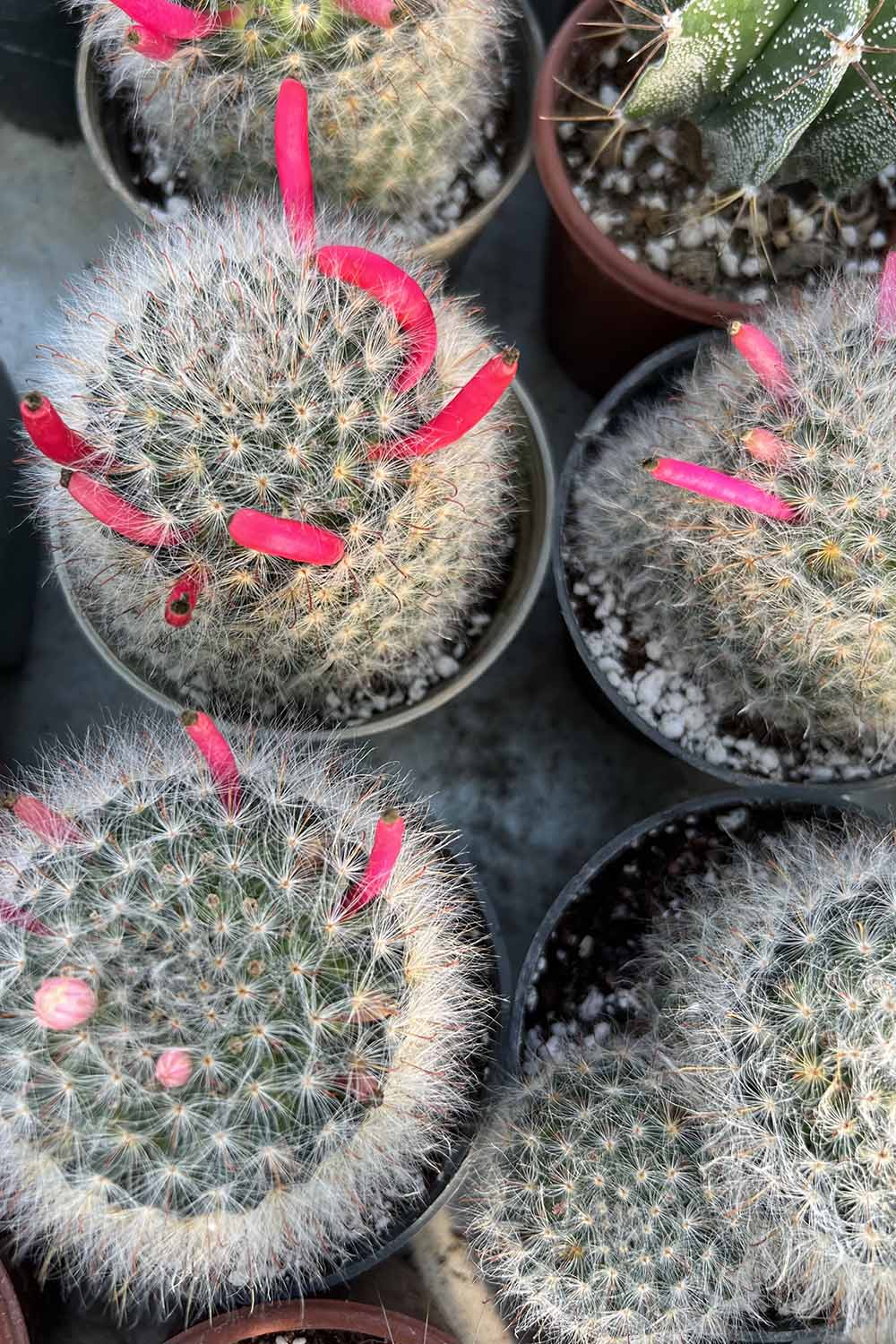
Slice the fruits lengthwise and scrape the seeds and flesh onto a paper towel.
Remove as much of the flesh as possible, rinse the seeds in a tea strainer, and let them dry overnight on a clean paper towel.
Prepare a seed tray by filling the cells three-quarters full of moist cactus and succulent potting soil.
Sprinkle one or two seeds per cell and press them gently to hold them in place.
Cover the tray tightly with clear plastic wrap to create a self-watering greenhouse-like environment.
Set the tray on a heat mat or in a warm location to maintain a 70°F temperature during germination. Set the tray about a foot from a sunny window for bright, indirect light.
Loosen the plastic when the first seeds sprout and gradually remove it altogether when most are up.
Mist the soil lightly as needed to keep it from completely drying out.
Allow the seedlings to remain in place until they begin to touch and crowd each other.
By Offset Division
Offsets or “pups”grow at the base and on the sides of mature powder puff cacti. They are easy to twist off and transplant as desired.
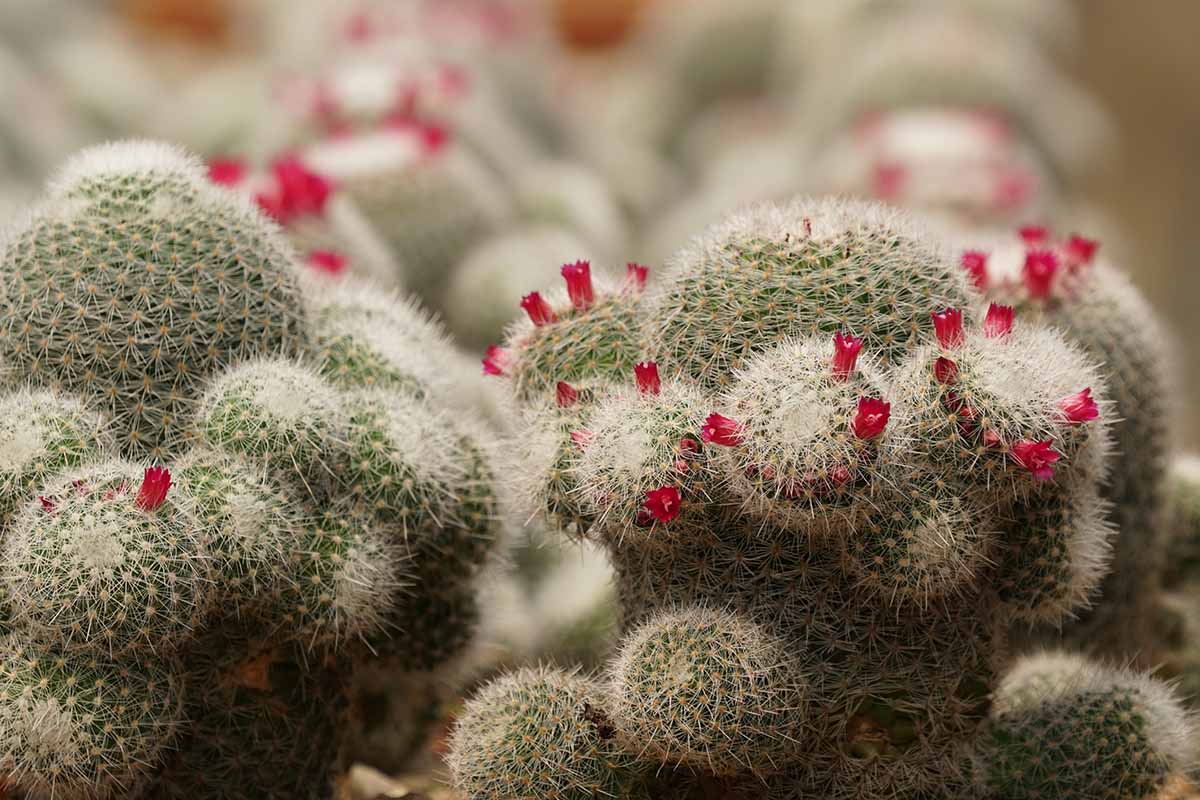
Select a pup that is at least an inch in diameter or a third the size of a parent for best results.
Lay it on a paper towel and let the severed end dry to form a callus. This generally takes at least a few days.
Once dry, it is ready to transplant.
Transplanting
Transplanting seedlings and pups follows the same basic steps, whether you’re potting them up or planting out in the garden.
Moisten the seed tray cells the day before.
To transplant to a container, select a well-draining vessel one to two inches wider and deeper than the root mass.
You’ll need a pot for each cell in the tray. Fill it two-thirds to three-quarters full of cactus and succulent mix and moisten the medium.
Set the contents of a starter cell at its original depth, or a pup just deep enough to hold it in place, and backfill to hold the plant firmly. Repeat for all cells.
Place the freshly planted pots in an east-facing window or a south-facing window with a sheer curtain. Water when the soil dries completely.
To transplant to ground soil, choose a sunny location and work the soil to a depth of four to six inches.
Afternoon shade is desirable in the warmest regions. Moisten the soil.
Set the contents of each cell at the original depth and space them eight inches apart. If you’re planting a pup, set it just deep enough to stay upright.
Water when the ground soil is dry at two inches deep.
Pests and Disease
Cacti are not prone to pests or diseases. However, sapsucking pests, such as spider mites, mealybugs, and scale, favor arid conditions.
Fungal and bacterial infections proliferate where there is excess moisture. The best avoidance measures are to meet all cultural requirements and avoid both under- and overwatering.
Our guides to cactus pests and cactus rotting have more information.
A Little Gem
Unlike towering ridged columnar and paddle cactus varieties, the powder puff offers gardeners an attractive petite option with tubercles, silky hairs, hooked spines, and a charming ring of blossoms.
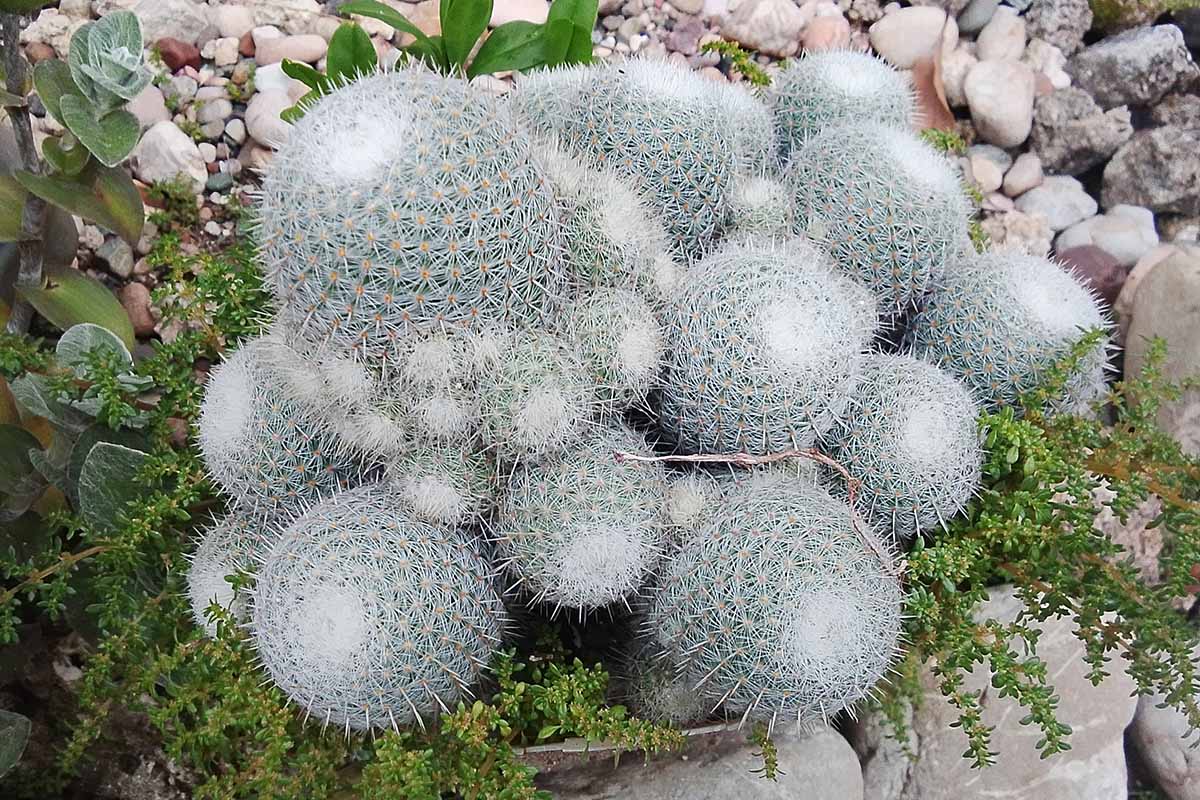
This little gem is easy to care for and water-wise. Are you ready to introduce it into a succulent garden or potted collection?
If you are growing powder puff cacti and have tips to offer, please share them in the comments section below.
We hope you found this article informative. To learn more about growing cacti and succulents, we recommend the following: