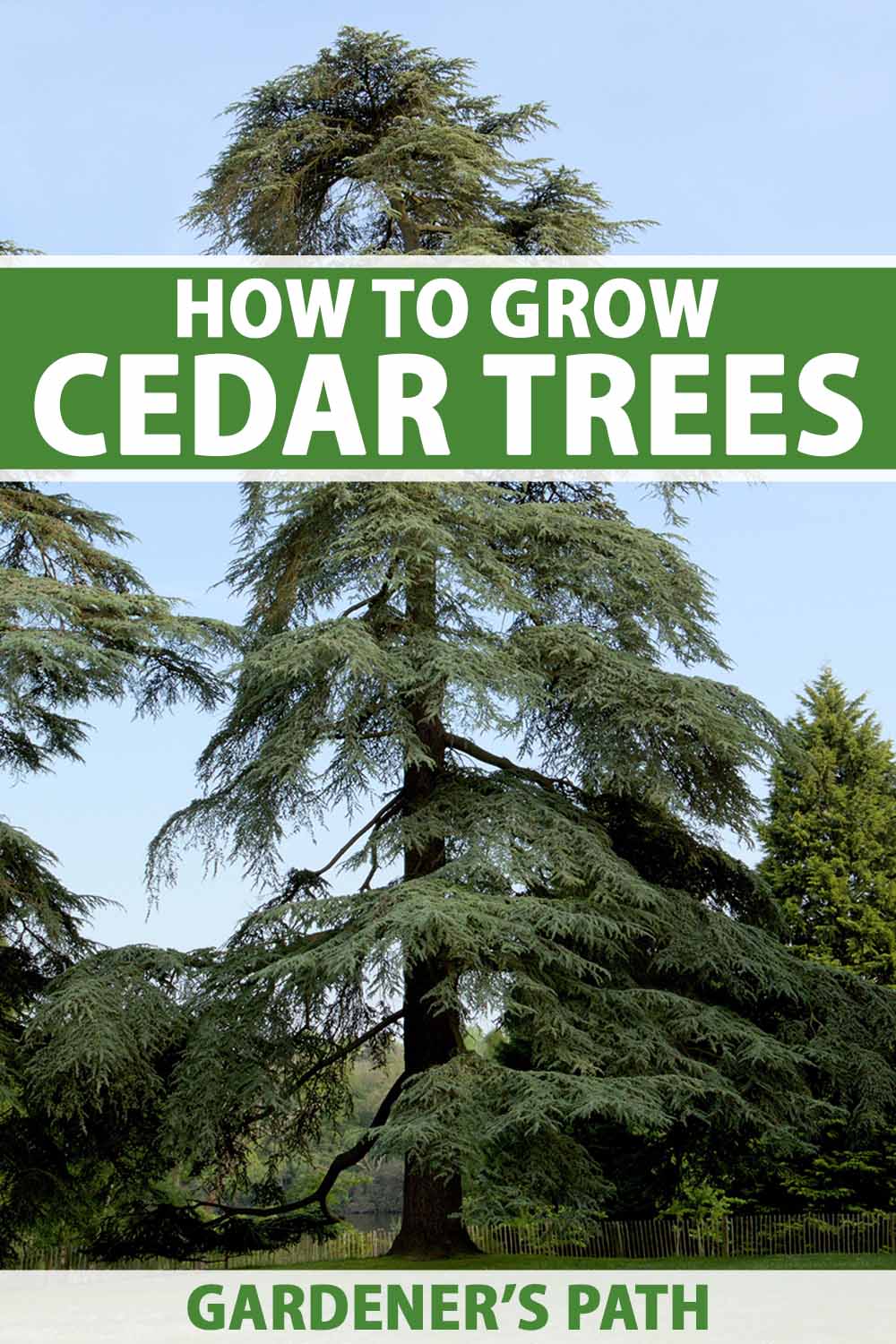
Cedrus spp.
Cedars are slow-growing evergreen conifers in the Cedrus genus. That’s the technical description, anyway, but in reality they are so much more than that.
These conifers are enmeshed in our culture all the way back to ancient Mesopotamia where people believed that the gods dwelled in glorious cedar forests.
Cedars have been an important part of human societies ever since.
Today, they have spread far outside of their indigenous range and are hugely popular in the art of bonsai as well as for landscaping.
We link to vendors to help you find relevant products. If you buy from one of our links, we may earn a commission.
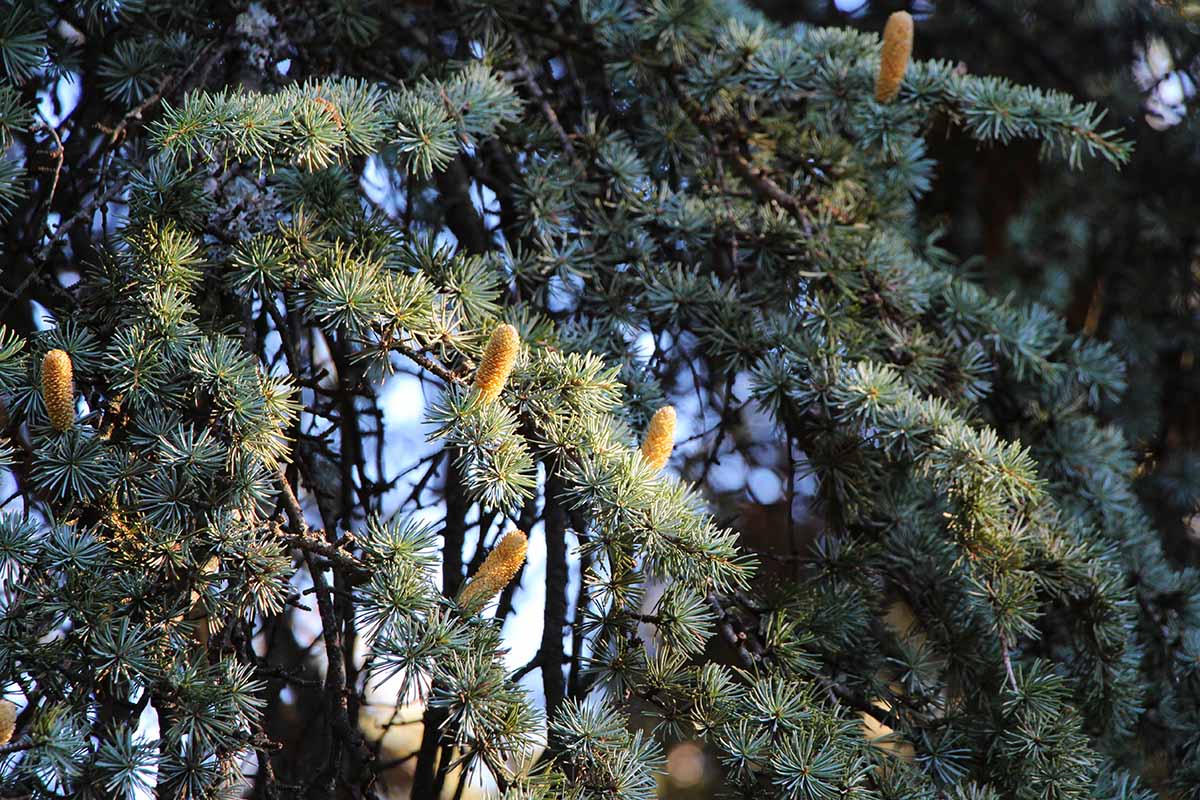
They are members of the pine family, but they differ from traditional pines because their short needles appear in spiral clusters of 30 to 40 per bunch, giving the branches a soft, fuzzy appearance.
The needles themselves are stiff, but if you brush your palm down a branch, it feels soft thanks to the sheer number of needles. The leaves range from bright green to silvery-blue.
When they are young, cedar trees have a pyramidal shape, becoming more umbrella-like as they age, with craggy, irregular branches that can appear windswept, upright, weeping, and anything in between.
Combined with the fascinating cones and the textured bark with a spicy, resinous fragrance, cedars are enchanting evergreens that will act as the crowning centerpiece to a garden.
Keeping a cedar thriving doesn’t require all that much work. We’ll cover everything you need to know, and more, in this guide. Here’s what’s coming up:
What You’ll Learn
The plants in the Cedrus genus are all indigenous to the western Himalayas and the Mediterranean region.
Today, they are grown across the globe as ornamental additions to the garden.
This genus has been through a bit of a shake up in recent years.
It used to be thought that there were four species: Cyprus (C. brevifolia), Lebanon (C. libani), blue atlas (C. atlantica), and deodar (C. deodara).
Recently, the genus was reorganized to include just two species: Deodar (C. deodara) and Lebanon (C. libani).
Blue atlas is now classified as a subspecies, C. libani ssp. atlantica, if it’s separated at all. Some taxonomists think the subspecies is redundant.
Cyprus is now classified as C. libani subsp. (or, sometimes, var.) brevifolia.
Blue atlas cultivars are, by far, the most popular in cultivation. You’ll often still see them listed for sale under the previous classification, C. atlantica.
To be honest, the differences between the various species are minimal. They mostly come down to size and shape.
Quick Look
Common name(s): Cedar, true cedar
Plant type: Woody evergreen conifer
Hardiness (USDA Zone): 5-9
Native to: Himalayas, Mediterranean
Bloom time / season: Evergreen
Exposure: Full sun to partial sun
Soil type: Moist, deep, loamy, well-draining
Soil pH: 6.0-8.0, slightly acidic to neutral
Time to maturity: Up to 50 years
Mature size: Up to 200 feet tall, though most stay under 100 feet
Best uses: Accent, bonsai, buffer, screen, shade, specimen, texture, winter garden
Taxonomy
Order: Pinales
Family: Pinaceae
Genus: Cedrus
Species: Deodara, libani
The other matter that adds to the confusion is that Cryptomeria, Chamaecyparis, Calocedrus, and Thuja species are commonly called “cedars,” but they aren’t even closely related.
If you went into a nursery and asked to be pointed to the cedar trees, chances are good you’d be sent to the Japanese cedars (Cryptomeria spp.), which are actually in the cypress family (Cupressaceae).
Or perhaps you’d be told to browse the white cedars (Chamaecyparis thyoides), also in the cypress family.
Maybe you’d look at a lovely western red cedar (Thuja plicata), which, you guessed it, is in the cypress family.
And don’t forget incense cedars (Calocedrus spp.) which are, yep, in the cypress family as well. Don’t look at me! I didn’t name them.
True cedars (Cedrus) are in the pine family, Pinaceae.
Depending on the species, they are suitable for cultivation in USDA Zones 5 to 9, with some only hardy to Zone 6, with the exception of a few cultivars that have been bred to be more cold-tolerant.
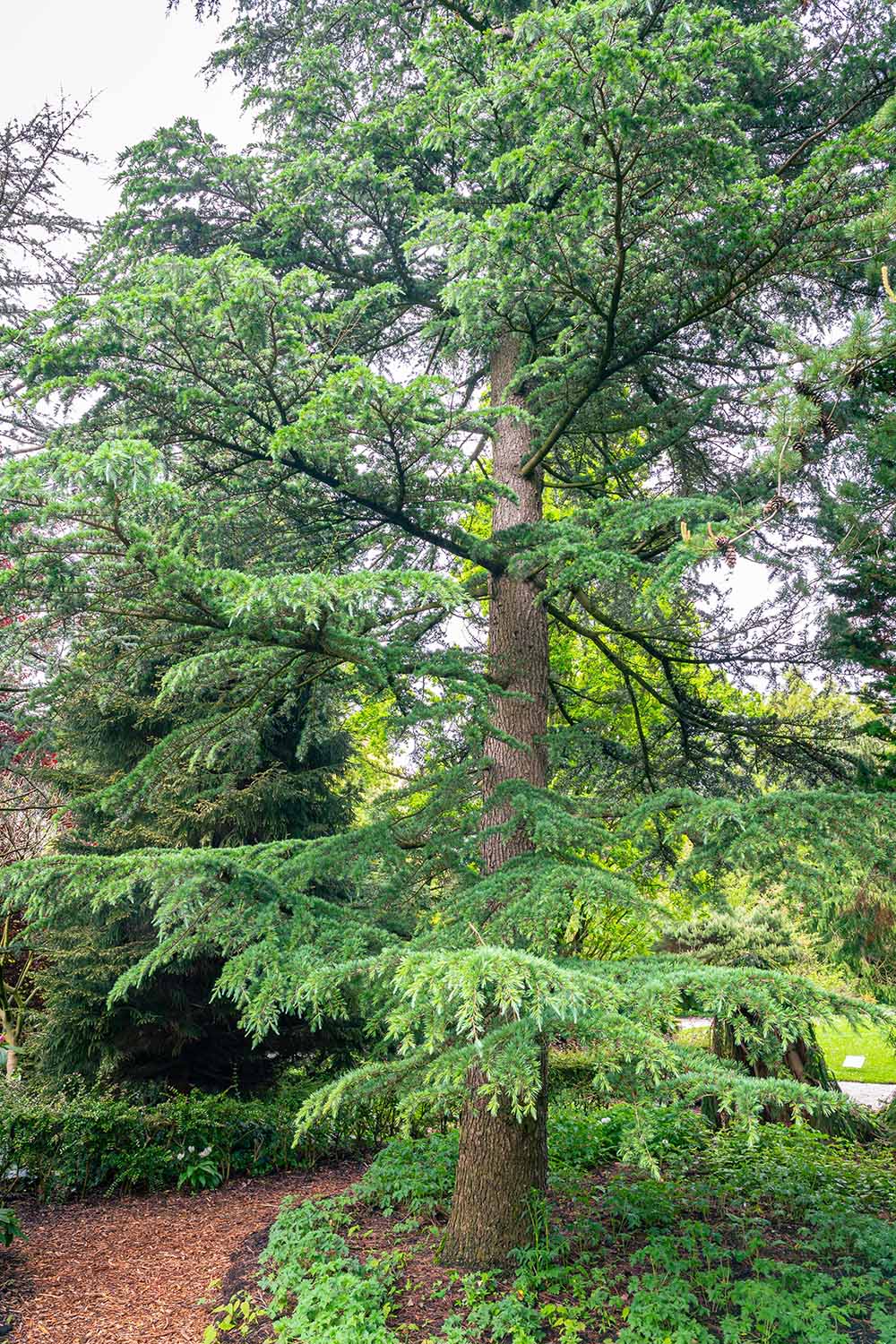
Trees in the Cedrus genus have been known to grow over 200 feet tall, but most stay half that size, and often even smaller in the home garden.
Plus, there are numerous compact cultivars that have been selected for their smaller stature.
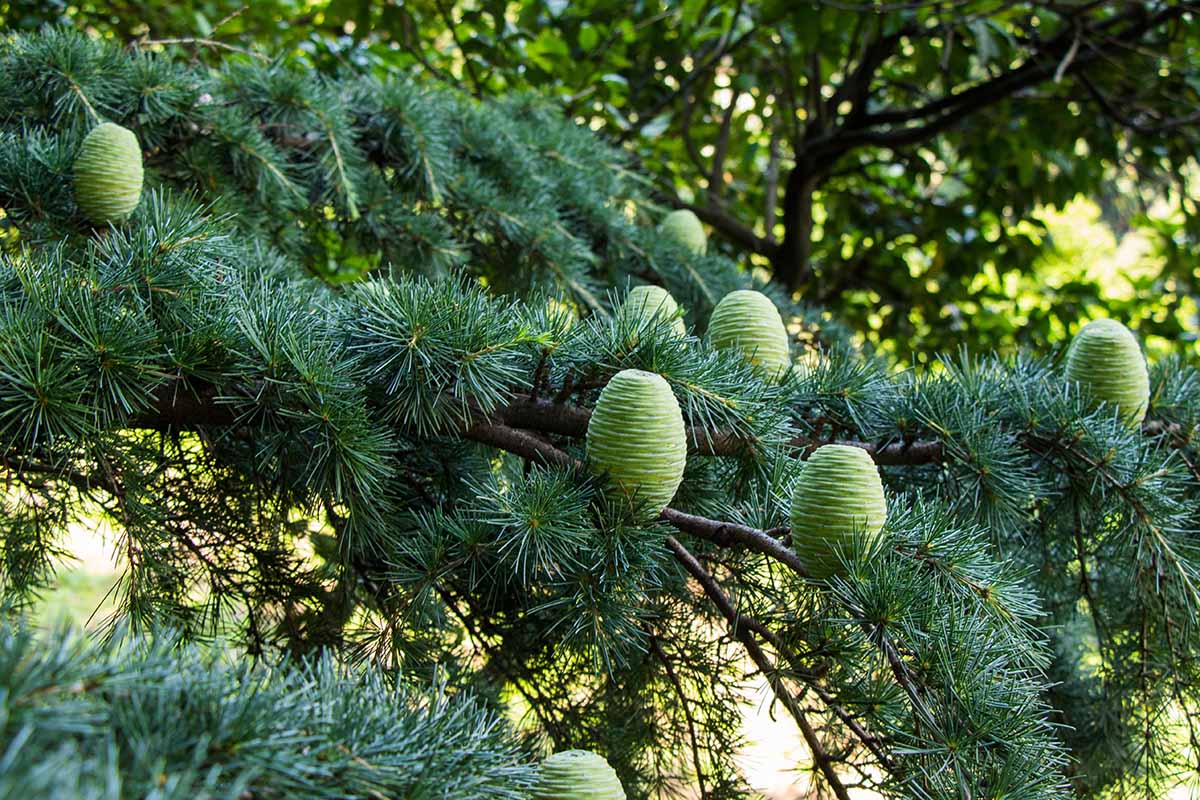
I’m going to nerd out a bit here, but I think cedar trees have the coolest cones of any conifer.
These grow upright on the branches and break apart when mature, releasing winged seeds that are carried on the wind.
They are also covered in a sticky, bitter resin that seals the scales, preventing squirrels and birds from taking a nibble and causing damage before they’re ready to open.
How to Grow
In the right conditions, cedar trees can grow up to two feet a year until they reach their mature height, which can take up to 50 years.
That may seem like a long time, but given that they can live for 125 years and more, they grow relatively quickly.
The trees can tolerate some salt, so they’re popular in coastal communities. They can also tolerate heat and some drought.
Light
You’ll want to select a spot with full sun exposure, more than eight hours per day.
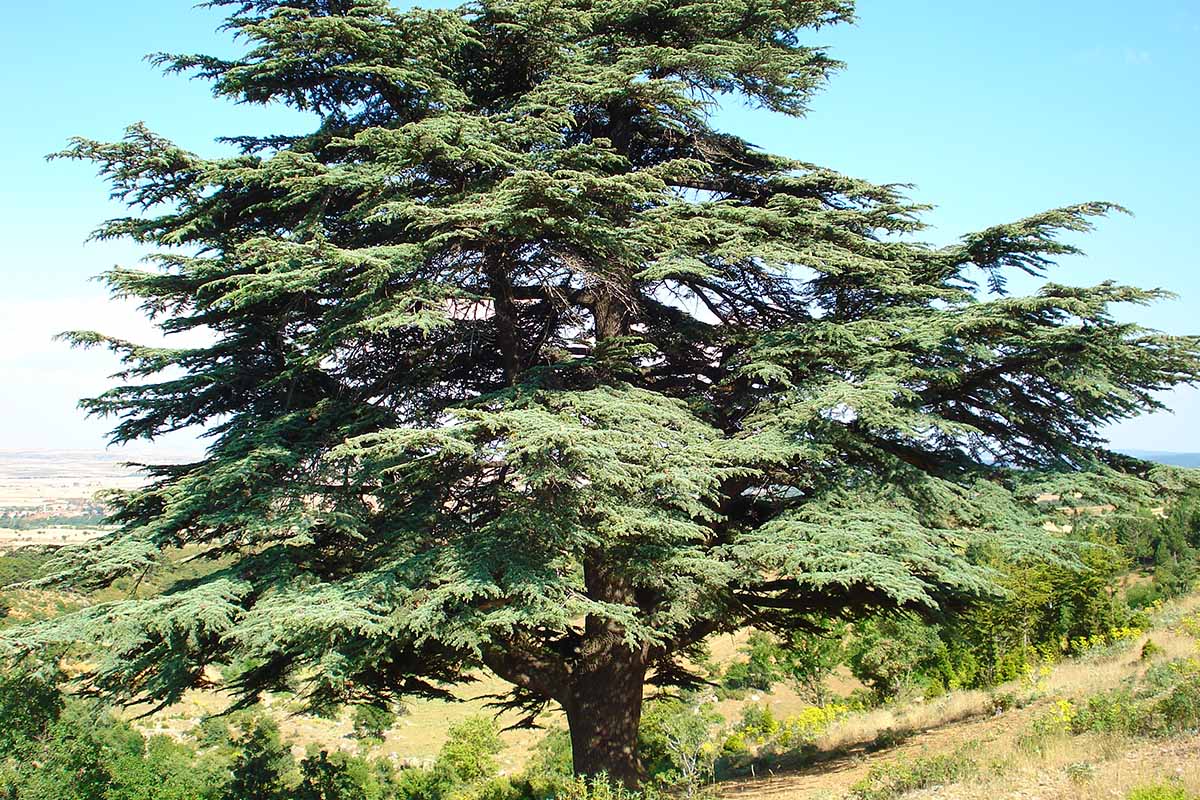
In warmer climates, you can get away with partial sun, about four to six hours per day, but don’t go below four hours, as the trees won’t do well.
Soil
Cedar trees are adaptable and they’ll make do with a wide range of soil types. But ideally, you’ll give them a spot with deep, moist, loamy soil.
That said, I have some pretty heavy clay soil that becomes nearly cement-like in the summer and cedars abound in my neighborhood.
They’ll also tolerate sandy soil, but make sure they’re protected from heavy winds if you have sandy soil, or else you might find your tree is blown right over.
The soil pH isn’t really important so long as it isn’t in the extremes. Anything from 6.0 to 8.0 is fine.
Water
When the plant is young, you need to keep the soil evenly moist at all times.
Sometimes gardeners get tripped up and think that moist means wet, but what you’re aiming for is soil that feels like a sponge that you’ve wrung out really well.
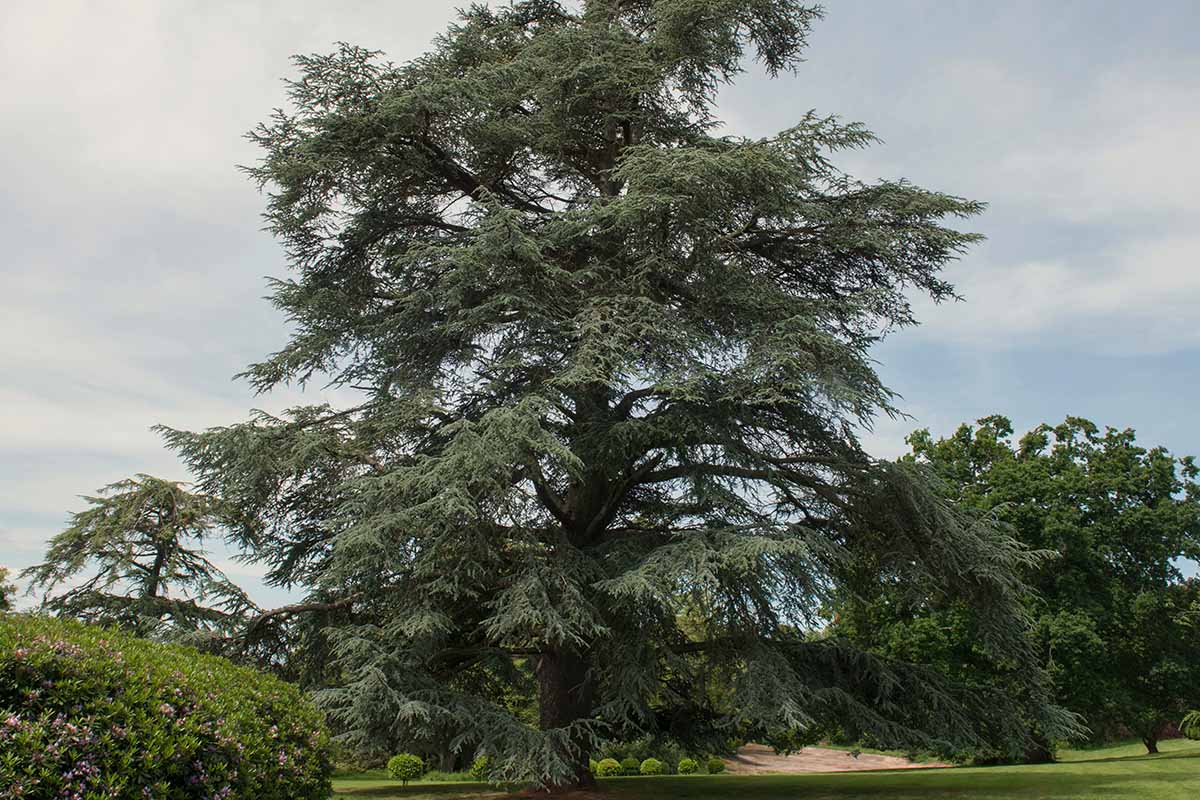
Don’t worry if the surface of the soil dries out, just make sure it stays moist a few inches down.
Once the tree is established, after about five or so years, you don’t need to be quite so attentive, but you’ll need to provide supplemental water during extreme heat or long periods of drought.
Fertilizer
Mature trees might never need fertilizing unless your soil is particularly deficient.
I always recommend that you test your soil before fertilizing so that you don’t end up adding nutrients that are already abundant.
You can reach out to your local University extension office for advice on finding a good testing company in your area.
Home soil tests are usually pretty cheap and local companies will be able to give you tailored advice on how to address your soil.
If you want to skip all that, you can fertilize young specimens with a fertilizer formulated for evergreens or a good quality all-purpose product. Apply in spring when new growth is emerging.
I always reach for Down to Earth’s All Purpose food. It’s made with organic ingredients and comes in a compostable box.
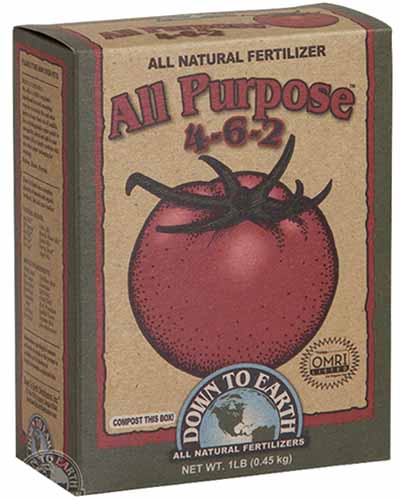
You can find Down to Earth All Purpose Mix available at Arbico Organics in one-, five-, and 15-pound containers.
Species and Cultivars
There are some fantastic cultivars out there bred from the various Cedrus species.
Most have some variation in size, meaning you’ve got options if you don’t have room for a full-sized tree. Here are some of my favorites:
Blue Atlas
The blue atlas cedar ( C. libani ssp. atlantica ‘Glauca’) is a favorite for good reason.
The needles are covered in a waxy blue coating that gives the plant a bright blue appearance.
When young, this one has a compact pyramidal shape, but as it matures, it takes on a more open, irregular form.
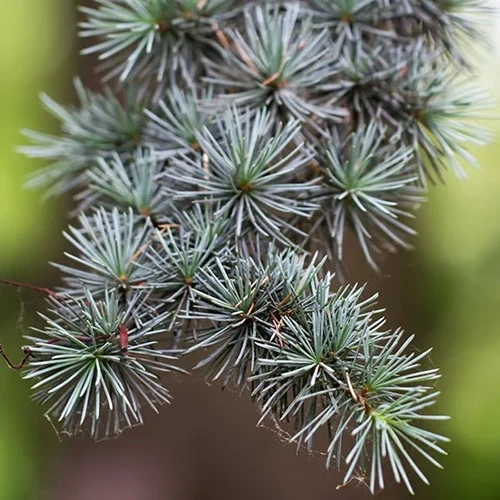
It can grow up to 100 feet tall, but will usually stay closer to 60 feet, and about 30 feet wide.
Blue atlas cedar is exceptionally drought tolerant, so ideal for water-wise yards.
You can find blue atlas available at Nature Hills Nursery.
Cyprus
Cyprus cedars (C. libani, syn. C. brevifolia) are less common in ornamental plantings than their close relatives, but don’t let that put you off.
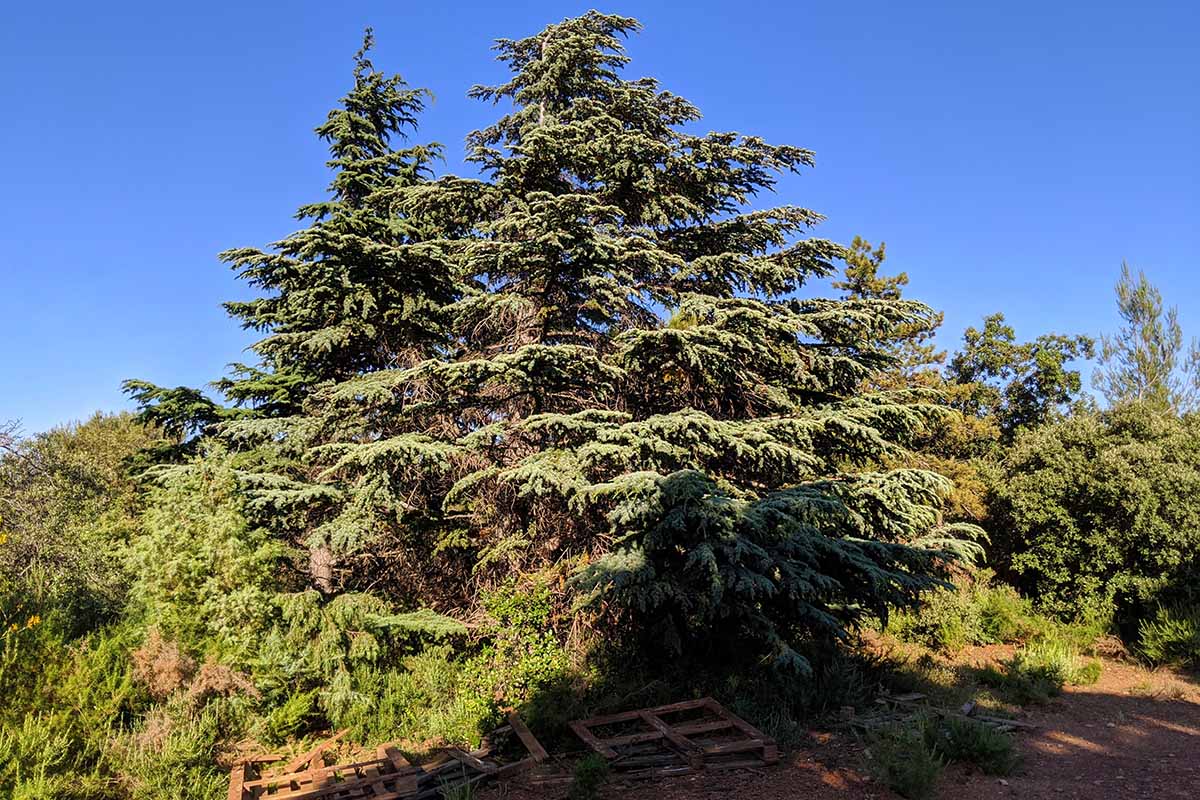
These trees reach about 40 feet tall and as they mature, their pyramidal shape gradually spreads into a flatter, umbrella-like crown.
Native to the mountains of Cyprus, this species has blue-green needles and is hardy down to Zone 6.
Deodar
If you want a stately specimen to fill a large space, go with the original C. deodara.
It will eventually reach a towering 70 feet or so in height, with a spread of up to 40 feet and a tidy pyramidal shape.
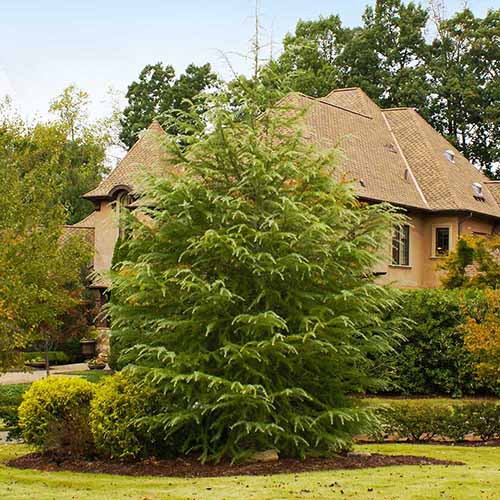
The needles grow in whorls, which makes the tree look soft to the touch. Coupled with the silvery-green color, it’s a real standout.
You can pick up a deodar cedar at Trees.com, which carries them in one- to two-foot or three- to four-foot sizes.
Golden Deodar
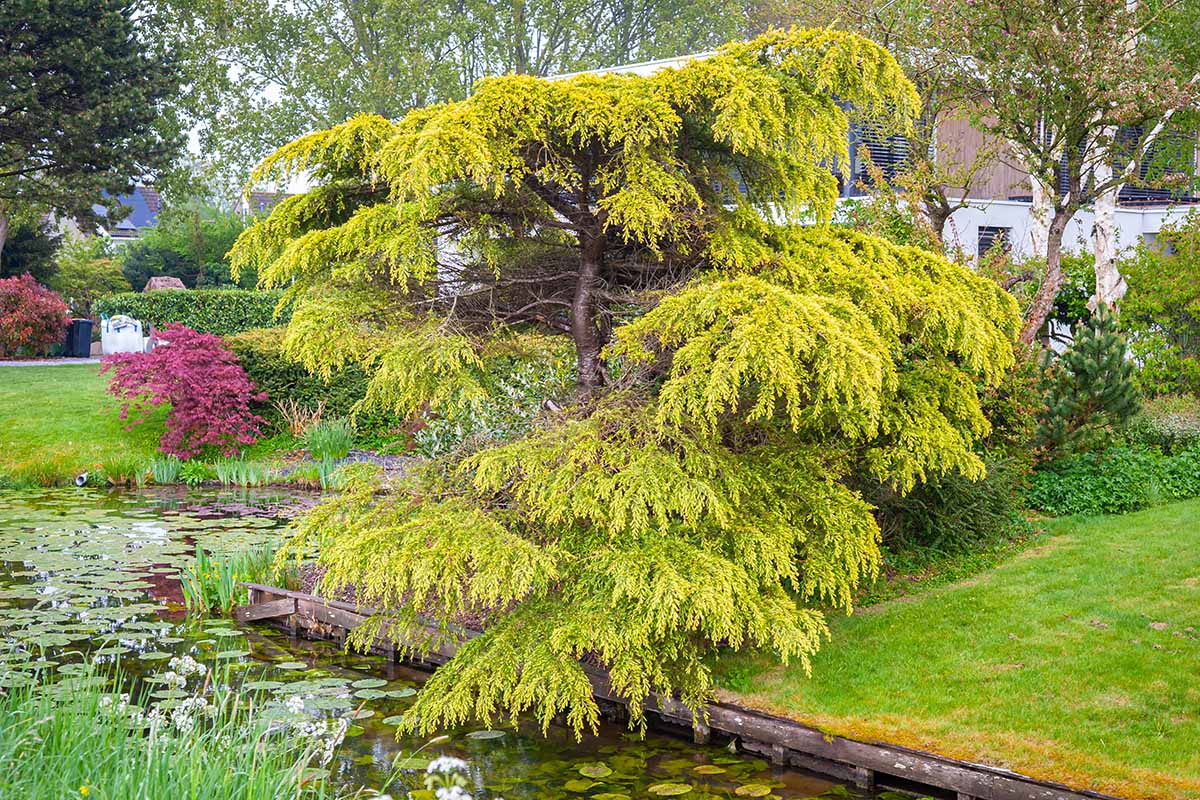
C. deodara ‘Aurea’ is a striking deodar cultivar. Soft, golden-yellow foliage covers this 35-foot-tall, 15-foot-wide tree and its weeping, arching branches.
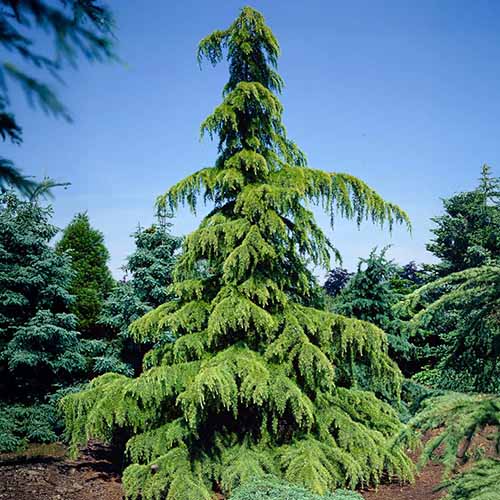
The pyramidal shape suits all kinds of spaces, whether you want to create a dramatic background for your garden or grow it as a focal point.
Sound like just what you want? You can find ‘Aurea’ available at Trees.com.
Horstmann Blue Atlas
If you’re dreaming of a blue Atlas cedar but you lack the space, let me introduce you to ‘Horstmann.’
Hardy to Zone 6, it’s a semi-dwarf tree that sports the characteristic steely-blue needles of the species, but in a petite pyramidal shape that tops out at 12 feet tall and eight feet wide.
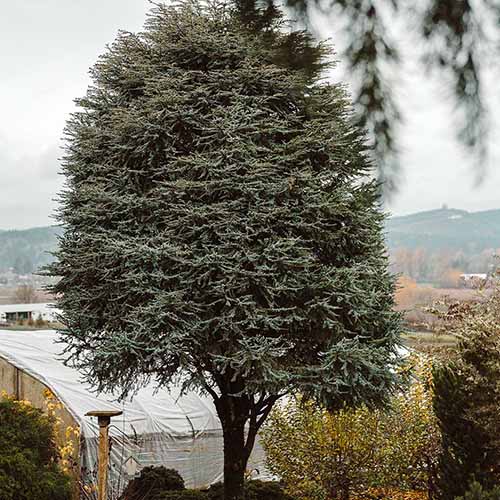
Like the original blue Atlas, it’s drought tolerant and tough as nails, making it a good option for challenging areas.
Find yours at Trees.com in two-to-three foot or three-to-four foot sizes.
Karl Fuchs
‘Karl Fuchs’ is a deodar (C. deodara) cultivar and one of my favorites. It has a classic pyramidal shape, with gently swooping, arcing branches draped in soft blue-green needles.
I think “fountain-like” is an apt description, as it does indeed resemble the graceful arc of a beautiful fountain.
It can grow up to 35 feet tall, but most stay much smaller, and it only spreads to about six feet wide.
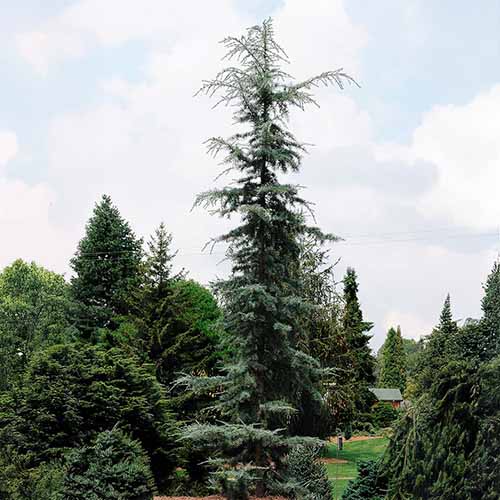
This cultivar is perfect for those smaller areas where you want the drama of a Himalayan cedar but lack the space for the full-sized species.
Pick one up at Trees.com, which carries it in two- to three-foot or three- to four-foot sizes.
Prostrate Beauty
‘Prostrate Beauty’ stands out because of its shape. This slow-growing C. deodara cultivar gradually reaches just a foot or two tall and five or six feet wide when young.
Smothered in fine blue needles, it makes for a distinct evergreen carpet in the garden.
What I love about it is that when it’s young, it crawls along the ground, but as it matures, it develops a short trunk that lifts the whole thing up a bit, eventually reaching five feet in height.
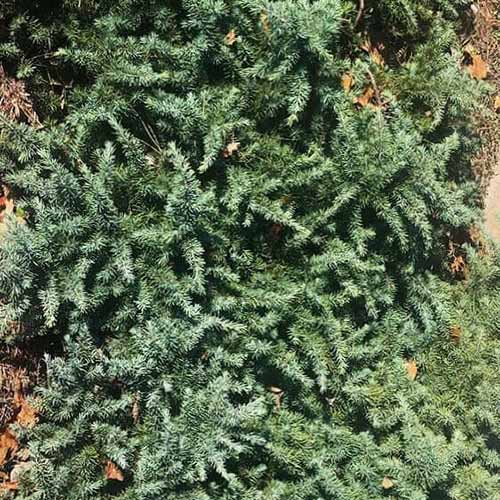
You can prune it to keep it as a ground cover, or let it mature into its unique umbrella-like shape.
Developed by Iseli Nursery, you can purchase one for your garden from Maple Ridge Nursery.
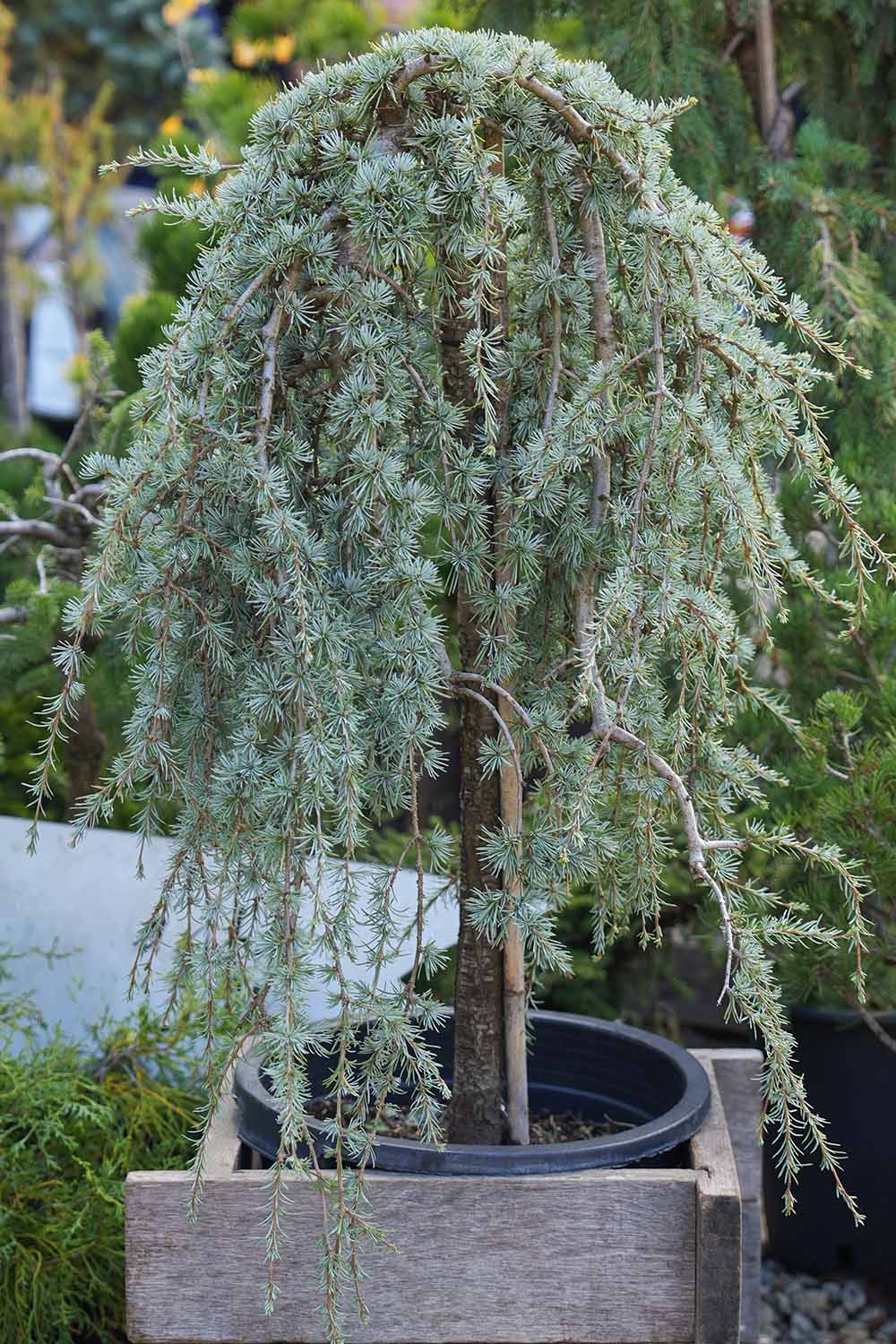
Weeping Blue
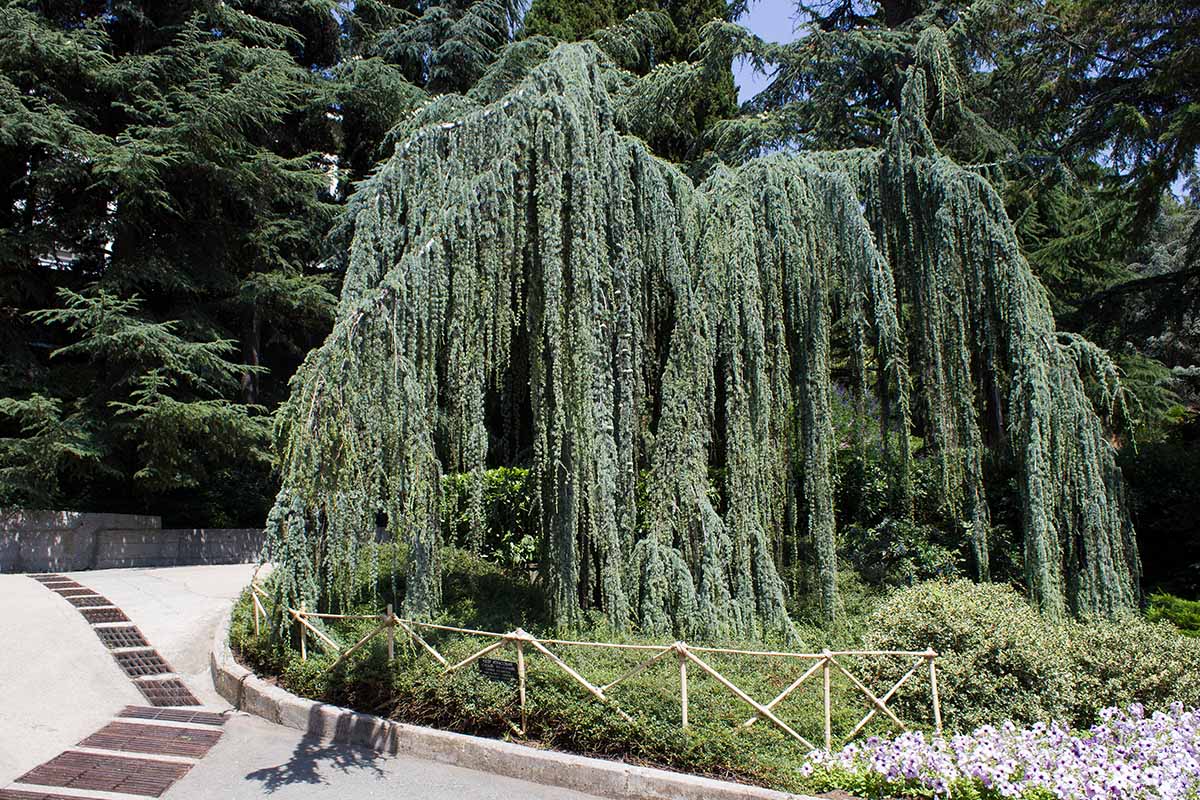
Take your blue Atlas cedar and make it even more striking, and you’ve got C. libani subsp. atlantica ‘Glauca Pendula.’
It is stunning! Every time I pass one, I get a little lost admiring its graceful shape and unusual color.
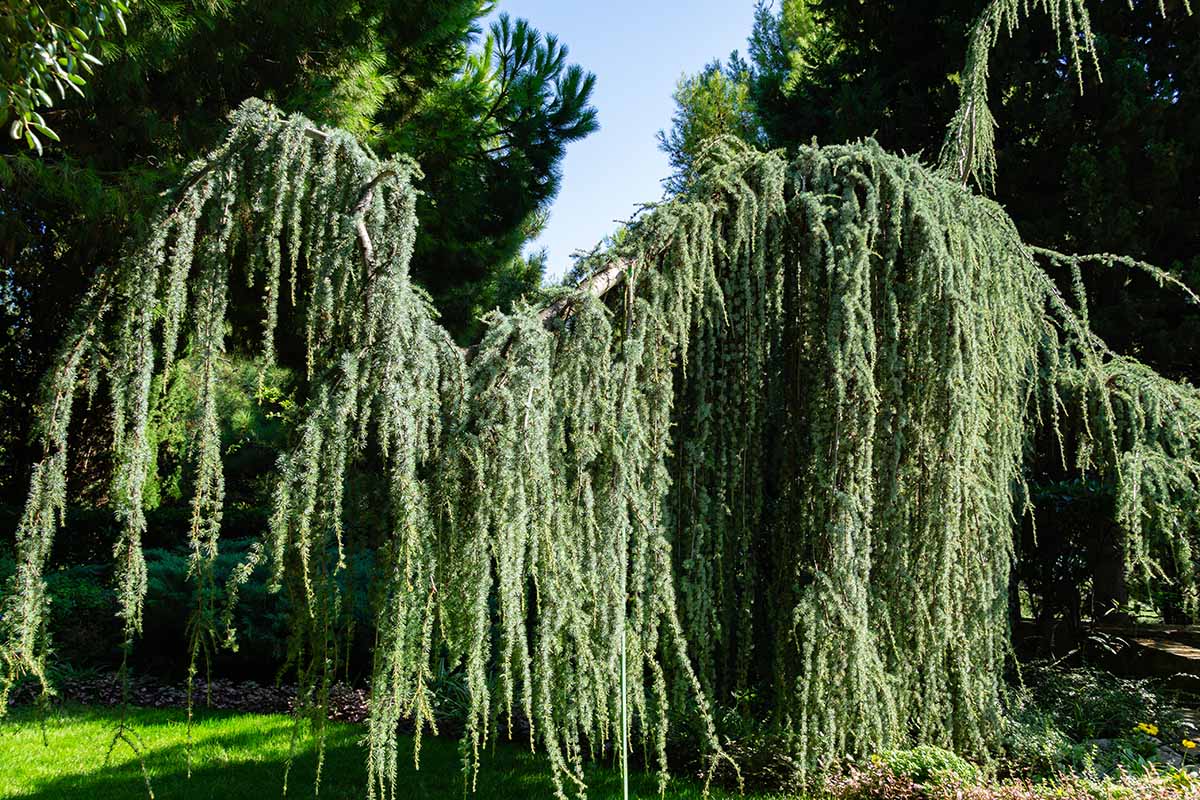
It has the blue cedar’s characteristic foliage, but the branches have an arcing, weeping shape, and the tree can be trained into all kinds of forms.
It’s honestly such a looker that it’s one of the first evergreens I recommend for gardeners who want something really eye-catching to act as a focal point that anchors the landscape.
It grows to about 15 feet tall and 20 feet wide, though this can vary depending on how you train it and the growing environment.
Maintenance
It’s a gardening myth that fallen needles will kill plants underneath an evergreen tree or that they will turn the soil acidic.
Usually, plants like turfgrass die underneath evergreens because they don’t receive enough sunlight.
So feel free to leave the needles on the ground if you want. The litter provides protection for all kinds of critters and birds will use them for nesting material.
The exceptions are if you want to keep the area under the tree clean or if you’re dealing with pest or disease problems.
Similarly, pruning isn’t necessary unless there are dead, dying, or broken branches.
These should be removed whenever you see them. Learn more about pruning conifers here.
If you want to train a cedar into a bonsai, check out our guide.
Propagation
Growing from seed is an exercise in patience. If you’d like to try this method, read our complete guide to growing pines from seed.
From Cuttings
Vegetative reproduction is the way to guarantee that the resulting plant will be an exact replica of the parent.
This process should be done using new growth that has hardened, known as semi-hardwood. The best time to take cuttings is in late summer to fall.
Snip off a branch tip that is still flexible but has hardwood growth at least at the lower section. You need about six inches in length.
If you want to give your plant an extra boost at developing roots, make sure to get a bit of “heel” when you take the cutting.
A heel is a piece of older wood, meaning second year growth. Usually, this is just a strip of outer bark and cambium at the end of the cutting.
It’s not necessary, but it can help your cutting develop.
Strip off any needles from the bottom half and dip the end in rooting hormone powder.
Fill a deep container with equal parts sand and sphagnum moss and poke a hole in the center.
Insert the cutting into the hole, about two inches deep, and firm up the medium around the cutting.
Keep the medium moist but not wet at all times, and ideally, keep the cutting humid, as well.
You can do this by covering the pot in a plastic bag or cloche, or growing in a tent. Once new growth develops, you can remove the cover.
You also want to keep the medium at a temperature of about 65°F. A heat mat can help you do this.
Give the cutting partial sun or dappled light, or the grow light equivalent, until new growth develops.
Then you can gradually introduce the cutting to direct light an additional hour at a time each day for a week.
Grow the cutting in place until the second spring, at which point you can transplant it into the garden.
Transplanting
Most of us will start by purchasing a potted cedar from the nursery and it’s easy to transplant into the garden.
Dig a hole the same depth as the growing container and about twice as wide.
Gently remove the plant from the growing container and knock or brush away as much of the growing medium as you can.
Gently loosen up any twisted or curled roots so that they grow out from the plant.
Set it in the ground and fill around the roots with soil. Water well and add more soil if it settles. You want your cedar sitting at the same height it was in the growing container.
Pests and Disease
Cedars are blessedly unbothered by pests, including herbivores. But there are a few diseases that can be a problem.
Needle blight is a disease that is more common on Cedrus species growing in regions that are cool and wet. Those in drier, warmer areas will probably not encounter this disease.
Caused by the fungi Sirococcus conigenus, S. tsugae, and Kabatina spp., the disease causes needles and sometimes new wood to turn tan or pinkish in the spring as the young spores (conidia) infect the tree.
In the summer, the infected areas die and may drop. The spores will then overwinter on the dropped debris and the cycle starts all over again.
There isn’t a good way to control the disease with chemicals, so you’ll need to immediately remove infected areas from the tree.
Clean up any fall debris in the fall to prevent reinfection.
Some Cedrus species have been infected by phytophthora rot, but it’s fairly rare.
Fragrance, Texture, and Structure
Cedars are truly something special in the garden. They have such a dramatic shape, plus all that texture from the needles and bark, not to mention those cool looking cones.
And let’s not forget that incredible fragrance. There are so many reasons to have one of these conifers in your space.
Are you growing cedars? Which is your favorite? Let us know in the comments section below!
And for more information about growing conifers in your landscape, add these guides to your reading list next: