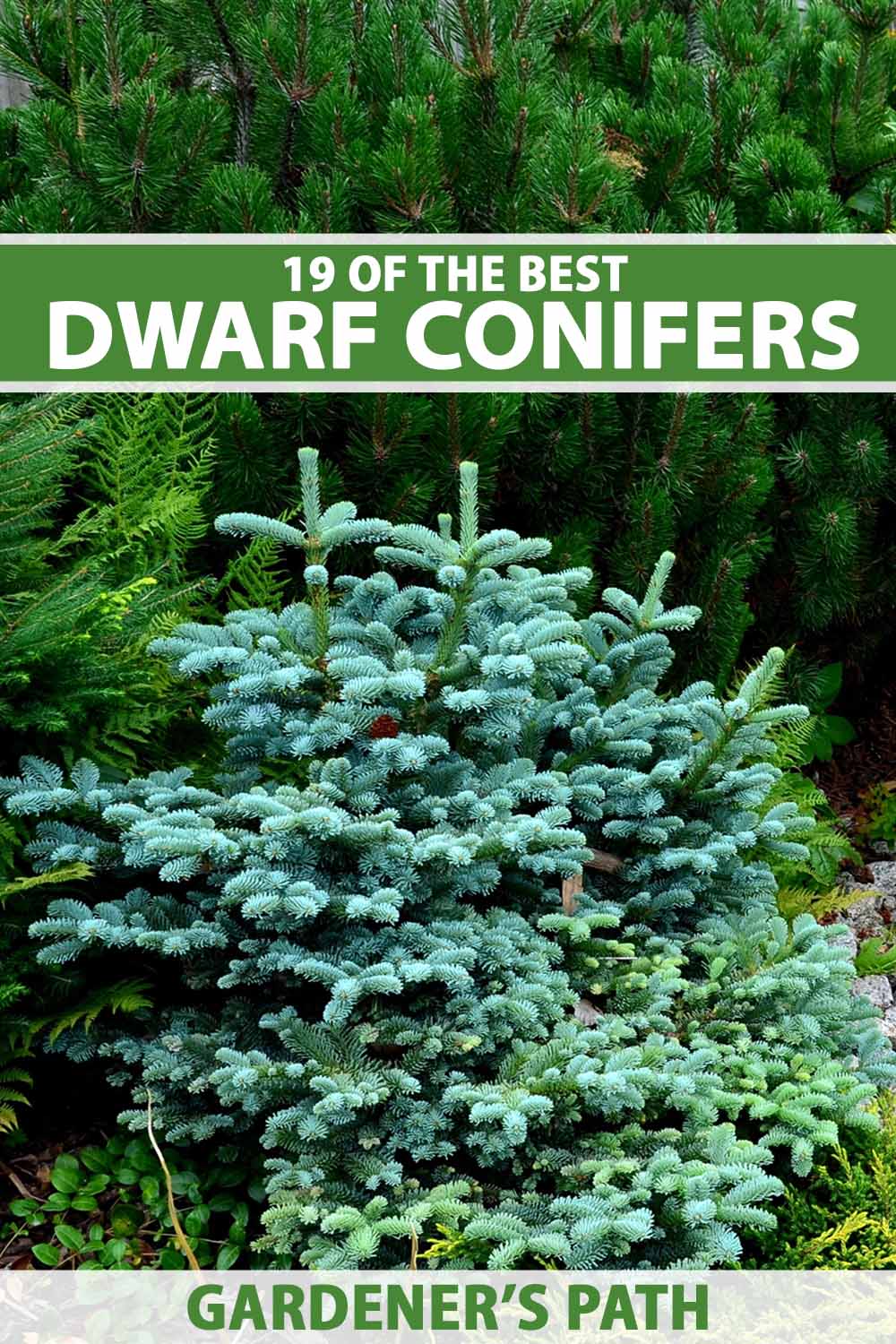
Conifers add structure, texture, and year-round interest to the landscape, but not everyone has space for a massive spruce or pine.
Fortunately, there are plenty of dwarf conifer cultivars that pack all the charm of their full-sized cousins into a much smaller footprint.

We link to vendors to help you find relevant products. If you buy from one of our links, we may earn a commission.
Whether you want something that maintains its shape without pruning, will look like a piece of living art, or to fill a challenging spot, you’ll find an option on this list.
Here are 19 beautiful, adaptable, and interesting dwarf conifers to consider:
Best Dwarf Conifers for Your Landscape
We’re going to start with one of my absolute favorite conifers, both in terms of species and cultivars. It’s a striking option that works just about anywhere.
1. Adcock’s Japanese White Pine
I’m obsessed with Japanese white pines (Pinus parviflora) and ‘Adcock’s Dwarf’ is an exceptional option.
Discovered by Hillier Nursery in England in the early 1960’s and named for head propagator Graham Adcock, it’s a slow-growing, mounding, globose cultivar that stands about four feet tall and wide at most, but it takes decades to get there.

The short needles twist and curve around the branches, revealing their white undersides and giving the plant its signature silvery look.
‘Adcock’s Dwarf’ is a popular option for bonsai because it looks like an old tree even when young, but it’s just as striking in the garden. It’s hardy in Zones 3 to 8.
You can find ‘Adcock’s Dwarf’ available at Maple Ridge Nursery.
Learn more about growing Japanese white pines here.
2. Barnes Caucasian Spruce
‘Barnes’ is a compact, globose dwarf Caucasian spruce (Picea orientalis) that manages to stand out from the crowd with its dense, heavy branching.
It looks like some kind of shaggy muppet in the best possible way.
This dwarf conifer is a wonderfully slow grower that thrives in Zones 4 to 8, topping out at about three feet tall and four feet wide over a decade or so.
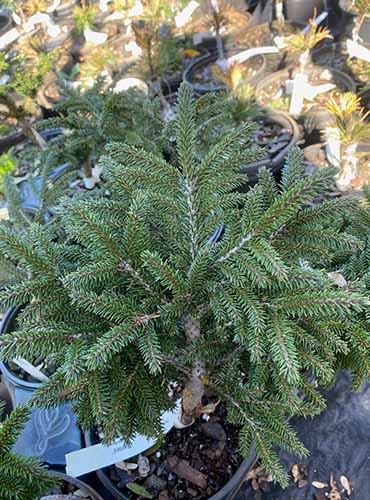
The shiny gray needles are soft to touch so you can grow it in areas where you might brush past without worrying about accidental stabbings.
Grab yours in one- or three-gallon containers at Maple Ridge Nursery.
3. Chirimen Hinoki Cypress
The first time I saw a hinoki false cypress (Chamaecyparis obtusa), I honestly thought it was fake. The foliage is so elegant and the shape so unusual that it just seems like it can’t be real.
‘Chirimen’ takes that unusual appearance and ramps it up 100 percent.
The long, upright, irregular branches are covered in short, deep green, crinkled needles. Young foliage is more lime green, but the slow growth means you’ll only see a little of it each year.
This dwarf conifer cultivar can grow over five feet tall and three feet wide, but it can take decades to get there.
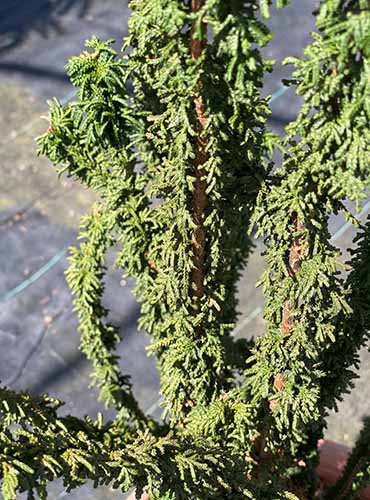
If you want something that will draw constant attention and comments, you couldn’t find a better option for Zones 4 to 8.
Maple Ridge Nursery carries this unusual conifer in one- and three-gallon containers.
4. Conica Alberta Spruce
A miniature version of the statuesque white spruce, dwarf alberta spruce (Picea glauca ‘Conica’) is a treat in the garden.
Whether you leave it in its natural conical shape or you prune it into a spiral or other topiary, this tiny Christmas tree is instantly recognizable.
The dense growth and compact needles of this conifer make it ideal for use as a privacy screen, in patio containers, or even in bonsai. Is there anything it can’t do?
Discovered in 1904 by naturalist John George Jack and botanical taxonomist Alfred Rehder at Lake Laggan in Alberta, Canada, it’s no surprise this cultivar thrives in the cold.
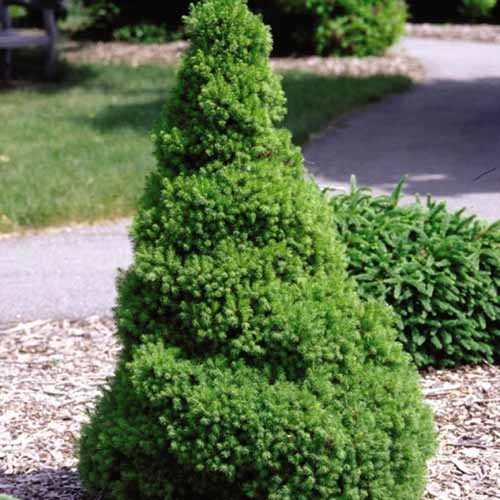
‘Conica’ is hardy in Zones 2 to 8 and typically matures around eight feet tall and five feet wide, though many stay much smaller.
You can find this cultivar in #1, #2, and #3 containers available at Nature Hills Nursery.
5. Dwarf Mugo Pine
Dwarf mugo pines (Pinus mugo var. pumilio) have a bit of a reputation. Plenty of gardeners have planted one expecting a petite shrub, only to end up with a monster.
The key is to choose a vegetatively propagated cultivated hybrid, not just anything labeled “dwarf.”
My grandma once planted a pair of mugo pines that grew so large she swore off anything with “dwarf” in the name ever again.
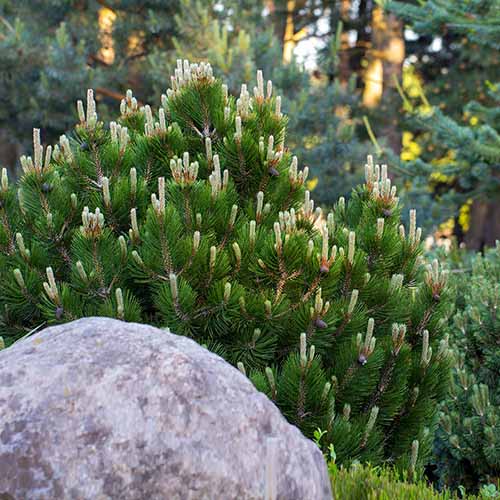
But if you pick the right one, you’ll be treated to a slow-growing evergreen conifer that eventually reaches five feet tall and 10 feet wide at most, though it usually remains smaller.
This dwarf conifer has a tidy, mounding habit and is hardy in Zones 2 to 8.
You can find plants in one-, two-, and seven-gallon containers available at Fast Growing Trees.
Learn more about mugo pines here and discover more varieties in our roundup.
6. Gimborne’s Ideal Japanese White Pine
It might be Gimborne’s ideal, but it’s mine, too. The petite Japanese white pine (Pinus parviflora) has dense clusters of blue-green needles with a distinct white stripe down the center.
‘Gimborne’s Ideal’ has a pyramidal shape and grows to about 10 feet tall over several decades.
With its twisted shape, this conifer looks like a full-sized bonsai that escaped its container and is happily growing in Zones 4 to 8.
7. Golden Mop Sawara Cypress
Most conifers are green, and we love them for it, but sometimes a golden pop of color is exactly what the garden needs. ‘Golden Mop’ delivers just that.
This sawara false cypress (Chamaecyparis pisifera) cultivar looks delicate, but don’t let that fool you.
It’s a tough, low-maintenance plant that thrives in Zones 4-8, with elegantly weeping branches covered in bright golden foliage.

Topping out around three feet tall and four feet wide, this dwarf cultivar fits neatly into small spaces while still making a big visual impact.
Purchase yours at Nature Hills Nursery in #2, #3, or #5 containers.
8. Golden Sands Sawara Cypress
‘Golden Sands’ is another sawara false cypress (Chamaecyparis pisifera) cultivar that sports eye-catching variegated foliage in lime green with cream-colored spots.
It has an airy, open form that matures to about three feet tall and just under three feet wide, creating a graceful, vase-like silhouette.

If you live in Zones 4 to 9, consider giving this conifer a spot in your garden.
You can find ‘Golden Sands’ available at Maple Ridge Nursery.
9. Goldilocks Japanese White Pine
I’m an unabashed lover of Japanese pines, and how adorable is little ‘Goldilocks’?
This white pine (Pinus parviflora) cultivar, sometimes written as “Goldylocks” and more accurately known as ‘Tenysu-kazu,’ has deep green needles tipped in blonde.

It has an irregular, upright form with graceful, sweeping branches. A slow grower, this compact conifer eventually reaches about eight feet tall and five feet wide, and it thrives in Zones 4 to 8.
‘Goldilocks’ performs best in a sunny spot, where the color can really shine.
You can find live plants in one- or three-gallon containers at Maple Ridge Nursery.
10. Green Penguin Scotch Pine
I mean, sometimes plant names are certifiably absurd, but ‘Green Penguin’ really lives up to its moniker.
One look at the pear-shaped dwarf scotch pine (Pinus sylvestris) and you can instantly see where the name comes from.
It has a naturally topiary-like form with a rounded top and wider base, creating a shape reminiscent of a waddling little penguin.
You won’t need to lift a pair of shears to keep this conifer looking manicured.

In Zones 3 to 7, this quirky cultivar grows to about six feet tall and three feet wide with a wider base and cute little round top.
I don’t know how you could say “no” to ‘Green Penguin’ if you’re in the market for a whimsical dwarf conifer.
You can find plants available in #5 containers at Nature Hills Nursery.
11. Koshyi Japanese Cedar
Endemic to Japan, a Japanese cedar (Cryptomeria japonica) is a sight to see. But most of us don’t have the space for the full-sized species.
That’s where dwarf options like ‘Koshyi’ come in. Happy in Zones 5 to 9, it’s a petite little conifer that grows slowly to form a tight, mounding shape about two feet tall and three feet wide.

It maintains a dense, compact habit even in partial shade, so you can add texture and evergreen color to those tricky, low-light spots in Zones 5 to 9.
You can find plants in three-gallon containers available at Maple Ridge Nursery.
12. Kotobuki Japanese Black Pine
Japanese black pines (Pinus thunbergii) are appreciated for their dramatic form and dark green needles, and ‘Kotobuki’ aka ‘Koto Buki’ offers those same traits in a smaller package.
This dwarf cultivar has short, dense needles and an upright, narrow growth habit that makes it useful in tight spaces or formal designs.
Over time, it can reach about four to five feet tall and up to four feet wide, but this conifer grows slowly and maintains a tidy, compact shape with minimal pruning.

‘Kotobuki’ is well suited to training as bonsai. If you want to add a Japanese pine to the landscape but don’t have much room, this is an excellent option for Zones 5 to 8.
You can find plants available at Maple Ridge Nursery.
Check out our guide to growing Japanese black pines for more information.
13. Mr. Bowling Ball Arborvitae
With a name like Mr. Bowling Ball®, you’d expect this arborvitae to be nearly perfectly round and ready to roll down the alley.
You’re in luck because that’s exactly what Thuja occidentalis ‘Bobozam’ delivers.

At three feet tall and wide when mature, with a perfectly round shape, it looks like you spent hours shaping your topiary, when all you did is put it in the ground and added some water.
This unique, beautiful arborvitae is hardy in Zones 3 to 8.
You can find Mr Bowling Ball® available at Nature Hills Nursery in #3 containers.
Get tips for growing arborvitae here.
14. Nana Hinoki Cypress
‘Nana’ is a true dwarf cultivar of the Japanese or hinoki false cypress (Chamaecyparis obtusa).
This conifer is extremely slow growing, which means you won’t have to worry about it outgrowing even the smallest of spaces.
After a decade, it might only reach nine inches tall. Eventually, it tops out around three feet high and four feet wide, but you’ll be waiting a long time to see it get there.

The elegant foliage and compact, mounding habit make this cultivar perfect for Japanese, rock, or container gardens in Zones 5 to 8.
It’s definitely one I’d recommend to anyone in the market for a dwarf conifer.
You can find ‘Nana’ available at Nature Hills Nursery in #3 containers.
15. Nana Japanese Garden Juniper
Japanese garden junipers (Juniperus procumbens) are naturally small anyway, but the most common cultivar, ‘Nana,’ is tiny.
Even when it’s fully mature, ‘Nana’ only grows to about a foot tall and maybe a touch over five feet wide.
The twining branches spread out gracefully, creating an elegant ground cover without having to do much at all.
You can influence its shape by the amount of space you provide. ‘Nana’ will sprawl in large areas or grow taller and more mounding in a smaller space.

‘Nana’ Japanese Garden Juniper
This conifer even nabbed the Royal Horticultural Society’s coveted Award of Garden Merit in 1993.
Introduced in Japan in 1922, it quickly spread around the world and is a wildly popular option in the US in Zones 4 to 9.
You can find plants available at Nature Hills in #2 and #3 containers.
Learn more about growing juniper here.
16. Niagara Falls Eastern White Pine
If you’ve ever admired the weeping eastern white pine (Pinus strobus ‘Pendula’), but you wanted it in miniature, meet ‘Niagara Falls.’
It was discovered in 1998 by Mike and Ken Yeager of Hickory Hollow Nursery in Tuxedo, New York as a branch mutation on a ‘Pendula’ but stays just a fraction of the size, topping out at just six feet tall and 10 feet wide over several decades.
The sweeping, cascading branches are lined with soft, two-toned needles, and the dense growth is so thick you can’t even see the wood underneath.

This dwarf conifer is hardy in Zones 3-8 and brings graceful movement and structure to the garden.
You can find ‘Niagara Falls’ in one- and three-gallon containers at Maple Ridge Nursery.
17. Piccolo Balsam Fir
‘Piccolo’ is a globose, mounding, ultra-compact balsam fir (Abies balsamea) with dense, tiny needles.
In spring, brown buds appear before giving way to petite cones that add seasonal interest.
It’s a slow grower that stands out from other conifers in that it loves being in partial shade.

This cultivar will take years to reach its full size of two feet tall and wide, so you don’t have to worry that it will outgrow the space in your garden. It’s hardy in Zones 3 to 9.
You can find ‘Piccolo’ available at Maple Ridge Nursery.
18. Pumila Norway Spruce
I adore a Norway spruce (Picea abies), but I don’t have room for such a towering tree in my yard.
Thankfully, someone in the mid-1800s discovered ‘Pumila,’ a compact cultivar that lets small-space gardeners enjoy all the grandeur of the species.
This mounding shrub, covered in dense blue-green needles, grows slowly to about four feet tall and five feet wide.

It’s a classic, no-fuss dwarf conifer that thrives in Zones 3 to 8 and brings all the stately charm of a full-sized Norway spruce in a far more manageable package.
You can find ‘Pumila’ in #3 containers at Nature Hills Nursery.
Find tips for growing Norway spruce here.
19. Tompa Norway Spruce
While the species is a sight to behold, a dwarf Norway spruce (Picea abies) can be just as impactful without taking up so much space.
That’s the case with ‘Tompa,’ an adorably small conifer with a dense, compact pyramidal shape.
When mature, it’s a mere three feet tall and two feet wide at the widest point and will maintain its topiary-like shape without any complicated pruning.

Hardy in Zones 3 to 8, it’s a low-maintenance way to add evergreen character year-round.
You can find ‘Tompa’ available from Maple Ridge Nursery in one- and three-gallon containers.
Small But Mighty
There’s no reason any garden has to be without a conifer, no matter its size constraints.
Most of the dwarf conifers listed above are suitable for container growing or can adapt to even the smallest area provided they receive enough sun.

Do you have a favorite from the list? Or is there a beloved dwarf conifer in your yard that we didn’t include? Let us know in the comments section below!
And for more information about growing conifers in your landscape, check out these guides next: