Native plants have been gaining well-deserved attention in recent years, and among the most fascinating of these are the orchids found growing wild across North America.
While many associate these plants with tropical climates and grocery store displays, there are actually dozens of native species thriving in forests, grasslands, wetlands, and even alpine regions across the continent.
Pretty much every area in North America has its own orchids growing wild.

We link to vendors to help you find relevant products. If you buy from one of our links, we may earn a commission.
You can find them on the frigid slopes of the Yukon in Canada, all the way down to Florida, with its abundance of species. Only those in the driest desert climates are deprived.
Our guide to growing orchids covers the wide variety of plants in the Orchidaceae family and gives an overview of cultivation.
But even if you aren’t interested in growing them, you might just want to know about what grows in your area so you can keep an eye out while you hike.
I could talk about both orchids and native plants all day, but we’ll try to keep it organized and brief. Here are the topics I’ll go over:
What You’ll Learn
What Are Native Plants?
First, let’s define what a “native” plant is. A native or indigenous species is one that has evolved over thousands of years to grow in a certain area without human intervention.
Most botanists define a plant as “native” if it has been present in a region for at least a thousand years.

This time period is generally considered sufficient for the species to have adapted to local conditions and evolved alongside the area’s wildlife, making it a functional part of the ecosystem regardless of how it first arrived.
Every orchid species is native to somewhere.
For example, the popular Phalaenopsis that appears in practically every grocery store in North America is native to most of Asia and Oceania, but not North or South America. So it’s a “native” orchid, just not to the Americas.
So, knowing that, why do we care?
Indigenous species have evolved alongside the bees, butterflies, moths, and other native insects in an area.
As a result, local wildlife is well adapted to use these plants for food and shelter, while the plants often benefit through pollination and other ecological interactions.
Numerous studies show that local pollinators are both more abundant and more effective around native species.
In most regions, native and non-native species grow side by side.
For example, Norway maples (Acer platonoides) are considered a nuisance in Canada, while the native sugar maple (A. saccharum) is a beloved maple. Both are grown there, but only one evolved there.
In Florida, Chinese crown orchids (Eulophia graminea) have become invasive and are pushing out indigenous species.
So, in this list, we’re going to talk about indigenous species in North America.
If you live in Australia, Europe, Asia, South America, or somewhere else, these plants likely won’t qualify as “native” to your region.
Native North American Orchids
Florida is a hotbed of floral abundance with about 100 species growing in the state.
Altogether, there are over 200 native species across North America, covering every corner of the country including Alaska. If you add Hawaii, the number is even higher.
There were once even more species, but some are now extinct in the wild and can only be found in private collections.
The rat tail orchid (Bulbophyllum pachyrachis) needed a better publicist because “rat tail” doesn’t do it justice.
It does produce a long, dangling pseudobulb that resembles the tail of a rat, but the purple, red, green, and brown flowers are striking. Sadly, it’s no longer found in its south Florida home.
Here are some common species you may come across:
Butterfly
The Florida butterfly orchid (Encyclia tampensis) is widespread across the state and among the most common native species.

It’s an epiphyte that generally grows on trees along waterways.
The narrow, grass-like leaves aren’t particularly distinctive but each stalk can produce up to 45 flowers, and the plants tend to cluster together with an abundance of flowers.
Highly fragrant blossoms appear in shades of yellow, cooper, pink, bronze, and green, with white labellum.
The intensely fragrant rufous butterfly (E. rufa) also grows in Florida but it’s endangered and rare to encounter.
Coralroot
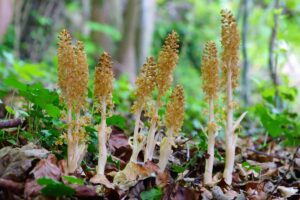
With seven species of Corallorhiza in North America, your chances of spotting this terrestrial orchid are pretty good if you live near a temperate forest.

They grow in both coniferous and deciduous forests and rely on the ectomycorrhizal fungi in the soil to survive, since most species lack the ability to photosynthesize.
Interestingly, many plants bloom once in their first year and then vanish underground for several years before re-emerging.
If you come across one in the wild, don’t be surprised if it isn’t there the following season, though you can usually find others nearby.
They produce tall, straight stalks lined with small flowers that are easy to overlook unless you examine them closely.
The blossoms can be yellow, brown, green, orange, red, or even multicolored.
Corduroy
There are dozens of corduroy orchids (Eulophia spp.) across the glove, with just a few native to North America. The wild coco (E. alta) and giant (E. ecristata) species grow across the South.

One Asian species, Chinese crowned (E. graminea) has escaped cultivation and naturalized in the same area.
Wild coco is one of the largest orchids native to the South, producing racemes that can hold up to 50 flowers each.
Blooming for as long as six months beginning in June, it displays white, green, brown, crimson, and purple blossoms, and can reach more than three feet in height when flowering.
Giant corduroy orchids are about the same size, but the flowers are a bit less showy and are primarily yellow and crimson. They are endangered in much of their range.
Both species are terrestrial, typically found growing in wet, boggy soils.
Fairy Slippers
Fairy slipper orchids (Calypso bulbosa) are found in eastern Canada and the northeast US, across to western Canada and the Pacific border.
They are rare in some areas, such as Vermont and Michigan, but more abundant in places like Maine, Washington, and Oregon.

There are two varieties. Western fairy slipper (C. bulbosa var. occidentalis) inhabits the western part of the range and C. bulbosa var. americana, which appears throughout the rest of the range except in California, Oregon, and Idaho.
Each plant bears a single two-inch basal leaf and a slender stalk topped with one, occasionally two, flowers.
Blossoms are pink to magenta, with a pouch-like labellum that gives the plant its common name.
The varieties differ mainly in the coloration of the labellum, which may display varying amounts of pink and white, sometimes with yellow highlights.
In most of its range, this species is found in boggy, wet areas, though it can grow in drier spots in the Pacific Northwest.
Fringed
Sometimes called bog orchids, fringed orchids (Platanthera spp.) are found worldwide in temperate regions, typically in marshes and bogs.

Historically, P. hyperborea was thought to occur in Alaska and western Canada, with spikes of pale-yellow flowers and ovate leaves.
But recent research has revealed that P. hyperborea is largely restricted to Greenland, Iceland, and parts of the Arctic.
Many North American populations once labeled as P. hyperborea are now recognized as a separate species, P. aquilonis which sports small, greenish-yellow blooms.
Round-leaved bog orchid (P. orbiculata) can be found growing across Canada and northern US, with some reaching as far as South Carolina. It bears spikes of greenish-white flowers.
Hooker’s bog (P. hookeri) has ovate leaves and spikes of green flowers. It grows in northeastern US and eastern Canada.
Galearis
The Galearis genus includes two species that grow in North America.
The first is showy (Galearis spectabilis), which grows east of the Rockies, and the second is roundleaf or round-leaved (G. rotundifolia), which grows above the 45th parallel.

Both species bloom early in the spring before the trees leaf out and then fade when the forest trees under which they grow fill out.
Roundleaf is so named for the single basal leaf of the juvenile plants, which is distinctly circular. Mature plants produce a tall stalk bearing numerous small flowers in shades of pale pink, mauve, and white.
The showy orchid has two ovate leaves with shorter stalks of white and pinky-purple flowers.
Sadly, it’s considered endangered or threatened in all parts of the US and many parts of Canada.
Both species are terrestrial, growing in shaded forest habitats.
Ghost
You’re unlikely to encounter the ghost orchid (Dendrophylax lindenii) in the wild.
It only inhabits the everglades in Collier and Hendry counties in Florida, where it grows on trees as an epiphyte in swampy forests on pond apples (Annona glabra) and pop ash (Fraxinus caroliniana).

It’s at risk of extinction and enthusiasts consider finding one a major success. Harvesting one from the wild is illegal.
This species lacks the typical leaves, bearing only stems and scale-like foliage. When it blooms, it sends out a long spike with intensely fragrant white flowers.
You can’t see the roots, which anchor into the tree, which makes the flowers look like tiny floating ghosts hovering around the tree trunk.
If you want to read a non-fictional story about hunting, poaching, and propagating this striking plant, check out “The Orchid Thief” by Susan Orlean. Pick up a copy at Amazon.
Learn more about ghost orchids here.
Habenaria
Water spider orchid (Habenaria repens) doesn’t bear just a passing resemblance to a spider.
The shape certainly resembles an arachnid, plus it has markings that make it look even more spider-like.

If you didn’t know it was an orchid, you might think you were looking at a plant with a spike covered in spiders.
This species grows in wet habitats across the South, producing tall racemes densely packed with flowers in shades of white, green, yellow, and brown.
The similar-looking, though slightly less spider-like, toothed rein (H. floribunda) and Michaux’s (H. quinqueseta) are the most abundant orchids in Florida.
Lady’s Slipper
Cypripedium species are known as lady’s slippers, but they’re sometimes called hardy orchids because the plants are able to tolerate freezing temperatures.
There are 13 species indigenous to North America.

C. acaule and showy C. reginae grow in the east, clustered (C. fasciculatum) in the Pacific Northwest, and mountain (C. montanum) in the mountain states. California and Oregon boast the California lady’s slipper (C. californicum).
The genus name translates from the Greek as “slipper of Aphrodite” referring to the inflated labellum – the pouch-like lower petal – that resembles a small shoe. The common name is an English description of the same.
They’re terrestrial, bearing yellow, red, magenta, pink, cream, or white flowers, and grow in woodland environments.
Harvesting lady’s slippers from federal lands is illegal, and transplanting them is rarely successful, as the plants usually die after being moved.
Lady’s Tresses
Spiranthes species, commonly known as lady’s tresses, are found across North America.
Hooded lady’s tresses (S. romanzoffiana) grow in the Pacific Northwest, while little lady’s tresses (S. tuberosa) are more common in the southern and central United States.

In the east, nodding lady’s tresses (S. cernua) is widespread, along with slender lady’s tresses (S. lacera), short-lipped lady’s tresses (S. brevilabris), and fragrant lady’s tresses (S. odorata).
Unlike some orchids, many Spiranthes species are not as frequently poached and I suspect that’s because they don’t look like your typical orchid.
Many have grass-like leaves at the base and tall spikes of white or yellow flowers which can be mistaken for speedwell or lobelia.
As hardy terrestrial species, lady’s tresses are adaptable and can thrive in gardens as well as in the meadows, fields, and woodlands where they grow naturally.
Rattlesnake Plantain
Rattlesnake orchids, or rattlesnake plantains (Goodyera spp.), are widespread across North America.
In the northwest, the giant rattlesnake plantain (G. oblongifolia) is most common.

The downy species (G. pubescens) grows across the eastern half of the continent, while the dwarf species (G. repens) is found throughout northern regions above the 45th parallel, except in the Pacific Northwest. It also occurs in parts of the southwest.
These species are terrestrial and are easily identified by their evergreen leaves which form a rosette at the base of the plant.
The foliage is marked with distinctive pale veins and dark mottling, a pattern reminiscent of a rattlesnake’s skin. Their flowers are small and white, borne on upright stalks.
Rattlesnake orchids typically grow in coniferous or mixed forests, where they thrive in the shady understory.
Recognizing Wild Species
Before we jump in here, a warning: never harvest or remove orchids from the wild.
Many species are endangered. Unless you are certain of the species and know it is legal to collect in your area, leave them untouched.

Take photos or sketch them in your field journal, but leave them alone so we can continue to enjoy these special plants in the future.
With that out of the way, let’s talk about identification.
As you probably surmised from the list above, these plants come in a wide range of shapes and sizes.
Some have grass-like leaves, some have oval leaves with distinct patterns, and some appear to have no leaves at all.
Unless you have an expert with you or an incredibly detailed book, it’s going to be hard to identify any plant that isn’t in bloom.
You might have the best luck researching those that grow in your area and start your hunt by looking for epiphytes, in particular.
Epiphytes are usually the easiest to spot since relatively few plants grow attached to trees.
If you see one clinging to a trunk or branch, chances are good it belongs to this group, and you can often narrow it down to genus or species with further research.
Terrestrial orchids are a bit more challenging unless they’re in bloom.
When flowering, your job is easier as almost all orchids are symmetrical, with three sepals, two petals, and a column and labellum (or lips) at the center.
The sepals include the uppermost segment and two lower segments that resemble petals. The true petals extend outward near the top, like raised arms.
At the center is the column, which contains the reproductive organs, while the labellum acts as a landing platform to guide pollinators.
All species will have these elements, but they can vary in size, color, and shapes.
Some species have a massive top sepal, some have fused sepals giving them a bell-like appearance, and sometimes the lower, lateral sepals will fuse together.
The labellum may be petite or long and elegant, as with ghost orchids.
It is typically colorful, has a different color or pattern to the rest of the petals, and is modified in some way to attract pollinators.
These modifications can include hairs or tails, ruffles, pouches, mohawks or crests, and fans. The flowers may or may not be fragrant.
Landscaping with Native Orchids
When you buy your plants, ask how they were obtained. Some unscrupulous vendors poach wild plants and sell them, while those cloned in a lab will often be labeled “mericlone.”

Because native orchids are adapted to local conditions, many can be grown outdoors.
You might display them in containers, plant them directly in the ground for a more natural look, or mount epiphytic types on trees to mimic their wild habitat.
Learn the conditions that the particular species you want to grow requires and try to recreate those in your garden.
For example, if you want to grow a rattlesnake plantain, you’d want to plant it in loose, rich, loamy, well-draining soil in a shady spot, like you’d find in its natural environment.
A butterfly orchid, by contrast, should be mounted on a tree or grown in a loose, chunky potting medium to reflect its epiphytic nature.
Explore Your World Close to Home
I love that native plants are gaining more attention and finding a place in home gardens.
They benefit the environment and introduce gardeners to an often-overlooked world of diversity. North America, in particular, is rich in native species – if you know where to look.
Want to talk some more about indigenous plants or orchids? Is there something I missed or a question you didn’t get answered? Jump in the comments and fill us in!
And if you’d like to learn more about orchids, we’ve got your back! Add these guides to your reading list next: