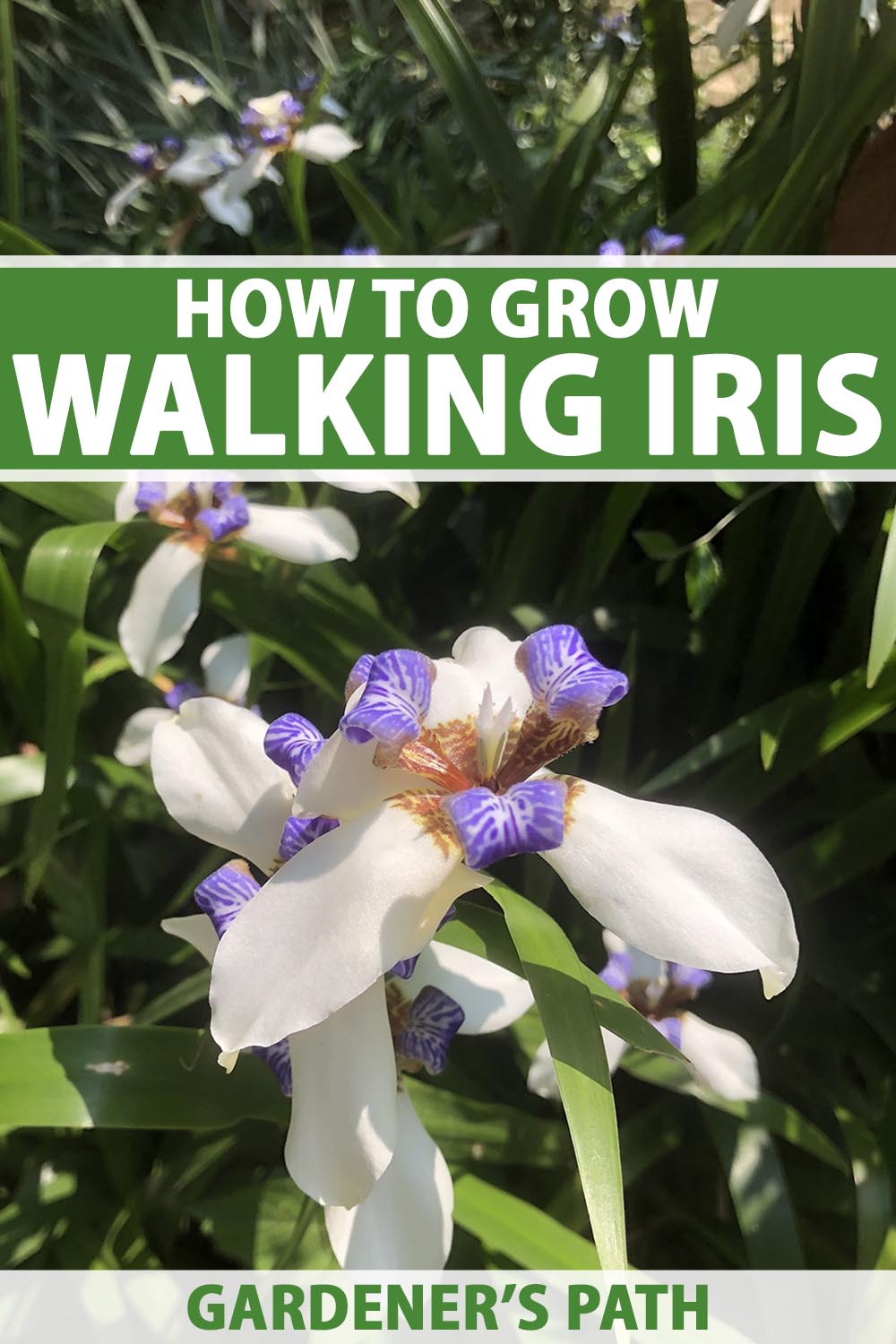
Trimezia spp. (syn. Neomarica spp.)
Irises are delightful flowers that add vibrant color and vertical interest to spring landscapes.
Unlike many common garden varieties suited to Zones in the 3 to 10 range, walking irises, Trimezia spp., prefer the year-round warmth of Zone 10 and 11 gardens.
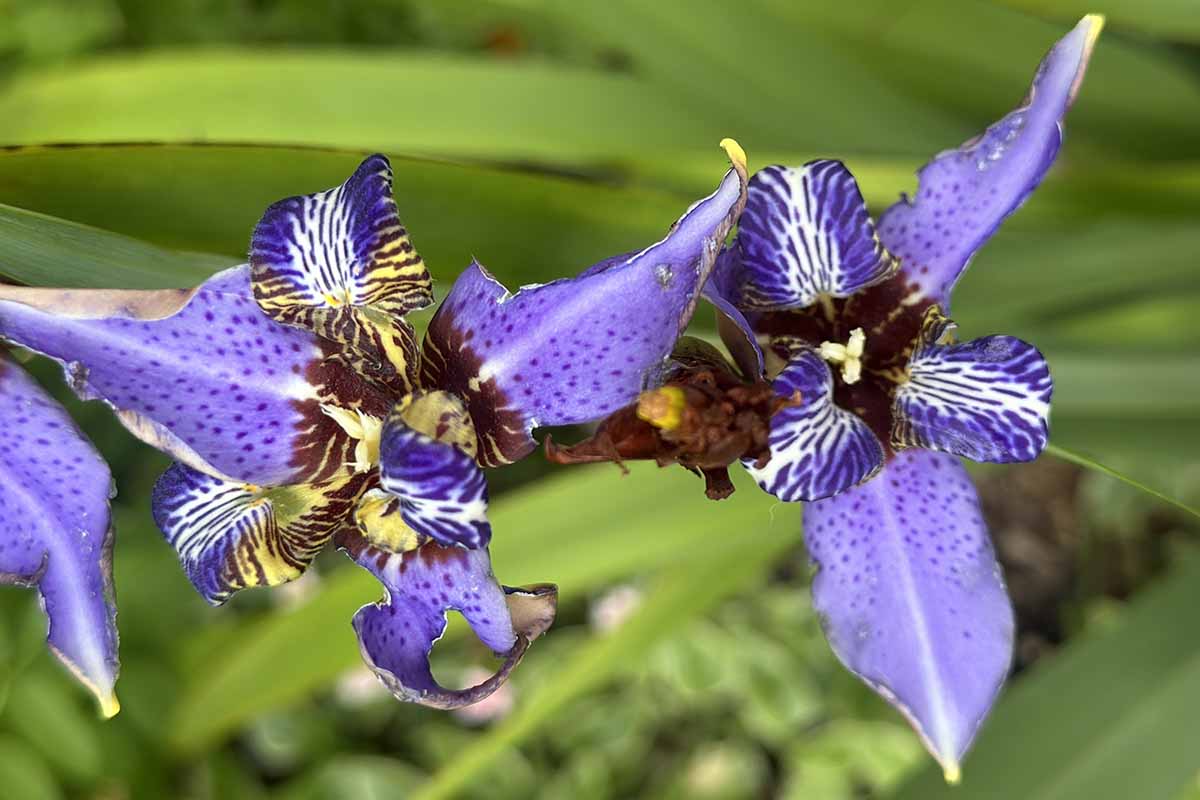
While walking irises have the typical slender flower stalks with blue, purple, white, or yellow blossoms, fanned-out, sword-like leaves, and clumping growth habit we have come to identify with irises, they offer some exceptional features.
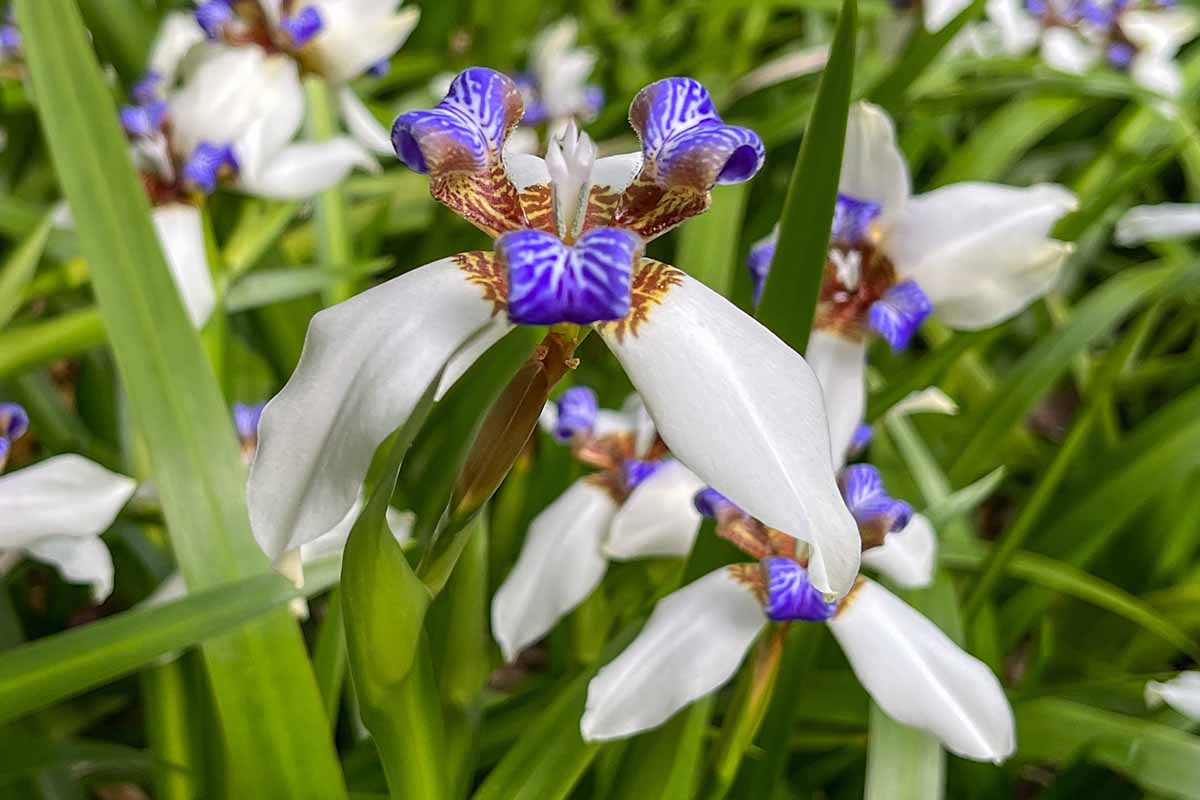
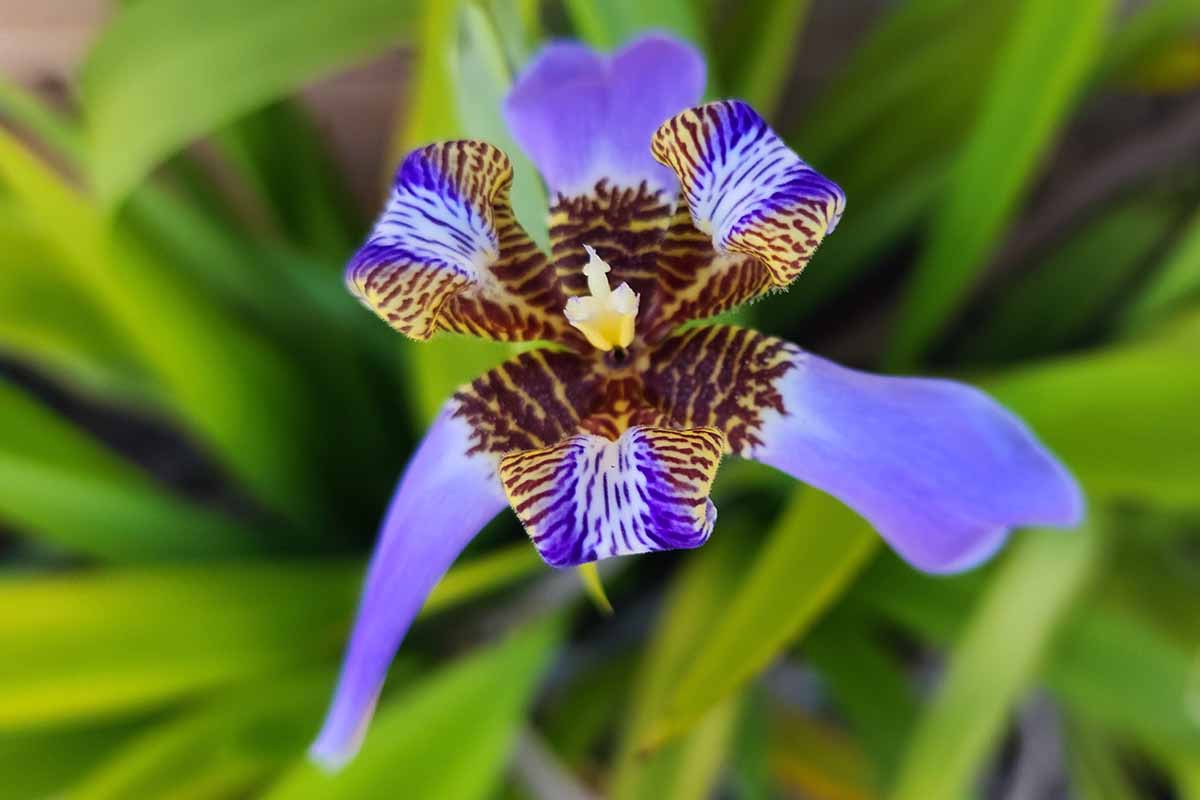
The flowers are mildly fragrant. The outer petals extend horizontally, instead of drooping, and the inner ones curl under, instead of standing upright.
Contrasting accents complete the unique combination, creating an enchanting impression of an orchid.
In addition, after the flowers bloom, each bare stalk grows a “plantlet” at the tip.
The weight of the new growth bends the stalk to the ground, where the tip shoot roots, giving the impression of “walking” through the garden as it self-propagates.
In this guide, I’ll cover how to cultivate walking irises in your landscape. Here’s what’s ahead:
What You’ll Learn
Walking irises are also called apostle plants because folklore has it that 12 leaves, like the 12 biblical apostles, grow before blooming begins.
You may also see them referred to as fan iris or poor man’s orchid.
These attractive flowering perennials were previously members of the Neomarica genus before being absorbed by the larger Trimezia genus.
Not all botanists agree on this reclassification, so both terms are used interchangeably.
Also, note that there are species listed under both classifications that do not exhibit the walking trait, although some may be called walking irises.
You’ll find examples in the cultivars section below.
Quick Look
Common name(s): Apostle plant, apostles’ iris, fan iris, poor man’s orchid, walking iris
Plant type: Rhizomatous perennial
Hardiness (USDA Zone): 10-11
Native to: Central and South America, primarily Brazil
Bloom time / season: Spring; continuing through summer in the warmest Zones
Exposure: Dappled shade, filtered sunlight, afternoon shade
Soil type: Moist, average to sandy loam, well-draining
Soil pH: 5.8-6.2, slightly acidic
Time to maturity: 1-2 years
Mature size: 2-5 feet tall by 2-3 feet wide
Best uses: Beds, borders, containers, drifts, houseplant, mass planting, shade gardens
Taxonomy
Order: Asperagales
Family: Iridaceae
Genus: Trimezia (syn. Neomarica)
Species: Candida, coerulea, gracilis, longifolia, northiana, steyermarkii
Because they increase their landscape footprint by rhizome expansion and plantlet propagation, walking irises need room to roam.
Space them generously along the back of a foundation planting to anchor shorter flora in front.
Mass plant them in a border along a walkway or a standalone mid-lawn drift. Add a few richly-hued walking iris specimens to a mixed bed in your shade garden.
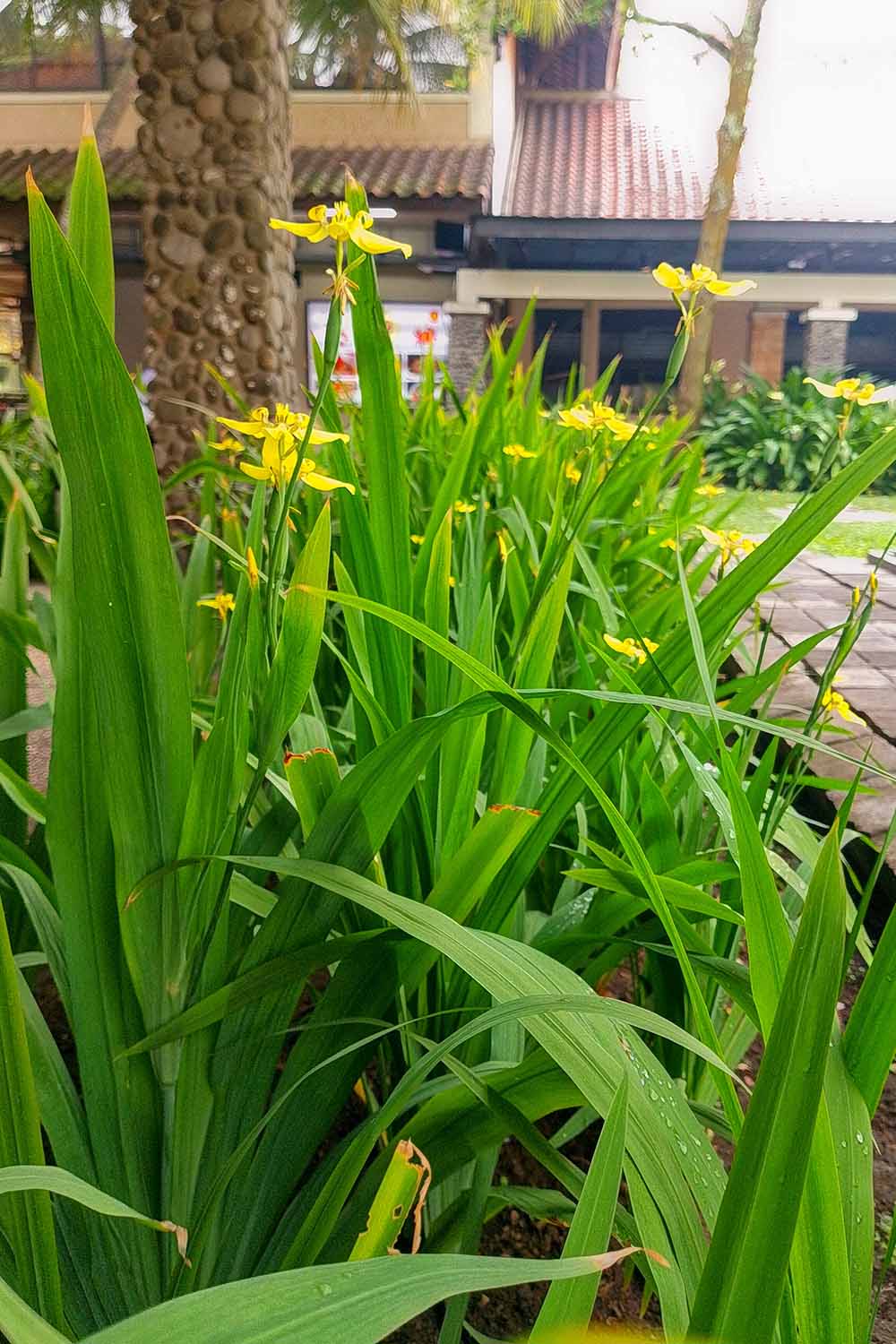
You can also grow walking irises in containers. If you live in a Zone that freezes, you can bring the plants indoors for the winter or even grow them as houseplants year-round.
With their growing needs met, walking irises will make a spectacular spring showing with flowers blooming in succession along the stalks, each lasting one day.
Sporadic blooming all the way to fall is possible under ideal conditions.
Versatile and varied, you’re sure to find ways to love and care for walking irises, especially when you understand their cultural requirements.
How to Grow
Walking irises are endemic to Central and South America, including the Amazon Basin of Brazil, where they thrive in subtropical and tropical climates.
They experience abundant rainfall, high humidity, and temperatures averaging 72 to 92°F.
In southern Brazil, the temperature may briefly dip below freezing, and the blue species that grows there is hardier than most.
Gardeners in Zones 10 and 11 with rainy springs, humid summers, and mild winters are best positioned to grow Trimezia.
For indoor cultivation, provide a temperature of at least 70°F and humidity above 50 percent, to mimic tropical conditions and offer the best chance of success.
Light
Walking irises grow natively in the dappled shade of rainforest canopies and do well in locations with some sun protection.
If you are in one of the warmest regions, morning sun and afternoon shade are ideal.
For those growing indoors, bright, indirect sunlight is best for keeping the leaves green and lush.
Soil
In the Brazilian rainforests, the soil is acidic and nutrient-poor.
Because the rhizomes sit high in the ground and plantlets propagate on the soil surface, they are able to absorb nutrients from rich organic debris, like leaf litter.
To replicate these conditions, gardeners should grow in average to sandy loam with a slightly acidic pH of 5.8 to 6.2.
Water
In the wild, walking irises have perpetually “wet feet.”
However, unlike the blue flag and Japanese irises that thrive in marshes, and Siberian types that tolerate the occasional deluge, these rainforest dwellers may rot in standing water.
To provide consistent moisture without oversaturation, water when the top two inches of soil are dry.
Use a moisture meter as your guide and take forecasted rain into account when making judgments.
Moisture needs vary by the season. In Zones 10 and 11, where the foliage is evergreen, you will need to monitor them year-round.
Fertilizer
Apply a low-nitrogen fertilizer, such as a 6-10-10 N-P-K, at half-strength in early spring, and monthly through the summer.
Avoid high-nitrogen products as these will encourage excessive foliage growth at the expense of flowers.
For container gardening, many folks mix half potting soil and half perlite or coconut coir for a moisture-retentive, well-draining substrate. Fertilize from spring through summer as above.
Note that the rhizomes prefer a snug fit which helps to prevent oversaturation. There should be no more than one inch of space around and under the rootstock.
Species and Cultivars
Here are some lovely options to consider:
North’s False Flag
T. northiana has white outer petals, yellow centers with brown speckles, and violet-blue inner petals.
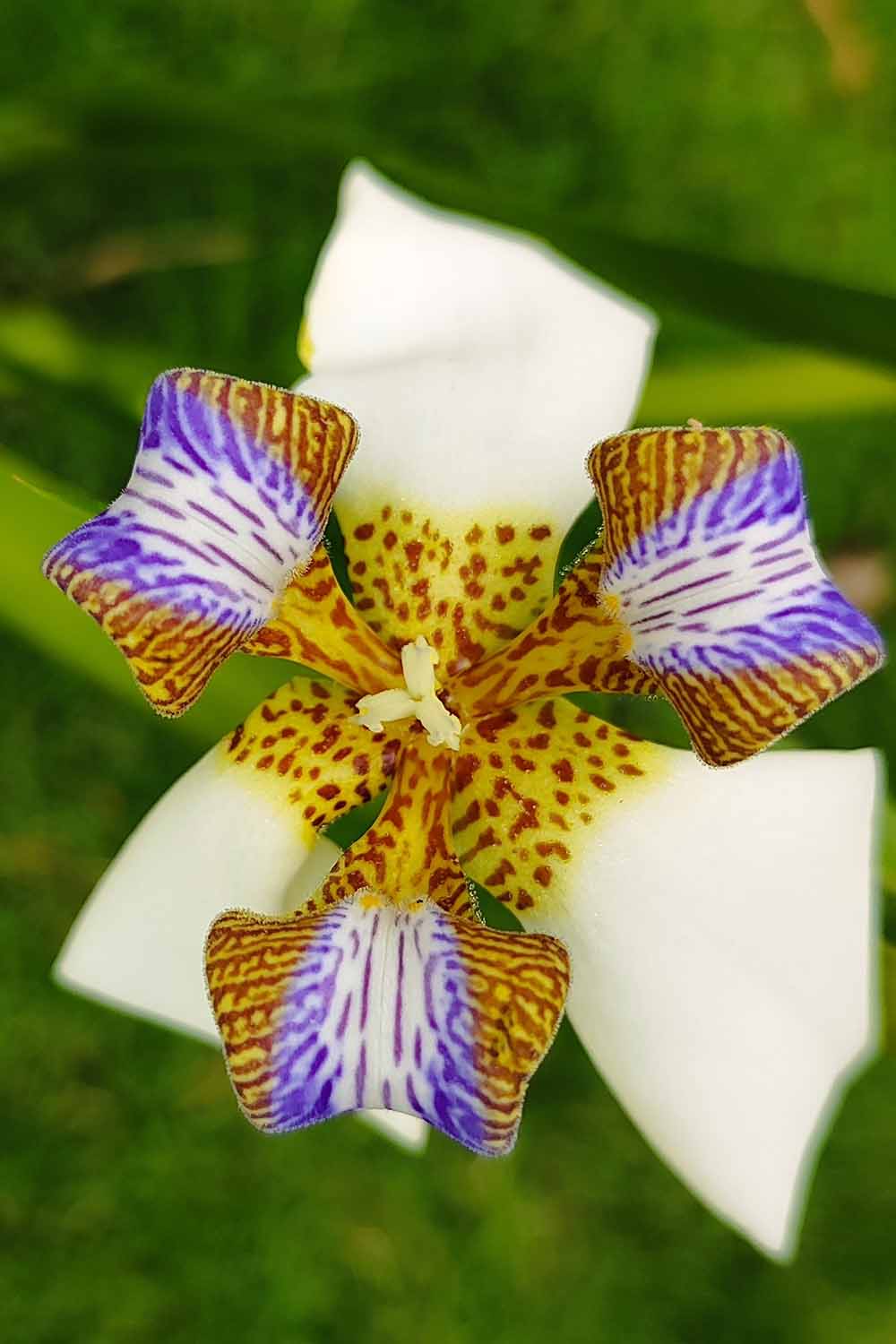
It is so similar to T. candida and T. gracilis that they are often sold interchangeably. Mature heights are two to three feet.
Walking Iris
T. gracilis has white outer petals and violet-blue inner ones.
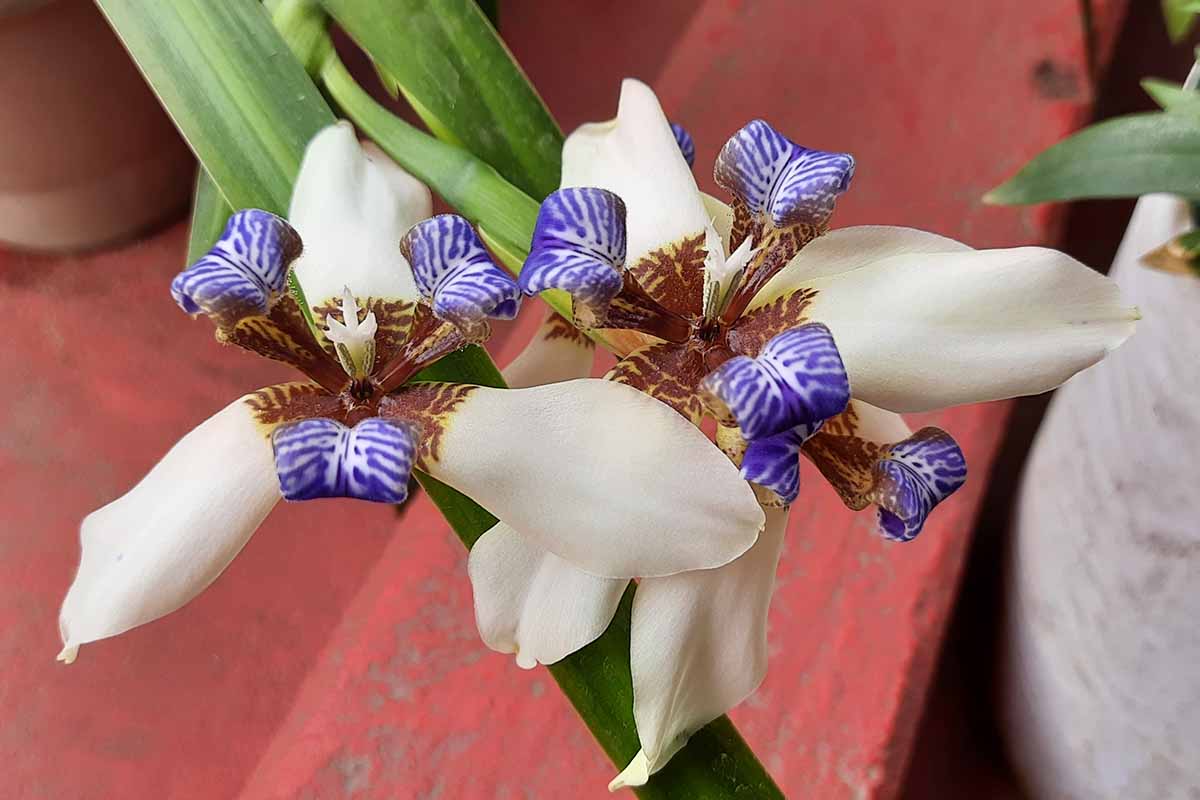
It closely resembles T. northiana and T. candida, but a close inspection reveals throat markings that are predominantly solid brown.
Mature heights are 12 to 28 inches.
T. gracilis is the species you are most likely to encounter when shopping for walking irises.
Blue
The blue walking iris, T. coerulea, aka giant queen iris, or giant apostles’ iris, and the cultivated variety ‘Regina,’ have especially sturdy, upright flower stalks.
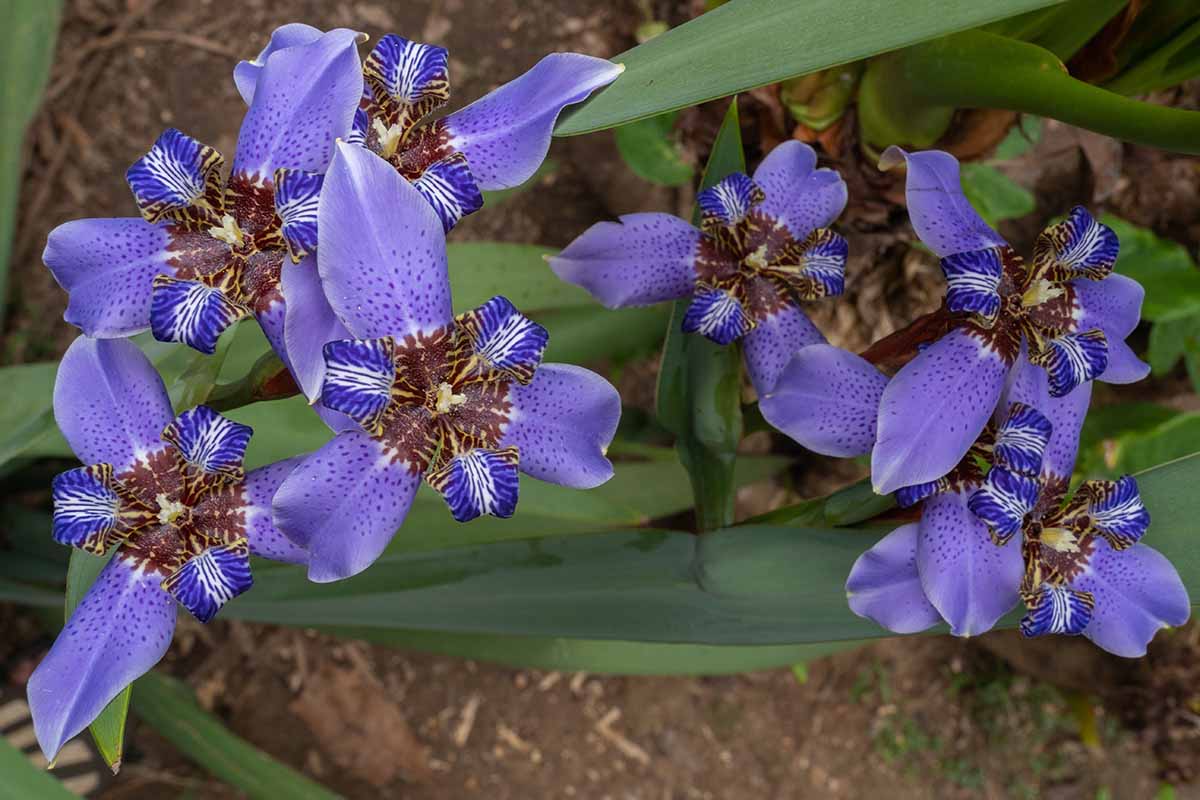
They can reach heights of approximately three to five feet.
Although they don’t bend post-bloom, they do grow tip plantlets that are easily removed for propagation. What was nature thinking?
The blue types are some of the most cold hardy, withstanding the occasional dip to 25°F.
White
T. candida has white outer petals, yellow and brown striped center markings, and violet-blue inner petals. It is very similar to T. northiana and T. gracilis.
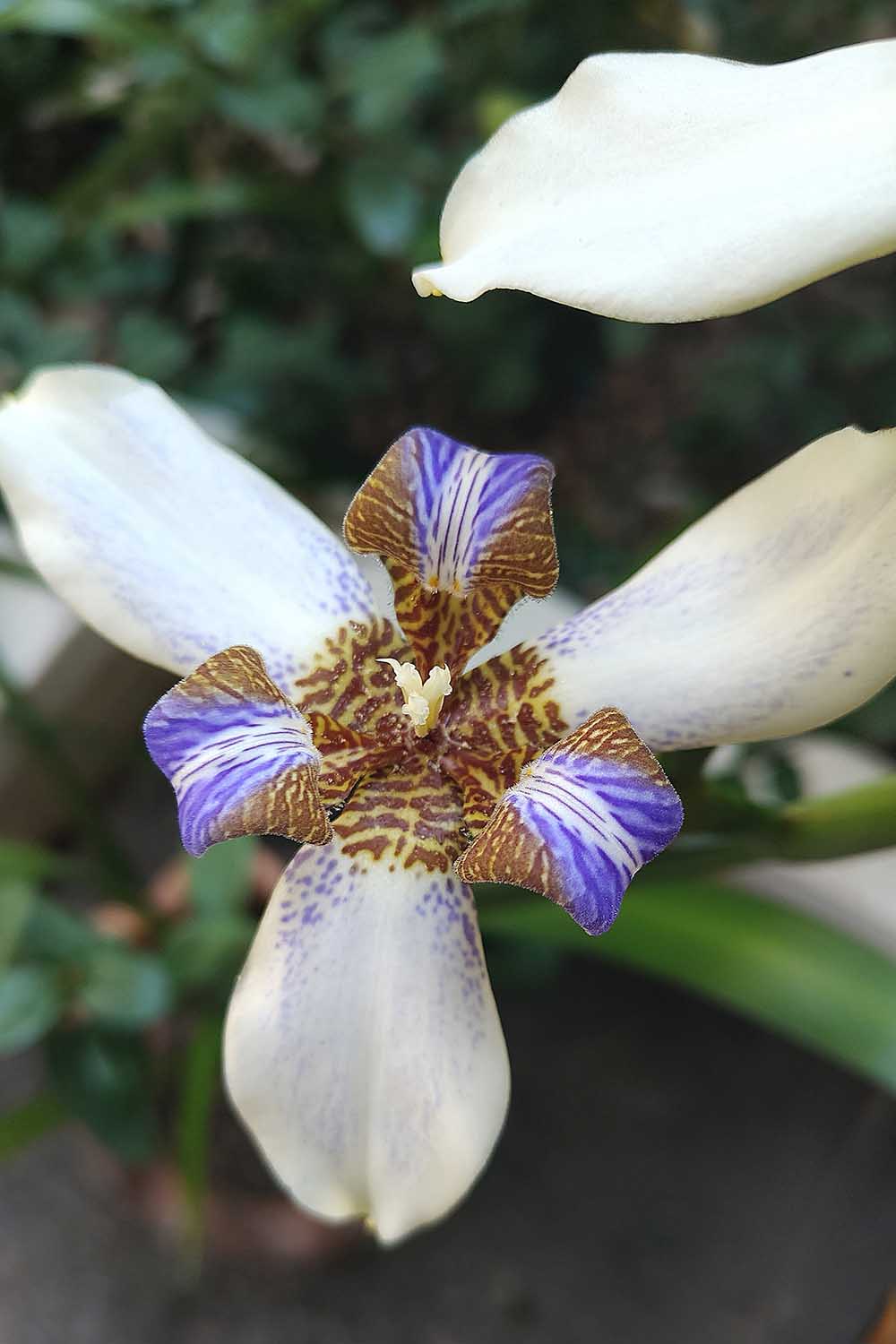
Mature heights are 18 to 36 inches.
Yellow
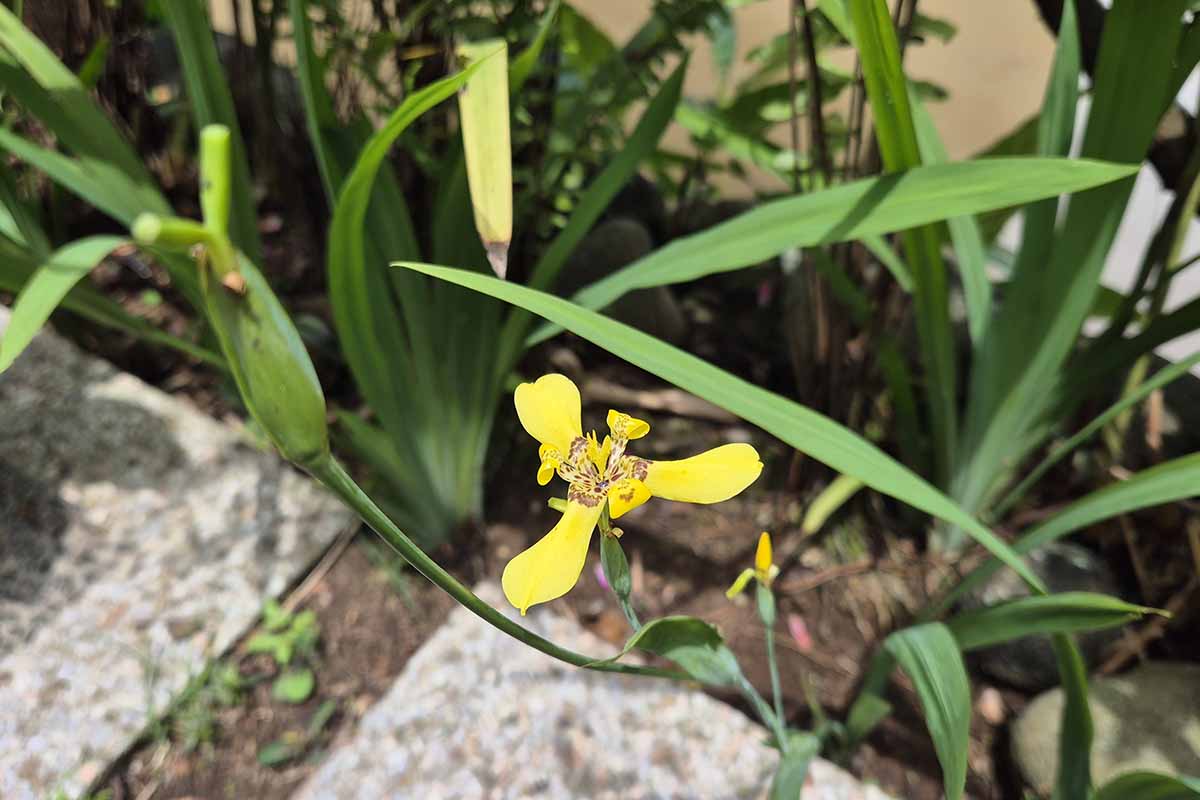
Flat-stalked T. longifolia and round-stalked T. steyermarkii have bright yellow flowers with contrasting brown mottled centers.
They are sold interchangeably, and other than their flower stalks, are virtually indistinguishable.
Mature heights are 36 to 48 inches and these are suitable for cultivation in Zones 8 to 11.
You may find the foliage freezes to the ground in Zones 8 and 9.
However, as long as the rhizomes don’t freeze, they will regrow the following spring. Resist the temptation to mulch, as it may cause rotting.
Maintenance
Maintenance requirements are moderate. Remove damaged or discolored leaves as needed to maintain health and aesthetics.
Once a flower stalk finishes blooming and bends to the ground, the new shoot at the tip will root.
You can snip off the spent flower stalk by severing it at the base and just above the rooted plantlet.
To prevent unwanted spreading, remove spent flower stalks before the plantlets root, or pull them up like weeds.
Remember to fertilize in early spring and monthly through the summer.
Container gardeners may need to divide and/or repot every three years or so.
If you see roots protruding from the drainage holes or the pots looking overcrowded, that’s a sign you need to repot to maintain an inch of space around and below the roots.
To repot, select a container that is no more than one inch deeper and wider than the root mass.
Fill the bottom third with a well-draining, moisture-retentive potting medium containing one part potting soil and two parts perlite or coconut coir.
Unpot the plant from its existing container, discarding most, but not all of the original soil.
Set the plant at the same depth as it was in its original pot and backfill with potting medium.
Water lightly and tamp the soil firmly.
Propagation
There are four easy ways to start these plants: sow bare rootstock, propagate plantlets, divide an existing clump of foliage, or buy mature nursery stock.
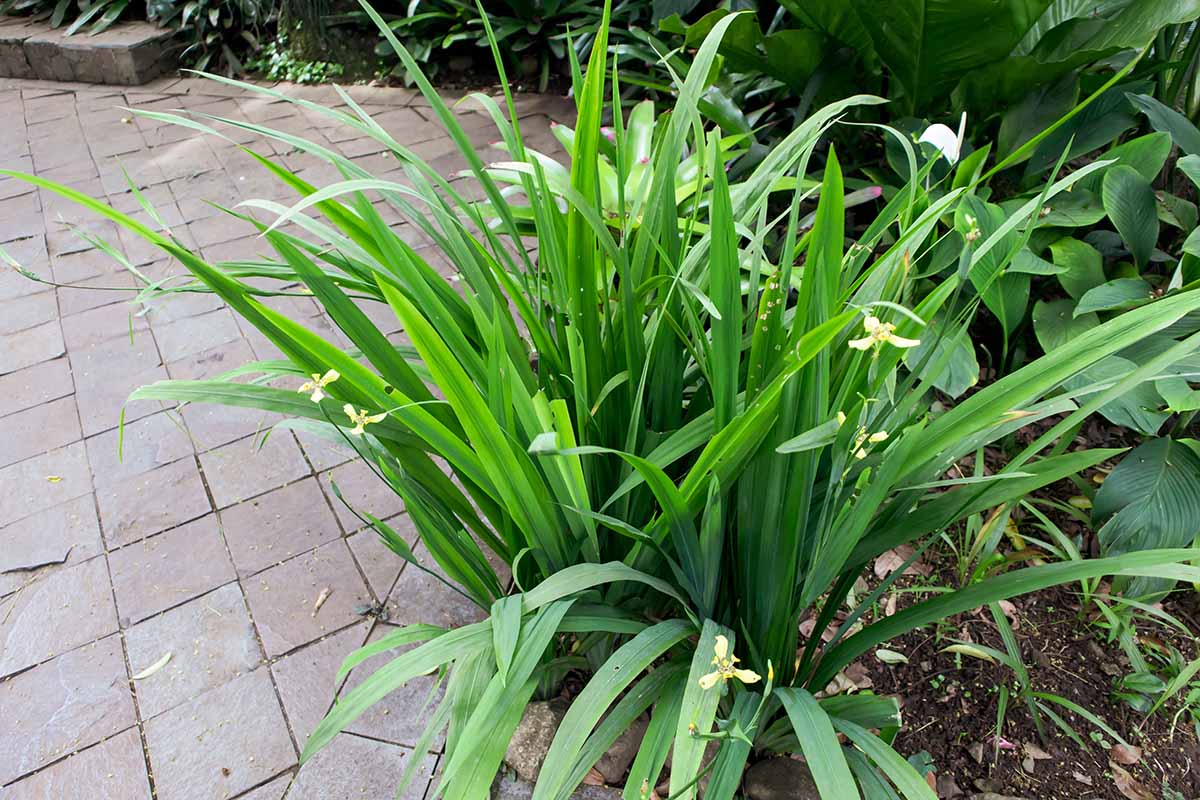
Let’s explore each.
Bare Rootstock
Some nurseries sell walking irises as bare rootstock ready for spring planting.
Each specimen has a rhizome at the base with fine, protruding roots. There is a fan of foliage at the top that is trimmed short for safe transport.
Set the rootstock two inches deep in garden or potting soil and water it well.
Space multiple rhizomes 24 to 36 inches apart in the ground. For container gardening, select a container that is no more than an inch wider and deeper than the root mass.
From Plantlets
When the plantlets bend toward the ground post-bloom, you have two options:
- Let them root naturally.
- Cut them off and root in soil or water.
Let’s consider each.
You can do nothing and let the tip shoots root in the soil and grow where they land.
Some gardeners like to assist them by pushing a U-shaped wire gently over each stalk to help hold it down. By the following spring, the shoots will be well established.
Or you can remove each plantlet before it takes root.
Select a tip shoot that is three to four inches long.
Remove the dried flower and gently pull the multi-leafed plantlet out of the main leaf.
Place the rounded root end (called a “bum”) into a three inch-pot filled three quarters with well-draining potting soil.
Bury it just deep enough to cover the rounded root end and any roots that may have already grown.
Water and tamp down the soil.
Once it is about six to eight inches tall, you can transplant to a larger container or out into the garden.
You can also root detached plantlets in a cup of water just deep enough to cover the root end.
Change the water daily.
When the roots are three inches long, transplant to a three-inch pot, burying the roots just deep enough to cover them and hold the leaves upright.
Transplant to the garden or a larger container when the foliage is six to eight inches tall.
By Division
In early spring, dig up a clump of foliage and lay it on its side.
Separate a fanned cluster of leaves attached to one rhizome.
Gently pry it away from the rest of the clump.
If there are multiple foliage fans on a large rhizome, you can slice down through the rootstock with a clean garden knife to further divide them.
As long as each group of leaves is attached to a bit of root, the cluster should be able to grow independently.
Plant divisions as desired, setting them at the original depth.
Nursery Stock
If you are able to purchase a potted specimen, you can transplant it into the garden.
Here’s how:
Water the plant the day before you intend to transplant.
Work your garden soil to a depth of 10 to 12 inches until it is loose and free from debris.
Dig a hole as deep as the original container and twice as wide.
Unpot the plant and remove most, but not all of the potting soil.
Set the contents of the container at the original depth and backfill, so the rhizomes sit high in the soil.
Water lightly and tamp to remove air pockets.
Pests and Disease
You are not likely to encounter many pests or diseases when growing Trimezia.
However, overwatering invites night-feeding slugs and snails that devour foliage.
Signs of excess moisture are standing water and yellow, droopy, mushy leaves. Unchecked, the rootstock may rot.
Similarly, underwatering and dry conditions may attract sap-sucking spider mites.
Yellow leaves with crisp, brown tips are indicators of moisture stress.
In the event of an infestation, dislodge the pests with a firm spray of the hose and treat the foliage with organic neem oil.
The prompt treatment of pests keeps the whole garden healthy, as they often carry and spread plant diseases.
Plentiful Plantlets
Let’s recap. Trimezia species do well in Zone 10 to 11 gardens with partial sun and moist, well-draining soil.
Water them when the top two inches of soil are dry, and feed them lightly but regularly, to enjoy abundant spring blooms and pops of color all summer long.
With ample space, they freely self-propagate via plantlets, for an ever-expanding garden footprint.
Do you grow walking irises? Please share your tips in the comments section below!
If you found this guide informative and want to learn about other types of irises, we recommend the following guides next: