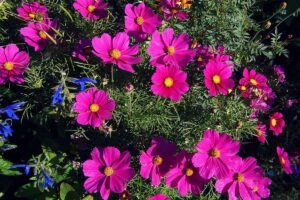
Knautia spp.
Knautia is a genus of about 55 species and numerous subspecies of herbaceous flowers in the Caprifoliaceae or honeysuckle family.
Commonly called pincushion flowers or scabious, both names they share with related plants in the Scabiosa genus, Knautia species are native to western Eurasia.

We link to vendors to help you find relevant products. If you buy from one of our links, we may earn a commission.
These wildflowers are suitable for cultivation in USDA Hardiness Zones 5 to 9, but beware – they naturalize readily.
Some species and cultivars are more likely than others to become invasive under ideal growing conditions.
Read on to learn about this midsummer to fall bloomer and decide whether it merits a place in your home landscape.
What You’ll Learn
Knautia has a long tap root and clumping growth habit. A mound of hairy foliage at the base has leaves ranging from slightly lobed to lance-shaped and finely pinnate or featherlike.
The margins may be serrated or smooth. These characteristics vary between and within species, which can make identification challenging.

Branching, leafless, wiry stalks rise from the foliage. At the terminal end of each stem is a one- to two-inch pincushion-like flower head consisting of lots of tiny blossoms, known as a composite flower.
The color palette includes blue, burgundy, lavender, pink, red, white, and yellow.
The flowers produce seeds coated with eliasome, a fatty layer that attracts ants.
Knautia has a symbiotic relationship with ants, as they benefit from the food and in return, carry seeds to new locations in the landscape.
In addition to robust self-sowing and ant-aided seed dispersal, Knautia species hybridize readily, contributing to a region’s biodiversity.
It is a deer and drought-tolerant pollinator magnet that attracts bees, butterflies, and moths to its nectar and pollen.
Quick Look
Common name(s): Knautia, pincushion flower, scabious
Plant type: Herbaceous perennial
Hardiness (USDA Zone): 5-9 (outdoors)
Native to: Western Eurasia
Bloom time / season: Midsummer to fall
Exposure: Full sun
Soil type: Average, well draining
Soil pH: 6.0-8.0, slightly acidic to slightly alkaline
Time to maturity: 3-5 years
Mature size: 12-24 inches wide x 12-36 inches high
Best uses: Beds, borders, containers, cutting garden, mass planting
Taxonomy
Order: Dipsacales
Family: Caprifoliaceae
Genus: Knautia
Species: Arvensis, macedonica
The two species you are most likely to come across while researching and shopping are:
- Field scabious, aka blue buttons, K. arvensis, formerly Scabiosa arvensis
- Macedonian scabious, K. macedonica, formerly Scabiosa rumelica
The lavender to pink flowers of field scabious may be pretty along roadsides where it naturalizes readily, but its deep roots and a vigorous nature make it difficult to eradicate.

Because of its aggressive behavior and danger to native flora, it is listed in the Invasive Plant Atlas of the United States.
Macedonian scabious is a short-lived perennial, usually lasting two to five years with blossoms a deep shade of purplish-crimson.

Cultivated varieties range from full-size three- to four-foot plants to dwarf 12- to 18-inch specimens.
Knautia can be a valuable addition to the landscape, attracting bees, butterflies, and moths to its nectar and pollen, contributing to local biodiversity.
The flowers make an excellent fresh or dry addition to vase arrangements.
The genus name Knautia honors 17th-century botanist, librarian, and physician Christoph Knaut. Extracts from these plants have a history of use as astringents and diuretics.
Many Knautia species were formerly classified as Scabiosa, a related genus of flowers with a similar appearance, also called pincushions. Many of these are suited to Zones 5 to 9 and tend to be invasive.
There are two primary distinctions between the genera:
- The tiny blossoms that make up the flower heads have five lobes in Scabiosa and only four in Knautia species.
- A membrane encases each Scabiosa blossom. Knautia has no membranes.
Species in both genera are cultural companions suited to sharing garden beds.
How to Grow
Because of their invasive nature, it’s a good idea to plan how you want to contain Knautia plants.
You have a number of choices:
- Grow pincushion flowers in pots on a sunny patio providing easy access for deadheading and avoid contact with garden soil.
- Cultivate them as annuals, deadheading throughout the summer and digging and disposing of plants at season’s end.
- Restrict sprawl by mass-planting in a raised bed for a showy expanse of color and deadhead regularly.

If you have ample room, you may wish to scatter seeds through a meadow to naturalize among cultural companions like anise hyssop, bee balm, coneflower, Joe-pye weed, Russian sage, Scabiosa, and yarrow.
Let’s discuss the ideal conditions for cultivating pincushion flowers.
Temperature and Humidity
Knautia does best with temperatures of between 60 and 80˚F in locations where the humidity is low and the nights are cool.

Regions with warm summer nights and high humidity may stress plants, causing wilting and poor performance.
Plants may withstand a spell of dry subzero temperatures but will die back to the ground with the first autumn frost.
Light and Soil
Plants prefer full sun, and average, well-draining soil. The pH should be nearly neutral, between 6.0 and 8.0.
Select a location that is sheltered from wind to protect tall stems from breakage. Stake them if necessary.
Water
In the first season, water once a week in the absence of rain.
In the second year, they are tolerant of drought and require supplemental water only during prolonged dry spells.
Fertilizing
As Knautia species are aggressive, fertilizing is not needed unless the soil is severely depleted.
Fertilizing when it’s not required can cause the plants to produce a lot of foliar growth with floppy stems and a poor floral display.
Deadheading
If you grow a manageable number of Knautia plants you can deadhead them to encourage more blooming throughout the growing season and inhibit self-sowing.
To deadhead:
- As the petals fade and before seed pods form, cut each spent flower stem to its point of origin, just above where it meets the central stalk.
- Provided that the pods haven’t formed, new stems should sprout and blossom.
You can read more about deadheading perennials here.
Winter Care
If you’re growing your pincushion flowers as perennials, at summer’s end cut or mow all stems to the ground.
Remove all debris and dispose of it in the compost heap or trash to avoid harboring pests and pathogens through the off-season.
If you mulch around plants, rake away the old and replace it with new every spring.
Divide crowded plants in the spring every three years or so to improve airflow and reduce competition for nutrients.
You can learn more about dividing perennials in our guide.
Cultivars to Select
K. macedonica is the species you will commonly find for sale for the home garden. In addition to the straight species, there are cultivated varieties, including:
Mars Midget
‘Mars Midget’ is a dwarf cultivar with rich red blossoms.

It’s an excellent choice for Zones 5 to 8 measuring 12 to 18 inches tall and wide.
Melton Pastels
‘Melton Pastels’ has variegated mauve, pink, and red flowers.

The variations add depth and visual appeal, drawing the eye into the garden to discern the distinctions.
Plants are best suited to Zones 5 to 8. Mature heights are 36 to 48 inches with a spread of 12 to 18 inches.
Red Knight
‘Red Knight’ boasts bright red blossoms that sizzle in summer gardens.
Cultivate in Zones 5 to 9. Mature dimensions are 36 to 48 inches tall and about 16 inches wide.
‘Red Knight’ seeds are available from Hazzard’s Seeds via Amazon.
Thunder and Lightening
‘Thunder and Lightning’ is a dwarf cultivar with variegated green foliage with cream margins, and purplish-red blooms.

Cultivate this exciting option in Zones 5 to 8. Mature heights are 12 to 18 inches with an equal spread.
Propagation
You’ll need seeds, cuttings, or potted transplants from the nursery to start plants in your outdoor living space.

Let’s explore each method.
From Seed
You can choose to sow seeds in spring or in late summer or early fall. If you want to sow in spring, you will need to cold stratify the seeds first.
Here’s how:
- About three weeks before the last frost date of spring, wet a sturdy paper towel.
- Squeeze out most of the water so it is damp but not dripping.
- Open it up again and lay it flat.
- Sprinkle seeds in a single layer over the top half of the paper towel.
- Fold the bottom half of the paper towel up and over the seeds.
- Place the folded paper towel in a large zippered plastic bag, keeping the seeds in a flat, single layer.
- Press out extra air and zip the bag shut.
- Store in the refrigerator.
After the last frost date, sow the seeds outdoors in the garden or start seeds indoors in pots or trays.
Here’s how to sow cold stratified seeds:
- Work the soil to a depth of four to six inches until it is crumbly and debris-free.
- Push one or two seeds into the soil every 18 to 24 inches so the soil barely covers them.
- Water lightly.
- Keep the soil evenly moist but not soggy during germination.
- When seedlings have several sets of true leaves, thin them as desired.
Alternatively, you can sow one seed in each cell of a seed starter tray filled with all-purpose potting soil. Maintain even moisture.
From Cuttings
In addition to seed propagation, you can take basal cuttings from existing plants in the spring.
To do this, cut straight down through non-flowering side shoots that emerge from the crown at the soil level where the stems and roots meet.
Each severed shoot should have a bit of root attached.
Trim the foliage so it’s about four inches long.
Transplant cuttings immediately to the garden or into six-inch starter pots three-quarters full of potting soil.
Set them so the root portion is below the soil and tamp the soil firmly to hold them upright.
Water well and maintain even moisture without oversaturation until new growth appears.
Transplanting
To transplant seedlings with several sets of true leaves, cuttings that have successfully rooted, and nursery potted plants:
Prepare the garden soil to a depth of six to 10 inches.
For container gardening, use an all-purpose potting soil in a pot with a depth of 10 to 12 inches and a diameter suited to a 12- to 24-inch spread per plant.
Set the contents of the container at the same depth as in the original pot.
Backfill, tamp, and water well.
Maintain even moisture until new growth indicates a successful transplant.
Managing Pests and Disease
Pincushion plants are not prone to pests or disease; however, in overly dry weather, they may become attractive to aphids.
Where there is excessive moisture, the fungal spores of powdery mildew may proliferate.
A treatment option suitable for both conditions is organic insecticidal and fungicidal neem oil.
Know What You’re Taking On
Many wildflowers, both non-native and native, can become aggressive under ideal growing conditions.

It’s best to consult regional lists of invasive and potentially invasive species before planting to avoid violating regulations.
Gardeners who choose to grow Knautia are forewarned of its invasive tendencies.
So, why grow these flowers?
The flowers attract beneficial pollinators and are lovely to cut for long-lasting additions to vase arrangements.
Will pincushion flowers find a place in your garden planner this year? Or are you growing them already? Please share your thoughts in the comments section below.
If you found this article informative and want to learn about other wildflowers with invasive tendencies, we recommend the following: