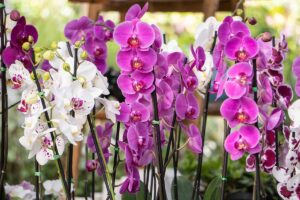
Cyclamen is a genus of showy, colorful perennials featuring lively, upswept flowers in bright shades of mauve, pink, purple, and white that seem to float above pretty rafts of variegated, silvery foliage.
Some varieties have a lovely perfume, sweetly floral with a little hint of spice or honey, or even coconut.
Depending on the species, they flower in spring, summer, fall, or winter, with plants spreading readily into carpets of color in alpine meadows, rock gardens, woodland edges, and under deciduous trees and shrubs.

We link to vendors to help you find relevant products. If you buy from one of our links, we may earn a commission.
Most gardeners are familiar with the florists’ variety, C. persicum, a cold-tender species commonly grown as a houseplant to brighten the winter months with their delightful blooms.
But there are also several hardy and semi-hardy species for the garden that are more cold-tolerant, thriving as far north as Zone 4.
Easily cultivated, these plants are low maintenance and drought-tolerant once established, growing into attractive mounds that spread readily into large carpets of color.
In our guide to growing cyclamen we discuss how to cultivate the tender types indoors.
Now let’s jump into a closer look at cyclamen plant types and learn more about the different varieties!
Here’s what you’ll find ahead:
15 Cyclamen Species
There are around 20 species in the Cyclamen genus and they generally bloom for up to three months.
Most Cyclamen species are from the coastal areas of the Mediterranean basin, the Balkans and Caucasus regions, and parts of the Middle East – with two outliers native to northern Africa.
They’re typically found in alpine meadows, rocky slopes, screes, and woodlands.
Many behave as evergreens, with the attractive foliage in place year-round, while others are herbaceous and lose their leaves for part of the year.

Flowering can take place at any time of the year, depending on the species.
Flower colors are white or a variety of mauve, pink, and red shades. They take on a pendant-like form, with recurved, flag-like petals sweeping up and away from an open mouth, giving them a lively, animated appearance.
The attractive, round to heart-shaped foliage grows in mounds and features wonderful patterns and variegations in light and dark greens that are often highlighted with accents of silver or white.

Many gardeners treat those tender varieties grown indoors as annuals and discard them after the winter blooms are finished.
However, it’s possible to encourage the plants to rebloom year after year with the right care.
For the home grower, cyclamen generally fall into two categories:
- Tender or florists’ types
- Hardy to semi-hardy varieties
Florists’ varieties are the ones we bring into our homes to add color in the winter months.
These cheerful plants are hardy only in USDA Zones 9 to 11 and are readily available from florists and garden centers that carry a good selection of houseplants.

Hardy species and cultivars are perfect for naturalizing as ground covers in shady spots under trees or any partial sun location, often adding color when nothing else is flowering.
These hardy types can be a bit more difficult to source but can be found at retailers and catalogue outlets that specialize in bulbs, large garden centers, and those that cater to alpine and rock gardens.
Alpine, bulb, and cyclamen societies are often reliable sources for seed and bulb stock as well, although a small membership fee is usually required for access.
Now let’s dive into the details of 15 different cyclamen species!
1. Africanum
C. africanum is indigenous to north Africa, with sweetly scented flowers in colors of rose pink or violet that bloom in autumn.

Hardy in USDA Zones 9 to 11, it thrives in mild Mediterranean climates and requires protection from frost.
The heart-shaped foliage has green, silver, or marbled patterns and purplish undersides, emerging alongside the blooms in fall.
This species goes dormant in summer as part of its natural cycle.
2. Alpinum
C. alpinum is the alpine variety, flowering as soon as the snows retreat, or late winter through early spring.

Plants are indigenous to southwest Turkey and feature handsome, rounded leaves of pale to dark green with generous splotches of gray or silver.
The pretty flowers of light pink to deep carmine have a sweet, primrose-like scent.
Alpine varieties are semi-hardy and suitable for cultivation in Zones 7 to 9.
3. Balearicum
C. balearicum is a Mediterranean variety that flowers from mid-winter through spring and has a strong, sweet perfume.

The flowers are mostly white, some featuring a little pink, and the heart-shaped leaves are dark to light green with blue-green to gray patterning.
Native to the south of France and the Balearic islands, this species is semi-hardy and suitable for Zones 6 to 9.
4. Cilicium
C. cilicium is renowned for its sweet, honey-scented flowers that bloom in autumn.

The oval to heart-shaped leaves have dark green, patterned centers that look like a Christmas tree coupled with grayish-green margins. Flowers are deep pink to white.
Native to southern Turkey through the Tarsus Mountains, plants are hardy in Zones 5 to 7.
5. Coum
C. coum is one of the most popular late-flowering species, and commonly known as hardy or winter cyclamen, and eastern sowbread.
It has a primary habitat from Bulgaria, northern Turkey, and Crimea and a secondary range nearer the Mediterranean, from southern Turkey through Lebanon and into northern Israel.

Plants have pretty, heart-shaped leaves of mid to dark green speckled with silver, and dainty blooms in shades of rosy pink, purple, or white. This species is hardy in Zones 4 to 9.
Five-packs of hardy C. coum bulbs are available at Nature Hills Nursery.
6. Creticum
C. creticum is a native to the island of Crete and features sweetly perfumed white to pink flowers that bloom in spring.

Hardy in Zones 9 to 10, this species thrives in Mediterranean climates with mild, wet winters and hot, dry summers.
Its heart-shaped leaves, which emerge in autumn, are dark green with silver marbling on the upper surface and often display a reddish hue underneath.
7. Cyprium
C. cyprium is localized to Cyprus, and the pale pink, highly fragrant flowers bloom from fall to mid-winter.

The heart-shaped green leaves have striking silver or pale green mottling and emerge in fall. It’s hardy in Zones 9 to 10 and goes dormant in spring.
8. Graecum
C. graecum is Greek cyclamen and native to southern Greece and the Cyclades islands of the eastern Aegean Sea.

The broad oval leaves are variegated in icy green, forest green, and silver with a satiny shine and purple underside.
The pink, purple, or white flowers bloom in fall and plants are semi-hardy in Zones 7 to 9.
9. Hederifolium
C. hederifolium is known as ivy-leaf cyclamen and is among the most robust for growing in coastal climates.

The pale pink to magenta or purple flowers bloom in late summer through fall and the attractive leaves are heart- or spade-shaped in various shades of green with creamy white to silver patterning.
Native to the Mediterranean from southern France to western Turkey, ivy leaf cyclamen has naturalized extensively in lightly shaded coastal woodlands of northern Europe and in the mild Pacific Northwest.
A leisurely drive on a sunny autumn day often reveals impressive sweeps of color from Victoria, BC, to Eugene, OR. Hardy in Zones 5 to 9.
10. Libanoticum
C. libanoticum is the Lebanese species and native only to a single specific mountain and valley in Lebanon.
Flowering from late winter to mid-spring, the pink to mauve flowers have a spicy, peppery fragrance.
Leaves are heart-shaped with a dark green center and surrounded with an icy frosting of silvery gray. Plants are semi-hardy in Zones 6 to 9.
11. Maritimum
C. maritimum is a native of the island of Rhodes and southern Turkey, with lightly scented flowers in various shades of pink that flower in fall.
The heart-shaped leaves display intricate silver or pale green marbling, emerging after the flowers and persisting through winter. It’s hardy in Zones 9 to 10.
12. Mirabile
C. mirabile flowers from early to late autumn in colors that range from deep pink to white, featuring a coconut-like scent.
The rounded leaves have inky green centers with flanks of gray-green or silver.
Native to southwest Turkey, this species is semi-hardy and suitable for cultivation in Zones 6 to 9.
13. Persicum
The most common florists’ species is C. persicum, also known as Persian cyclamen. This cyclamen flowers from fall to early spring in shades of mauve, pink, purple, scarlet, and white.
The plants have large petals and the most ornate flowers, with double, single, crested, and frilled forms available.

Persian varieties are hardy only in Zones 9 to 11, although they may survive outdoors in Zone 8 if planted in a protected spot.
Packets of 100 seeds of C. persicum can be purchased from Outsidepride via Walmart.
14. Purpurascens
C. purpurascens is known as the purple or Mediterranean cyclamen and has a scent like that of lily of the valley.

Leaves are heart-shaped, oval, or triangular, in patterned shades of green, silver, and white, and may have purple undersides.
With a strong, sweet fragrance, the rosy pink to magenta flowers bloom from midsummer through fall and plants are hardy in Zones 5 to 9.
15. Repandum
C. repandum is known as spring sowbread, blooming in spring with reddish pink to magenta flowers that bear a strong, sweet scent.

The heart-shaped to triangular leaves have dark green backgrounds with patterned zones of cream, pale, green, or silver.
Native to the coastal regions of Croatia and Bosnia-Herzegovina, southern France, and the Mediterranean islands of Corsica, Sardinia, and Sicily, plants are hardy in Zones 5 to 8.
The Power of Pink
If you’re a fan of flowering houseplants to brighten the home over winter, tender florists’ cyclamens provide weeks of pink-to-red-toned, sweetly scented blooms.

For pink-hued color schemes in the garden, the easily cultivated hardy varieties are undisturbed by frost and snow and spread eagerly into handsome carpets of vibrancy.
With just a little planning, you can grow a selection of species to enjoy their long flowering time in every season!
Do you have any favorite cyclamen varieties for the home and garden? Let us know in the comments section below!
And for more information about growing and caring for cyclamen plants, add these guides to your reading list next: