From early summer to fall, low-maintenance, perennial coneflowers, Echinacea spp., grace gardens in USDA Hardiness Zones 5 to 9.
These North American natives are members of the aster family with orange, pink, purple, red, or white petal-like rays surrounding a prominent, raised, cone-like central disk.
Depending on the cultivar, coneflower plants grow up to four feet tall and 18 inches wide.

We link to vendors to help you find relevant products. If you buy from one of our links, we may earn a commission.
Cultural requirements include full sun to part shade and slightly acidic, well-draining, sandy loam. Water requirements are low.
Our coneflower growing guide has all you need to know to enjoy cultivating plants in your outdoor living space.
This article presents 21 companion plants that share the same cultural requirements as coneflowers and grow well together.
Here’s our lineup:
21 Coneflower Companions
1. Anise Hyssop
Midsummer- to fall-blooming anise hyssop, Agastache foeniculum, is a short-lived perennial with upright spikes of blue, lavender, or purple blossoms that work well when planted with coneflowers.
It’s a pollinator magnet that readily self-sows to increase its footprint in the landscape.
Depending on the variety, mature heights are two to four feet with a spread of one and a half to two feet.
Also called licorice mint, lavender anise hyssop is a North American native and a member of the mint family.

It has edible flowers, leaves, and seeds, and a long history of use in traditional medicine. Plants are suited to Zones 4 to 9.
Lavender anise hyssop is available from Botanical Interests.
See our guide to growing anise hyssop for more information.
2. Asters
“Asters” is a catch-all name for plants in the Aster, Doellingeria, Eurybia, Inonactis, and Symphyotrichum genera.
They are North American native perennials with masses of small, blue, pink, purple, or white daisy-like flowers that work nicely with coneflowers when grown in a native wildflower planting.
Depending on the species, they bloom from late summer to fall in Zones 4 to 8. Plants grow from six to 72 inches tall and eight to 36 inches wide.
‘Purple Dome’ is a New England aster that is a garden classic prized for its long-lasting profusion of deep purple flowers which attract beneficial insects.

‘Purple Dome’ New England Aster
Mature heights are one to two feet and they spread about two to three feet.
‘Purple Dome’ New England asters are available at Nature Hills Nursery.
Our aster growing guide has details.
3. Bee Balm
Bee balm, Monarda spp., is a North American native that blooms from midsummer to fall suited to Zones 3 to 9.
It has tubular lavender, pink, purple, or red petals that arch downward like the water in a fountain, contrasting with the daisy-like blooms of coneflowers.
The leaves and flowers are edible.
Mature dimensions are three to five feet tall and 18 to 36 inches wide.

Monarda didyma ‘Jacob Cline’ has dynamic red blossoms perched atop three-foot stems. They are very appealing to hummingbirds.
‘Jacob Cline’ seeds are available from Burpee.
See our guide to growing bee balm for cultivation instructions.
4. Black-Eyed Susans
Black-eyed Susans, Rudbeckia hirta, are North American native perennials or annuals for Zones 3 to 9 that self-sow with vigor.
This species is a member of the aster family with golden yellow rays and brown to black center disks. Mature heights are two to three feet with a spread of 12 to 18 inches.
These coneflower companions bloom from early summer to fall and the seed heads are attractive to foraging birds at season’s end.

Black-Eyed Susan seeds are available from Botanical Interests.
Our black-eyed Susan growing guide has more details.
5. Blazing Star
Blazing star, Liatris spicata, aka gayfeather, liatris, and prairie star, is a North American native perennial with lavender, pink, purple, or white blossoms that cluster like bottle brushes at the tips of two- to four-foot stems.
Plants are 15 to 18 inches wide and make excellent companions for coneflowers.
Blazing star blooms from mid to late summer and is hardy in Zones 3 to 9.

‘Z-Scape’ is a cultivar that provides vertical drama with vibrant purple spikes.
Seeds in a variety of packet sizes are available from True Leaf Market.
See our guide to growing blazing star for more information.
6. Boneset
Boneset, Eupatorium perfoliatum, is a North American native perennial in the aster family.
Its flattened umbels of copious, fluffy white flowers bloom from midsummer to fall, attracting all kinds of pollinators.

Depending on the variety, these coneflower companion plants may reach dimensions of six feet tall and four feet wide. They are best suited to Zones 3 to 8.
You can find boneset seeds in packets of 100 available from Earthbeat Seeds.
Our boneset growing guide has cultivation instructions.
7. Catmint
Long-blooming Catmint, Nepeta spp., is an herb in the mint family with spikes of bluish-lavender or pink blossoms that bloom from spring to fall.
The flowers and leaves are edible. Another favorite of pollinators, catmint is a welcome coneflower companion that repels pests, including aphids and squash bugs.
Suited to Zones 3 to 9, plants mature to a height of two to four feet tall with a spread of four feet.

‘Blue Moon’ offers mounds of upright spikes laden with tubular lavender blossoms that play well with daisy-like companion blooms.
You can find ‘Blue Moon’ seeds available from True Leaf Market.
See our guide to growing catmint for details.
8. Coreopsis
Coreopsis spp., aka tickseed, is a spring to fall blooming annual or perennial in the aster family suited to Zones 4 to 10.
Wiry stems sport daisy-like flowers with cream, pink, red, yellow, or bicolored rays around a central disk of tightly packed cylindrical blossoms.
Mature dimensions vary from one to three feet tall and wide.

Showy ‘Mercury Rising’ boasts luxurious, velvety wine-red rays highlighted by white tips that contrast beautifully with coneflowers.
You can find ‘Mercury Rising’ plants available from Burpee.
Our coreopsis growing guide has more information.
9. Cosmos
Cosmos, Cosmos spp., are summer to fall blooming annuals for Zones 2 to 11.
These members of the aster family have fine, airy foliage and feature delicate, broad, toothed rays around a central disk.
The palette includes orange, pink, purple, red, white, yellow, and bicolor combinations.
Plants grow one to six feet tall and one to three feet wide.

Seashells Blend offers a “pretty in pink” tissue-paper panorama of rose- and white-hued fluted, torn-edge rays, adding texture amongst the coneflowers.
Seashells Blend cosmos seeds are available from Botanical Interests.
See our guide to growing cosmos for cultivation details.
10. Daylilies
Daylilies, Hemorocallis spp., grow from thick roots called rhizomes.
They are suited to Zones 3 to 9, where their long-blooming scapes laden with star-shaped blossoms bloom from spring to fall, depending on the cultivar.
The color options include shades of orange, pink, purple, red, yellow, white, and bi- and tricolor combinations.
Mature dimensions are eight inches to five feet tall with a spread up to three feet.

‘Mighty Chestnut’ is a hybrid cultivar that sports ruffled orange petals with a burgundy eye and yellow throat. It reaches a height and width of 26 to 30 inches.
You can find ‘Mighty Chestnut’ bare roots available from Burpee.
Our daylily growing guide has details.
11. Fountain Grass
Fountain grass, Pennisetum spp., is a perennial ornamental grass for Zones 4 to 10 with narrow, downward curved, fountain-like green to bronze foliage.
From late summer to fall, copper, pink, purple, or white seed heads cluster at the terminal ends of striking upright spikes.
Mature dimensions are one to four feet tall with a spread of one to three feet.
P. alopecuroides ‘Hameln’ is a compact cultivar with buff-colored seed heads that grows 12 to 24 inches tall and 12 to 18 inches wide.

Its size and texture make it an excellent small-scale ornamental grass companion for coneflowers.
You can find ‘Hameln’ plants available from Nature Hills Nursery.
See our guide to growing fountain grass for more information.
12. Globe Amaranth
Summer- to fall-blooming globe amaranth, Gomphrena globosa, aka gomphrena, is a short-lived perennial coneflower companion for Zones 2 to 11.
Herbalists have long used the edible flowers, leaves, roots, and seeds to treat a range of ailments.
The thistle-like, rounded flowers are available in lilac, magenta, pink, purple, red, orange, and white.
Depending on the cultivar, plants reach a height of six to 48 inches with a spread of eight to 24 inches.

The Gnome series offers low-profile plants in pink, purple, or white, depending on teh cultivar. Mature dimensions are just six to 10 inches tall and 10 to 12 inches wide.
You can find seeds for a mix of Gnome series colors available from True Leaf Market.
Our globe amaranth growing guide has cultivation details.
13. Hollyhocks
Self-sowing hollyhocks, Alcea rosea, are biennials or short-lived perennials in the mallow family suited to Zones 3 to 10.
They impress with funnel-shaped, outward-facing burgundy, peach, pink, purple, red, white, yellow, or bicolor flowers that grow along tall, upright stalks.
Mature dimensions are three to nine feet tall and one to four feet wide, depending on the cultivar. They provide height when grown amongst coneflowers.

‘Henry VIII Lemon’ displays spectacular six-inch lemon yellow blooms on stems that soar six to eight feet tall with a spread of one to two feet, attracting butterflies and bees for a genetically diverse growing environment.
You can find ‘Henry VIII Lemon’ seeds available from Eden Brothers.
See our guide to growing hollyhocks for more information.
14. Joe-Pye Weed
Joe-pye weed, Eutrochium spp., is a herbaceous perennial in the aster family suited to Zones 3 to 9 with flattened clusters or umbels of pink, purple, or white blossoms.
Mature heights are four to seven feet with a spread of three to four feet.

E. purpureum, which blooms from late summer to fall, is a North American native wildflower perfect for growing with coneflowers, and a favorite of bees, butterflies, and hummingbirds.
You can find E. purpureum seeds available from Eden Brothers.
Learn more about growing joe-pye weed here.
15. Lavender
Summer-blooming lavender, Lavandula spp., is a woody shrub with pungently fragrant blossom spikes in shades of blue, pink, purple, and white.
There are cultivars for Zones 4 to 11. There are two main types of lavender plants: English and French.
‘Munstead’ is an early-blooming English variety. English types have a long history of use in culinary and essential oil preparations.

It thrives in Zones 5 to 9 and reaches mature dimensions of 12 to 18 inches tall and up to 24 inches wide.
You can find ‘Munstead’ seeds available from Botanical Interests.
See our guide to growing lavender for details.
16. Marigolds
Marigolds, Tagetes spp., are annuals in the aster family for Zones 1 to 11 with a strong, distinctive scent that helps deter pests in the garden.
Their rounded, ruffled spring-to-fall blooms sport bright yellow, orange, and burgundy hues and have long been appreciated for their ease of cultivation.
Dwarf and full-size cultivars are available with mature dimensions reaching two feet tall and wide.
African marigolds (Tagetes erecta), in spite of their name, are native to Guatemala and Mexico and their bright petals provide a pop of color amongst the coneflowers.
They have a clumping growth habit and full, round orange and yellow flowers atop three-foot stems for bold, vertical garden interest.

Crackerjack Mix African Marigold
Crackerjack Mix features a mix of orange and yellow African marigold flowers.
You can find Crackerjack Mix seeds available from Eden Brothers.
Learn more about growing marigolds here.
17. Salvia
Salvia, Salvia spp., is a genus of woody or herbaceous plants suitable for Zones 3 to 10.
There are annual and perennial species native to every continent except Antarctica.
Plants typically have a mounding growth habit, yellow, white, red, purple, pink, orange, green, or blue blossom spikes, and mature dimensions of one to five feet tall and one to four feet wide, depending on the cultivar.

‘Flare’ is a fiery red cultivar that reaches 18 to 20 inches tall and 12 to 16 inches wide. It is a favorite of hummingbirds and butterflies.
You can find ‘Flare’ seeds available from Burpee.
See our guide to growing salvia for more information.
18. Sedum
Summer to fall blooming sedum, Sedum spp., is a varied genus also known as stonecrop.
Some members of this genus have been reclassified as Hylotelephium but are still commonly called “sedum.”
There are species suited to Zones ranging from 3 to 10.
Flower colors are orange, pink, red, white, or yellow, heights are three to 24 inches tall, and widths are 24 to 36 inches so there are plenty of options for planting with coneflowers.
‘Autumn Joy’ is suited to Zones 3 to 9. It has flattened umbels or clusters of tiny blossoms that open pink and deepen to a rusty mauve as the growing season draws to a close.

Mature dimensions are 15 to 24 inches tall and wide.
‘Autumn Joy’ bare roots are available from Eden Brothers.
Learn more about ‘Autumn Joy’ sedum here.
19. Shasta Daisies
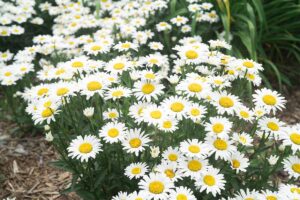
Perennial Shasta daisies, Leucanthemum x superbum, are classic white-rayed, yellow-centered daisies in the aster family that grow in Zones 4 to 9.
Bloom time is late spring to summer, and mature heights are 24 to 36 inches with a spread of 18 inches.
‘Alaska’ features crisp, snowy white rays that angle dramatically downward, accenting sunny, dome-like yellow centers. They are similar in shape to coneflowers.

Expect mature dimensions of 30 to 36 inches tall and 24 to 30 inches wide.
You can find ‘Alaska’ seeds or plants available from Burpee.
See our guide to growing Shasta daisies to learn more.
20. Yarrow
Yarrow, Achillea spp., is a perennial for Zones 3 to 9. Some species are North American natives and most bloom from late spring through early summer.
The plant produces compound corymbs which are clusters of small flower heads in a naturally flat-topped or slightly domed inflorescence.
Blooms may be pink, red, white, or yellow. Heights range from two to four feet with a spread of one to three feet.

‘Sunny’ is a cultivar in the patented Seduction™ series with bright yellow flowers that fade to pale yellow as they age. Heights are 24 to 30 inches with an 18- to 24-inch spread.
You can find ‘Sunny’ Seduction plants in #1 containers available at Nature Hills Nursery.
Our yarrow growing guide has more information.
21. Zinnias
Zinnias, Zinnia spp., are daisy-like annuals in the aster family suited to Zones 3 to 10.
You’ll find rich-colored rays around center disks in every shade except blue, plus multicolor combinations. Bloom time is from summer to fall.
Heights range from six to 48 inches with a spread of six to 18 inches, depending on the variety.
The Queeny Lime series is an outstanding choice. The ‘Red’ variety has large, three-inch single-ray flowers with soft burgundy outer rays shading to lime toward the center.

The height is an impressive 30 to 40 inches with a spread of 12 to 16 inches.
You can find Queeny Lime ‘Red’ seeds available from Botanical Interests.
See our guide to growing zinnias for details.
Getting Cozy with Coneflowers
With 21 potential companions for coneflowers, it’s time to open your garden planner and design space for your new favorites.

With similar sun, soil, and water requirements as coneflowers, garden care becomes a uniform, efficient operation, giving you more time to stretch out on a comfy lawn chair and enjoy the view.
Do you grow coneflowers? What flora shares garden space with them? Please tell us in the comments section below.
And for more information about growing coneflowers in your garden, add these guides to your reading list next: